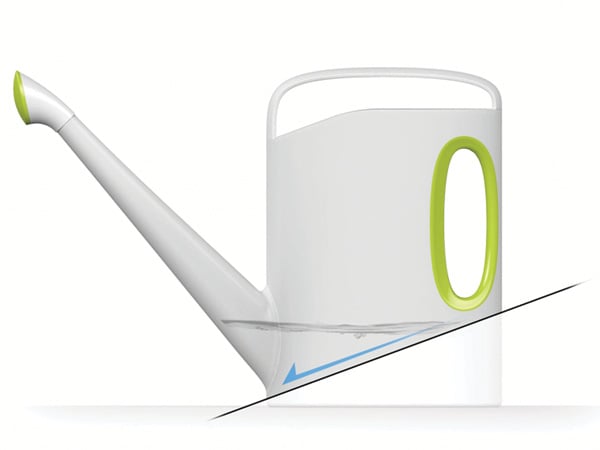
What makes the Tilt It, the watering can stand out is its diagonal base. This kind of orientation makes it easier to pour out the water with less lifting. Essentially a lot of wrist work is required and pouring out the last of the water from a traditional flat-bottomed watering can cause a strain. Hit the jump for the details.
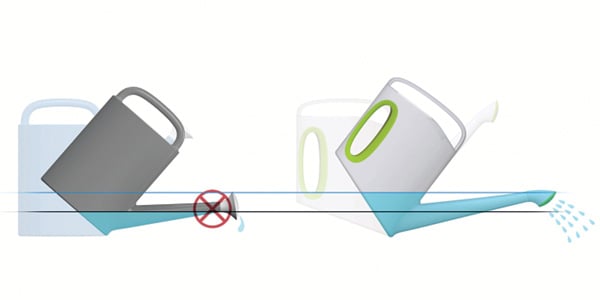
- Pouring from a traditional can requires the user the lift and tilt it to ninety degrees. There is a need to lift one’s arm quite high and bend the wrists considerably.
- Tilt It, on the other hand, has a ‘diagonal’ base.
- When Tilt It is held ‘vertically’ by its top handle, the water inside naturally flows to the lowest point of the diagonal, near the base of the spout.
- This means that less tilting is required by the gardener in order to pour the water out. One needn’t lift their arms so high.
- When Tilt It is placed on the floor, its diagonal base causes it to tilt backwards. The top handle sits at an angle, which allows it to be grasped more comfortably.
Tilt It is a 2013 Red Dot Award: Design Concept Winner.
Designers: Choi Hyunchul, Prof. Doh Han Young & Kim SooHwan
SHARE