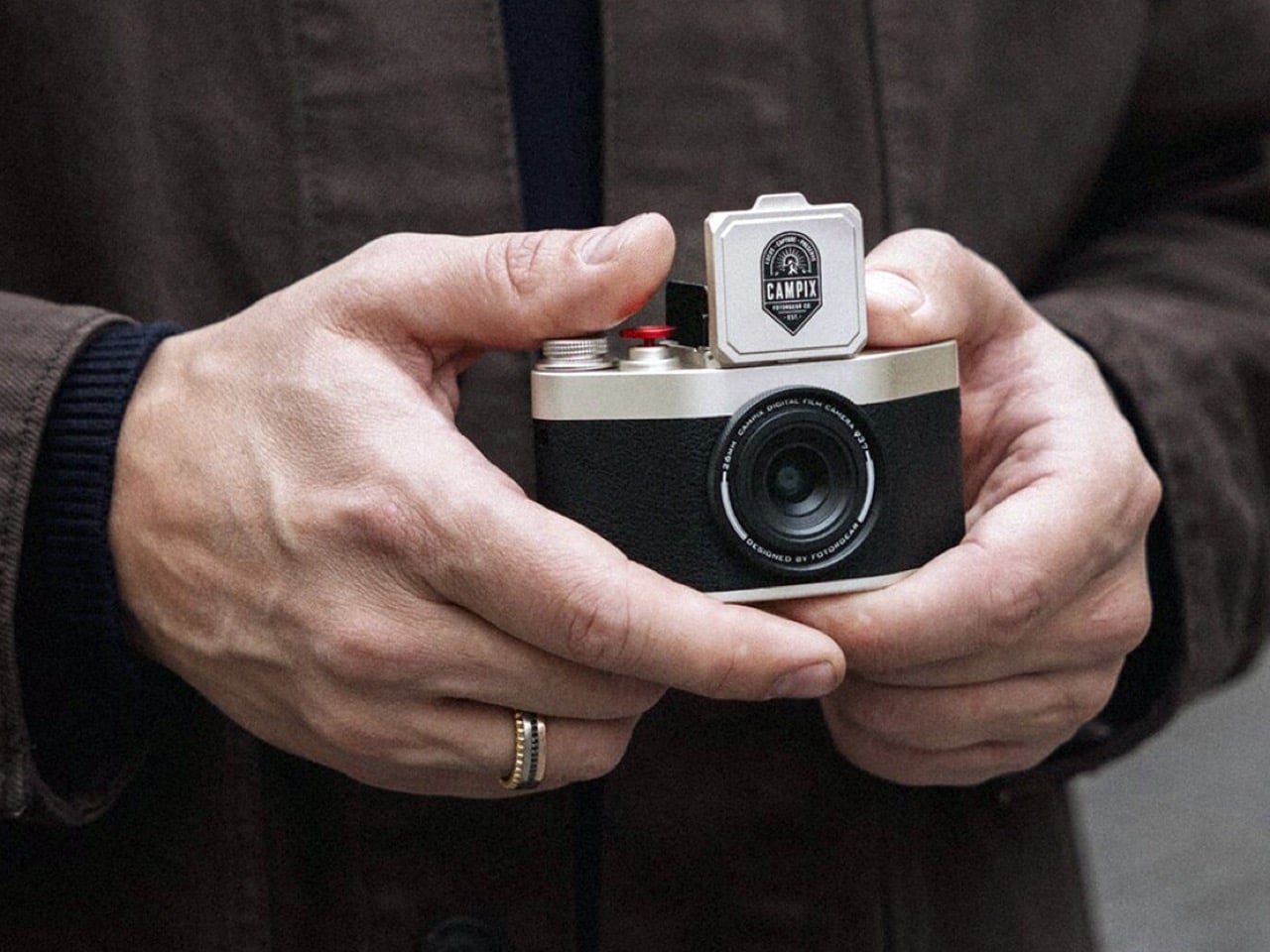
For years, FotorGear’s whole business was convincing your iPhone it was a camera. The Hong Kong brand built clip-on lenses, grips, and a retro photography kit that won Gold for Product Design at the 2024 London Design Awards, all to make a phone feel like something with a film door. With the Campix, the company finally stopped pretending and built the actual camera. It’s a 4.6-ounce (129g) digital shooter with a flip-up waist-level viewfinder, zero screens on the back, and a wind dial you turn between frames. Call it the logical endpoint of a company that kept bolting camera bits onto phones until the phone part became optional.
The design leans hard on the 1950s, especially the Exakta Varex, an East German SLR famous for letting you swap its prism for a waist-level hood. Campix shoots 36-frame digital rolls through a 13MP Sony sensor and a 26mm f/2.2 lens, with a recipe dial holding six film looks and a TTL xenon flash for nights out. The front T-mount takes the very same fisheye, wide, portrait, macro, and anamorphic lenses FotorGear sells for phones, so anyone with a drawer full of them just found those lenses a second home. Retail sits at $209, about a quarter of the $849 Fujifilm X half.
Designer: Fotorgear
A waist-level viewfinder and a dial you have to wind

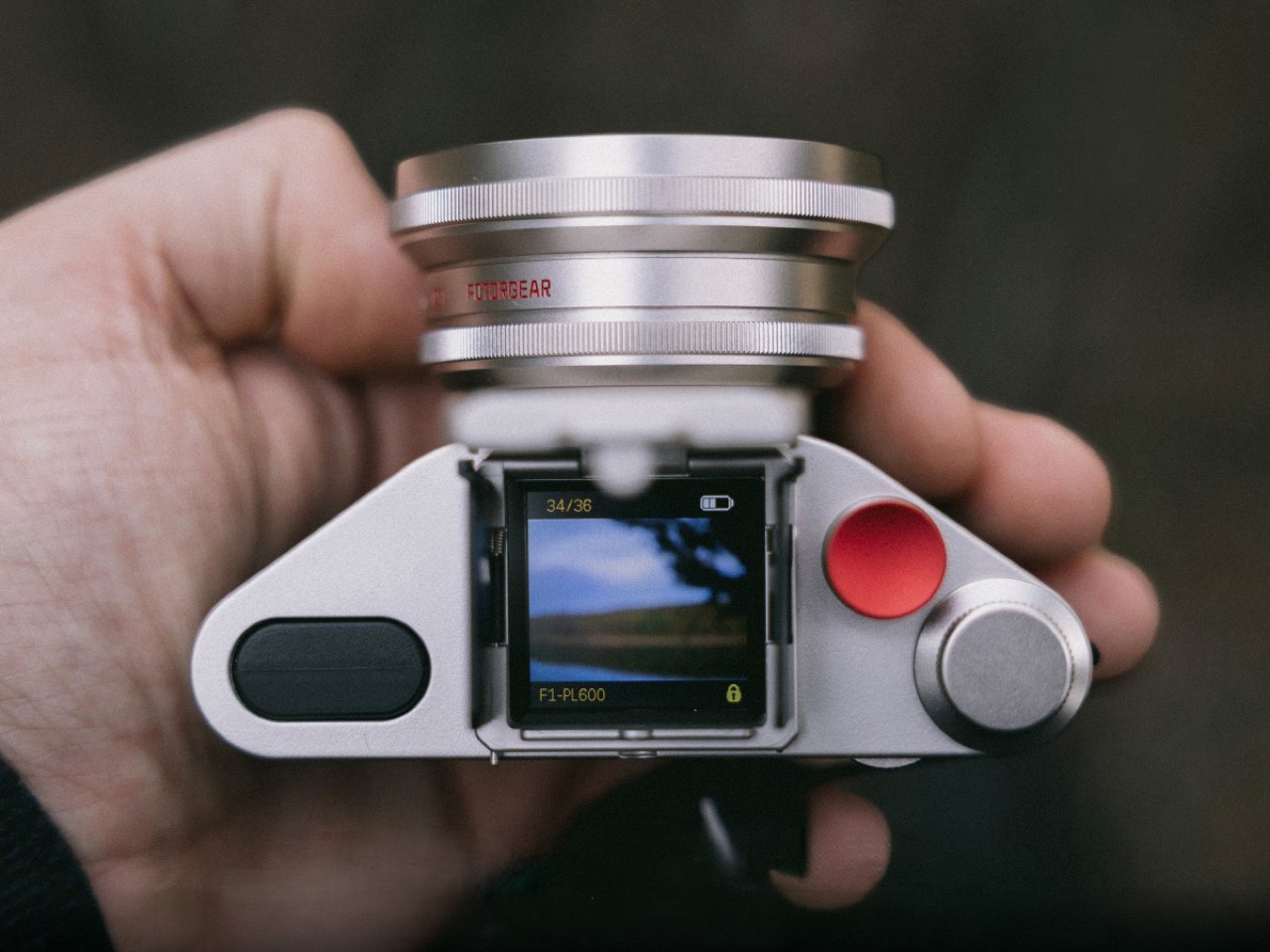
Flip open the lid on the Campix’s top plate and you find a small display recessed inside a hood, angled so you look straight down at it. That screen is your only window into the camera, showing battery level, the active film look, and how many frames remain on the roll. There’s no rear LCD and no playback, so every shot stays a mystery until it lands in the app. I’ve always loved how waist-level cameras change the body language of photography. You end up bowing toward the scene instead of aiming at it, and people tend to stay themselves when no lens is pointed at their face from eye height.
Every frame follows a little ritual: compose, press the red shutter button, then turn the thumb dial before the camera lets you fire again. FotorGear’s own diagram labels it a rewind dial, though in practice it behaves like a film winder. A second mechanical dial clicks between six film recipe slots, and each 36-frame roll commits you to one look, the same way loading Portra or Tri-X used to. Fujifilm offers a similar Film Camera Mode on the X half, but there it’s a setting you switch on, with the rear screen disabled and an optical tunnel finder taking over. Campix builds the entire camera around the constraint, and I find that a far more honest piece of design.
A phone-class sensor, fixed focus, and a proper xenon flash

The imaging hardware is a Sony IMX258, a 13MP chip (4128 x 3096 pixels) at the 1/3.06-inch size you’d usually find inside a mid-range smartphone. Ahead of it sits a 26mm-equivalent f/2.2 lens built from four glass elements and two plastic ones, with fixed focus from about 3 feet (0.9m) to infinity. Exposure is fully automatic, ISO runs from 100 to 3200, and white balance can stay on auto or be set manually. That small sensor explains the tiny body and the price, and the files will land closer to good phone shots than to the X half’s 1-inch output. Fixed focus suits the waist-level style, which has always been about zone focusing and anticipating the moment.
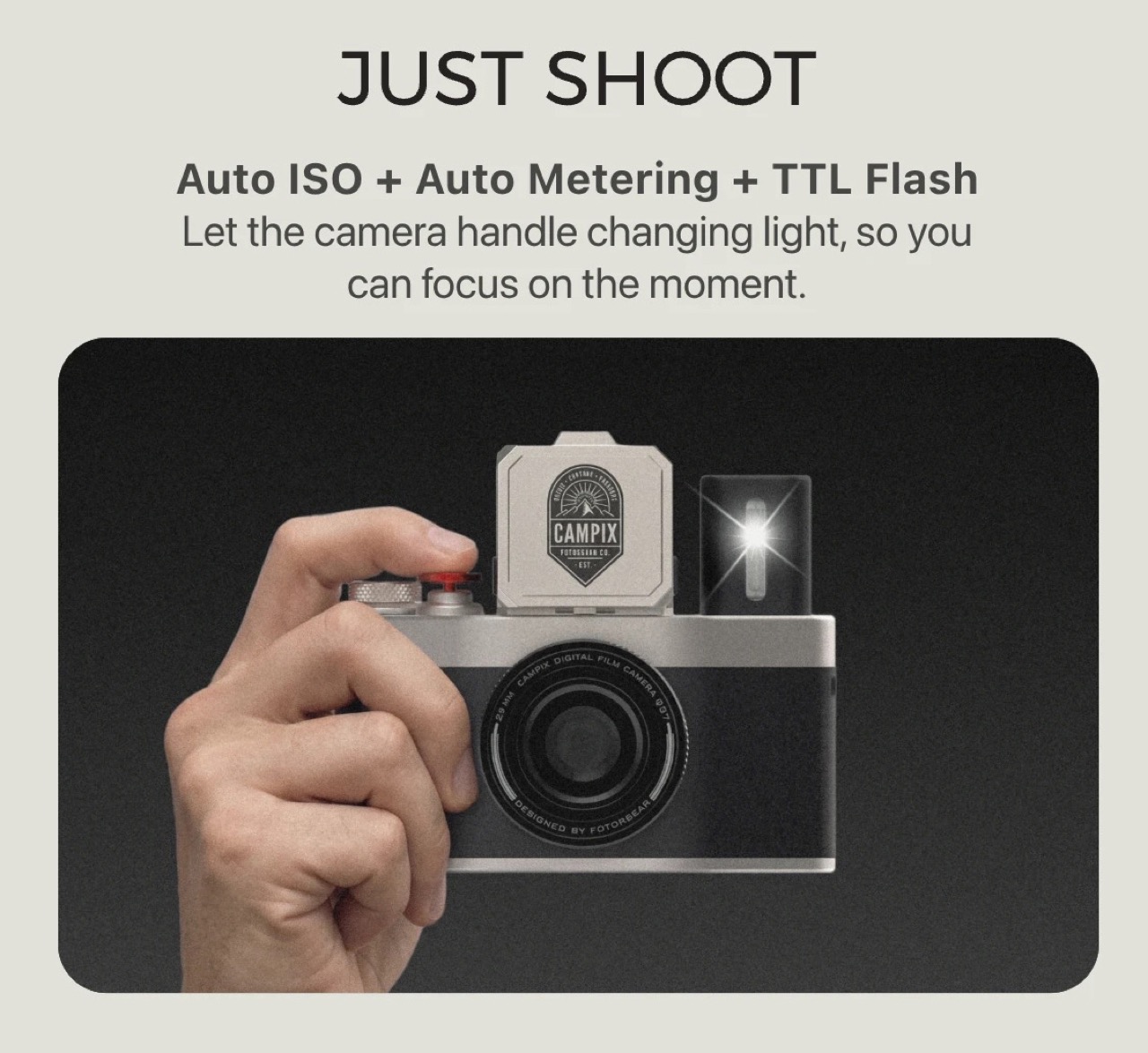
The flash is a xenon tube with TTL metering, meaning it reads light through the lens to set its output, and it works best between roughly 3 and 10 feet (1 to 3m). Xenon throws a shorter, brighter burst than a phone’s LED, freezing motion with the crisp, slightly harsh look people chase on old Yashica T4s and Olympus Mju IIs. The 1000mAh battery is rated for about 400 shots with flash or 600 without, roughly 11 to 16 full rolls per charge. Files travel over Wi-Fi to the iOS and Android app or over USB-C, and the included lanyard doubles as a USB-C cable. The polycarbonate and metal body measures 3.8 x 1.4 x 2.3 inches (97 x 35 x 58mm), dressed in titanium-toned metal and leather.
FotorGear’s T-mount lenses find a second home
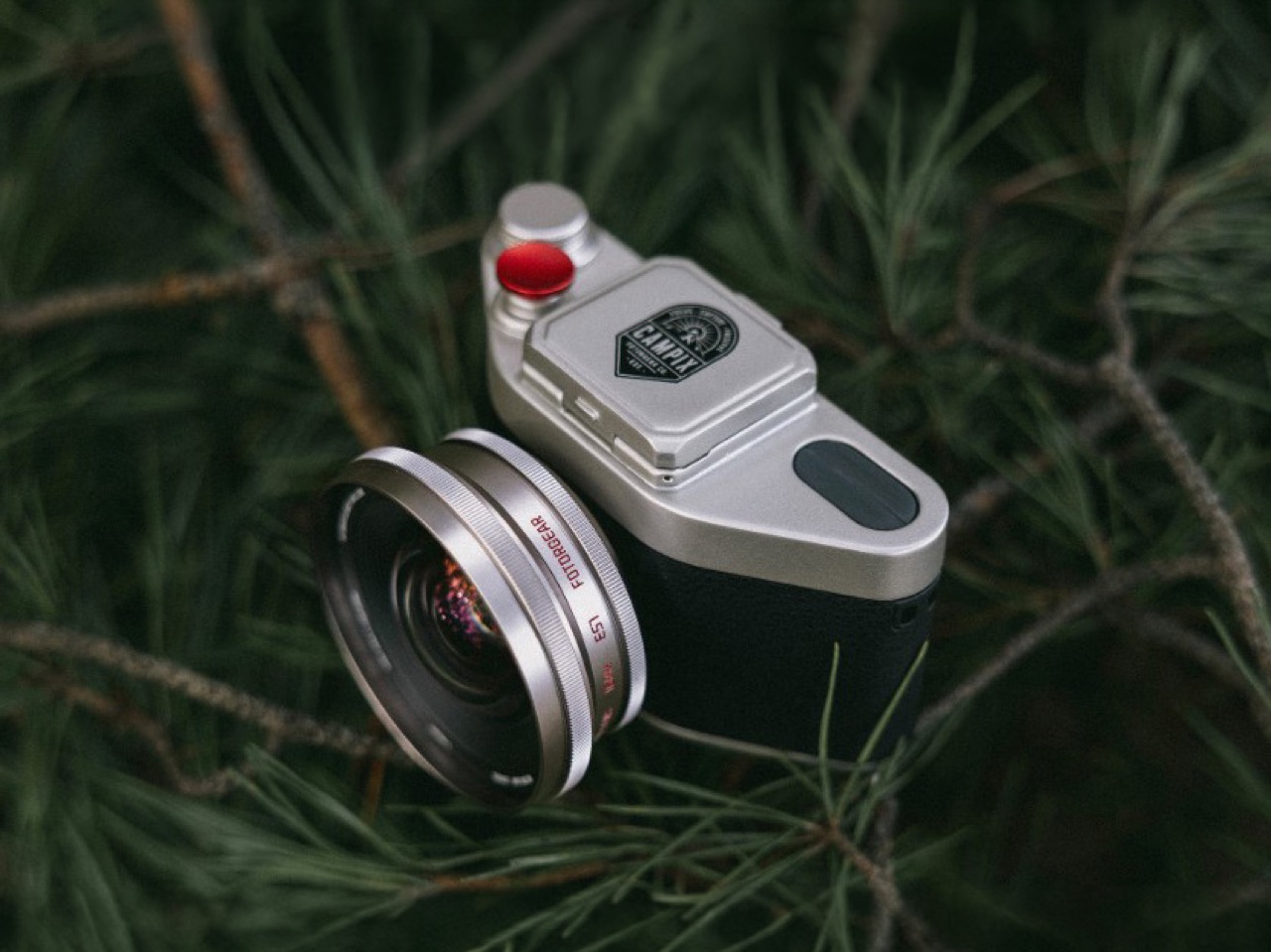
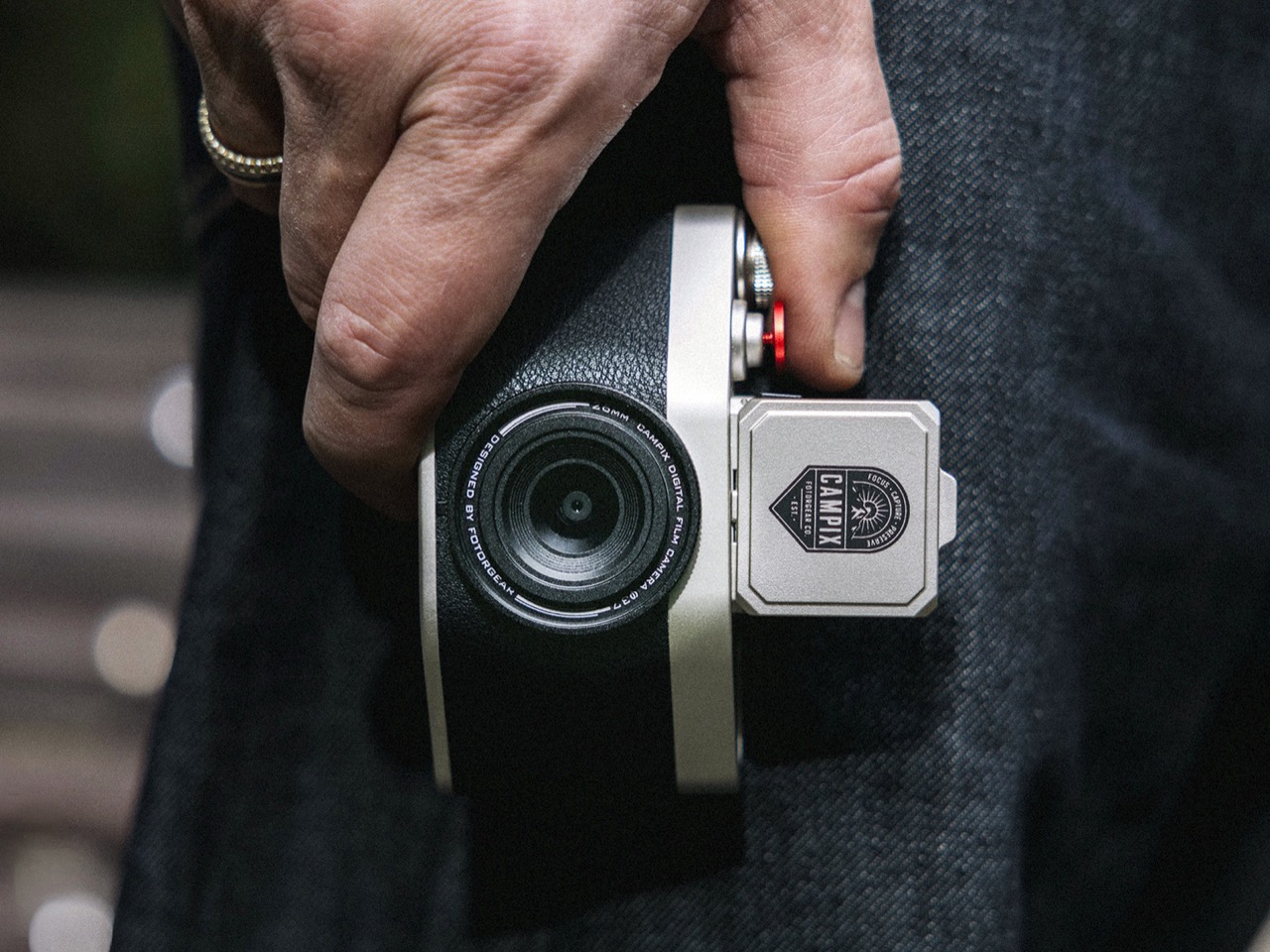
The front of the Campix carries FotorGear’s T-mount, the same lens mount the company uses on its Retro series phone lenses. That lineup covers an 8mm fisheye, a 16mm wide-angle, a 60mm portrait lens, a 75mm macro, and a 1.55x anamorphic, and FotorGear confirms lenses already bought for a phone fit Campix directly. The stock lens also has a 37mm thread, so standard screw-on filters work, and the top bundle includes a star filter, a circular polarizer, and a UV filter. Interchangeable optics are rare at this price, since most film-flavored compacts, from the X half to the Kodak Charmera, lock you into one focal length. A standard 1/4-inch tripod thread underneath rounds out the kit.
The anamorphic is my favorite option on paper. It squeezes a wider horizontal view into the frame, the same optical trick behind widescreen cinema, along with the streaky flares anamorphic adapters are known for. The macro and portrait lenses pull you in tighter, while the fisheye and 16mm push the low waist-level perspective into exaggerated territory that a top-down finder frames surprisingly well. With focus fixed on the body, the add-on optics shift where sharpness falls, so the macro in particular asks you to move your feet until the subject snaps in. It’s a trade-off born from the camera’s simplicity, and it suits a device designed to slow you down anyway.
Film recipes, a pocket darkroom, and Campix pricing

Campix ships with film-inspired recipes like EK80, a soft, cinematic look modeled on ’80s color stock, plus PT400 with creamy tones and diffused highlights, the playful FunS, FJ100, and a monochrome SilBW. Each recipe can be rebuilt in the app with controls for temperature, split toning, contrast, grain, halation, glow, vignette, and even chromatic aberration. You can import your own LUTs (lookup tables, the color presets video editors swap like baseball cards) and sync favorites to the dial’s six slots. Every JPEG can carry a RAW DNG twin, so a frame shot in PT400 can be regraded in SilBW later. The app adds double exposures with four blend modes, light leak and scratch effects, and six shutter sounds, while a desktop RAW Manager covers macOS and Windows.
At $209 retail, the Campix Basic undercuts the X half by $640 and includes the camera with its 26mm lens and a USB-C strap, with Kickstarter pricing starting at $109. The Campix Set adds a leather camera bag and the 60mm portrait lens for $199 on Kickstarter, against a $319 retail price. The Campix Full bundles that bag with the 16mm, 60mm, and 75mm lenses plus the star, CPL, and UV filters for $359, down from $509, and the 8mm fisheye is a $79 add-on. The companion app is free, with lifetime access to its features and no subscription. Shipping runs worldwide starting January 2027, and every unit carries a one-year warranty.