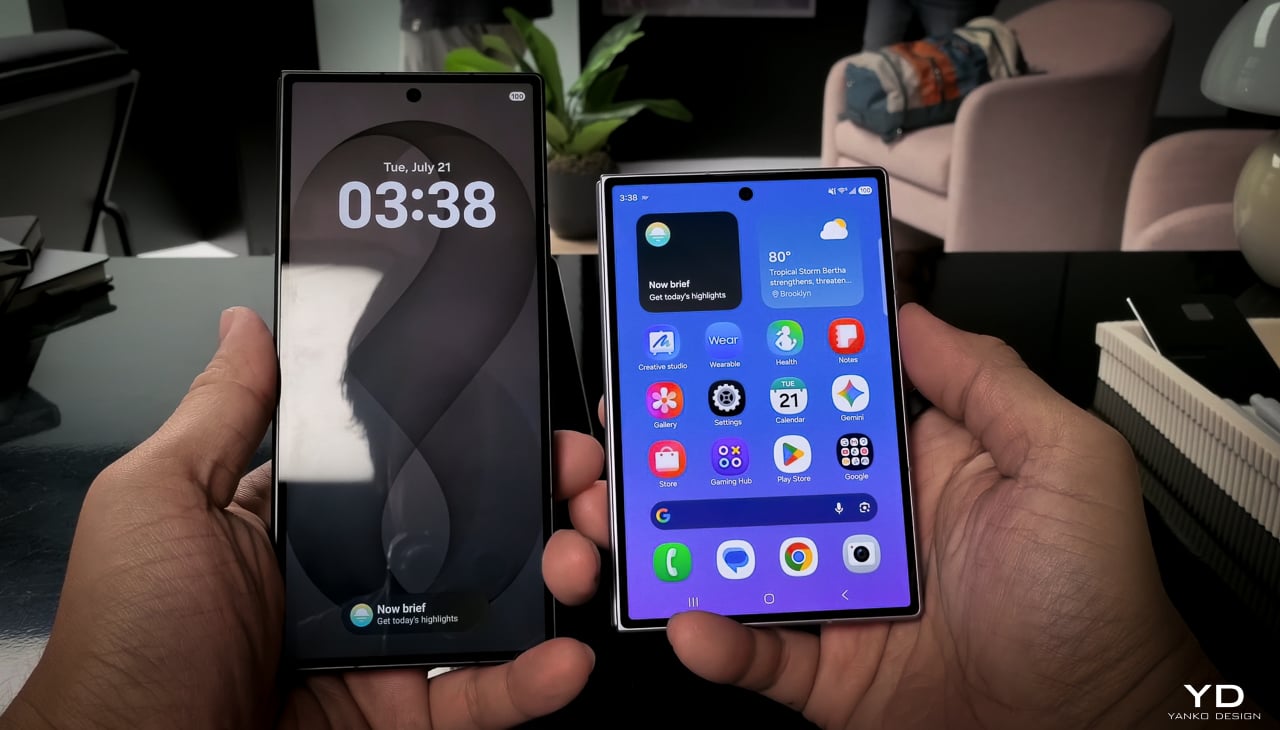
The standard Galaxy Z Fold8 looks broad enough in photographs to raise a question about grip, and I arrived at Samsung’s hands on session with exactly that reservation. In the hand, the width does something more useful: it spreads 201 grams across a shorter body, removes the top heavy sensation I associate with tall Folds, and gives the cover screen the proportions of a more natural phone. Beside it, the slimmer Fold8 Ultra uses a deeper camera stack, a finger groove, and a softer opening action to project a different kind of authority. Samsung hasn’t made one Fold at two prices. It has designed two physical personalities.
That distinction is the central design decision in Samsung’s new three device foldable family. Fold8 is shaped around approachability and content. Fold8 Ultra turns the same book style format into a larger, more architectural object built around creation and productivity. Flip 8 completes the system by shrinking the opening gesture, moving more interaction to the exterior, and treating color as part of the product’s identity.
My time with the devices was brief and preproduction. The observations here cover proportion, weight, balance, finish, hinge action, display shape, and visible interaction. Battery life, camera quality, durability, and long term crease behavior require full testing.
Samsung stopped treating the Fold as one object
For years, the book style foldable has carried an unresolved physical question. Should it feel like a phone that happens to open, or a small tablet that happens to close? Those goals pull the hardware in opposite directions. A tall, narrow exterior can preserve a familiar inner canvas, but it can also make the closed device feel remote like. A wider cover screen is easier to read and type on, but the extra width can make the object look cumbersome before anyone picks it up.
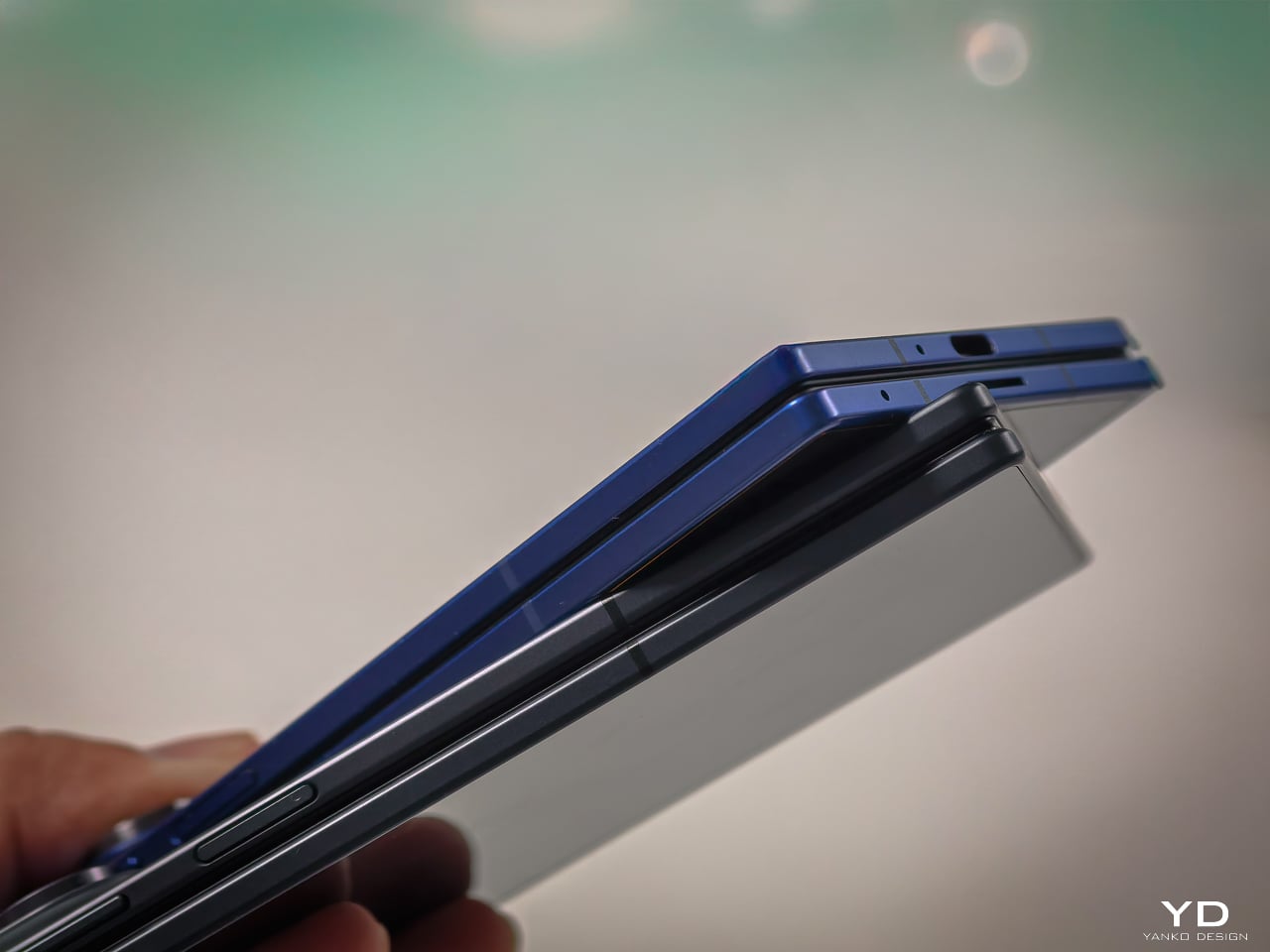
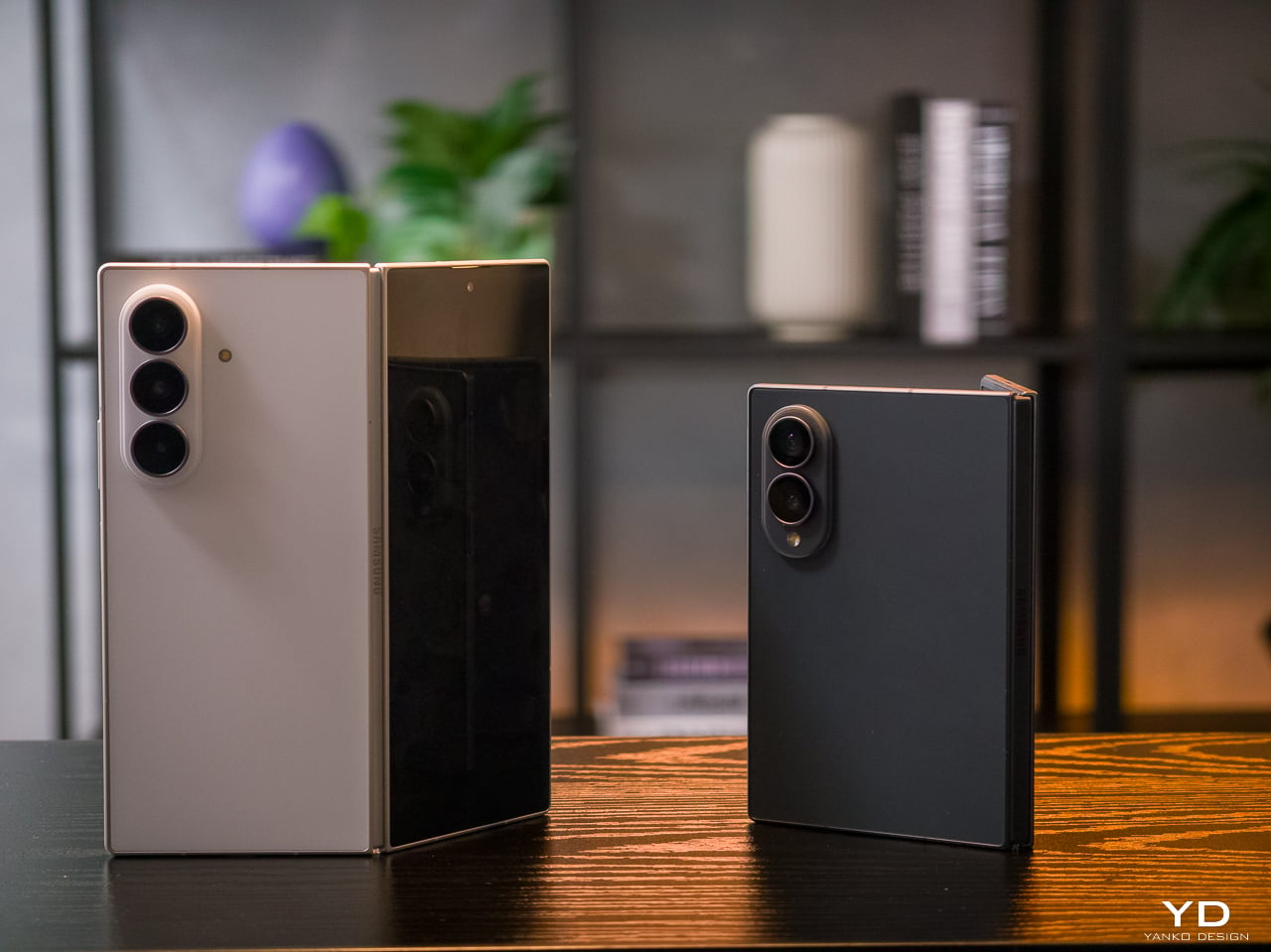
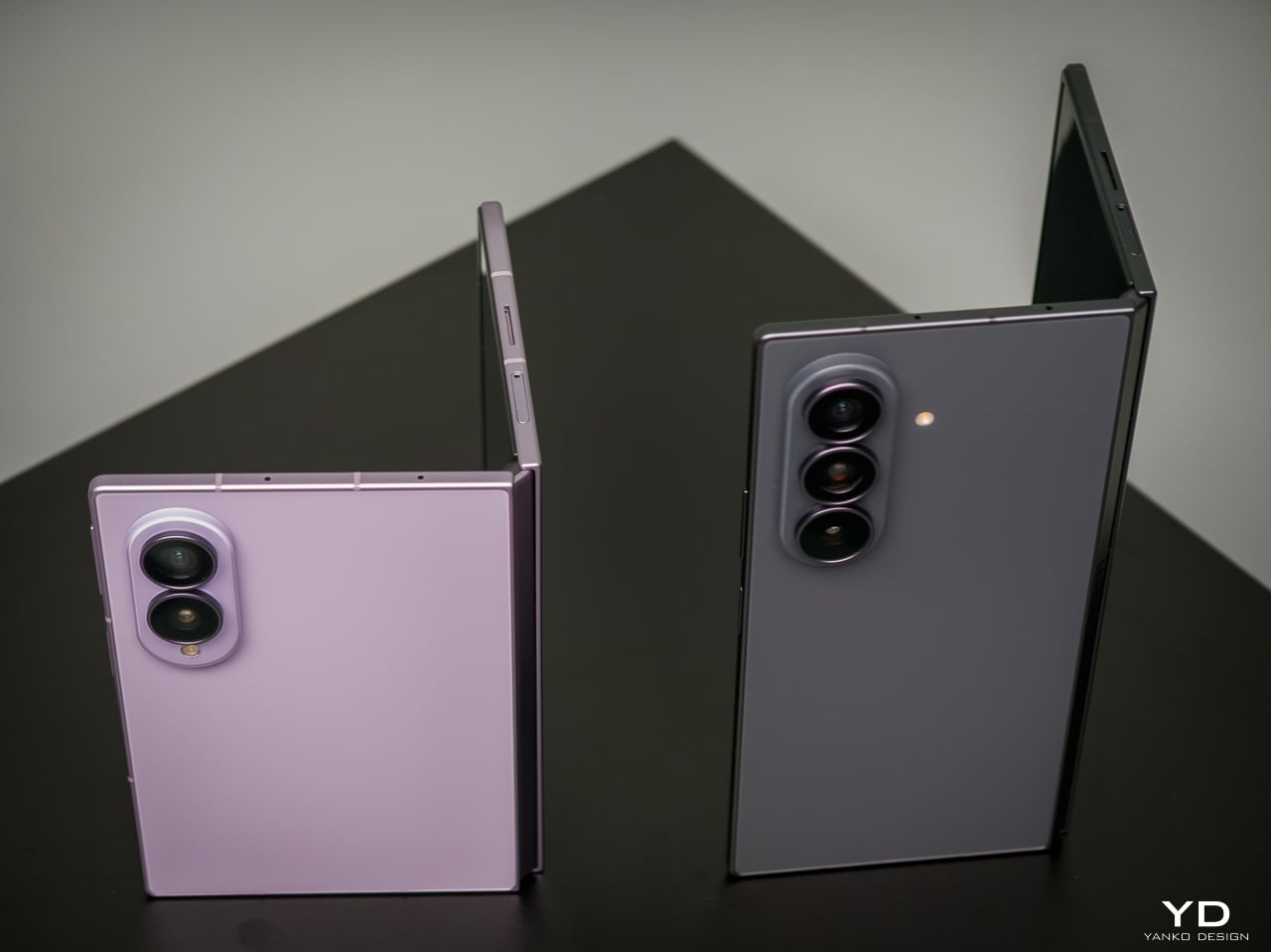
Samsung’s answer is no longer a single compromise. The Fold8 and Fold8 Ultra expose different priorities through their silhouettes. The standard model is shorter, wider, and visually quieter, with a dual camera arrangement that reduces the concentration of mass near the top. The Ultra is taller, thinner when open, and more assertive from the rear, where the camera hardware becomes part of its hierarchy.
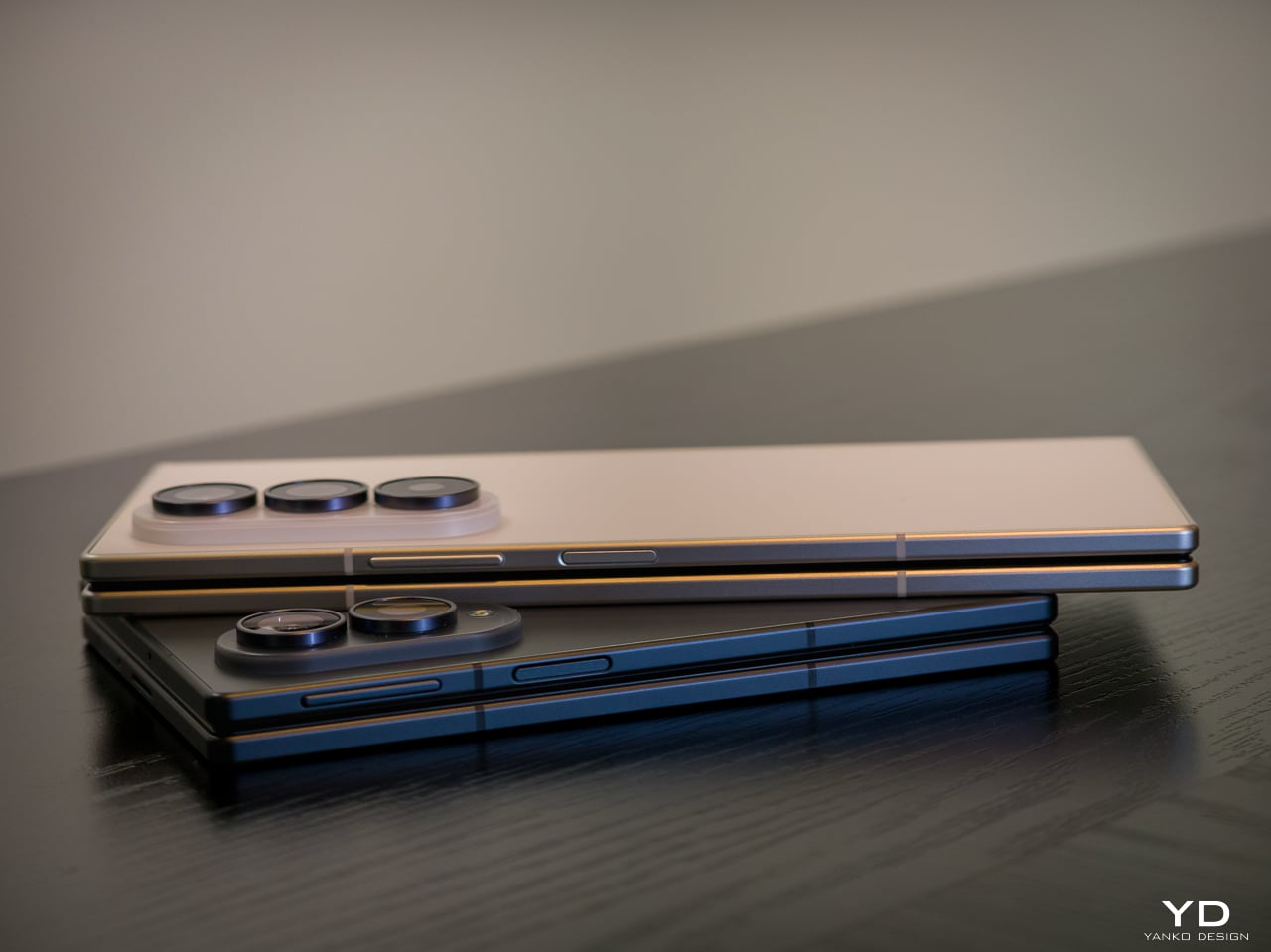
The effect appears before either screen turns on. Fold8 asks to be handled. Fold8 Ultra asks to be noticed.
The standard Fold distributes its mass instead of advertising it
Samsung lists the Fold8 at 201 grams and 4.5 mm thick when open. Numbers that small usually become launch trivia, but here they explain the object’s behavior. The wider frame spreads weight laterally, while the shorter body and simpler camera form reduce the sensation that the top of the device is pulling away from the hand.
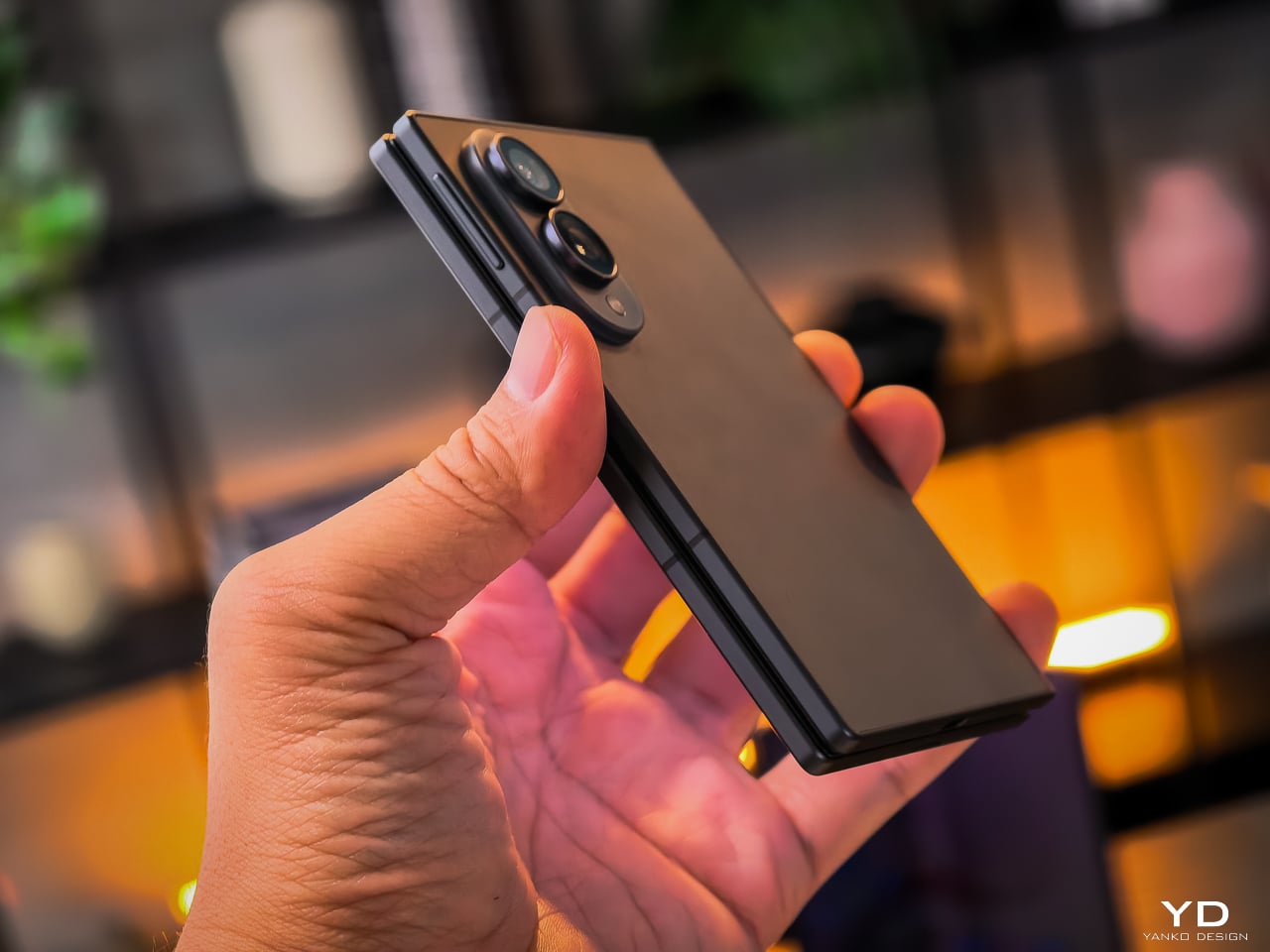
I was especially aware of that balance when rotating the Fold8 into portrait orientation. The device felt settled rather than perched. My concern that the new width would feel excessive faded quickly because the weight distribution gave the fingers a stable object to hold, not a tall slab to counterbalance.
This is where apparent weight separates from measured weight. A device can be light on a scale and still feel awkward if its center of mass sits too high or too far from the palm. Fold8’s proportions make 201 grams feel integrated into the form. It is still a folding phone with two halves, a hinge, and a large inner display, but it no longer announces those components as separate burdens.
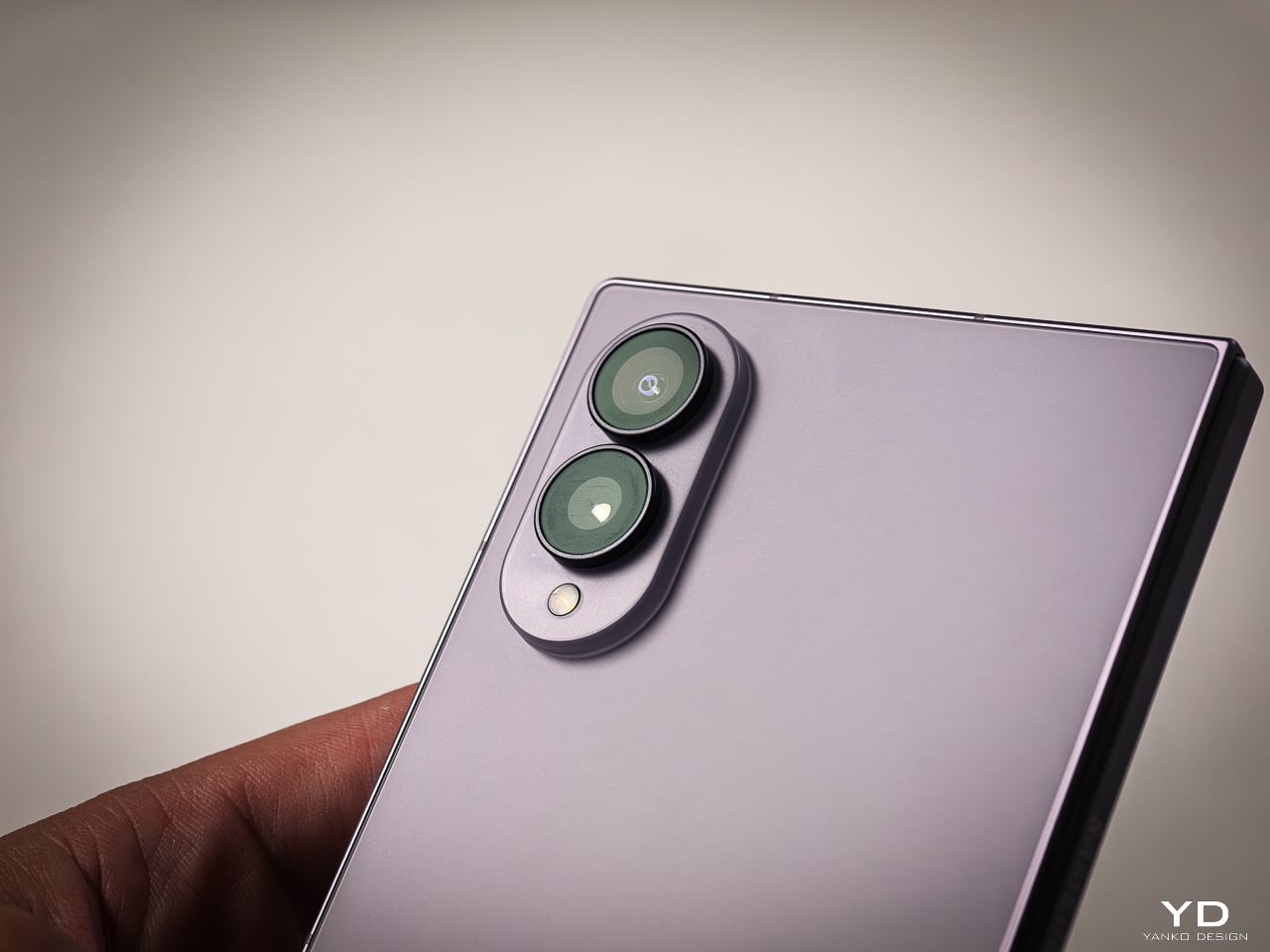
The rear camera layout supports that reading. Fold8’s dual 50 megapixel system is less ambitious than the Ultra’s camera package, but it also gives the standard model a calmer back surface and less visual weight. The specification tradeoff is visible in the silhouette, which is exactly how an intentional product family should communicate hierarchy.
Two screen ratios create one continuous object
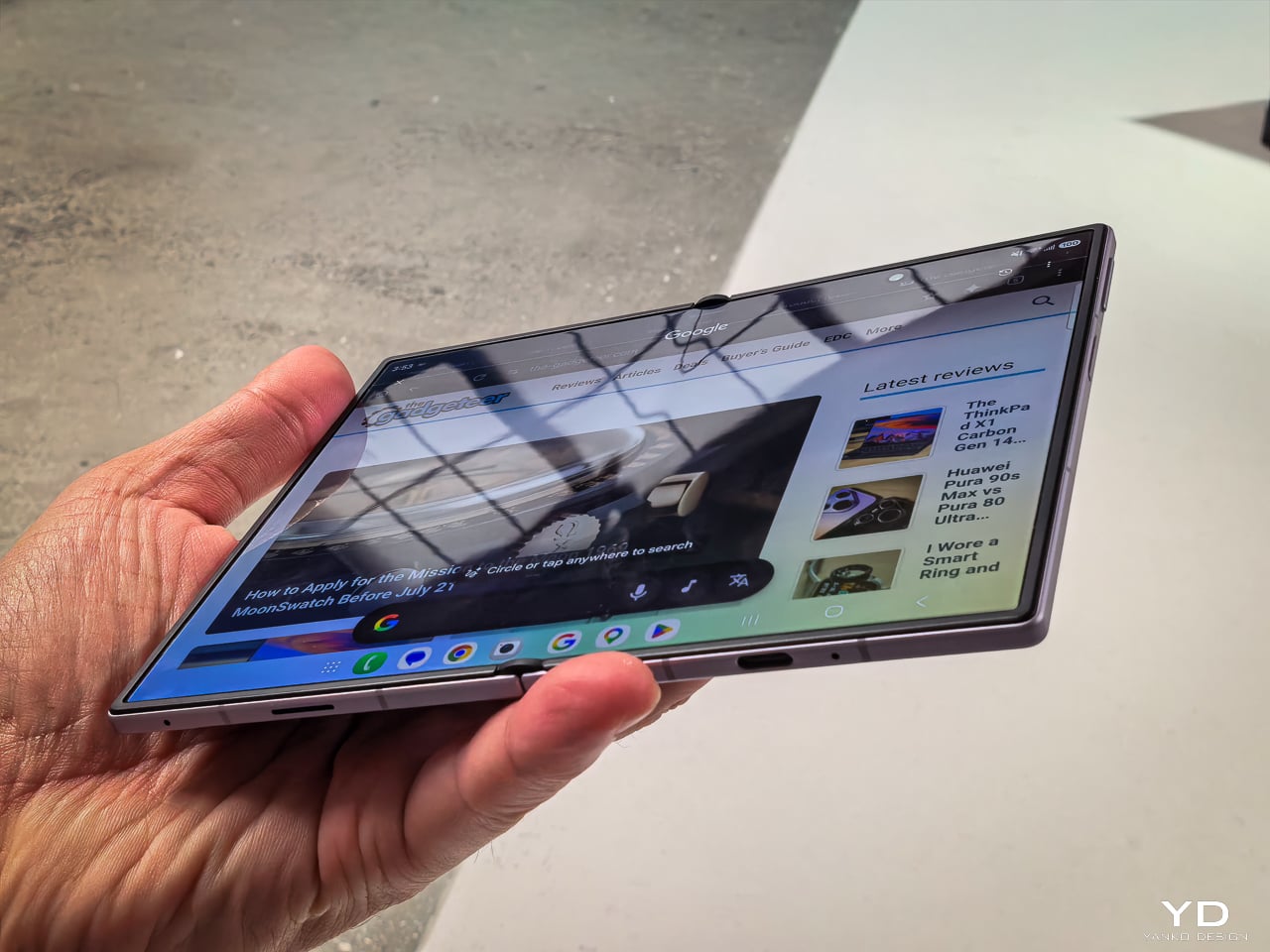
The 10:16 cover display and 4:3 inner display aren’t two isolated specifications. They form a sequence. Closed, the Fold8 presents a wider keyboard area and a more complete frame for short form content. Open, the 7.6 inch inner screen expands into a squarer field that gives reading, websites, video, and side by side tools more horizontal room.
That transition changes the physical logic of the Fold. Earlier narrow cover displays could feel like a temporary interface used on the way to the main screen. Yanko Design’s earlier coverage of the wider Fold8 form anticipated the geometric shift, but the final hardware is lighter and more balanced than leaked dimensions alone could show. Fold8’s exterior is proportioned to stand on its own, so opening the device becomes an expansion rather than an escape.
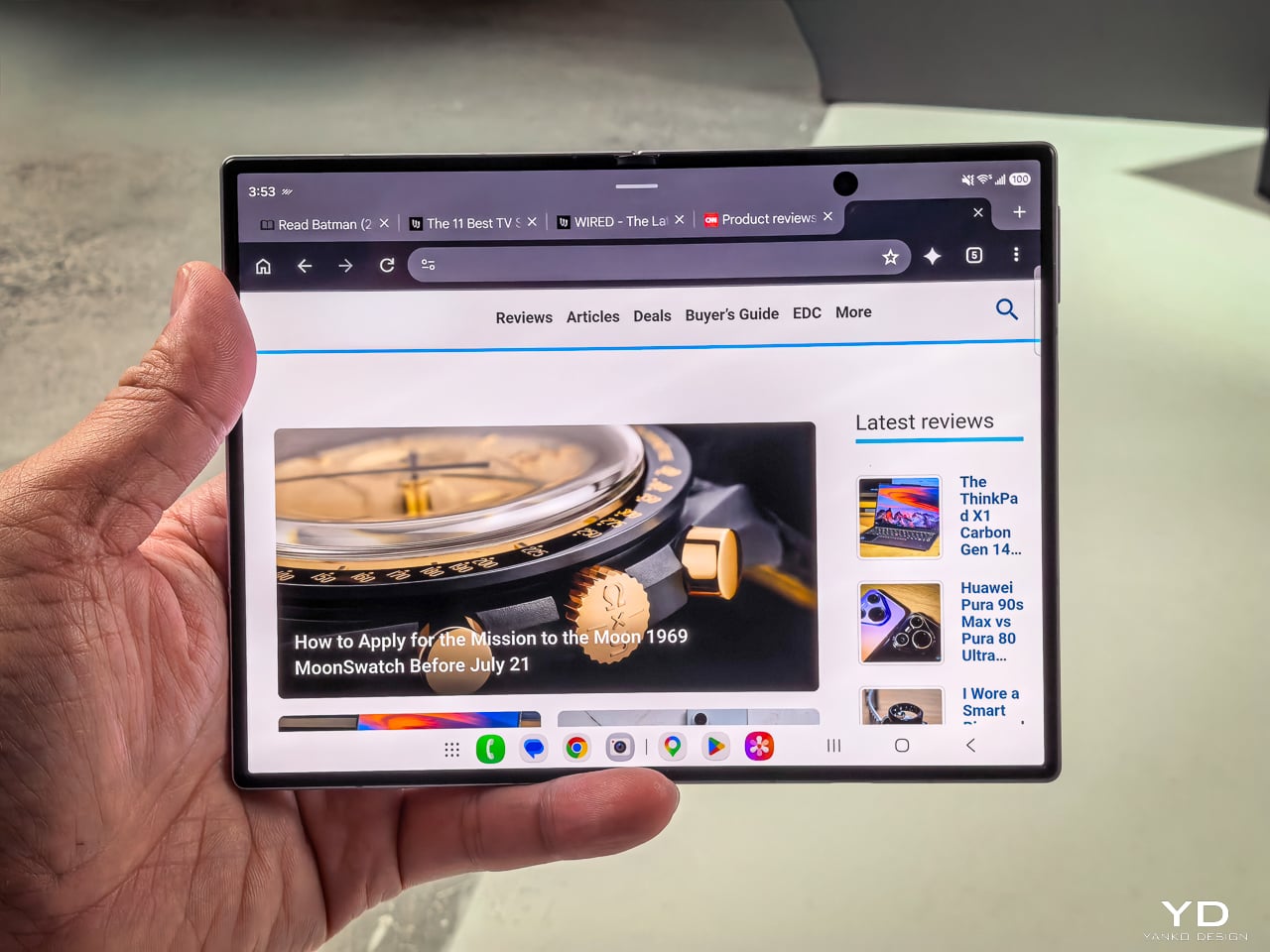
Samsung’s 3,000 nit peak brightness claim, Vision Booster, and anti reflective treatment support that architectural idea by keeping the canvas legible across changing conditions. During my limited session, I focused on the geometry and reflections rather than making a judgment about display quality. The crease remained part of the object. Samsung says the revised internal stack reduces its visibility, not that it disappears.
The most coherent part of the standard Fold may be this relationship between modes. Closed and open no longer feel like separate products sharing a hinge. The proportions create continuity.
Flex Titanium hides the design work below the surface
The name Flex Titanium invites an easy misunderstanding. Samsung hasn’t wrapped the Fold8 in a titanium exterior. The technology lives inside the folding display stack, where two titanium based components perform different jobs.
A titanium alloy film replaces the earlier polymer film, creating a thinner and more durable flexible layer, according to Samsung. Beneath it, a titanium plate adds rigidity. Pressure sensitive adhesive reduces air gaps between layers. Samsung says the combined structure improves durability and reduces crease visibility.
This is hidden engineering with visible consequences. A flatter looking surface, a thinner display assembly, and controlled reflections all change how the open device reads as a single plane. Yet the material story is strongest when it remains precise. The film flexes. The plate supports. Neither turns the chassis into a titanium object, and neither removes the crease from the physical vocabulary of a foldable screen.
The display stack also reveals why reducing thickness isn’t simply a process of shaving the exterior. Every fraction of a millimeter contains structural roles, adhesive spacing, sensor clearance, and protection for surfaces that close against each other. During the session, I asked whether more titanium could replace the raised inner border. Samsung’s representative explained that the slight lip creates separation when the device closes. The answer is a useful reminder: the part that looks removable may be the part preventing two delicate surfaces from touching.
The Ultra makes opening part of its identity
At 4.1 mm open, the Fold8 Ultra is 0.4 mm thinner than the standard Fold. I could feel that difference. The more revealing change, however, wasn’t the measurement. It was the way the Ultra opened.
Samsung shaved the outer bevels to create a groove between the panels, then adjusted the hinge and magnets. On the Fold 7 comparison unit, I had to work against noticeably more resistance. That tactile change extends the hinge refinement documented in Yanko Design’s Galaxy Z Fold7 hands on. The Fold8 Ultra gave my fingers a clear purchase point and opened with less effort. A tiny subtraction from the edge changes the whole sequence from searching, gripping, and pulling into one continuous action.
The magnets contribute to that choreography. Closed, the object feels intentionally sealed. Once the fingertips find the groove, the resistance releases more cleanly. This isn’t visual styling applied after engineering. It’s a designed gesture produced by edge geometry, hinge tuning, and magnetic force.
The Ultra’s 215 gram mass and larger camera system give it more physical presence. Its rear silhouette communicates image making capability even before Samsung’s 50 megapixel ultrawide, dual high resolution cameras, and 8K modes enter the conversation. Whether that camera stack reads as capability or excess will depend on the viewer, but it clearly distinguishes the Ultra from the standard model’s quieter back surface.
Its inner display uses the same broad material ideas: a titanium alloy film, titanium support plate, anti reflective layer, and a claimed 3,000 nit peak. The larger visual authority comes from how those components are framed by the taller object, the camera hierarchy, and the controlled opening action.
Fold8 and Ultra serve different design goals
| Design element | Fold8 | Fold8 Ultra | Flip8 |
|---|---|---|---|
| Primary physical intent | Approachable content canvas | Large screen creation and flagship presence | Compact interaction and self expression |
| Weight | 201 g | 215 g | 180 g |
| Unfolded thickness | 4.5 mm | 4.1 mm | 6.1 mm |
| Screen geometry | 10:16 outside, 4:3 inside | Taller book style canvas | Inner phone plus expanded FlexWindow |
| Opening interaction | Conventional book style fold | Finger groove, revised hinge, optimized magnets | Compact flip with redesigned hinge |
| Material story | Flex Titanium display stack | Flex Titanium display stack with thinner Fold construction | Thinner internal package and new hinge material |
| Visual character | Wide, balanced, visually quiet | Architectural, camera led, assertive | Colorful, pocketable, expressive |
The 200 dollar price gap will encourage a linear comparison, but the objects resist one. Fold8 Ultra isn’t simply the standard model with every value increased. It’s thinner when open yet heavier as a whole. Its camera stack gives the rear more authority and more visual complexity. Its opening groove improves a repeated physical action, while its larger canvas supports layered Gemini windows and creation tools.
Fold8 trades some of that equipment for a shape that felt more naturally balanced in my hand. It’s the more approachable object, not a reduced Ultra. The Ultra is the more elaborate object, not an automatically more resolved one.
Flip8 moves the phone toward its exterior
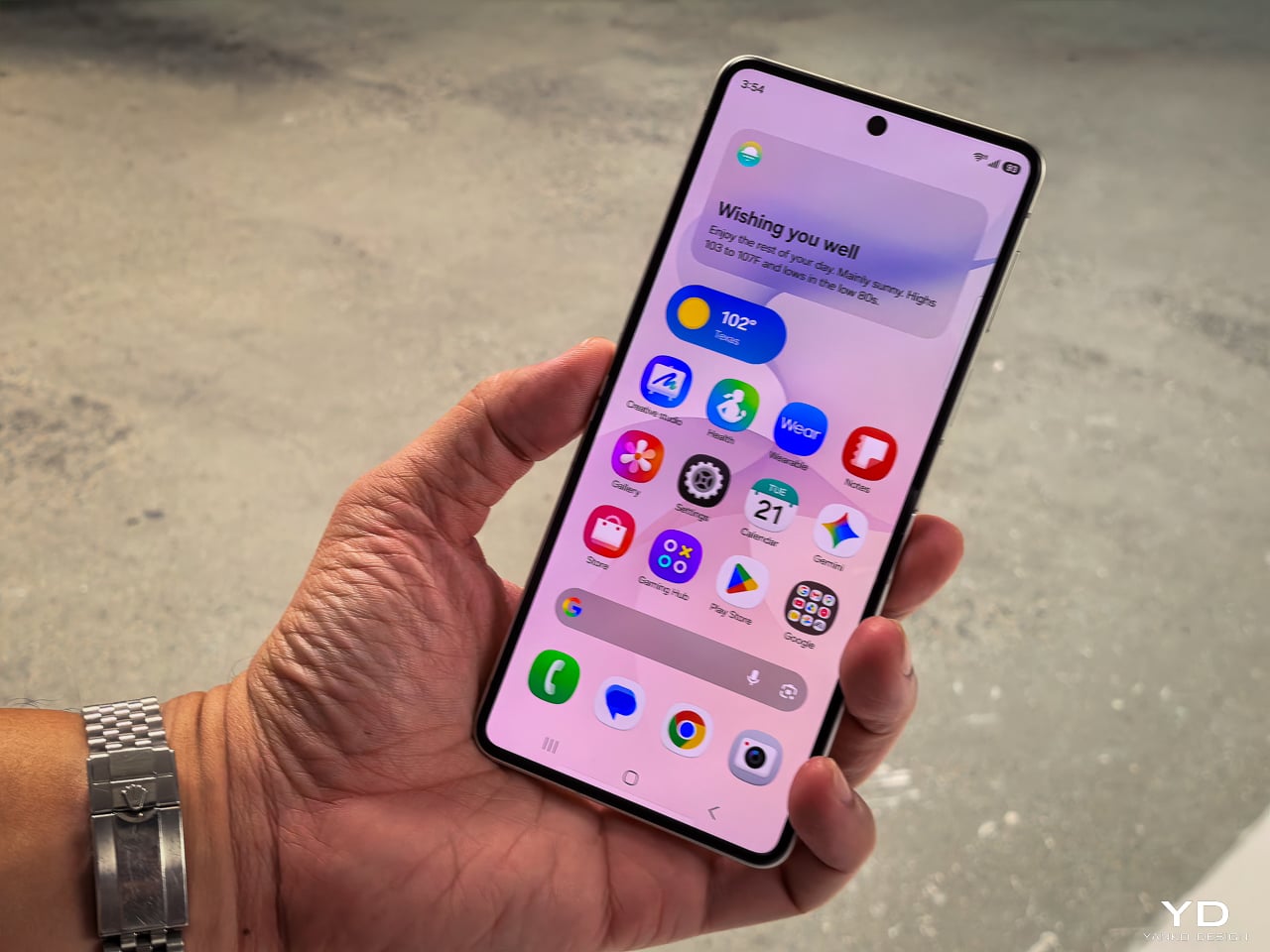
Samsung’s lineup argument would be incomplete without the Flip 8. At 180 grams and 6.1 mm when open, it pursues a different relationship between body and pocket. The hinge has been redesigned, but the larger conceptual change appears on the outside.
The FlexWindow now behaves less like a remote panel for the inner phone. Swipe down from the upper left for notifications, down from the upper right for quick settings, and up for a home screen with Now Brief, recommended actions, and an app row. A second upward swipe opens a full app tray. Samsung also demonstrated easier access to apps beyond the earlier whitelist.
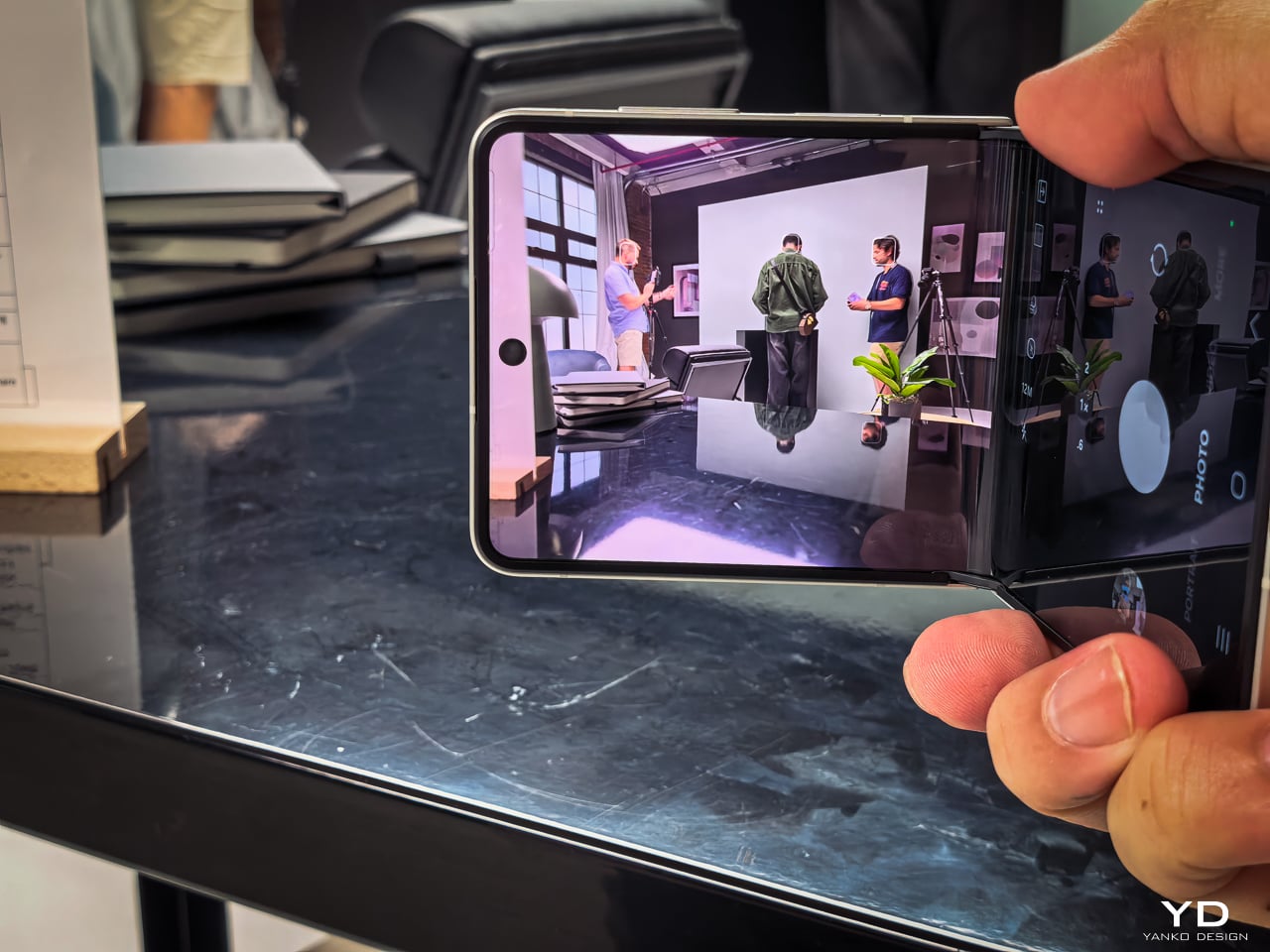
That sequence changes the folded object from an accessory to the main device for short interactions. Gemini automations can run from the cover, while Now Feed can surface Samsung’s expanded card system. Software is serving the physical state here: the phone stays closed because the exterior has become complete enough to use.
Bright Pink, Cream, Graphite, and Mint give the Flip a more expressive surface palette than either Fold. Samsung reserves Mint for its online store. Color isn’t incidental on a compact object that spends much of its time closed and visible. It carries identity while the larger screen remains hidden.
Price, colors, and availability
Samsung lists the Galaxy Z Fold8 from $1,899.99 in Lavender, Cream, Graphite, and Pistachio. Pistachio is exclusive to Samsung.com. The Galaxy Z Fold8 Ultra starts at $2,099.99 in Violet Shadow, Cream, Graphite, and Green Shadow, with Green Shadow exclusive to Samsung.com. Galaxy Z Flip 8 starts at $1,199.99 in Pink, Cream, Graphite, and Mint, with Mint exclusive to Samsung.com.
Official U.S. preorder and retail availability dates weren’t included in the prelaunch briefing record available before the 9:00 a.m. ET embargo. Those two dates must be inserted from Samsung’s launch release when it becomes public. No unverified date has been substituted.
Three forms, three behaviors
Samsung’s new foldables are most revealing before their processors, cameras, or AI tools begin working. Fold8 communicates approachability through width, lower mass, calmer camera geometry, and a cover screen that looks ready for ordinary phone use. Fold8 Ultra communicates presence through height, a stronger camera hierarchy, a thinner open profile, and an opening gesture with its own physical punctuation. Flip 8 communicates portability and personality by making the closed state increasingly self sufficient.
The family is coherent because each device uses the same basic grammar of folding displays, hinges, bright surfaces, and adaptive software. It’s convincing because Samsung allows those ingredients to produce different behaviors instead of forcing every model toward one ideal shape.
The Fold8 is the central design here. It turns the book style foldable from a narrow device that reveals a tablet into a balanced phone that expands into a broader canvas. The Ultra makes that expansion feel more deliberate and imposing. The Flip makes opening optional for more of the day.
Samsung’s foldable future no longer looks like one perfect hinge waiting to be discovered. It looks like three objects teaching the same screen to behave differently.