Most furniture is designed to stay put. It sits in a corner, holds your lamp, or supports your coffee cup, and asks nothing of you beyond basic acknowledgment. Console tables, in particular, tend to be the most ignored category in any room. They’re the utilitarian afterthought you dress up with a vase and a scented candle and then completely forget about. That’s why when a piece of furniture actually makes you stop mid-scroll and stare, it deserves a proper conversation. Deniz Aktay’s Flitter Console Table is worth that conversation.
The first thing you notice is that the tabletop doesn’t behave the way a tabletop is supposed to. Rather than lying flat across its entire length, the surface fans out at one end into a spread of layered wooden sheets, fanning open like the pages of a book someone has just let go of, or like a hand of cards splayed mid-shuffle. It’s an image that takes a second to fully process, because your brain keeps trying to categorize it as something recognizable before giving up and just letting it be exactly what it is: a genuinely new idea.
Designer: Deniz Aktay

The construction is plywood, and Aktay uses it with clear intentionality. The visible edge layering, that characteristic striping you see in exposed plywood cross-sections, becomes a deliberate design feature along the fanned end. Each layer is distinct, readable, and beautifully warm against what appears to be a light oak or birch veneer on the surface. The material choice isn’t incidental. Plywood is what allows those individual sheets to fan and separate without the design collapsing into something clunky. The thinness of each layer is essential to how the whole thing reads visually, light and feathered rather than stacked and heavy.
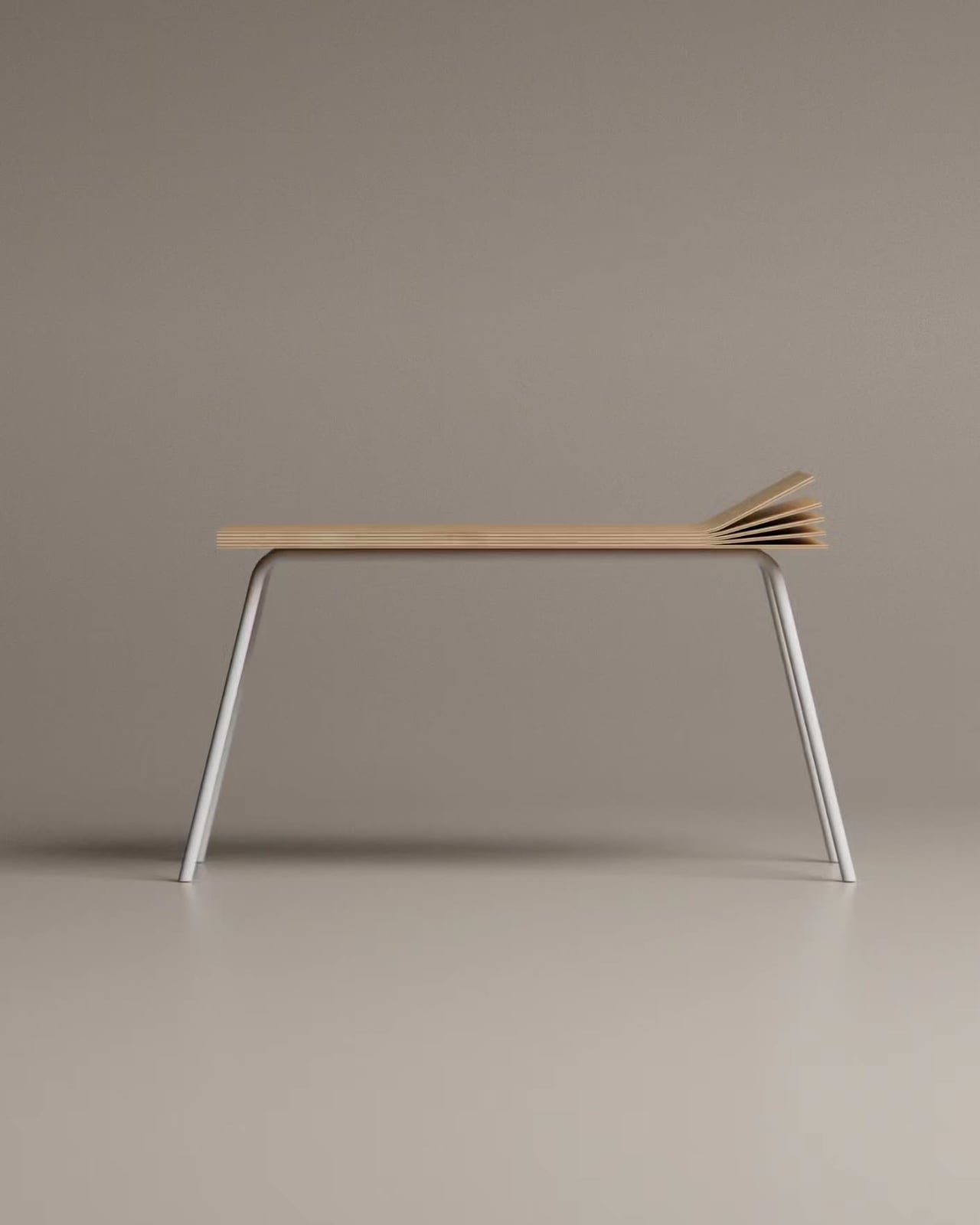
The base grounds all of this in a completely different register. Slim, white tubular metal legs splay outward at a slight angle, giving the table a stance that feels alert rather than static. They’re simple to the point of near-invisibility, which is exactly the right call. Any more visual weight in the base and the fanned top would lose its sense of lift. As it stands, the table seems to hover rather than sit, the warm wood floating above the pale floor with minimal interruption from the structure below.
The part that genuinely impressed me when I looked more closely at the images is that the fanned layers aren’t just decorative. The gaps between them are functional storage, wide enough to slot in magazines, books, or a tablet. The storage doesn’t announce itself. It’s worked into the structure so naturally that you might not even register it as a feature until you see a laptop tucked neatly between the sheets. That’s the kind of design thinking that separates a concept render from something that could actually live in a home. Aktay solved the console table’s eternal problem, that it holds things on top but rarely within, without adding bulk, drawers, or shelves. He just opened the surface up.

Seen from the end, the Flitter is almost unrecognizable as a console table. The fanned layers compress into what looks like a compact, striated block, geometric and architectural. Rotate your view to the side and it stretches out into something long and minimal with one quietly dramatic detail. The design rewards every angle differently, which is rare, and a little thrilling. Console tables as a category don’t usually excite me. They’re functional, they’re necessary, and occasionally they’re pretty, but very rarely are they surprising. The Flitter is surprising without being theatrical. It doesn’t shout. It just quietly does something no other table in the room is doing, and then sits there looking calm about it.
Deniz Aktay established his Stuttgart-based studio DEZIN in 2020 with a focus on pure lines and modern minimalism, often with a multifunctional purpose. The Flitter Console Table lands exactly on that brief, and then some. It’s the kind of piece that makes you reconsider what furniture is actually allowed to do.