Two Prongs of a Wall Socket
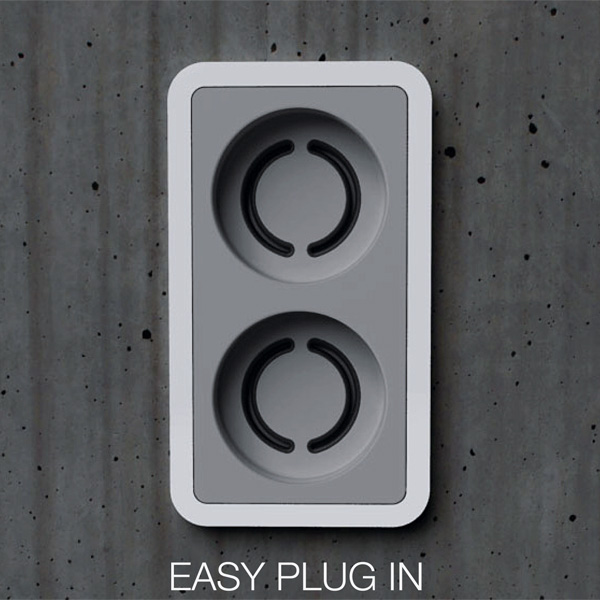
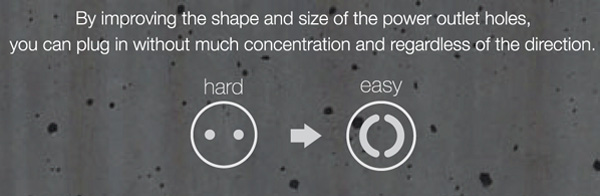
Sometimes trying to plug a cord into a wall socket is like an adult version of that children’s toy where you have to match the shapes up to get them to fit. No, it shouldn’t be difficult but imagine what it’s like for the disabled and vision impaired. Baek Kil Hyun’s solution is modifying the traditional prongs into two half-hemspheric rings. Theoretically, this makes it much easier to use and actually slightly resembles the universal power icon.
Designer: Baek Kil Hyun


20 Comments »
mugabo says
Correction: “modifying the traditional prongs” should say “receptacle” or “socket,” as the prongs attached to the cord are unchanged.
Also, providing a slight concave curve within the socket would help to guide the plug in more easily, as well (but not sure about the safety of the resulting gap, though).
Jason gretie says
So dangerous..
Daniel says
Wouldn't two concentric circles be even easier? And if you don't want it to rotate, two concentric squares. Maybe I should become a designer…
@katuroo says
how would you fit a 3 prong cord?
Bauski says
in Europe you don't have them
br0ther says
except for UK, Italy, Denmark, Ireland and Switzerland? Oh and how about the French with a peg in the socket that fit into a hole in the plug at the cable? https://secure.wikimedia.org/wikipedia/en/wiki/AC...
I do love the type C though.
mugabo says
Correction: “modifying the traditional prongs” should say “receptacle” or “socket,” as the prongs attached to the cord are unchanged.
Also, providing a slight concave curve within the socket would help to guide the plug in more easily, as well (but not sure about the safety of the resulting gap, though).
Jason gretie says
So dangerous..
Jimmy C says
Please expound Jason. How exactly is it dangerous?
Gary says
There would be no way of knowing which leg of the recepticle is the hot (live) leg. That is why the prongs are different. This would create the potential of something like theexterior of an a metal lamp being electricaly live even when the lamp was swiched off.
Thijs says
It would be better just to make a guide groove instead of a larger hole. Not only because of safety, but also as it would require a minimal change in production. Current designs use two pieces of metal clamping the leg of the plug. Making the entire hole larger would require a lot more metal and a whole new design.
Just help guide the plug to the right position would improve the design a lot.
Daniel says
Wouldn't two concentric circles be even easier? And if you don't want it to rotate, two concentric squares. Maybe I should become a designer…
@katuroo says
how would you fit a 3 prong cord?
Bauski says
in Europe you don't have them
br0ther says
except for UK, Italy, Denmark, Ireland and Switzerland? Oh and how about the French with a peg in the socket that fit into a hole in the plug at the cable? https://secure.wikimedia.org/wikipedia/en/wiki/AC...
I do love the type C though.
Bauski says
in Europe you don't have them
zzz says
Not new design.
zzz says
Not new design.
Fred says
Can't be universal because we use different voltage around the world. In US 110V in Europe 220/230V. So what happens if you plug in your device made for 110V into a 220/230V plug?
Fred says
Can't be universal because we use different voltage around the world. In US 110V in Europe 220/230V. So what happens if you plug in your device made for 110V into a 220/230V plug?