
Tumble Dry In Vacuum
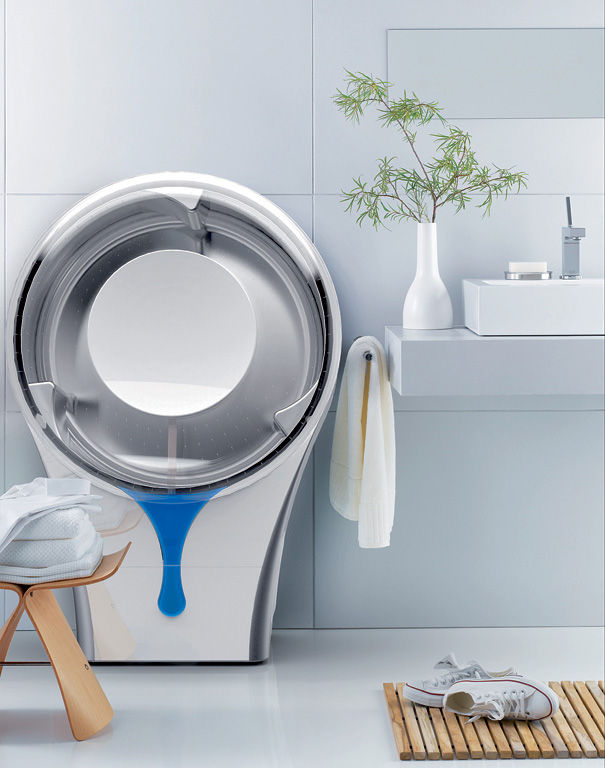
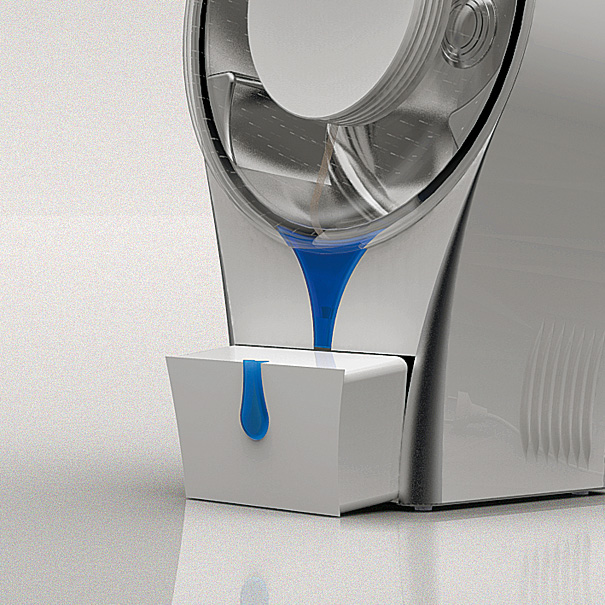
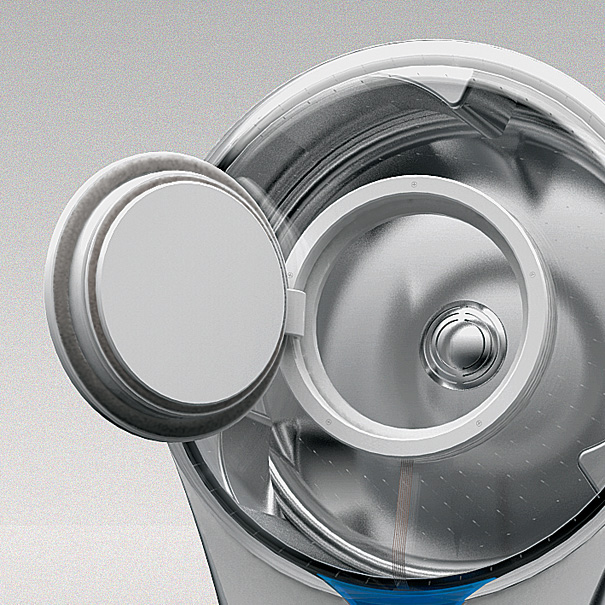
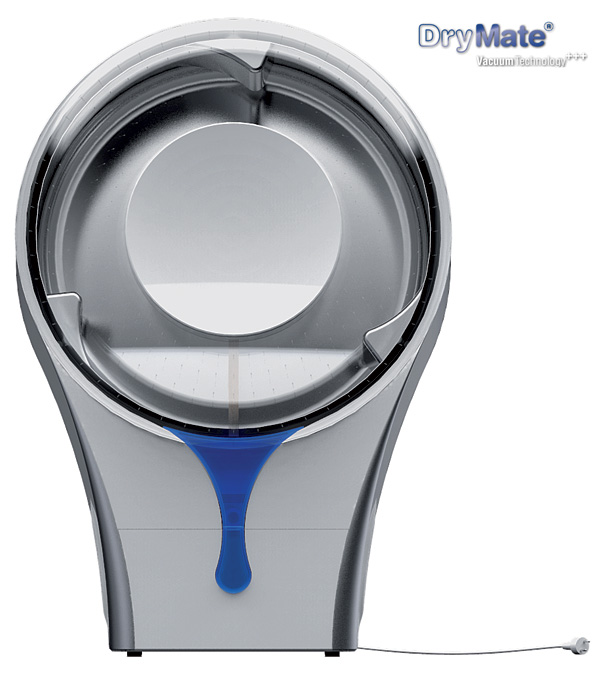
DryMate is a clothes dryer that uses a new vacuum technology to dry clothes at lower temperature. As a result lesser energy is consumed, and heat-related damage to the clothes is avoided. The dryer scores another brownie point for being easily accessible from a standing position. To aid its stand further, a 9 degree tilt and a wide-mouth drum has been incorporated to the design. The rounded exterior gives a refreshing new form to the redundant cuboids that we see at homes.
Technology as explained by Nico:
From a technical view every enclosed space with an air pressure lower than in our environment is already a vacuum. In every vacuum there are special physical conditions as a result of the lower amount of material. DryMate uses one of those special conditions. In a drum with lower air pressure (vacuum) water already evaporates at much lower temperatures than 100°C. The lower the air pressure the lower the temperature that is necessary to evaporate water. It is much more energy-saving to create a minor under pressure than heating your wet laundry to 100°C. Therefore DryMate can achieve much better energy efficiency than conventional tumble dryers.
Supervising Professor: Prof. Hatto Grosse, Köln International School of Design
Designer: Nico Kläber



23 Comments »
Berkana says
The idea of using a partial vacuum to assist in the drying of clothes is not new. Variations of this have popped up at various times in the past. It is not easy to do. This would certainly reduce the amount of heat needed, but until tests are done, it cannot be said that it would take less energy. Pumping out air to maintain a vacuum and continuing to pump out water vapor as the water evaporates takes a considerable amount of energy; additionally, sucking the air out of a closed chamber causes the temperature to drop dramatically. What you have here is an idea without implementation; if you have an idea for how to pump out the air and maintain a vacuum while somehow heating the very little air inside to warm the clothes (or at least to resist the adiabatic chilling effect of sucking air out) and assist in drying, bravo. If not, this design is styling more than design, especially if the core technology that is needed does not exist.
Berkana says
The idea of using a partial vacuum to assist in the drying of clothes is not new. Variations of this have popped up at various times in the past. It is not easy to do. This would certainly reduce the amount of heat needed, but until tests are done, it cannot be said that it would take less energy. Pumping out air to maintain a vacuum and continuing to pump out water vapor as the water evaporates takes a considerable amount of energy; additionally, sucking the air out of a closed chamber causes the temperature to drop dramatically. What you have here is an idea without implementation; if you have an idea for how to pump out the air and maintain a vacuum while somehow heating the very little air inside to warm the clothes (or at least to resist the adiabatic chilling effect of sucking air out) and assist in drying, bravo. If not, this design is styling more than design, especially if the core technology that is needed does not exist.
fritz says
Sometimes design concepts can push a good idea further and maybe someone finds a way to make it possible! Design is not only about technology. It's about use, it's about people, consumer behaviour, culture and so on.
jotpe says
For what clothes dryer at all? I don't understand
Fresh air outdoor is better…
Nico says
hey jotpe, clothes dryer are extremely important in densed cities with lack of space and in regions where the humidity is too high. And every family with children has a real need!
jotpe says
Hey Nico
You are a right when a humidity is too high… And the oder side I live in place where a humidity is low so… I made a simplify 
My comment wasn't a very serious
angel lee says
yes nico, definitely need one in my new hm now.hk's humidity is crazy. even more impt so when u live in a 2m by 2m room=p
Doris says
hey Nico
I read your invention in one of the Hong Kong magazines. And I found that it is so interesting and really suitable in HK as it is quite humid in Hong Kong, especially in spring. But i have some questions about the invention. I wold be grateful if you can reply me by emial. Thanks!!!
Doris says
hey Nico
I read your invention in one of the Hong Kong magazines. And I found that it is so interesting and really suitable in HK as it is quite humid in Hong Kong, especially in spring. But i have some questions about the invention. I wold be grateful if you can reply me by emial. Thanks!!!
Walter Weiler says
Hey Nico. I like the design and idea of your vacuum dryer but I also agree with Berkana's comment on the technology challenges. How did you come about it? Have you been approached by a white goods manufacturer? Or have you presented it to one of those companies? What were their reactions?
Thank you for your answers!
Walter
Walter Weiler says
Hey Nico. I like the design and idea of your vacuum dryer but I also agree with Berkana's comment on the technology challenges. How did you come about it? Have you been approached by a white goods manufacturer? Or have you presented it to one of those companies? What were their reactions?
Thank you for your answers!
Walter
ramble says
I'm not sure heat would be required to dry cloths. Cold environments are much more suitable for removing moisture.
ramble says
I'm not sure heat would be required to dry cloths. Cold environments are much more suitable for removing moisture.
richard bencsik says
I can actually say the idea of usinga vacumn to dry clothes was my very own original idea. However I have not had the time or money to test or develop it into a working model. On the surface it seems like a great idea. A typical clothes dry uses tons of energy to first tumble, and heat the clothes. And it still takes forever to get the clothes dry. I started thinking about ways to increase the evaporation process, which is all were talking about here. Lower pressure results in faster evaporation. Of course heat increases evaporation as well. Combine the 2, considering the idea is to save energy, and increase the process speed and you might have a working model. The questions are, how much energy is required to pump out all the air, and water vapor. How much heat energy would have to be added to the system. Would you result in a net savings of energy? Would you decrease the drying time? And what cost could a product like this be brought to the consumer? I highly doubt anything less than a perfect vacumn would work, except for novelty reasons such as the drymate. Sure you could add a small vacumn, with less heat, call it an eco-friendly dryer..but the damn thing takes 24 hours to dry your clothes.
richard bencsik says
On the same note, I saw a cool device that you can attach to a pressuized water line, run water past a valve and it can create a decent vacumn through a line connected to a chamber. Could it be possible to use some of the energy of a pressurized water line (typical 60 psi to a standard home) to create the vacumn needed to dry your clothes? Then the water would have to go into a holding chamber, then to be re-used to wash the clothes, or used for the rest of the home via a localized pump? More questions arise.. How much water would need to be used to create the vacumn long enough to sustain drying? How much more energy would be consumed to re-pump the same water back to the sinks and faucets. I would love to see this technology come to be, as long as I somehow get some money out of it.
richard bencsik says
I can actually say the idea of usinga vacumn to dry clothes was my very own original idea. However I have not had the time or money to test or develop it into a working model. On the surface it seems like a great idea. A typical clothes dry uses tons of energy to first tumble, and heat the clothes. And it still takes forever to get the clothes dry. I started thinking about ways to increase the evaporation process, which is all were talking about here. Lower pressure results in faster evaporation. Of course heat increases evaporation as well. Combine the 2, considering the idea is to save energy, and increase the process speed and you might have a working model. The questions are, how much energy is required to pump out all the air, and water vapor. How much heat energy would have to be added to the system. Would you result in a net savings of energy? Would you decrease the drying time? And what cost could a product like this be brought to the consumer? I highly doubt anything less than a perfect vacumn would work, except for novelty reasons such as the drymate. Sure you could add a small vacumn, with less heat, call it an eco-friendly dryer..but the damn thing takes 24 hours to dry your clothes.
richard bencsik says
On the same note, I saw a cool device that you can attach to a pressuized water line, run water past a valve and it can create a decent vacumn through a line connected to a chamber. Could it be possible to use some of the energy of a pressurized water line (typical 60 psi to a standard home) to create the vacumn needed to dry your clothes? Then the water would have to go into a holding chamber, then to be re-used to wash the clothes, or used for the rest of the home via a localized pump? More questions arise.. How much water would need to be used to create the vacumn long enough to sustain drying? How much more energy would be consumed to re-pump the same water back to the sinks and faucets. I would love to see this technology come to be, as long as I somehow get some money out of it.
engineering_thoughts says
You can extract some of the energy from a pressurized water line and use it for creating a vacuum. However, the amount of energy in a low pressure water line (60 psi is low pressure) isn’t much compared to the very large demand of continuously creating a vacuum in a large chamber.
The water lines in your home just don’t have much throughput (small volume of water).
At the end of the day, physics works against you. There is a minimum amount of activation energy required to get water to evaporate. Lowering the pressure reduces that activation energy, but artificially lowering the pressure requires a LOT of energy itself and adds another point of inefficiency in the system.
You could, perhaps, dry **faster** at the cost of requiring more power. People will pay for that – but you can’t lead them on to think it’s more energy efficient.
Trackbacks