
Moisture Collectors
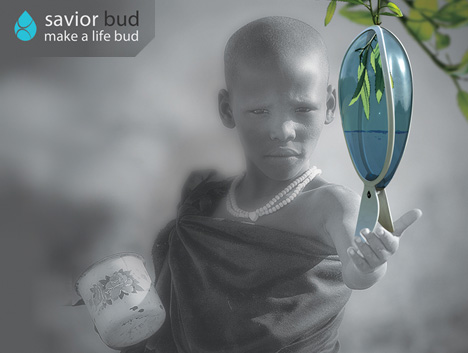
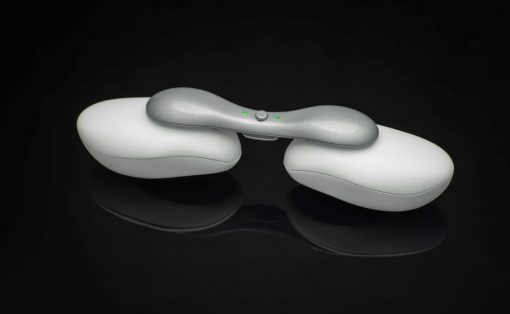
Inspired by the Giving Tree, this project called the “Savior Bud” latches on to trees (one of Earth’s most generous living things) and uses it’s natural recycling processes to obtain water. In a simple process which basically involves collecting the moisture from the leaves and emptying it out into containers, the Savior Bud takes one more step toward acceptable living conditions in Africa.
As our intrepid designers note, Africa is plagued twice by their hydration situation. Twice because not only is their water supply low, but the water that’s available is often undrinkable and polluted.
The process goes like this:
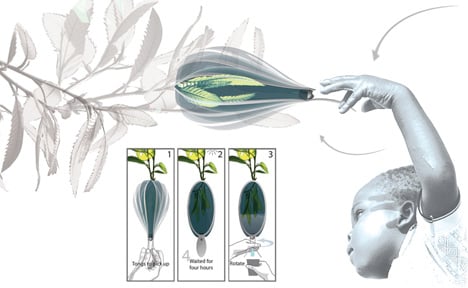
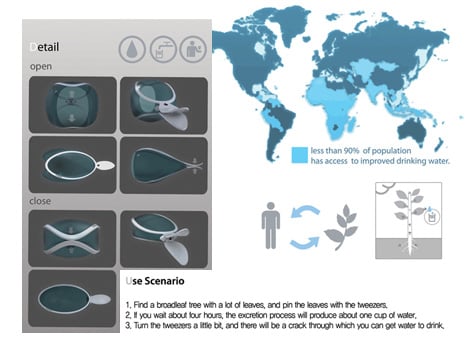
1. Find a broadleaf tree with lots of leaves.
2. Opening the Savior Bud like a giant clamp, surround a few leaves, and release. The Savior Bud should now be containing the leaves like you see in the picture below, sort of like a greenhouse.
3. In about four hours, the leaves will have produced about one cup of water. Turning the bottom of the bud like a faucet will release the water to be put into a separate container for drinking.
Additional details below. I wouldn’t mind one of these for camping or something like that, would you?
Also, C-3P0 not required.
Designers: Kim Hyo Jin and Seol Ah Sun


29 Comments »
kaisha says
i think this idea is thoroughly fat fetched
kaisha says
i think this idea is thoroughly far fetched
mf says
I am sorry if my biology knowledge is a bit rusted, but isn’t it more like:
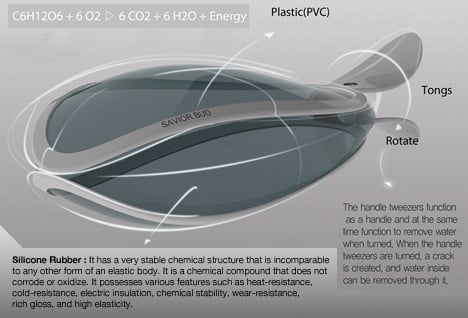
carbon dioxide + water + light energy → carbohydrate + oxygen
hmw says
Right ! The reaction sceme on the 4th pic has to be: 6H2O + 6CO2 –> C6H12O6 + 6O2
Gunnar Tveiten says
Water does indeed evaporate from leaves, but this thing still FAILS on several levels:
1) Water only evaporates because humidity is less than 100%, inside the bubble, humidity would quickly reach 100%, thereafter no additional evaporation takes place. (i.e. the bubble would gather a bit of dew on the inside, and that’d be it)
2) A few leaves most decidedly does not make a cup of water every 4 hours. That would be equivalent to 6 cups every day, or about 2 litres. A tree that lost a litre a day of moisture from every leaf, would dry out and die instantly unless planted in a swamp. (and since these are -dry- areas, that’s obviously not the case)
Sabina says
Hm, I was just wondering how it was supposed to work.I wonder if the designer knows something we don´t…
Chris says
tech: in terms of sustainability i wonder how much energie and water is consumed in the process of building this bud’s.
design: i like the shape and the presentation is good.
second thought: we’ve seen ideas on water purification here, i think thats what makes more sense.
Jeff says
Once again, designers show how little they know about the problems they’re trying to help with.
Gunnar provided some good points.
What I’m mainly concerned with, however, is the complexity of the device. That looks like a lot of manufactured parts, there, for something that could easily be achieved with a simple plastic bag.
We’re trying to reduce emissions and non-biodegradable waste, and here you are, wasting time and energy on an overly-complex non-functional solution, to a problem better handled.
jesus says
just bugger off with your crap!
Margot says
I applaud the idea and the concern behind this design. However, I have cultural question which I feel applies.
So many ideas are thought of with no knowledge of the people and cultural traditions of the group being targeted. Many peoples will not accept ideas from others into their communities, so, sadly, these wonderful inventions are never used by the people they are designed to help. Have the designers researched particular African tribal cultures to know if this device would be used and accepted and used by them?
p says
design for design’s sake. Even if the leaves did produce enough water to fill that thing, I doubt it would do it quickly enough to provide enough water for a person per day/per effort, let alone a polulation in need of it.
The form is really beautiful, but don’t apply it to some “save the world’s problems” concept. Design for the 3rd world, global warming, and the blind yields more bad than good concepts, despite good intentions. If this were a design for a purse or tupperware or an hairclip, it would be awesome, and i’d applaud you.
Justreid says
This is a nicely designed version of an already existing idea, it’s called a plastic bag.
The idea is not far fetched because I’ve seen it done. If anyone knows of survival expert Ray Mears then you might have seen him show us this exact technique. He wrapped a huge plastic bag (much larger than this device which would not produce enough water to drink) over many many leaves and waited longer than four hours to get about a cup full of water. So yes it does work and yes you would get more than a drop of dew if enough leaves are covered, because I’ve seen it done.
It doesn’t solve the water shortage problem in these countries as it just isn’t efficient enough to produce more than a mouthful. But, market this towards a survival tool for travelers instead of to the third world and it might get more praise. As when you’re dying of thirst, a mouthful of water will save your life. So in that sence, it works well. But so does a plastic bag….
Katherine says
First off, a device of that complexity is not going to be cheaply manufactured to the point of being affordable to third world countries. You need custom molds, machinery, workers, etc. Second off, if this really worked, then why wouldn’t you just put a plastic bottle over some leaves and gather water off of that? PVC, the material quoted, is just standard water bottle plastic. Third, to my knowledge, trees don’t ’sweat’ water, unless under extreme environmental conditions where the plant is so stressed it’s going to die. The best you’ll get from this is just the dew collected off of the leaves, which will take longer than 4 hours.
Trackbacks