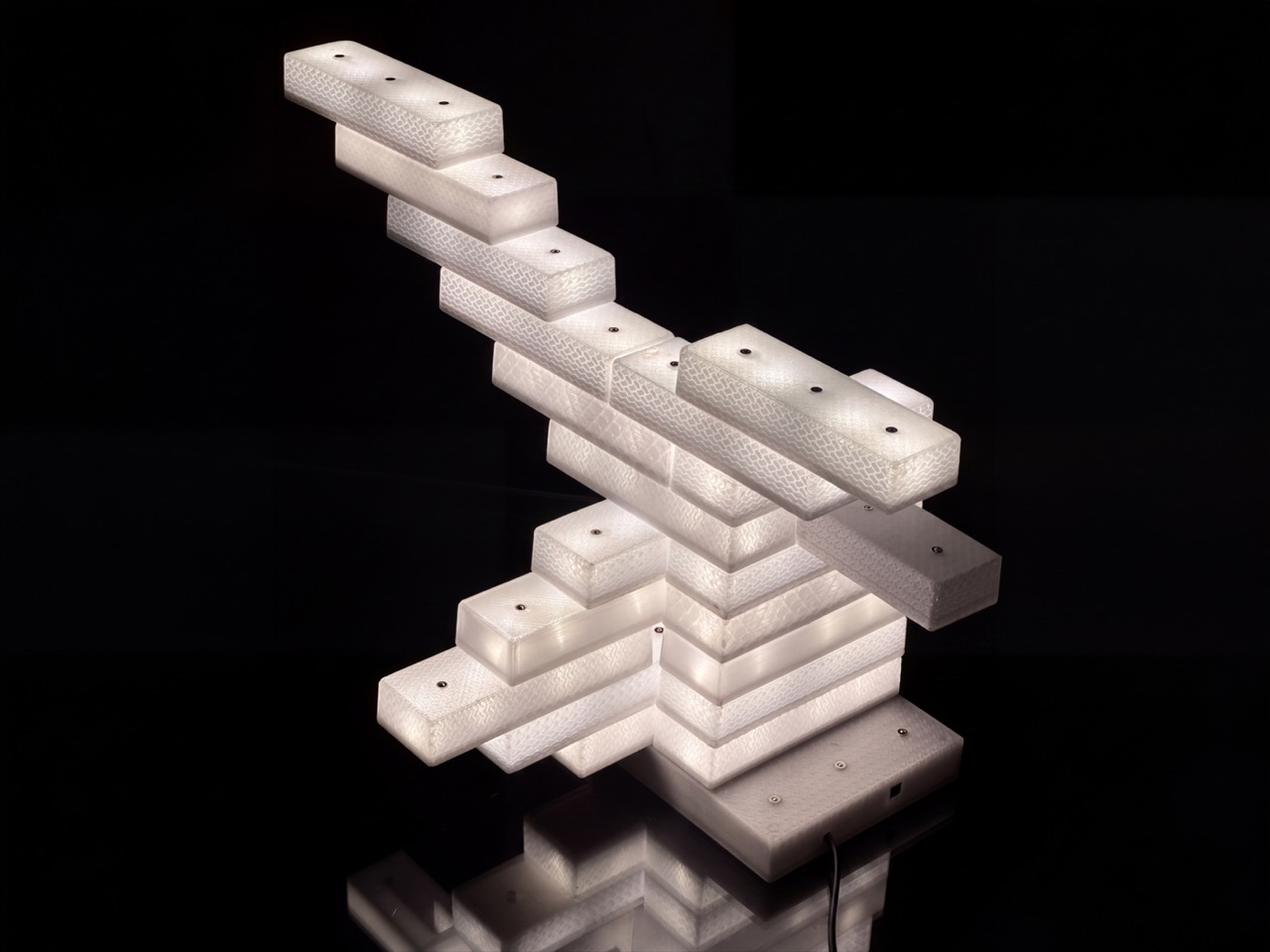
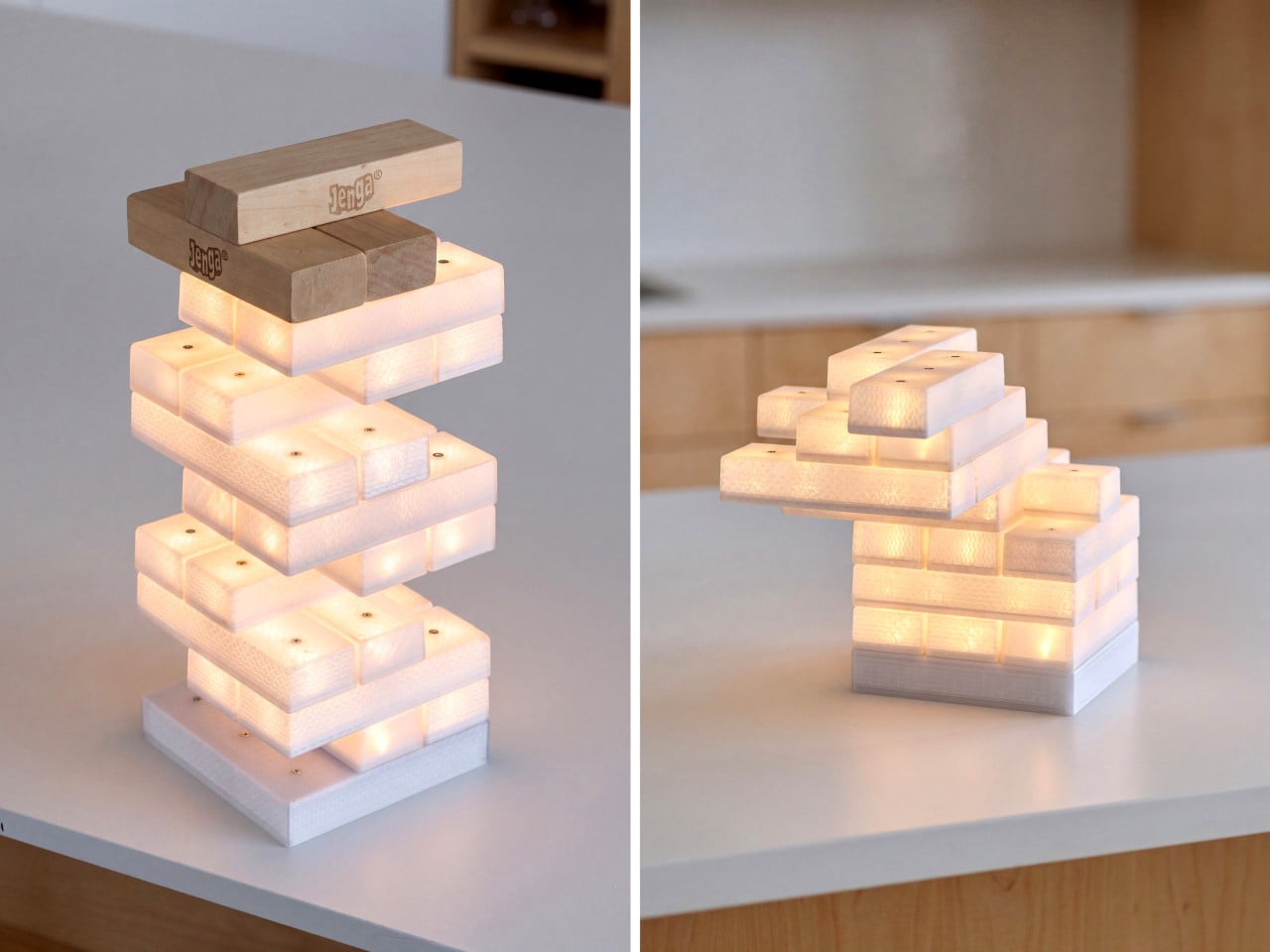
Give an architect a box of blocks and they’ll tell you it’s research. Toronto architecture studio PARTISANS took that excuse all the way and came out the other side with a lamp. The Jenga Light rebuilds the game’s famous rectangles in a translucent material that glows from inside. Set the blocks on a powered base and electricity travels upward through every point where one block rests on another. The path the weight takes is the same path the power takes. That one idea turns a party game about collapse into a lamp you build by hand, one glowing brick at a time.
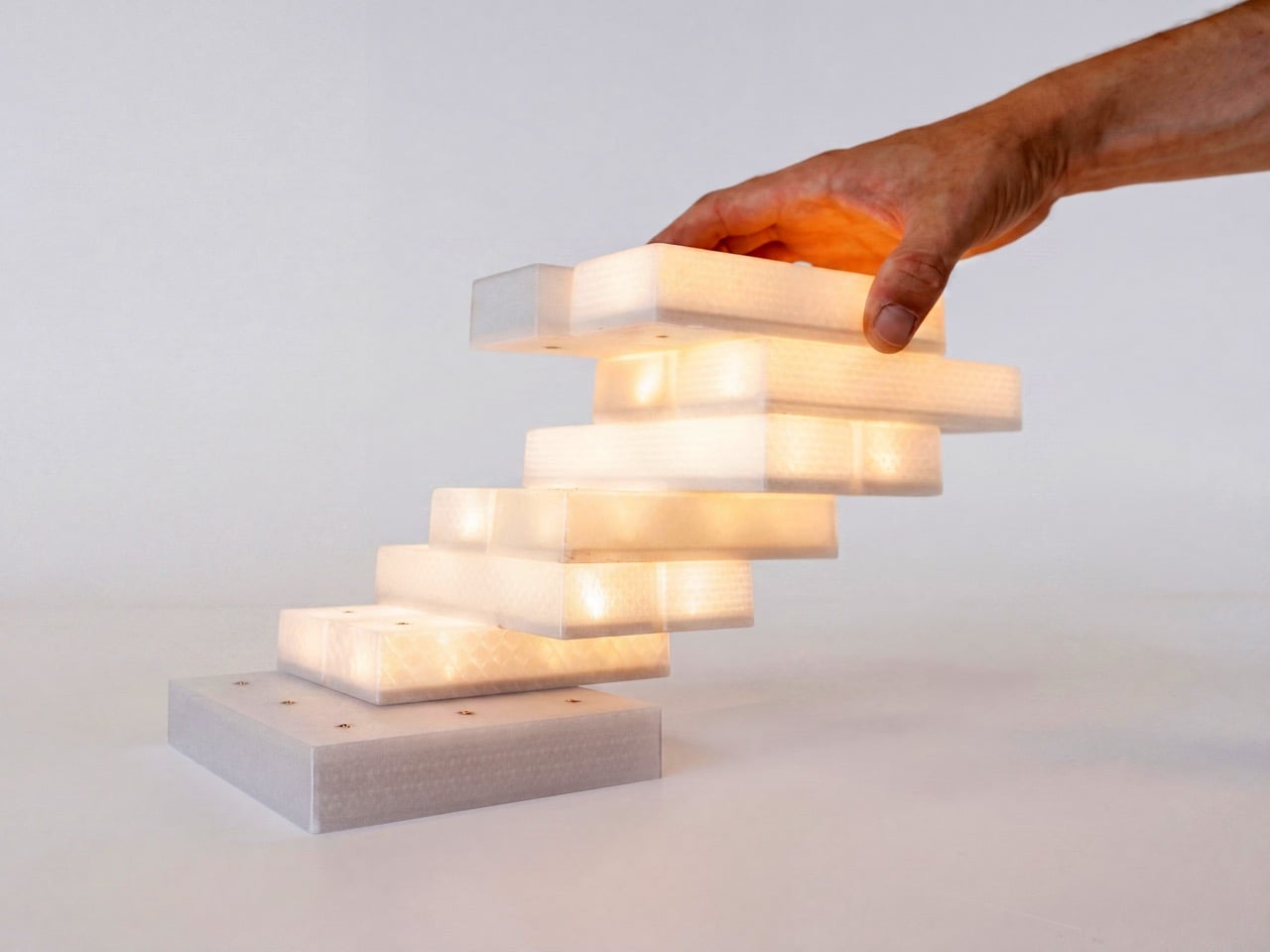
Lead designer Alex Josephson and teammate Teddy Shropshire solved the fiddliest part of the problem with a component most people have never heard of. The blocks hide bridge rectifiers, tiny circuits that make polarity a non-issue. Flip a block, rotate it, or push it into a cantilever that looks like it’s daring gravity, and it still lights. The lamp won its category, Home Lighting: Lamps and Luminaires, at the 2026 European Product Design Award, an international competition that welcomes prototypes as well as finished designs. Pricing and availability haven’t been announced yet. Meanwhile, I’m trying to figure out how many blocks it takes to reach the ceiling.
Designers: Alex Josephson & Teddy Shropshire
How bridge rectifiers make every block reversible
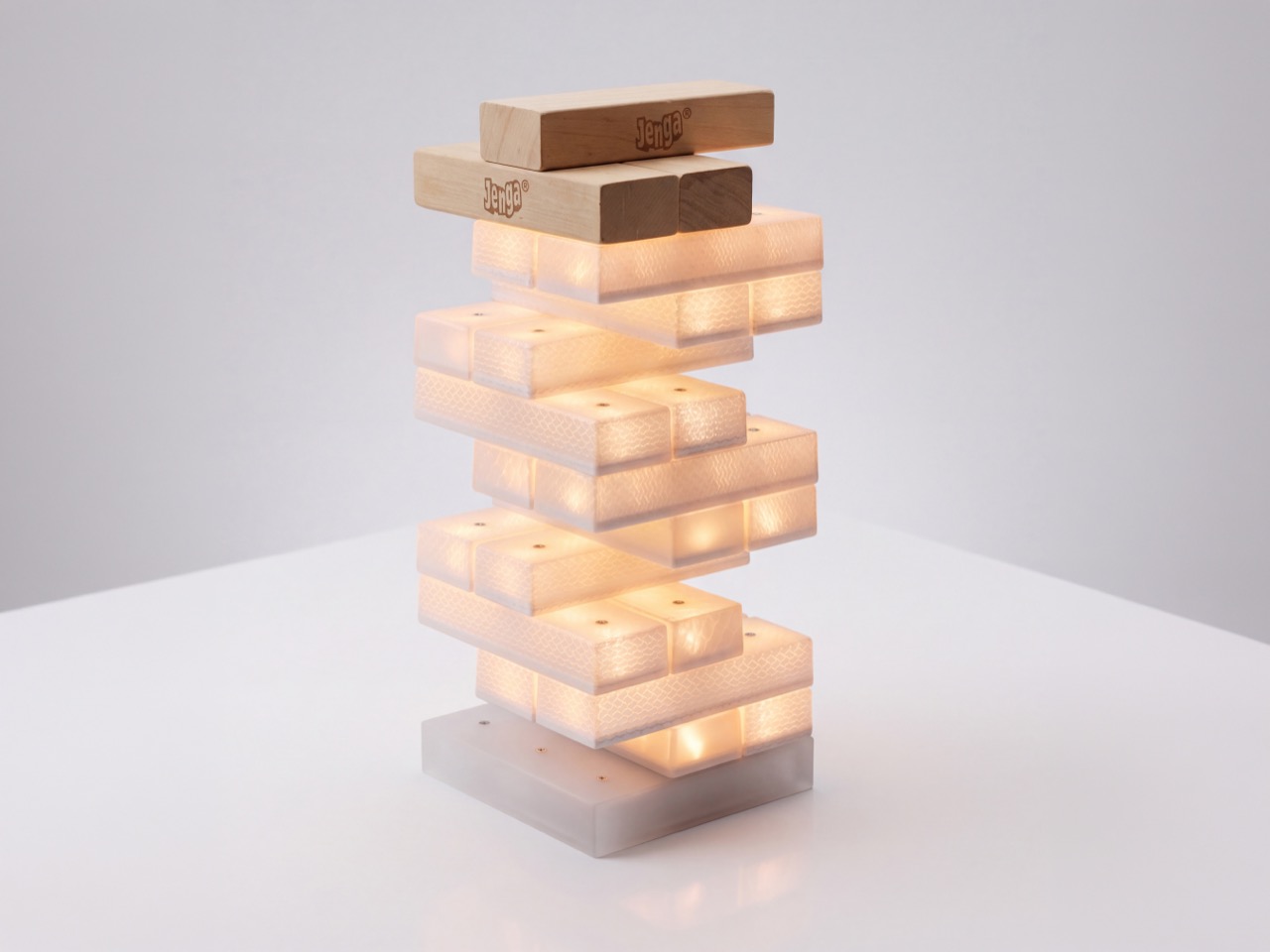
Every electrical connection has a positive side and a negative side, and most stacking lamps deal with that by forcing pieces to go one way. A bridge rectifier is four diodes arranged in a loop, and it sends current out the same way no matter which way it comes in. Tuck them inside the blocks and “upside down” stops meaning anything. A brick can sit flat, sit flipped, or spin around, and its LEDs get the right polarity every time. That one cheap part deletes every rule you’d otherwise have to learn before playing. It’s the electrical version of a USB-C plug, which also stopped caring which way you hold it.
Compare that with the Tetris lamp ThinkGeek sold around 2012, where a powered bottom piece fed light to the tetrominoes stacked above it and the interlocking shapes did the steering. Later patents for modular light kits went mechanical, adding magnets and contacts shaped to avoid short circuits when blocks meet at odd angles. LumiBlocks took the magnetic route too, pairing snap-together blocks with app control and RGBCW LEDs. PARTISANS skips magnets entirely, letting electronics handle orientation and gravity handle everything else. The result asks nothing of you except a steady hand. That also happens to be the only thing Jenga ever asked.
Translucent printed bricks and a grid of contacts
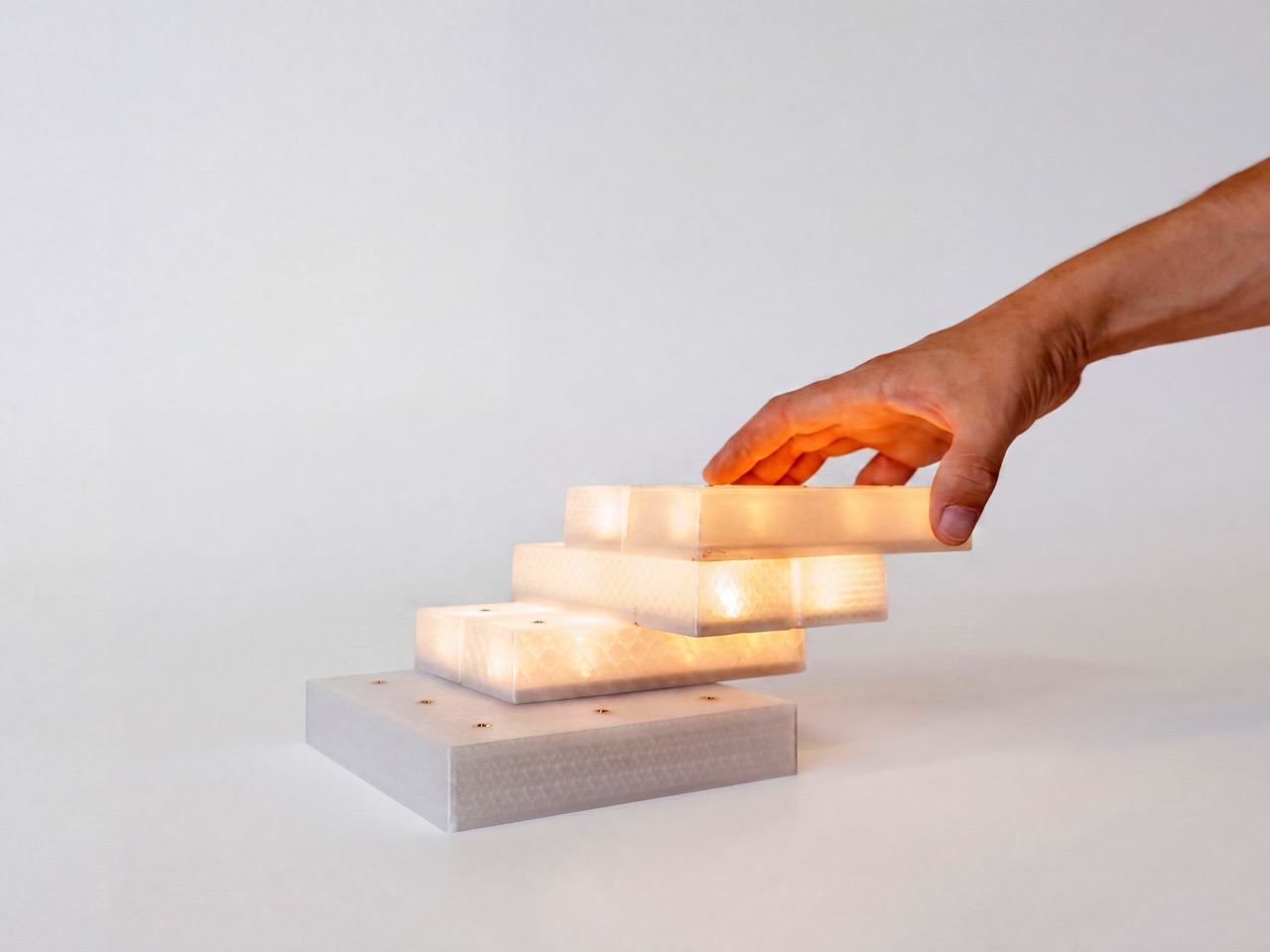
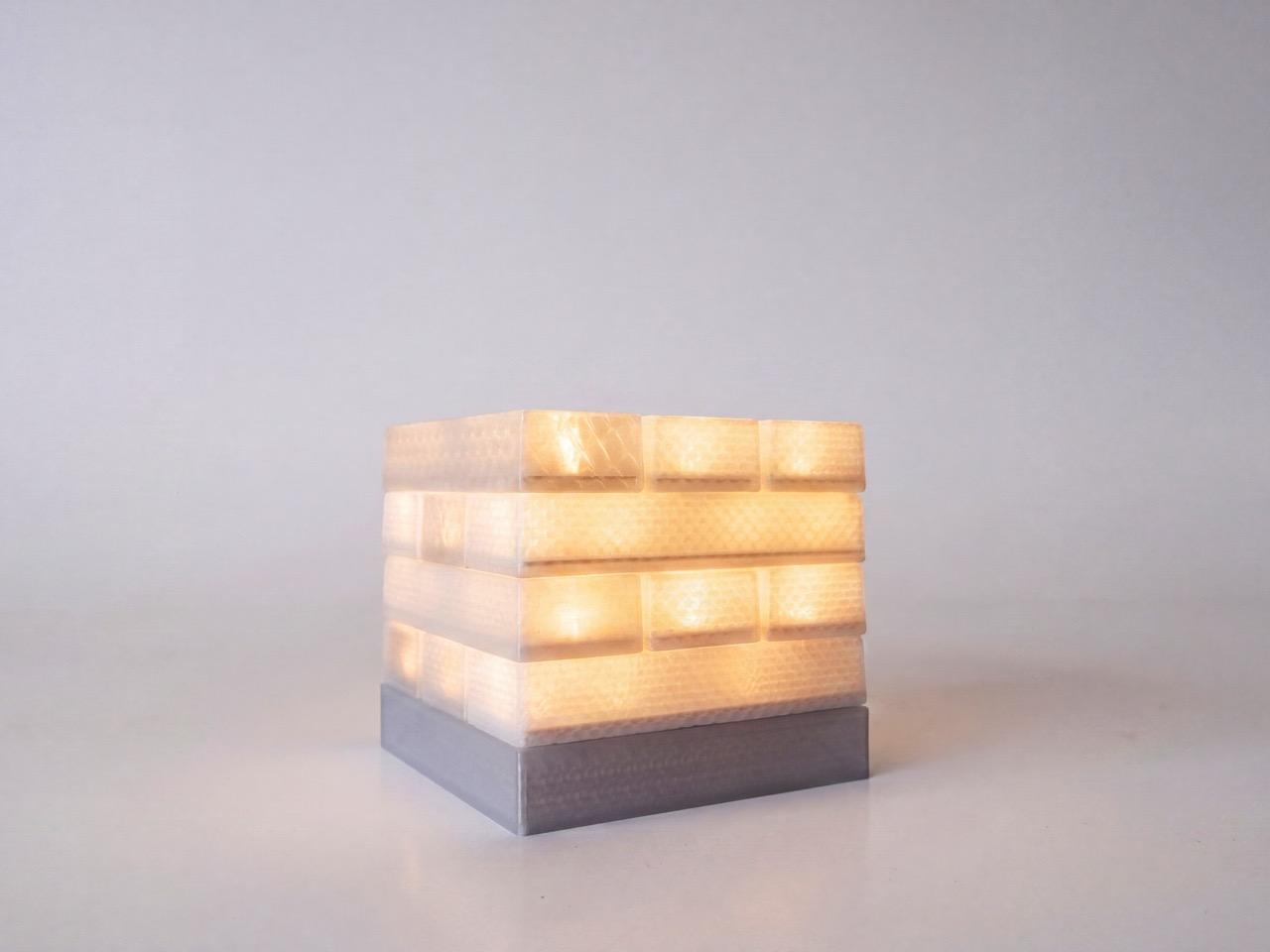
From the photos, the bricks appear 3D-printed in a translucent plastic, with visible layer lines and a wavy internal infill. Most designers would sand or hide that texture, but here it does the job of a lampshade. Light passes through the infill and paints a woven, scaly pattern across every face, so each block glows with a grain that frosted acrylic could never give you. The shots mostly show warm white light, with one hero image running cooler. PARTISANS hasn’t published brightness or color temperature figures yet. Stack enough bricks and the whole thing reads like a lantern built by someone who really loved masonry.
Small metal contacts dot the top of each block, three in a row on the long pieces, while the base carries more, plus a power cord and a small port on one side. Those dots likely form a grid that decides how far one block can overhang the next and still stay lit. They also mean you can’t play an actual round of Jenga on it, since shimmying a brick out of the middle of a tower will just disconnect the entire top half of the lamp. Think of it as Jenga-inspired, with the building half of the game kept and the pulling half retired. A bumped table can still flatten a ten-minute spiral, which is the most Jenga thing left about it.
From a Toronto toy fair to a Toronto studio
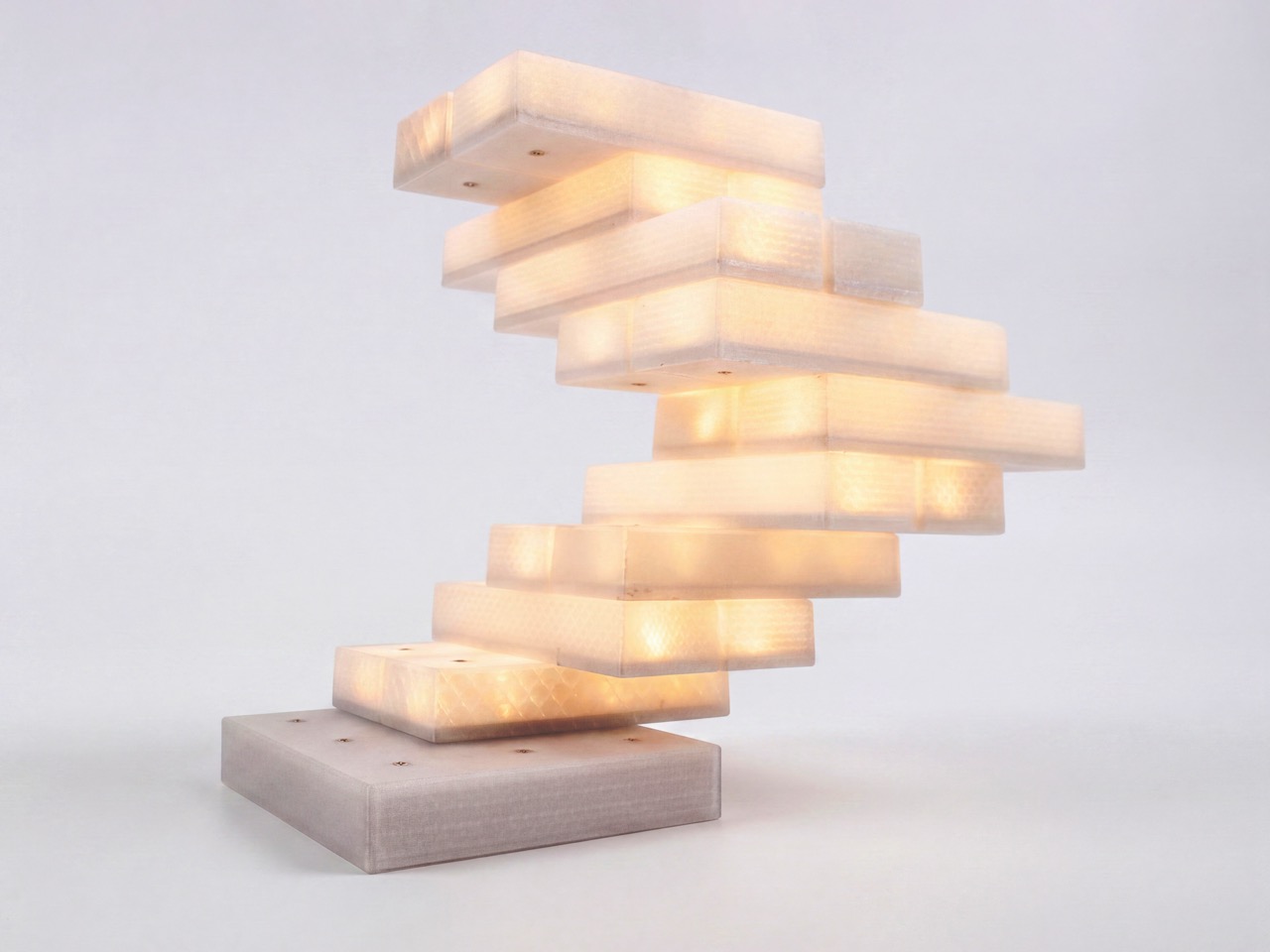
Jenga began as a family game Leslie Scott played with wooden blocks growing up in Ghana, and it launched at the London Toy Fair in 1983. Its real break came in 1986 at the Toronto Toy Fair, where Hasbro’s chairman reportedly decided he had to have it. Forty years later, a Toronto studio has turned the same stack into a table lamp. PARTISANS is mostly an architecture practice, best known for the cedar-lined Grotto Sauna on Georgian Bay, yet Josephson keeps drifting into lighting. His Gweilo lamps, made from hand-molded acrylic sheets, won the 2016 AZ Award for Best Lighting Installation.
Playful lighting has had a good run lately, from Analog lamps, which grew out of LEGO play and now sell at MoMA, to app-controlled magnetic blocks for desk setups. The Jenga Light skips apps and color modes and bets everything on the hands-on part. The European Product Design Award judges entries anonymously and accepts prototypes, so this win recognizes the idea and its engineering ahead of any retail launch. PARTISANS hasn’t announced pricing or a release date. Until it does, I’m staring at my old Jenga set and wondering how hard bridge rectifiers really are to solder.