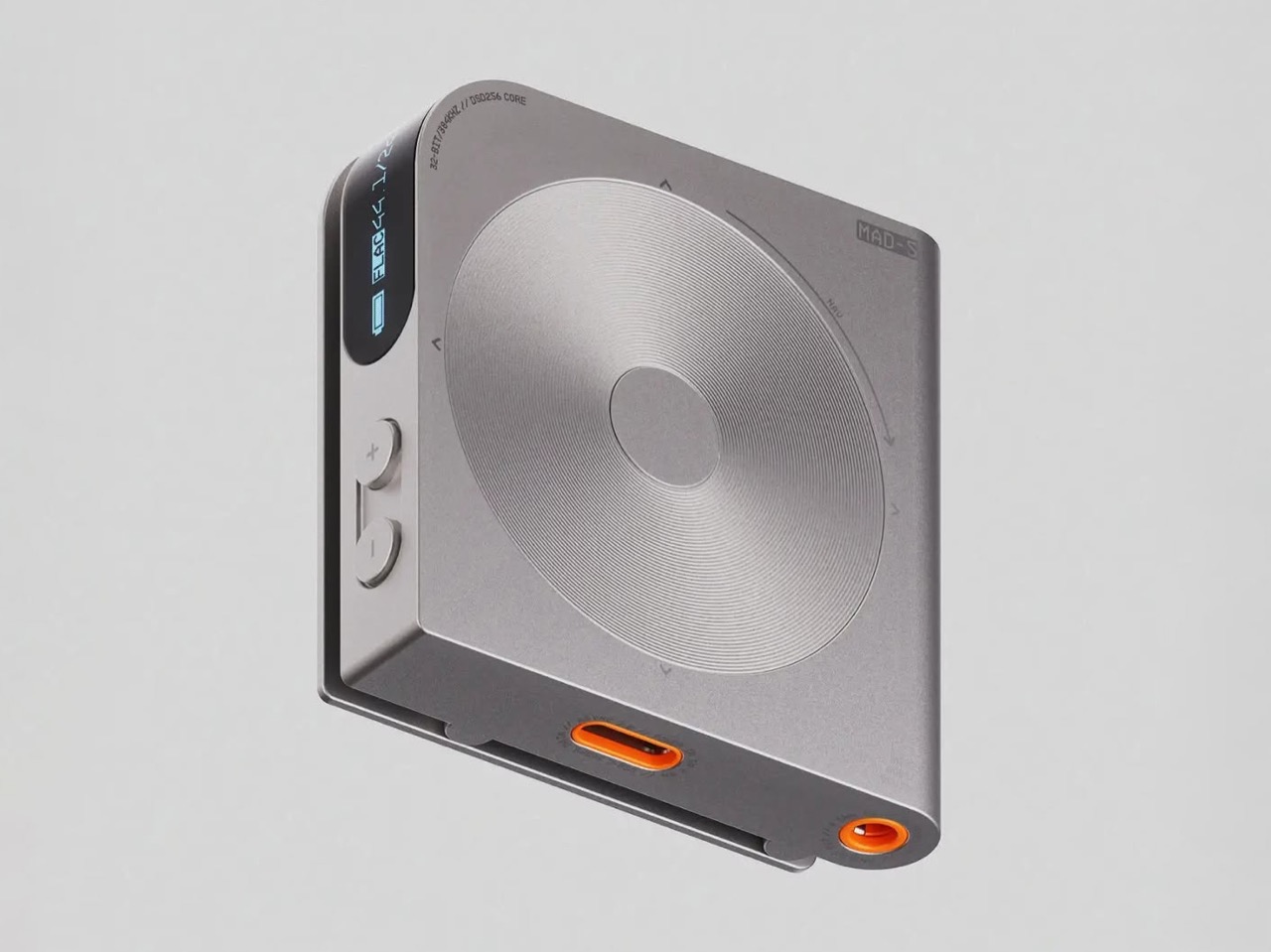
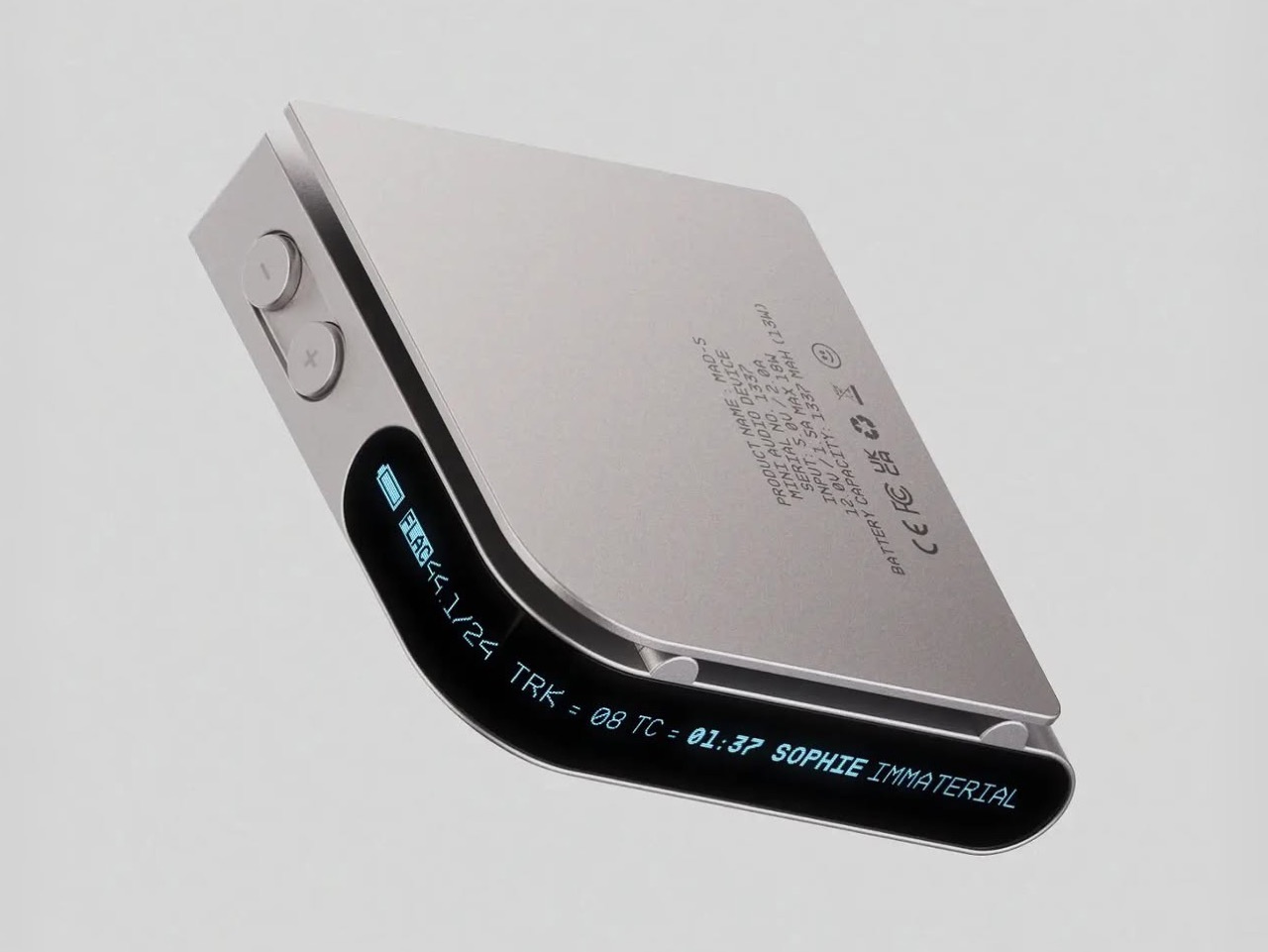
Sony killed the MiniDisc in 2006 with the MZ-RH1, a recorder so good that people still pay silly money for working ones on eBay. It did something unusual with its display, mounting the OLED on the front edge of the body rather than the top, so you could read it at an angle no other player offered. That edge-mounted screen is a small footnote in audio history, the kind of detail only a handful of collectors ever think about. Florent Porta has been staring at that screen for years, by his own admission, and the MAD-5 is what came out of the staring. It is a square aluminium player with a thin blue ticker running along its front lip, reading out format, sample rate, track number, timecode and song title.
The MZ-RH1 measured 83.8 by 84.4mm, which is to say almost perfectly square, and the MAD-5 lands on the same proportion. That is either a deliberate quote or a very good accident. What Porta has added is a clip, borrowed from the later iPod Shuffles, and the combination solves a problem Apple never bothered with. A clipped-on player shows you its edge, not its face. So put the words there.
Designer: Florent Porta
The third generation Shuffle in 2009 stripped every physical control off the body, leaving a bare power switch, and pushed volume and track changes onto a three-button remote wired into proprietary earbuds. Reviewers hated it, and Apple reversed course within a year, bringing the button ring back on a fourth generation that shrank into something nearly square. Porta borrows the fourth gen’s clip and skips the third gen’s whole premise, which is the correct call. Wrap a screen around the exposed edge of a clipped device and you get the information without a button, an earbud remote, or Apple’s old workaround, a talking menu called VoiceOver that was software standing in for a hardware idea nobody had built yet.
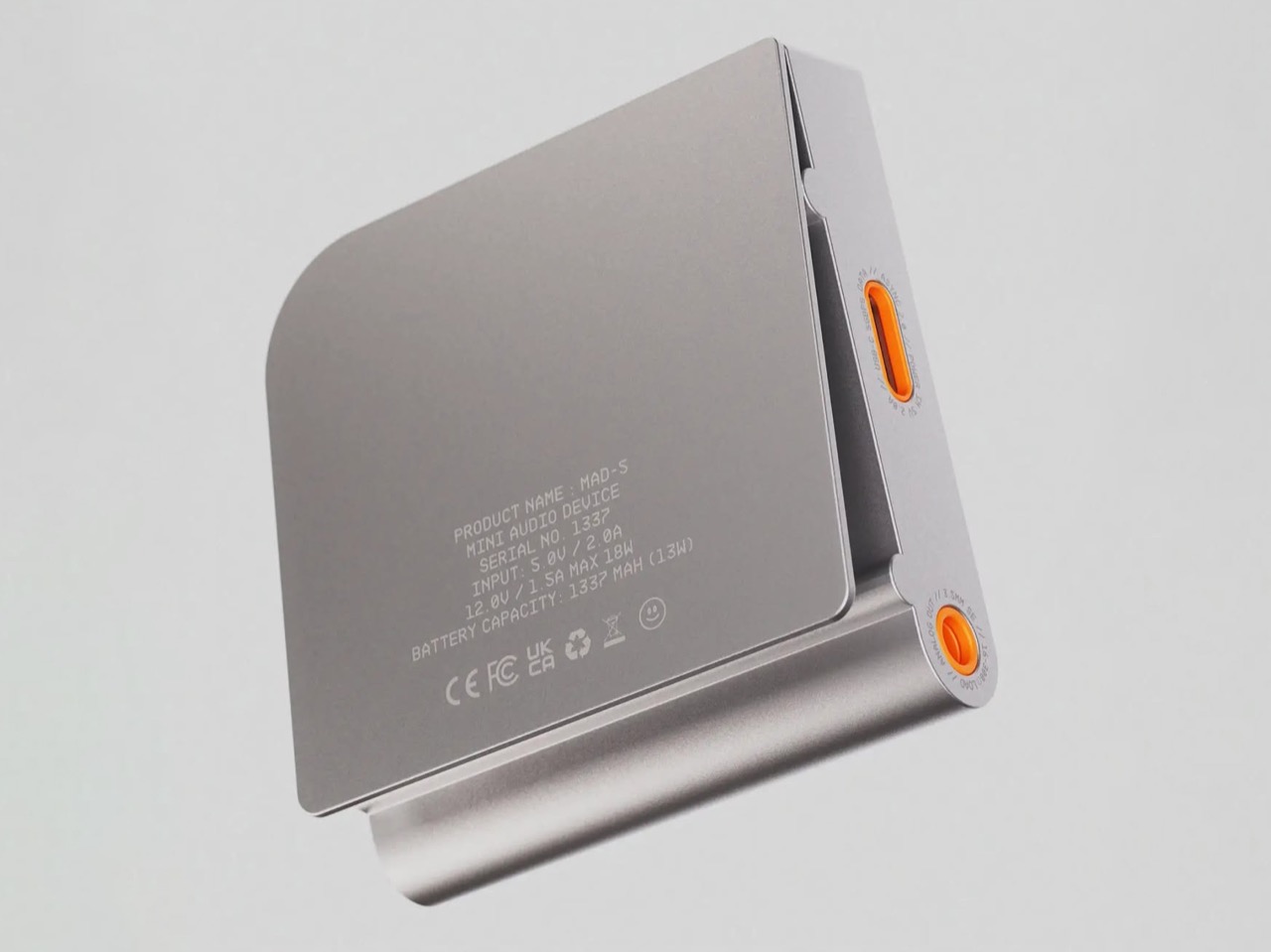
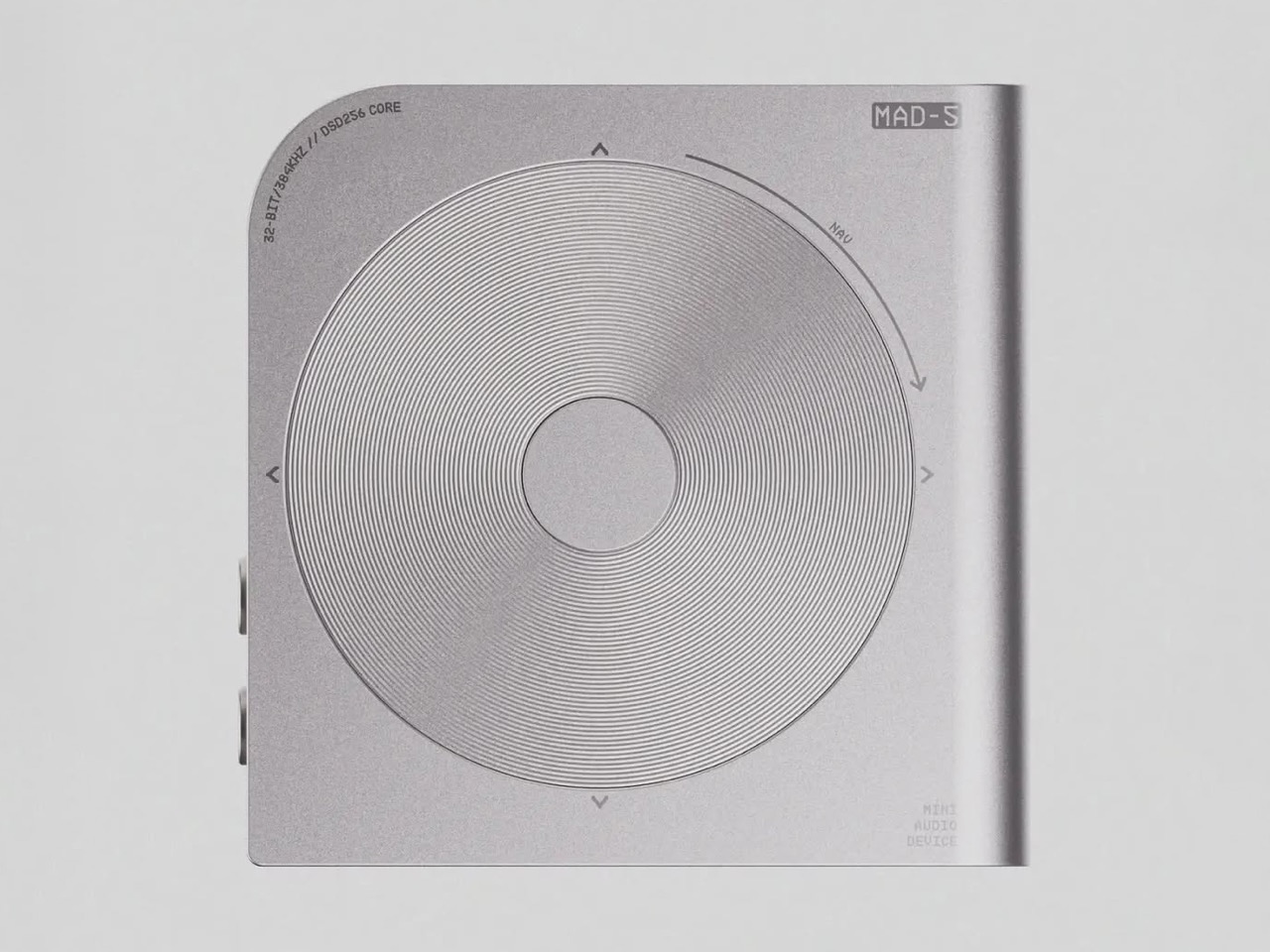
The jog disc on the face nods toward Teenage Engineering’s TP-7, the field recorder we covered when it landed in 2023, whose motorized tape reel actually spins under a brushed motor with ball bearings while you record or scrub through playback. Porta’s disc has no motor behind it, just concentric rings etched into aluminum with arrows for navigation, so the homage is visual rather than mechanical. That is a fair trade in a concept render, but it is worth naming, since a spinning reel earns its charm through motion and this one borrows the charm without it. The engraved spec plate leans aspirational too, and the 1337 mAh battery is the second time Porta has hidden that exact number in a product.
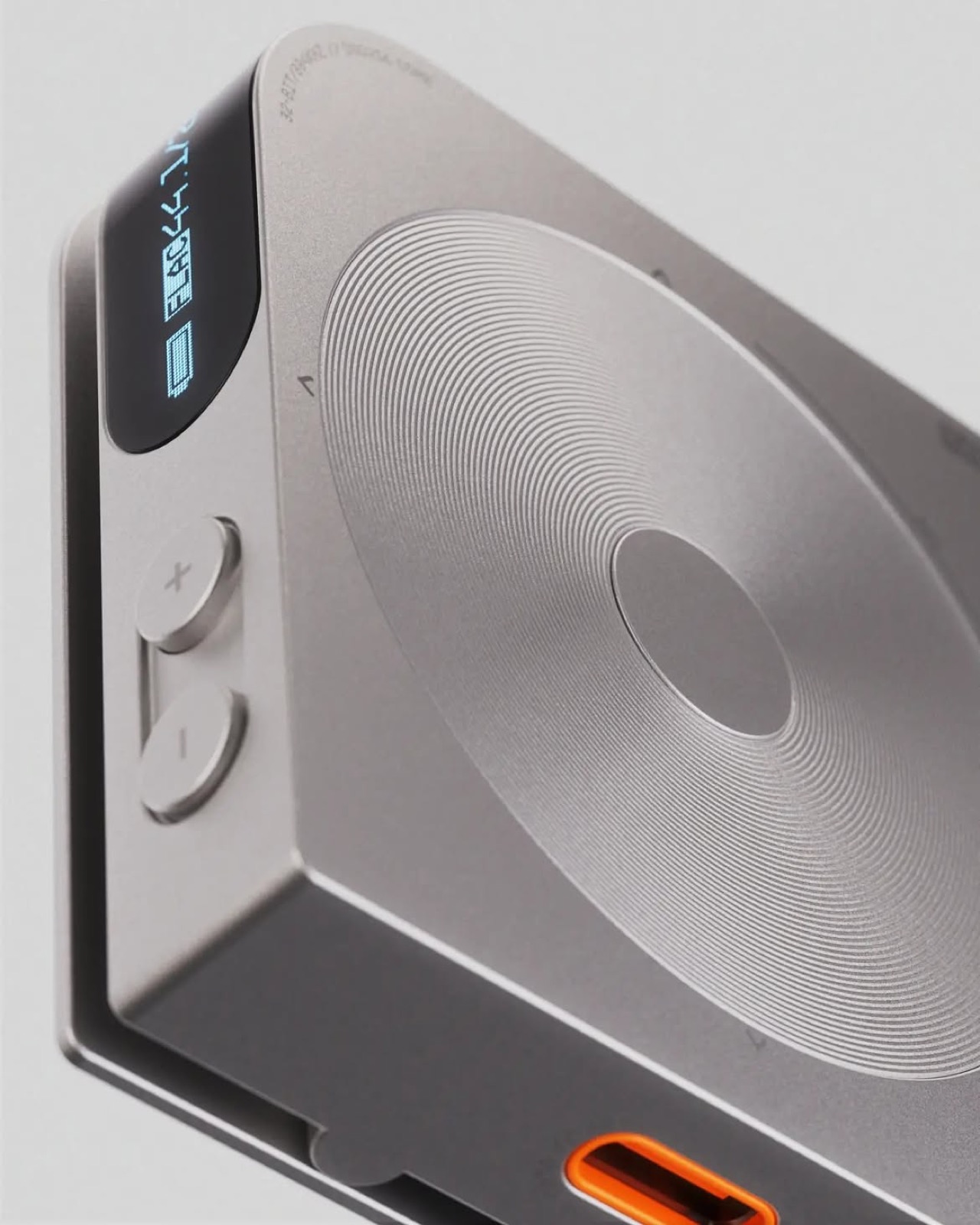
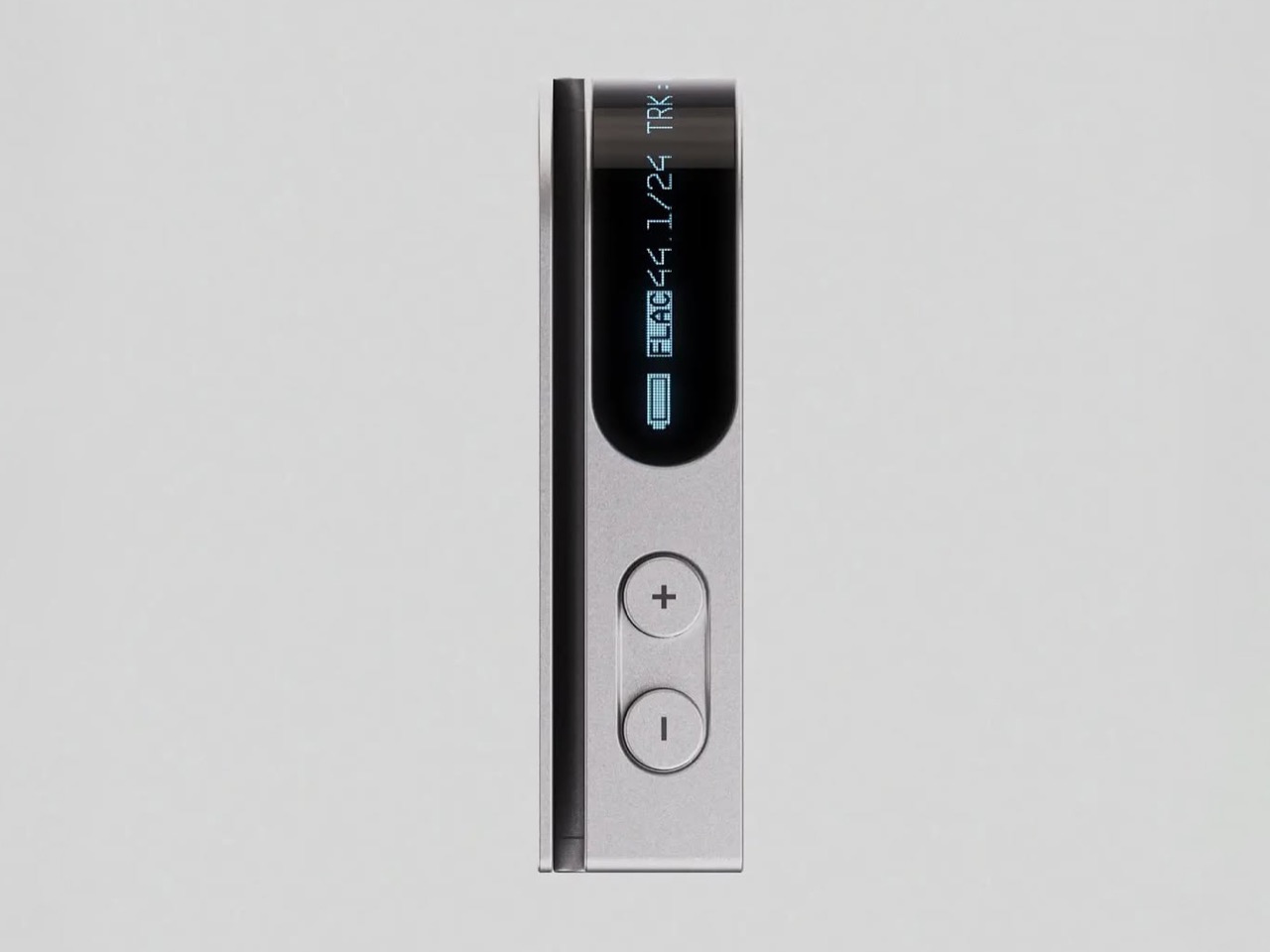
There is no Bluetooth listed anywhere on the body, no balanced output for the higher-end headphone crowd, and nothing marked for expandable storage, all of which current audiophile DAPs from Sony, FiiO and HiBy treat as standard at this level. The stronger idea might not be the ticker screen at all. It is the USB DAC mode, since anyone carrying a laptop already owns half the reason dongle DACs exist, and a player that folds into an audio interface the moment you plug it in solves a real annoyance rather than a cosmetic one. Porta says a desktop dock is next, meant to unlock more I/O once the MAD-5 is home, which quietly admits the ports on this version are thin. That is pretty self-aware for a concept render.
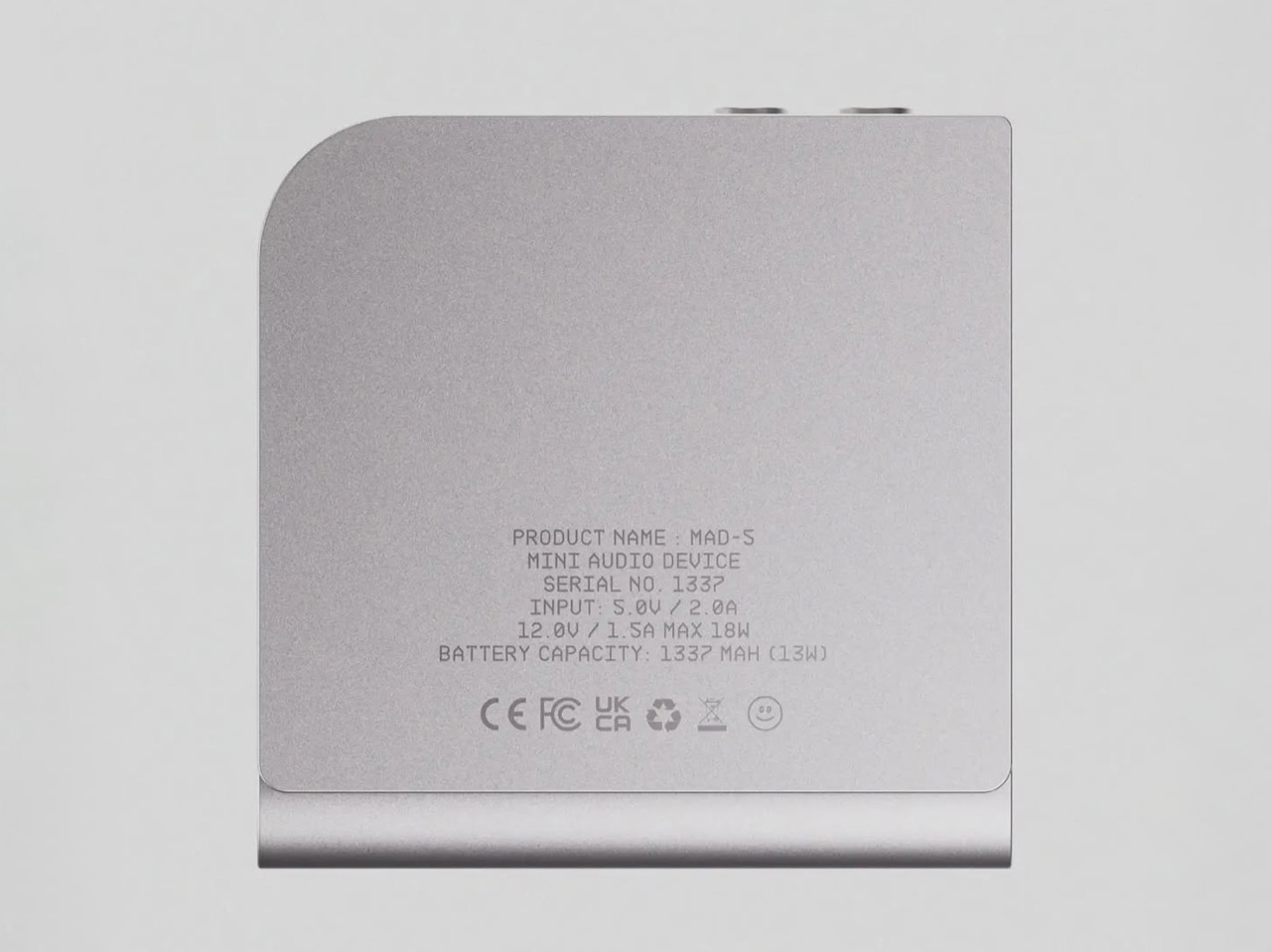
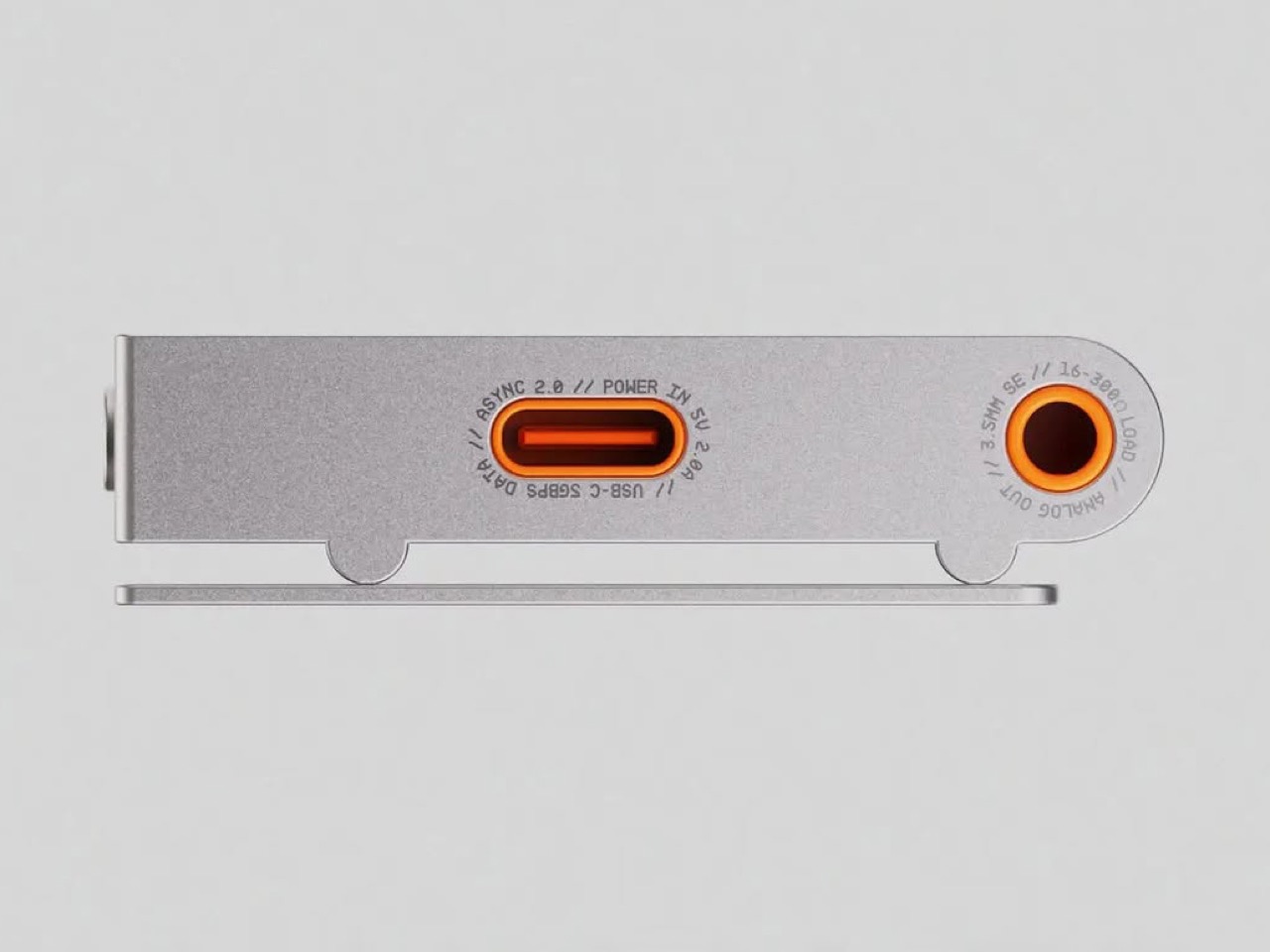
We covered Porta’s last swing at this category back in February, the DAP-1, a maximalist FLAC player built around an OLED touchscreen and a built-in speaker. The MAD-5 is the opposite instinct from the same person eight months later, stripped down to a disc, two buttons and a strip of text. Neither one exists as hardware yet, and a dock that is still just a thought puts no real timeline on anything. But the edge screen is worth remembering regardless of whether this specific object ever ships, because it solves something two decades of clip-on players walked straight past. Sony found the location by accident in 2006. Apple never looked. Porta just put both ideas in the same room.
SHARE