Robotic Wheelchair Wunkerkind!
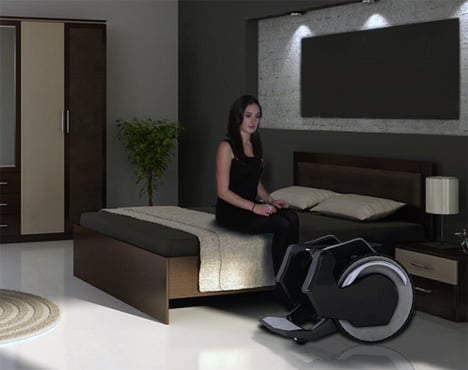
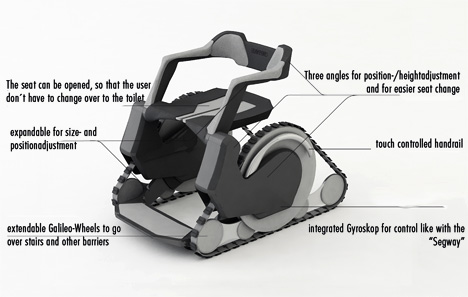
Wheelchairs are a dime a dozen but the advent of advance and affordable robotics is truly enabling the disabled. The CARRIER Wheelchair does almost everything – making sure the user is fully independent, capable of traversing any terrain and situation.
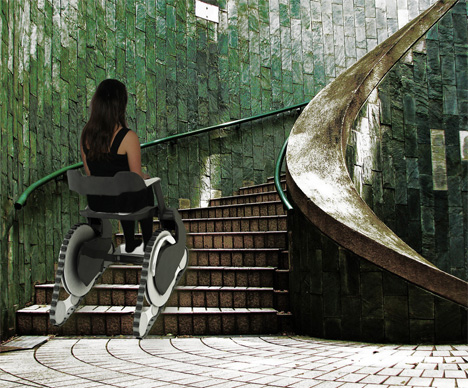
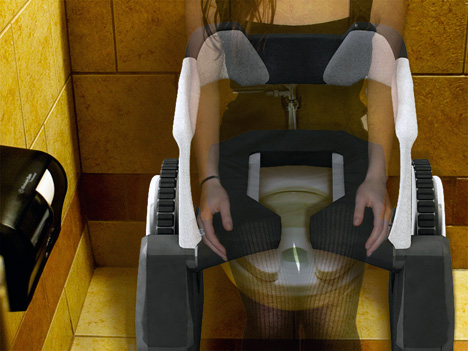
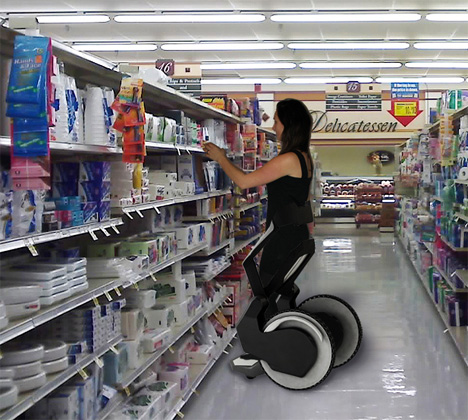
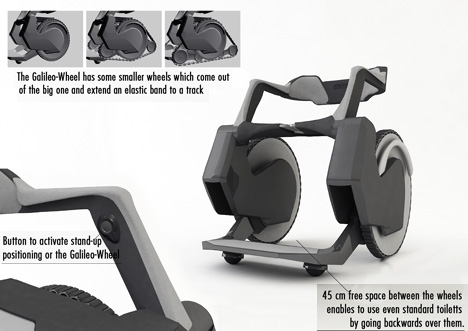
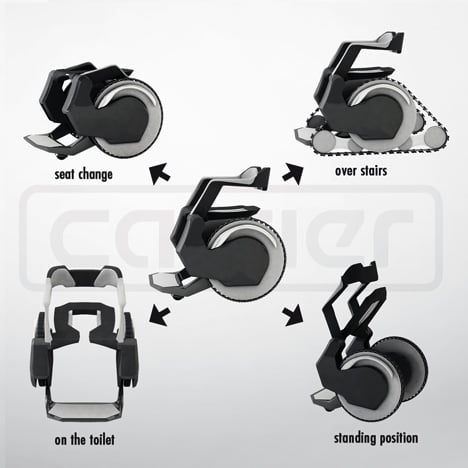
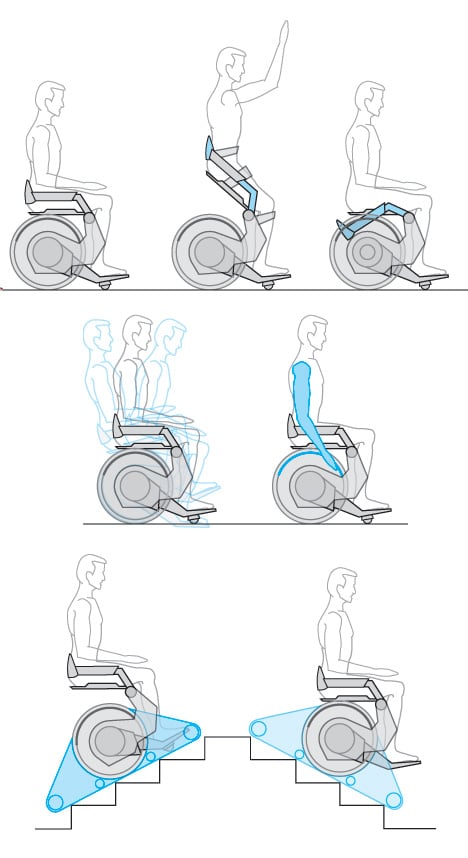
The frame is specially shaped to maneuver over a commode. A “trap door” opens so you can use the toilet in a dignified manner. No need for awkward transfers or assisted lifts. Stairs and inclines are a cinch too. A “Galileo Wheel” combines a wheel and track into a single drive with advantages from both. The entire chair even lifts to help you reach higher objects.
Nice concept tho not the first of its kind – the CARRIER seems well thought out and ripe for production. Hey, I’m all for design that can improve quality of life.
The CARRIER was developed as semesterproject at the University of Applied Arts in the Studio Industrial Design 2 Esslinger. (www.creativednaaustria.com)
Designers: Julia Kaisinger, Mayrhofer Mathias, Iranmanesh Niki, Demiric Bilge & Benesch Xiulian



8 Comments »
Mohan Sundaram says
Nice concept especially stair climbing. I’m physically challenged and am partially mobile. One important feature would be to try and make this light and foldable enough to carry as cabin baggage to enable travel for users.
Saltynay says
Where is the battery hidden?
Mert Can says
When I was at uni, I did a wheelchair project and first thing I’ve researched were the types of paralyzed patients and their disabilities, some can use their knees, some can use their back etc… “how can they reach up?”, if you won’t support their knees and L4/L5 spine-bones better while the chair is elevating, well this design will end up on the floor with the person on it.
Possibly the battery is “in” the wheels with the motor if any? Heavy wheels?
CITguy says
Interesting design, however there are several aspects of this design that need to be considered. I realize that this may have been a project, but I’d like to add that design is only one part of product development.
1) Stair Climbing
You claim that the gyroscopic system will stabilize the chair, but the stabilization will only work with a forward/backward tilt. Take a second look at the first set of stairs she’s climbing. They’re curved. Because the chair is essentially in a square base. The chair is highly susceptible to rolling on its side (rider included) in such situations.
2) Lift
I’m not sure how many paraplegic people you know, but I can tell you that they cannot support themselves with their legs in any way. The “standing lift” is a less than perfect solution to raising the rider. The only way to ensure a useful lift is to lift the individual in the seated position.
3) Redundancy
Let me ask you this question: How would the individual move around if the battery went dead while they were out in public? or on the stairs? You might want to consider any type failsafe system.
4) Comfort
Any individual that has to use a wheelchair will require using it for an extended period of time, so comfort is key. From my perspective of this design, it looks extremely uncomfortable to sit in. I see very little padding (if at all), a lot of hard plastic or composite materials and the backrest is completely useless unless the individual has full capability to sit upright. Even a paraplegic want to sit back. Don’t take my word for it. Look at the designs for current wheelchairs and see how much thought went into constructing the chair with the user’s comfort in mind.
Suggestions:
- Visit a medical supply store that sells electric wheelchairs and ask questions about how certain models work. Compare and contrast.
- Sit down and talk to a small set of wheelchair users. Find out the problems with the wheelchair directly from the users.
- Run your design by someone with a background in engineering (mechanical and/or electrical) to discover unforeseen problems.
Again, this is a promising design and I think you all have some very creative designs.
(Please keep in mind that I am in no way an expert in wheelchair design. Thank you for your understanding.)
Trackbacks