Tech companies love inventing new objects for you to carry around. Smart glasses, AI pins, little pucks you clip to your shirt that light up when they’re listening. Every year there’s a new shape competing for a spot in your pocket, and every year most of them simply disappear from group chats about gadgets that didn’t pan out. Meanwhile, the actual bottleneck in most professional days has nothing to do with a missing gadget. It’s the stubborn, unsexy fact that you cannot fully listen to someone and write down what they said at the same time.
The answer Scriben landed on was already sitting in the room. Instead of building a new device, they picked the one in your bag, your blazer pocket, or rolling around your desk drawer: a pen. Nobody in a meeting side-eyes you for picking one up, which is sort of the whole premise. It writes like a pen, sits in a room like a pen, and does considerably more thinking than a pen has any right to. Behind it is Sleepmind, Inc., led by Yidi Xu, a SPCr-backed founder whose previous job was helping build Microsoft Copilot.
Designer: Yidi Xu, Founder & CEO, Sleepmind, Inc.
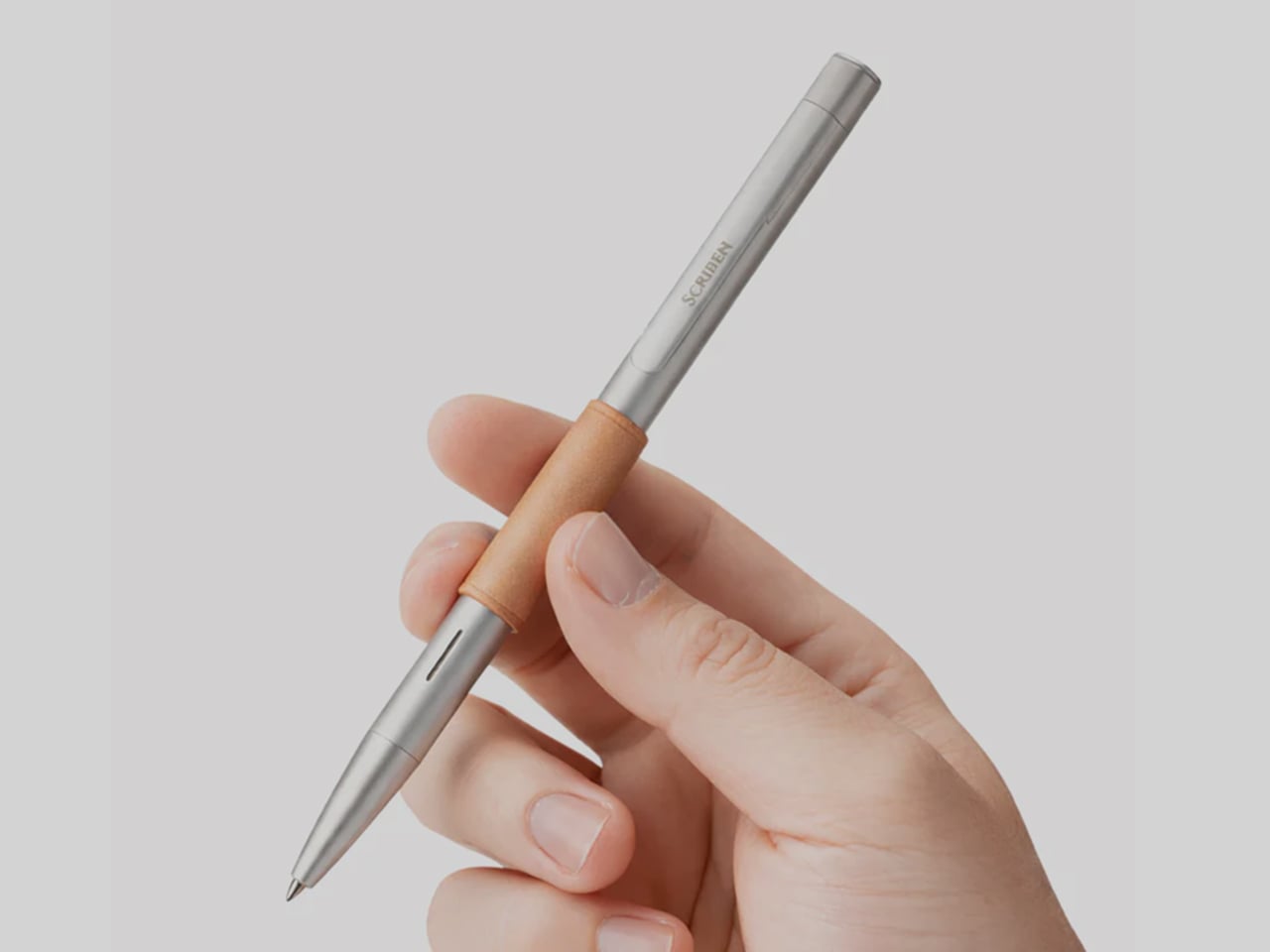
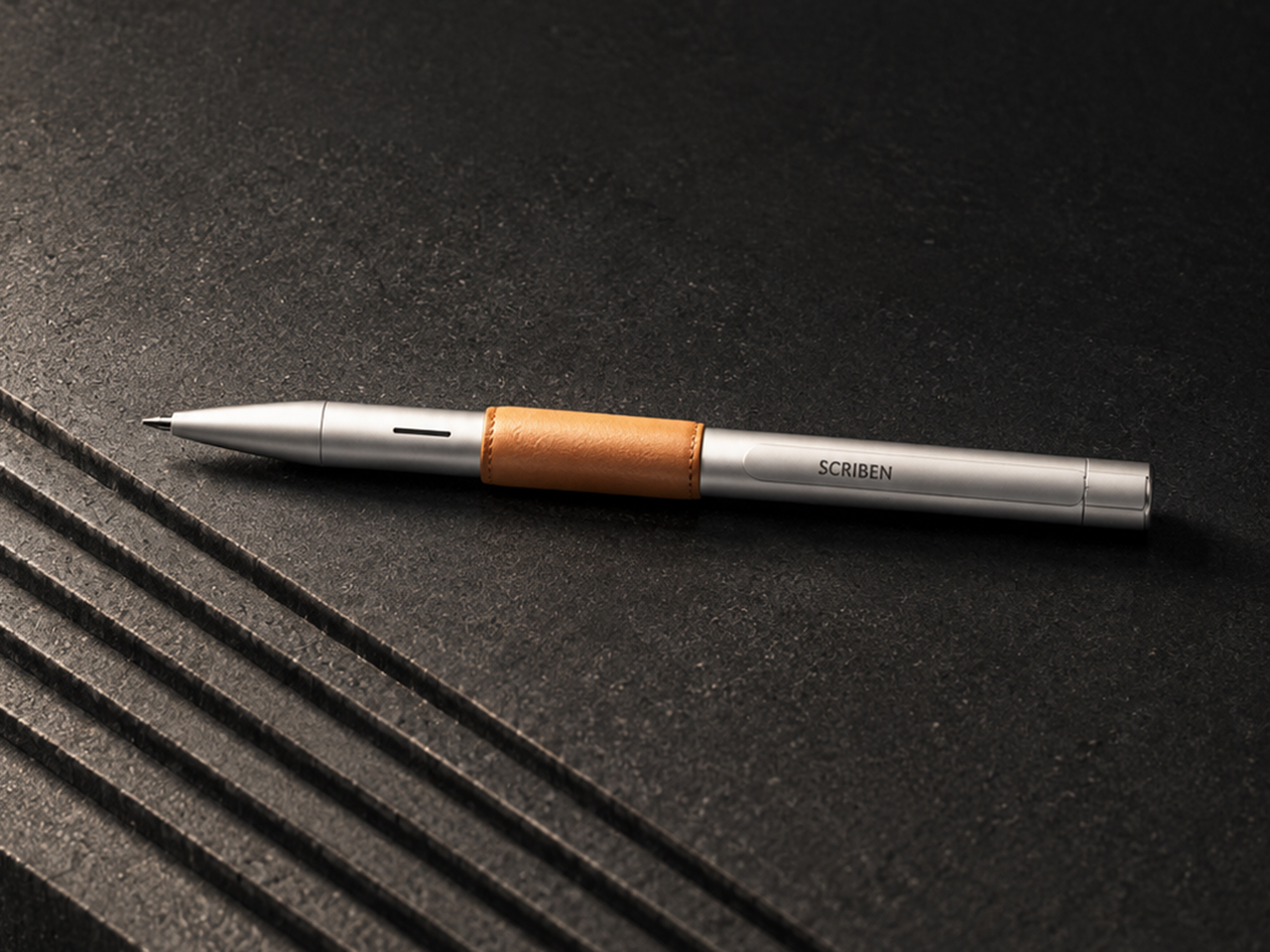
Silver or matte black, 0.6mm ballpoint, leather sleeve, and a single button: the Scriben pen’s spec sheet reads like a design school constraint exercise. It ships with a quick-start guide and writes on any paper with a standard ballpoint refill. The pen records audio but doesn’t attempt to digitize handwriting, unlike the Nuwa Pen’s handwriting-scanning approach, which put it in a different product category entirely. A USB-C port hides under the top cap, and the entire interaction model is that one button: press it and the pen records locally, storing up to 18 hours of audio on 64GB of onboard storage, roughly 400 hours total, offline, with no phone required. It has won a Red Dot Design Concept award, which evaluates design intent before production rather than a shipped product, and a 2026 MUSE Design Awards Silver in Product Design.
Xu spent years at Microsoft watching genuinely capable AI keep routing people back to a screen. Her training at Tsinghua, followed by an MBA at Wharton, crystallized one design instinct above all: solve the problem at the root, not the surface. The root problem was the habit of asking people to adopt new behaviors in exchange for intelligence that was supposed to simplify their lives. “AI should learn how you work,” she says, “not the other way around.” That inversion is Scriben’s entire design brief in one sentence.


Saying no to a feature is a design decision, and Sleepmind made a lot of them. No screen on the pen, no LED readout, no haptic patterns to decode, no mode-switching between recording and writing. If a feature made the object feel more impressive but the interaction more demanding, it got cut. This is the philosophy sometimes called calm technology: tools that operate in your peripheral awareness rather than demanding your foreground attention. YD has covered a growing wave of products chasing the same idea, from the Flowtica Scribe’s agentic recording approach and the MedPen’s secure capture pitch to SwitchBot’s clip-on wearable format, and Scriben is the first where the deliberate omissions feel like the actual design story, and honestly, that’s harder to pull off than it sounds.
Most AI recorders stop at capture: record, transcribe, surface a summary, repeat. The gap Scriben targets is everything that happens after, the follow-up email, the task that needs logging, the decision from last Tuesday that reappears in Thursday’s conversation with no context attached. The system builds persistent memory across recordings, not a library of audio files but an evolving understanding of your work, your people, and your open commitments. Transcription covers 85 languages, with speaker diarization that resolves names when the system has enough context to match voices to identities. Xu is explicit that this memory needs to be vertical: what matters to a lawyer is different from what matters to a sales executive, and treating every professional’s context the same way is a failure of design, not just technology.
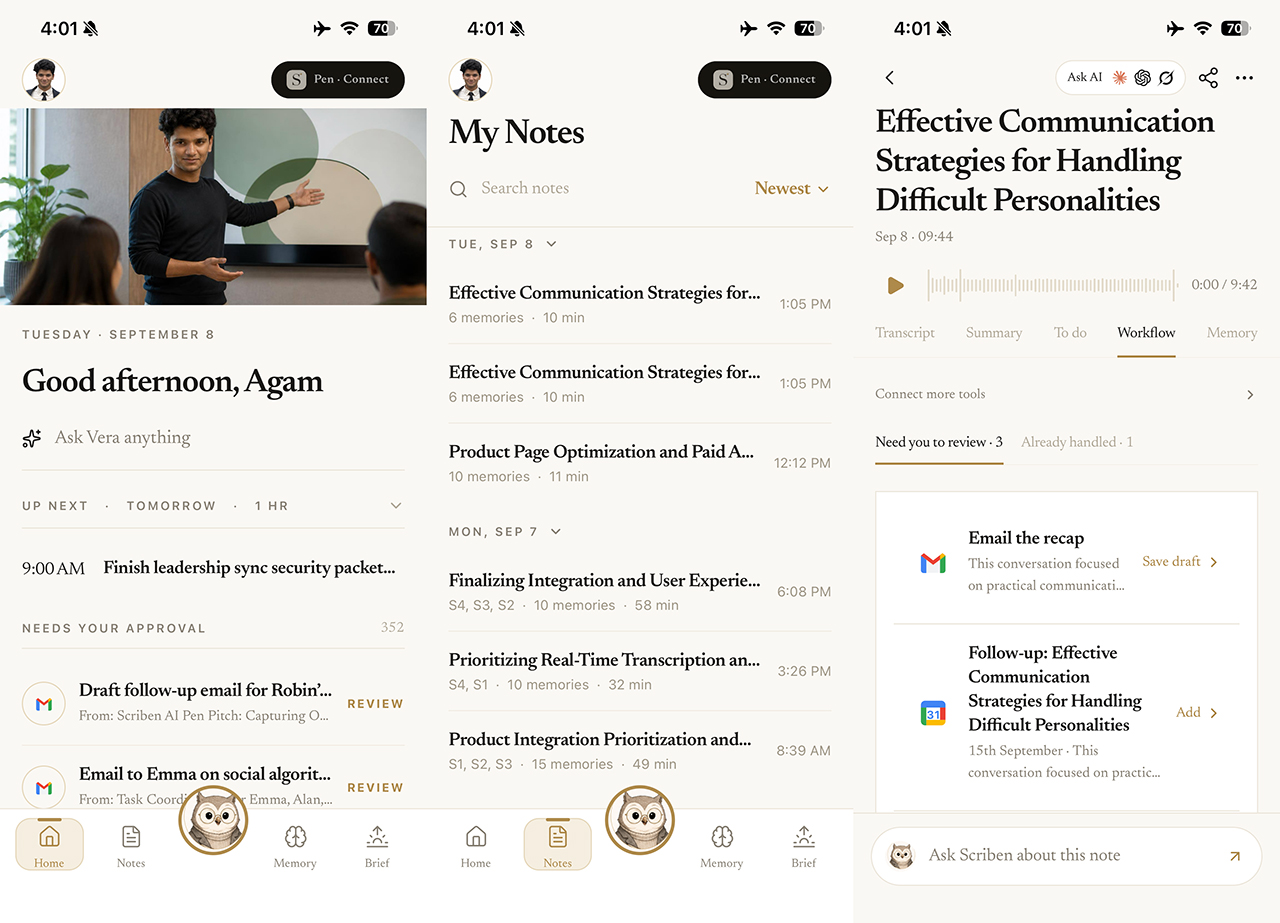
Scriben can draft the follow-up, prepare a document, or queue a task, but nothing leaves without a human sign-off first. This prepare, review, approve model treats autonomy as a governance decision rather than a default setting, which is a more honest framing of AI agency than the usual pitch that it just handles everything. The system connects to Gmail, Outlook, and over 9,000 tools through Zapier, generates a Morning Brief each morning built from your accumulated context, and supports Model Context Protocol letting it feed verified context to Claude, ChatGPT, and Zoom AI Companion. The intelligence sits in the middle; the person stays at both ends.
A pen that records conversations raises a real question before it raises any features. The social optics are context-dependent: a partner meeting at a law firm is a different environment from a first client call or a medical consultation. Scriben is clear that following applicable consent laws is the user’s responsibility, not the product’s. What the design does control is data architecture: audio is captured and stored locally until the user actively chooses to sync, so nothing streams to a server the moment you press the button. That’s a meaningfully different posture from most cloud-first recorders, and it matters considerably to anyone working in a regulated field.

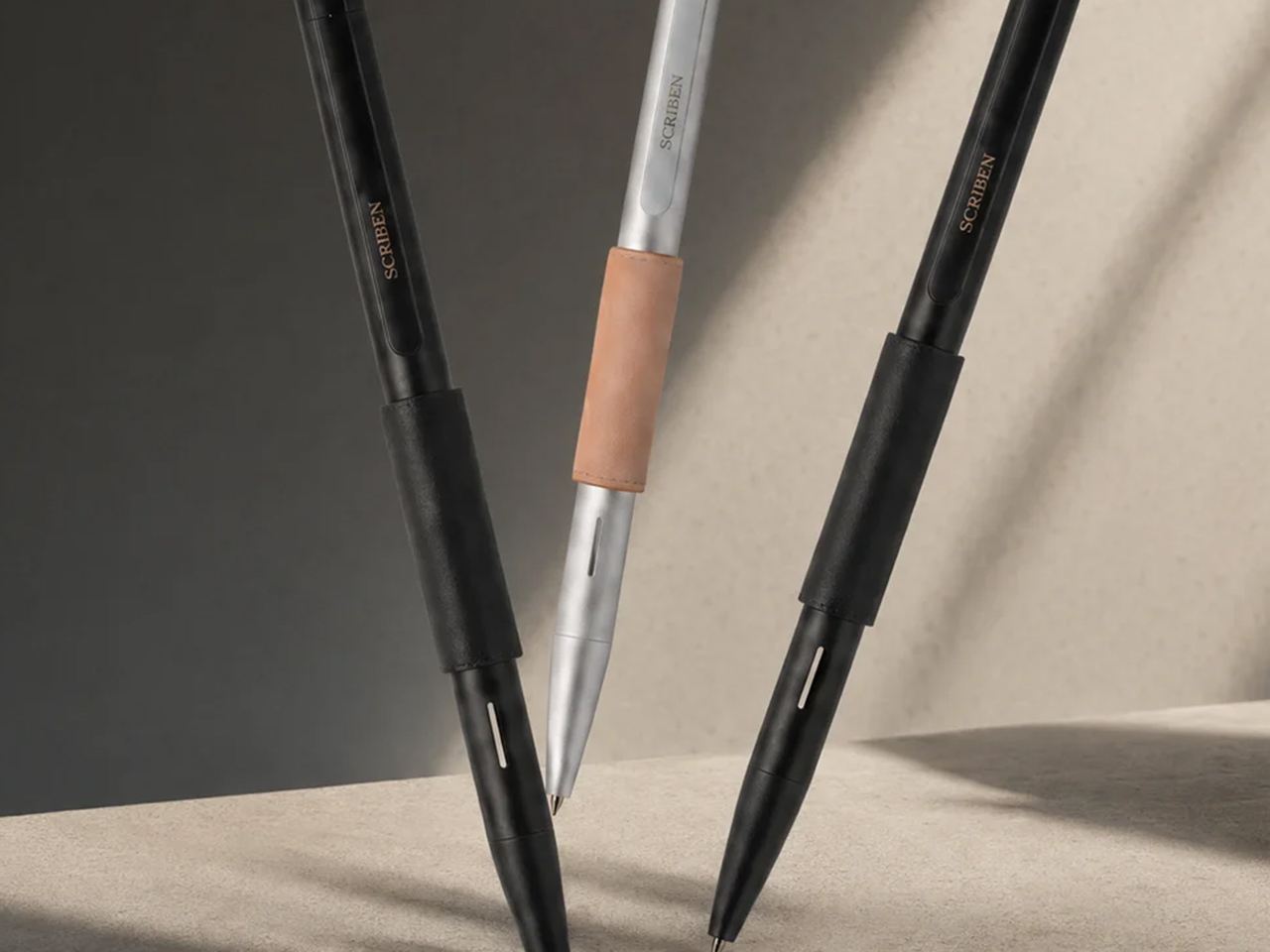
Scriben is available now at scriben.ai in silver and matte black, both shipping with a leather sleeve and a quick-start guide in the box. Xu frames the pen as the first expression of a larger ambition: a multimodal context layer that understands professional work across sources, formats, and industries, compounding over time. If that thesis holds, the most capable AI in your next meeting might turn out to be the object you’ve been reaching for your whole career. And it may just also be the perfect Christmas gift for that difficult-to-gift-for family-member or friend with a corporate job and an obsession with productivity.