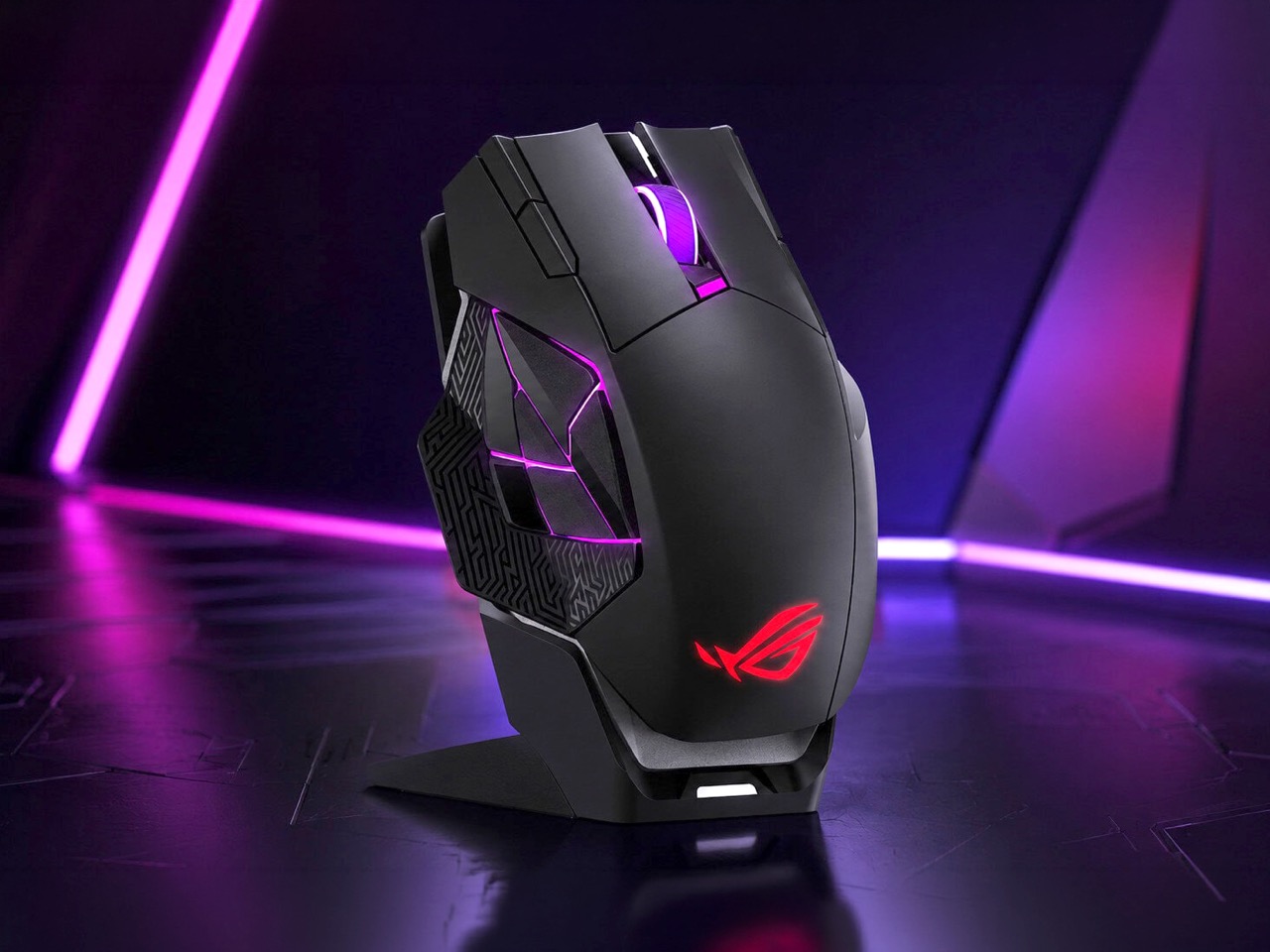
The ROG Spatha X 65K comes with a charging dock, and the dock is doing four jobs. It’s the 2.4 GHz receiver, the charger, a battery status readout with a toggle button on the back, and an angled plinth that holds the mouse nose-up like a museum piece. Fifteen minutes parked on it gets you 25 hours of gaming, which is roughly one very poor decision about bedtime.
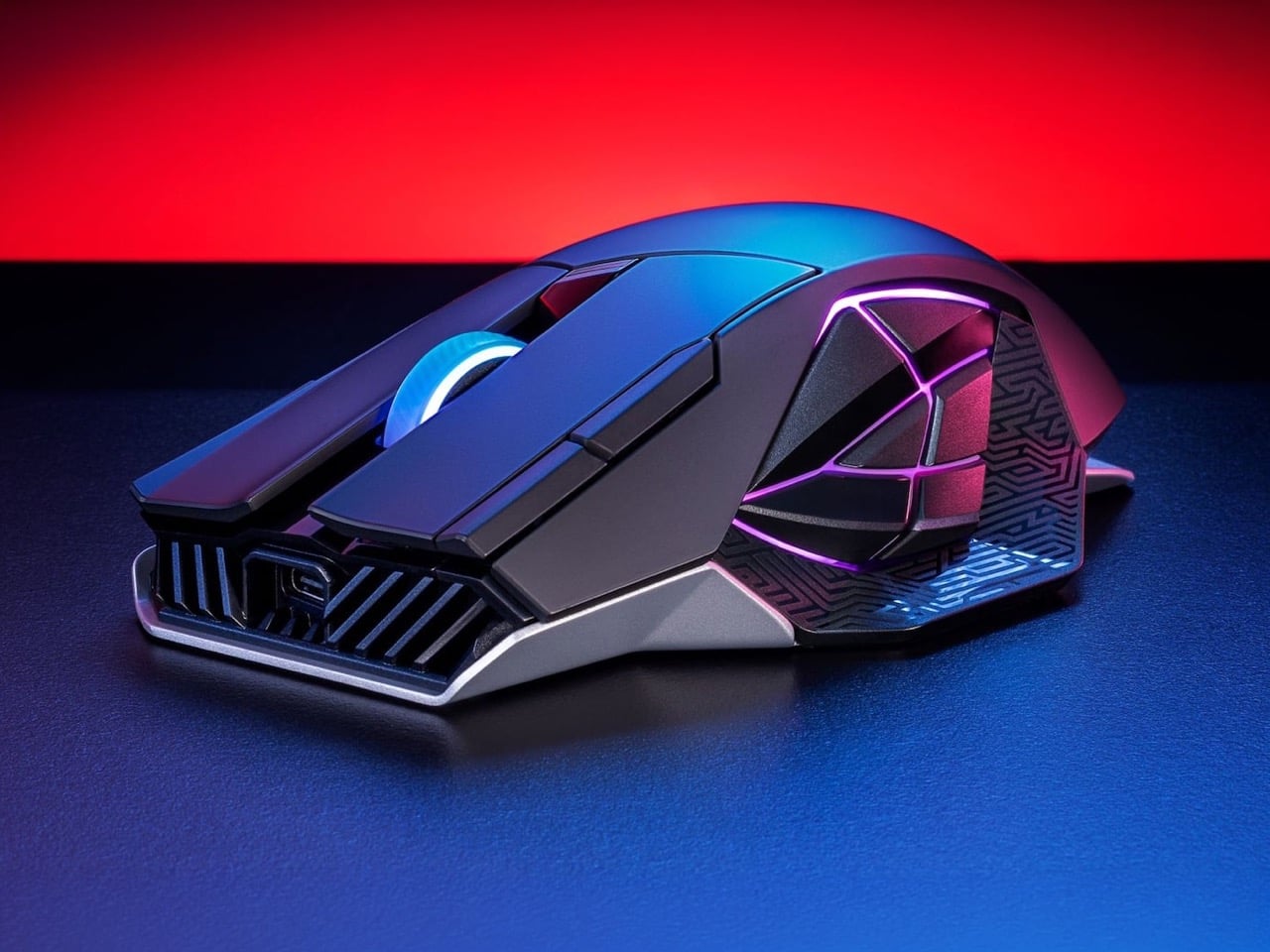
The mouse it holds is worth the pedestal. ASUS revived its MMO flagship at Gamescom 2026 with 12 programmable buttons, a 65,000 dpi AimPoint Pro sensor, hot-swappable Push-Fit Socket III switches, and a 126-gram body that takes two 10-gram weights across five front, center, and rear configurations. On the same stage, ASUS also showed the 56-gram Gladius IV Ace. One brand, one day, two completely opposite theories of what a mouse should weigh.
Designer: ASUS Republic of Gamers
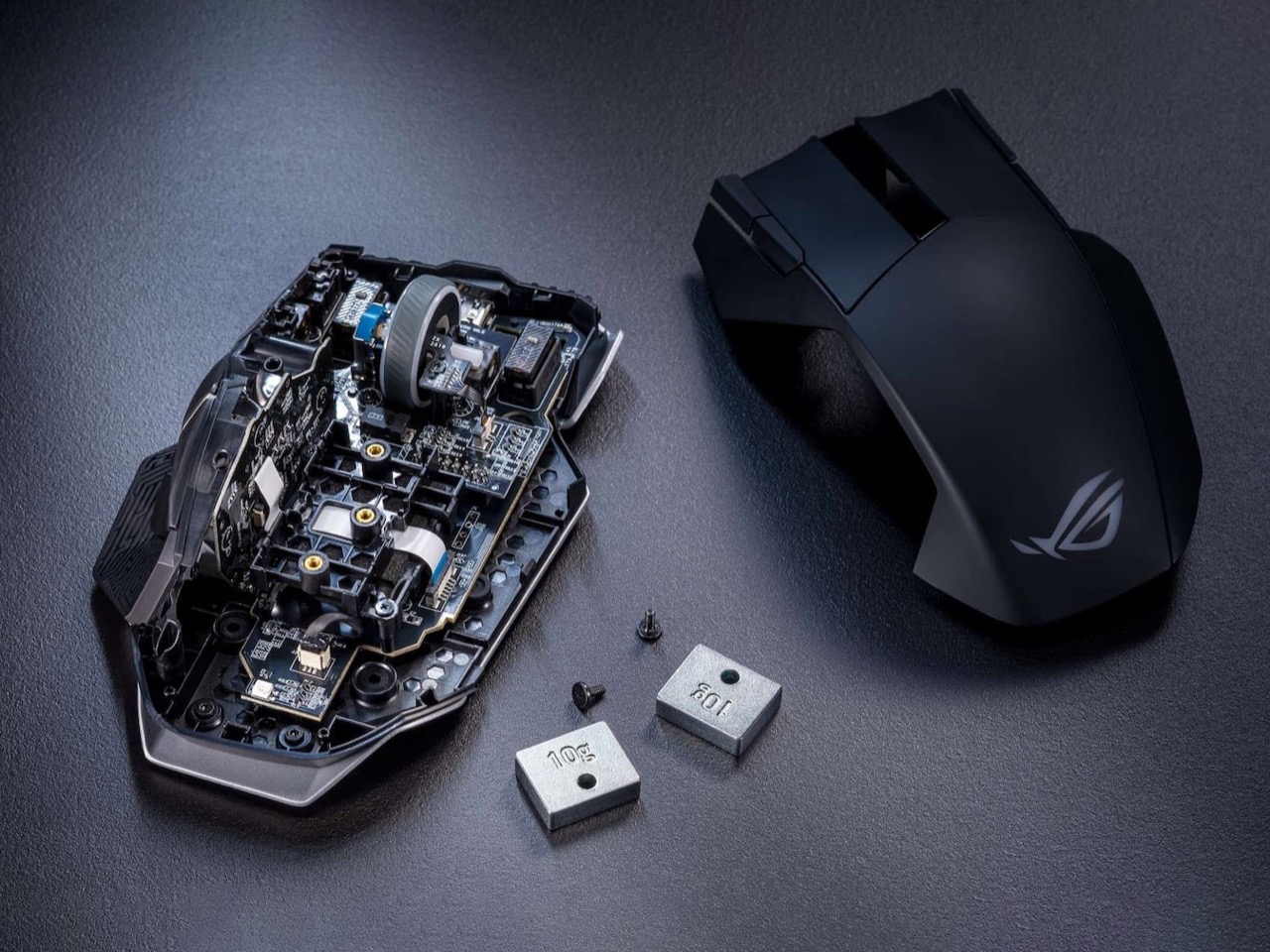
Two 10-gram modules and three mounting positions produce the five configurations ASUS advertises: bare at 126 grams, a single weight sitting front, center, or rear at 136, and both installed at 146. Three of those five options weigh exactly the same amount. What changes between them is the center of gravity, which moves the pivot point when you swing from the wrist. ASUS built a balance system and marketed it as a weight system, which undersells the more useful half. Anyone who has shimmed a mouse with coins and electrical tape will recognize the intent immediately.
Angular, deliberately mismatched thumb buttons arranged in the outline of the ROG eye carry straight over from the 2015 original, and ASUS says so out loud rather than pretending the shape is new. No two buttons in that cluster share a profile, so your thumb identifies them by edge geometry instead of counting positions. The side grip carries a Mayan-inspired pattern pressed into the surface, and the primary buttons are dished so fingertips settle into them. Eleven years on, that thumb logic holds up better than most ergonomic thinking from its era.
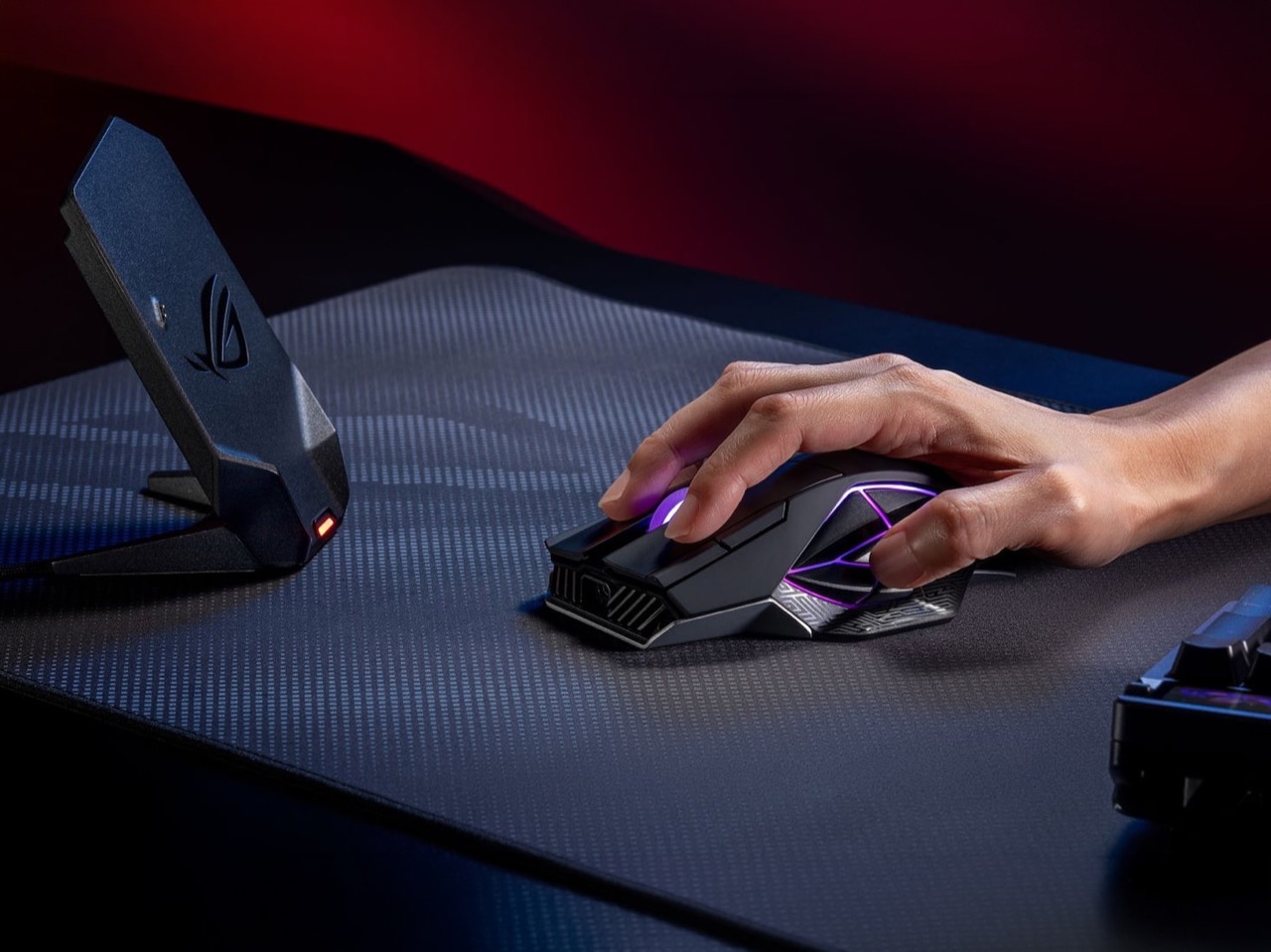
Nobody plays above 3,200 dpi, so the 65,000 figure exists to sit on a box next to a competitor’s smaller number. The upgrade that actually changes how the mouse behaves is the 11 preset lift-off distances, which matter enormously for a device built around low-sensitivity sweeping across a large pad. Repositioning a 126-gram body means lifting it constantly, and a badly calibrated lift-off turns every reset into a cursor jump. ASUS spent the engineering where it counts, then wrote the press release around the other thing. Standard industry practice, and mildly annoying every time.
Worn-out clicks kill more mice than dead sensors do, which makes Push-Fit Socket III the feature most likely to still matter in three years. The box ships with a switch tweezer, two spare ROG Silent Micro Switches, a PTFE feet set, and grip tape. The default ROG Micro Switch II is rated at 100 million clicks and the silent option at 50 million, with third-party switches dropping in within a few minutes. Configuration runs through Gear Link in a browser, so no Armoury Crate install is required. Anyone who has fought that software will read this as an apology.
ASUS has announced no price, no release date, no color beyond black, and no total battery life, which is a conspicuous omission for a device this heavy on radio duty. At 137mm long and 126 grams before you add anything, it also rules out small hands entirely. The 2021 Spatha X landed near $150, so budget accordingly and expect a premium on top of that. For a mouse asking you to push nearly a third of a pound around all evening, I’d want the runtime figure in writing before committing. The dock is beautiful. It should not have to work that hard.