
Wrap A Little Heat
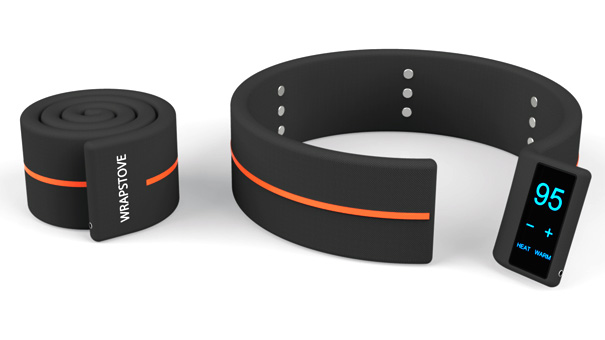
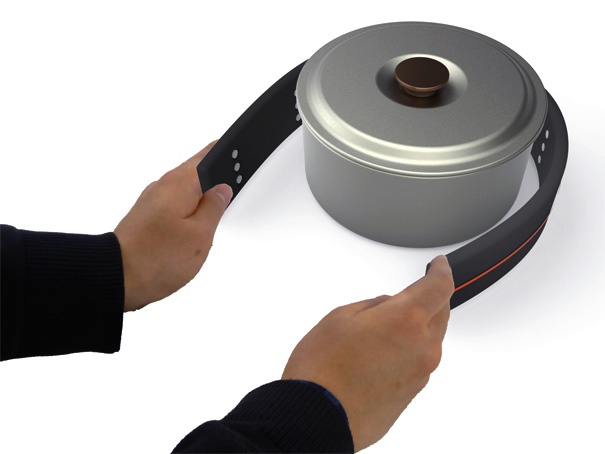
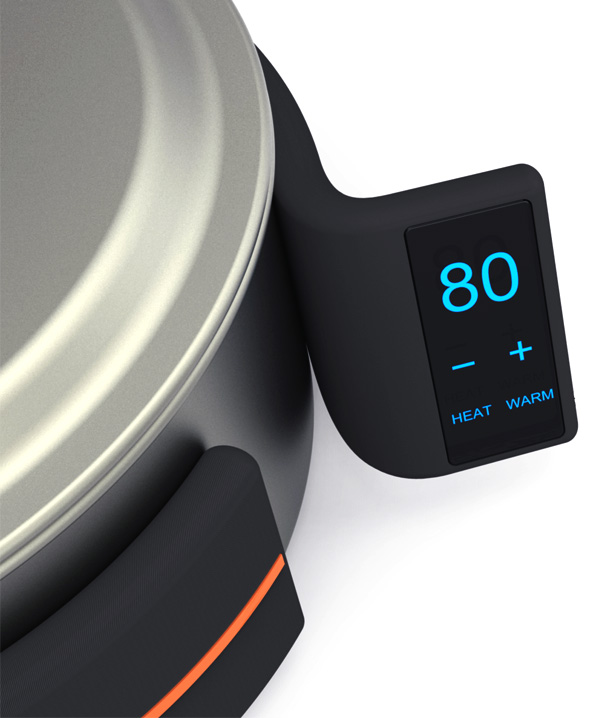
Portable burners are awesome for camping, but they do have their minor points like refilling gas and flames extinguishing during windy times. A good solution is using induction cooking stoves that are compact. The WrapStove here follows that norm and comes fitted with tiny magnets in the sleeve, to cling onto the vessel. It’s a flexible thang that is fashioned like a rolled up towel and wraps around the cooking pot. It switches-on only when the end tab is folded and the temperature is set via a touchscreen.
Since camping also means cramping, the WrapStove scores beautifully in the portability sector and takes up very little space in your bag.
Designer: Wonchul Hwang





25 Comments »
The Realist says
So let’s say I want to boil a litre of water.
The energy required to do so is equivalent to that stored in about 30 mobile phone batteries. So you’ve got to fit all those batteries in to that small space. (That’s assuming the heater is 100% efficient, and it won’t be, so add more.) Maybe that last picture shows a giant’s hand and his giant rucksack?
Also, in order to roll the heater up, you’ll need to make those batteries flexible. Good luck with that.
Around that you’ve got to fit your heating element and a heat shield (otherwise you’ll be heating your batteries up to around 100 degrees Celsius).
Once you’ve done all that, you boil your water and your heater is dead. You can’t keep that water boiling and you can’t cook anything else – unless you stick lots more batteries in, of course. No refuelling until you reach a mains socket – that’s a pretty limited camping trip.
But even if we set aside all these issues, there’s still one more. Steel, although magnetic, is heavy. So camping pans are made from aluminium. Which is, sadly for the Impossible Heater, not magnetic.
The other realist says
You forgot about the bulk of the electronics for high frequency switching needed for induction cooking, lots of copper coils in that one that often require cooling…and the need to shield the electronics from the heat…and the need to not shed energy to the atmosphere (insulation’s looking a bit thin there)…and that for efficient heat transfer the device needs to be significantly hotter than that which it is heating.
New idea…lasers!
Oh oh oh! And don’t forget not to exceed the curie temp of the magnets or the thing will fall off the pot.
This is so much more fun than my job as a product design engineer. Easier too.
Matt says
The concepts idea is good.
However, to add to the Realist’s comments:- as induction heating is only currently(at a maximum) 70% efficient, it’s not at all going to boil water nor heat it for a sustained length of time without a copious amount of energy.
Flexible batteries do actually exist and are in development by the major electronic companies to commercialise the technology.
All in all, the main reason why I chose to comment is to point out that the concept doesn’t solve any real issues – even if it did work, it would be drastically more expensive than current stoves, a lot (lot) heavier and only fractionally smaller than existing gas burner and gas cannister combined (they are tiny these days).
Final comment, It’d be nice to see more research done being done by designers before the pen’s put to paper.
The other realist says
I don’t know about the battery thing. We just incorporated some LiPO batteries hoping for flexibility but flexible means that they can be formed in odd shapes, not flexed once manufactured. The risk of of shorting the plates is very high when flexing a battery.
I’d be happy to be proven wrong on this.
And to the inventor, don’t be discouraged by us, the peanut gallery. Keep innovating.
David says
I wouldn’t be too worried about the inventor’s feelings. All those pictures are CG. It’s only a concept, and a ridiculous one at that.
The other realist says
It’s good exercise as a CAD model and rendering setup. It’s good that he’s trying.
Honestly my least favorite part about it is the ‘fuzzy grey minimal neon orange’ color scheme. I’m so sick of that…and it’s nasty.
The Optimist says
I think the concept is cool.
It may not cook food but why not a neck warmer?
JRP says
Before pitching in terms like Curie-temperature, it is better to check them. Curie temperature of ordinary magnets is about 550-600 Celsius (1050-1100 Fahrenheit). Now any foodstuff which is still foodstuff when reaching those temperatures? ….
Donkus says
Heating elements typically run about 1000 °C. There is no heat transfer without a differential.
JRP says
True,
but now we are nitpicking. If you want to boil and have a little patience such high temperatures are not necessary.
Roasting and frying is something else of course. But hey, we’re talking about something portable, electrical and relatively lightweight…
Trackbacks