Braille E-Book
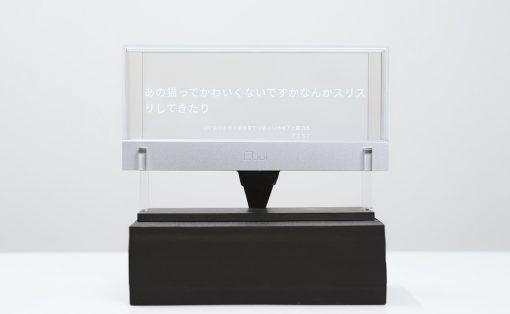
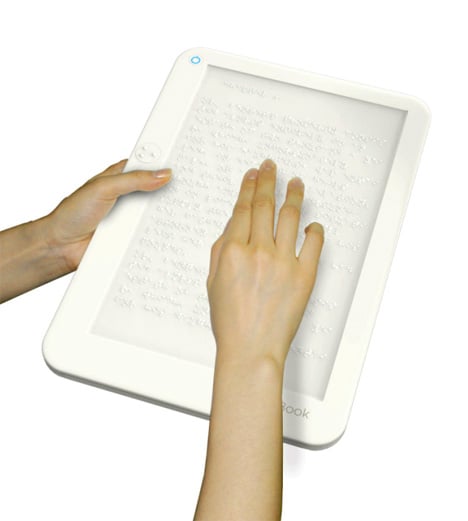
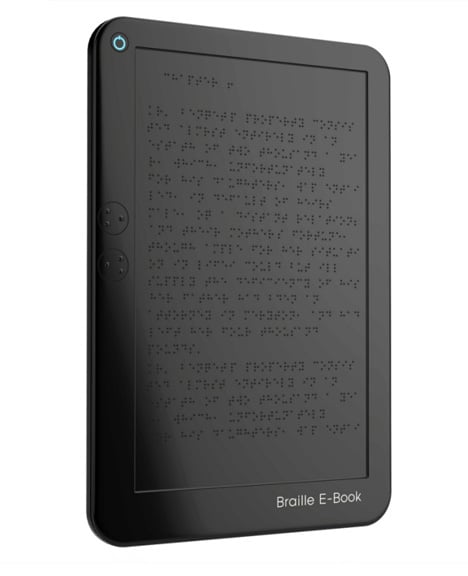
Visually challenged people require braille books in order to read. However, not many books are available in braille due to cost and inefficiency. Translating a 500 page book into braille nearly doubles the thickness. EAP is a technology that can dynamically change the surface pattern by way of an electromagnetic signal – simulating braille text. Not exactly a new idea but a nice executive nonetheless.
Designers: Seon-Keun Park, Byung-Min Woo, Sun-Hye Woo & Jin-Sun Park


107 Comments »
Douden says
Where can I buy it?
chad says
I like how the power button lights up, you know, so they can see if it’s on or not. A slide type toggle switch would have been more appropriate.
Ana says
I think they might know its on when the braille comes up…
이사 이명진 says
제품의 대한 문의가있어 글을올립니다
1. 제품이 한국에 협력업체가 있는지 있으면 담당자 및 연락처 부탁합니다.
2. 제품의 가격이 얼마나 되는지 확인 부탁드립니다
3. 제품 카다로그 도 부탁드립니다
EMIL : zbc2200@paran.com
Phone : 010-9340-1579 / 070-7017-7145
Denees lee says
The building is a company in Korea
This product is visually guipharyeoryeo products for the disabled
Distributor in South Korea this eopneunjiyo
If you do not know how, please contact the contract manager
superhobo says
Braille is a good application of this technology. But I’m thinking touchscreen keyboards with keys that raise themselves.
Kaitou KID says
The advantage of this over audio books for the blind (and not deaf) is what again?
superhobo says
You can read and understand much faster than you can hear and understand.
KaitouKID says
Well for me, I have eyes, so reading is many times faster. But I’ve seen people read with Braille and they use their fingers line by line so I’m not sure what the benefit would be on an E-reader vs audio that’s read to you. Plus a blind person kinda needs to find a way to get that stuff from a computer onto the reader…I just don’t see this working out, no pun intended.
OTJay says
I am a therapist who works with the blind and actually, in response to superhobo you hear and understand better since the auditory response is recognized by the brain first. Blind people actually have a faster synapse response when hearing as they have learned to compensate over time.
KaitouKID, the device is wonderful for those who are blind since they are more private people due to thier lack of sight and do not like to draw attention to themselves. Even if they did somehow need to have assistance putting information on the device, being able to read anywhere without using audio would enable them to be more like everyone else allowing a tighter integration into society.
this device is wonderful.
ak says
The advantage is scale. It is much easier and cheaper to transfer writing to Braille than it is to speech. For audio, you either need someone to record it or you need a speech emulator. The latter are generally unpleasant to listen to.
feffrey says
Why would the device need to be so big? Why not just make it the size of a small cell phone and the person can just leave their finger over the device. The device would then shift the dots as fast as the person would want.
Instead of the person moving their finger across a sheet of Braille, the person would keep their finger still while the device would form the Braille dots and would “move” the dots across the surface.
profs says
Because that’s not how Braille works. You need to move you finger for the text to be readable.
Beetle says
Yes, but one does not need more than a half horizontal line for full effect.
Dynamic Braille displays are insanely expensive already, and that is 40 cells at most.
DYMongoose says
My mom is blind so I’ve seen my share of braille books. They’re insanely thick do to the raised letters – a children’s story is as thick as a college textbook. This would be an amazing advance in the technology. Yes, it would probably require assistance from someone who can see during setup, but the use of it would (or should) not. Too cool, I say.
Tom Whild says
This is a great idea, and as far as can see (sorry) the best use for the ebook reader format that has yet been conceived. Where ebook readers don’t really add enough to the traditional printed book for me to get excited about, I think this is great
gadam07 says
Wow, that’s really fantastic! A truly brilliant idea to help the blind. I certainly hope this gets produced.
crackblind says
It’ll all be about the pricing. Refreshable Braille displays are incredibly expensive & can be delicate (breaking 1 pin in the display kinda screws the whole thing up).
But there is existing tech on this already. Portable Braille notetakers can take practically any standard text file (txt, doc & xml) and translate it to readable Braille. There are line length issues because of the number of cells on the display. The only benefit of this is a complete page – which is important to Braille readers.
David Spector says
This design does not use pins. It is a new concept (which I proposed several years ago) that presumably uses new plastics that pucker when you apply a electric voltage. This is a new concept that can result in affordable page-sized refreshable braille displays.
Sean Park says
I’m Seon-Keun Park (Eng name is Sean Park). Thanks for your comments. It’s just [Concept] design. So there are so many weakness in this concept. I wish your understanding.
Sergio Trujillo says
It’s a copy of my old product concept, the BrailleBook, that you can see in http://www.andalux.com/braillebook.
I had send to Yanko my design, but it is not in the blog. I don’t know why.
Sergio Trujillo says
This product is a copy of my design, which is a very much previous idea, of the year 2006. You can verify the date in http://www.youtube.com/watch?v=BwO8XqcZ5Q0. The BrailleBook is Sergio Trujillo’s original idea, and you must not design anything that already has designed other one before. My design appears in many technological important blogs. It is a plagiarism of my idea, you must admit it publicly. You can see my page of the concept art in http://www.andalux.com/braillebook.
futuromat3000 says
i´m wondering about the used technology. In this design the dots are raised, the swedish technology works (for my understanding) with vibration signals and these can be interpreted as dots. so for the user it works more like a morse code on a complete flat surface.
please exlpain…
Barbara63 says
I choose another pic that had less sunshine on it. ,
JXL68 says
The syntax of specifiers and heads. ,
Trackbacks