
LED Trojan Horse
Frog Design is at it again, this time with an environmentally friendly LED based lightbulb. Although CFL’s are marketed to be widely superior than incandescents, the fact of the matter is they’re still made using very toxic chemicals. Mass acceptance has also been slower than anticipated but it’s obvious why – the cold bluish tint they cast and being non-dimmable.
So what’s the alternative? LEDs. They’re getting cheaper to manufacturer. They use significantly less energy, require no harmful chemicals to produce and can be tuned to give off any hue in the visible color spectrum. The markets are already flooded with a handful of LED bulbs but they have failed to reach mass acceptance and Frog Design believes this is due to poor design.
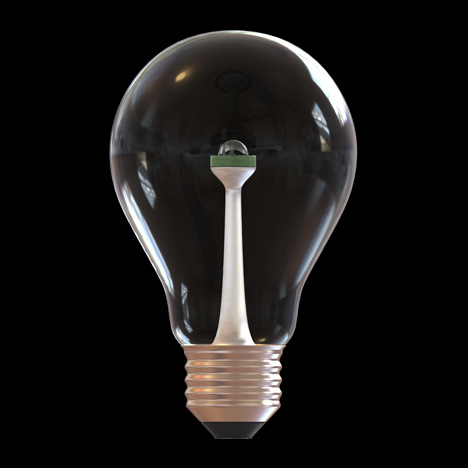
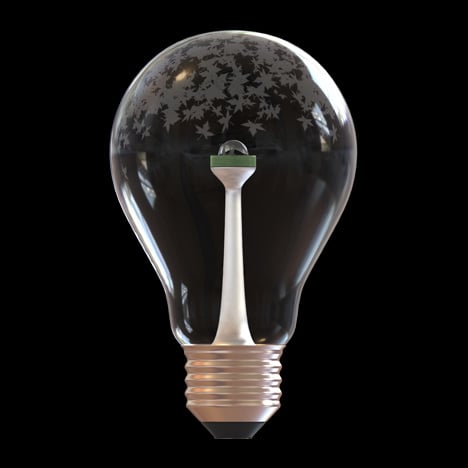
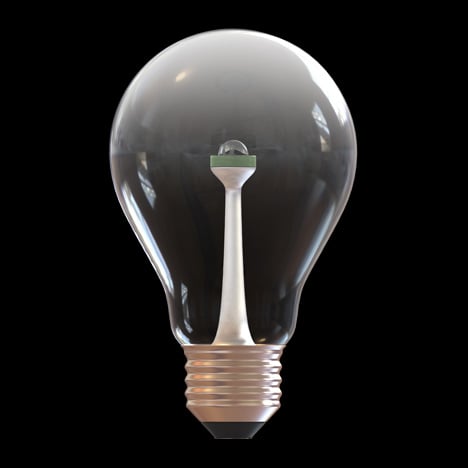
Their LED bulb looks like an incandescent. It works like one, uses the same aluminum socket and gives off the same warm color. The only difference is energy savings and a life span of 30+ years. In marketing these bulbs, is there even a need to educate the public about the advantages of LEDs? If you package your design to look like the defacto, then you may have a Trojan horse – ready to make the transition to LED bulbs invisible and a reality. Many LED bulbs on the market today are futuristic, modern, and require specially designed sockets. It’s no surprised you don’t see them in grandma’s vanity. I believe Frog Design may have hit the proverbial nail.
Designer: Frog Design






68 Comments »
Chris Burns says
Winner.
Adam G says
Uh…where and when can I get one??
zippyflounder says
typical frog over packaging, no need for the “light blub” shape, its just a waste of materials. I question its reality as well, LED’s even uber high output white ones are ganged up (10-30)to provide wide illumination patterns as well as the Light out put (lumins) to equal a “100 watt” blub (standard home size). The material that makes up the “blub” might be used to shift the color spectrum, but even if that is the case there is way way way more of it than needed.
Chris Burns says
the light bulb shape is there to sell the product, which it inevitably will because people are used to it.
zippyflounder says
so by that thinking compact florescents with their squggly shape dont sell….balderdash.
Chris Burns says
this universally understood object, the “lightbulb shape”, still outsells any other shape, regardless of features the other shapes offers.
JT says
And it’s easier to clean!
Dan says
The article says the whole point of the “lightbulb” shape is to be like a Trojan horse. If you make the new product look and function like the old one, then there are no boundaries for the consumer. The consumer doesn’t have to consider limitations, read instructions, or worry that it wont work. Its also a classic shape thats easily identifiable as a light bulb. I’m pretty sure Frog Design could release a compact florescent style bulb too if thats your style. Its all just to make the transition easier and transparent. Sure it uses more material than it needs to, but compare that to buying a regular bulb, and you’re still getting a better deal. Buying an old bulb and a new bulb is still going to waste the same sort of materials (minus some stuff like Tungsten and Mercury) but one is going to give you a longer lasting product, and better energy savings. One day this can all be scaled down, but thats all in transition.
deberry says
current CFLs won’t sell to us for many reasons. shape is one of them. they won’t fit many sockets and they are ugly as well. if this LED is for real it will really sell. I agree that you need a gang of LEDs to put out 100W lumin power though.
enoo says
I don’t know about the “chemicals” used to create LEDs, but I always heard that LEDs were the ones that created hard to recycle waste.
And also, CFL gives a cold bluish light? Wow, I suppose I don’t have the same CFL here, they all gives a warm light, much like the standart incadescent lamp. (but it’s a PITA to wait a couple of minutes to get a correct light, *sigh*)
On the other hand, many LED lights give a very bluish tint, at least, all the ones I’ve found on the market so far.
The last one I bought was a “single-led spot lightbulb”, and well… it was said to be very brigth and all, but it only gave a very dim bluish light, barely enough to read. Bleh.
So, I’m not really interested by a “LED lamp looking like a normal lightbulb” but if it can give an acceptable amount of light, and without being blueish, I suppose I’ll buy it.
Dan says
well, like the article said, LEDs can be made to be any colour in the spectrum (not just the visible). Some LEDs used in flash light products give off a white/blue light to be piercing when trying to illuminate a small area. It has no need to mimic a traditional lightbulb. Its like those new wind up flash lights, bright and white; maybe slightly blue. Im sure thats also partially marketing. When you see a white/blue light on a car or someone’s bike, you know that HAS to be brand new, and gives the product that “Modern and new” feel to it.
Now with the LED lightbulb, I’m pretty sure the aim would be to get that warm glow colour for sure, otherwise no one would buy it.
Jackie says
No. YOU read the article again. It doesn’t say *not just the visible*
Idiot.
deanween8 says
lame.
Just Cause says
Why?
By all means the one end must initially fit into traditional sockets, but why would you make the rest the same shape? It’s just like packing a CD in a big paper box (remember that), wasteful design.
But then I dream of a day when lighting will simulate the Sun, instead of the current life sucking (Joe Versus the Volcano) designs.
Mike says
Why? Besides the trojan horse concept, many lamps only accept, and many clip-on shades and shade harps will only fit the traditional “type A” bulb shape.
As to why CDs used to packaged in ‘long boxes’ was to facilite retailers transitioning from 12″ LPs to CDs. The standard LP rack could be divided in two to allow side-by-side display of longboxed CDs at the correct height, minimizing the amount of alteration needed for display. Function over form (and waste).
CPFReviews.com says
The design is nice, but not very practical.
Firstly, realistically speaking, LED at max will emit 200 Lumens (at 1A)
Secondly, heat emitted has no where to go, I would modify the design and put up heat radiating fins to the steam for a good heat dissipation and it will also be decorative.
Thirdly, It wont be able to compete with standard 60W incandescent bulb or CFL in terms of total light output.
Yes, More efficient than Incandescent Bulb but when it comes to shear output, single LED is no match for 60W bulb.
Dan says
wouldn’t it be cool if they made like… a flower-type design with multiple LEDs inside the bulb? all stemming from the centre and then just sorta… flowing out… That would give it a bit more light.
selfdestruct says
I’d choose LED over CFL’s, but there are dimmable CFL’s available, my house is full of them.
hanswurst0815 says
Maybe they should have shown a picture with the bulb being turned on?
Joetimek says
Besides keeping down energy costs, CFLs have no redeeming value. And thanks to my light sensitivity, they give me a lovely headache. I’ll probably keep a supply of incandescent bulbs to hold me over until the LED revolution hits.
ljj says
LED is the future. It cannot happen fast enough.
It’s the mercury, stupid. Mercury is very toxic. Unless you recycle your CFL, the mercury goes into the soil, water or air.
no says
…exactly where it came from…
Noobs-R-Us says
Actually, now thinking about that design a bit more I think it sucks!
Don’t they know that buy holding the LED in an enclosed space like that they would increase the temperature of the LED? LEDs are like your computer’s CPU. It can overhead and burn out with too much heat.
They should just have the design like that but WITHOUT the glass enclosure. We can all get use to having a skinny stick bulb.
Y2KGTP says
Why glass? People are going to still drop and break these things. Why not just clear plastic?
aboud saklou says
very nice i can the future
Johan says
LEDs are dimmable using pulse width modulation PWM…
Mick says
Very nice design. Instant classic
zippyflounder says
you have to ask yourself this question (pro’s and newbies alike) how much $$$ got for this “design” and how much we would have…..
Shane says
The new pill sized plasma bulbs may take over them all. 140 lumens/watt. a few of those will put holes in your retinas!
it’s a shame they didn’t use the ‘extra’ layer as a built-in light shade.
zippyflounder says
its frog, what od you expect shane?
Joel Hesselgren says
It’s sad that the designers haven’t done their research about LEDs.
The glassbulb would actually damage the LED because it needs to be cooled (that is why the aften looks ”futuristic” and ”modern”). If the LEDs are not cooled or as in this case heated up with a glassbulb the life span of the LED will be reduced drasticly (at the same time as the emitted light will go down). Instead of 30+ years life span, with this design it would be like 1+ (just guessing).
LA LA says
YO YO… I’ve seen some designs from Philips, the lightbulb is the same as the old incandescent ones, but the central part is actually a prism lens. By changing the design of the prism, you can change the light rays direction.
The cooling action is passed onto the aluminium base through which the heat is dissipated.
Tests are still going on…
pepinthewicked says
As much as I like the idea of a trojan horse, I hardly think we can attribute this idea to Frog. Many lightbulb companies have done their best to disguise CFLs in regular lightbulb packages. It works, to some extent, but to even an untrained eye, the result seems inauthentic.
There’s a big difference between LEDs and CFLs, however: LEDs produce a superior light. In fact, given their miniscule size and versatility, LEDs are superior to any light source short of the sun. Shouldn’t we take a page from the old modernists who, when given a new versatile material, decided that plastic should look like plastic and not wood or metal?
I think it’s time we learn to respect our medium and accept the failures of our current infrastructure. LEDs are an incredible gift to design. Let’s not try and sneak them into an aging electrical grid through some trojan horse. Instead, let’s how they can lead us to create entirely new ways of gathering energy and giving light.
Miles says
Yeah- the lead in to this article is way off base: CFLs (like their regular fluorescent predecessors) have relatively minute amounts of mercury which off-gases the moment they are broken and dissipate within minutes. CFLs also come in a wide range of Kelvin so that they can give off an incandescent-like light (yellow) or closer to sunlight (blue). I, too have several dimmable CFLs in my house.
So, what are the advantages of LEDs?
prodmod says
its a nice looking design, but at best this LED can only emit light above the stem in about a 180 degree range. An incandescent lightbulb and even the CFL bulbs emit light all around them, like a point source.
this LED bulb will be too focused.
For example, if you put this in a standard lamp where you screw the bulb in from the top (under the lampshade) you will project all of your light out the top of your lampshade, and some of its side, but not much below it (where your table top or writing surface might be)
Not saying this is bad, but it is not a replacement for CFL or incandescant as far as where the light will be directed.
LED Grow Lights says
Lets hope LEDs actually gain market share for all the right reasons.
Jackie says
I’ve seen some like this that aren’t so wasteful. The glass part comes off of the base so that you only have to replace the LED part.
anthony says
ahm… I’m a EE Tudent, can you help me on my project about LED lamps???
juice says
nice.but,where is the Driver??
tony says
Puzzles me why people are suggesting the shape of this bulb. Beyond it being instantly recognizable and thereby consumer friendly it is in itself a classic design. The glass shape has style and elan that allows it to exist without a shade and dimmed to revel in it’s curves. Why anyone has a use for 100w bulbs I really do not understand, I use a mixture of wattage around my small flat placed in corners, etc to work with shadows and create depth. Sheer blinding whiteness is more akin to torture to me!
This is an excellent design and I want some now!
john says
the light bulb shape is the problem, and frog is not solving the true design problem. new lighting sources will demand new shapes for lights. while they are trying to create a “trojan horse”, they are not doing anything new here that Philips, Sylvania, or GE has not already engineered and proofed. All frog has done is splash a fancy pattern on the bulb, or a little frosting – something that the little old lady in the craft store up the block from me has been doing since the 60’s.
Also, assuming that a single LED will create the correct amount of lumination is incorrect. Creating the equivalent of a 35 watt halogen spotlight currently requires an array of approximately 25 LEDs. You would need the LED equivalent of a small disco ball inside this buld for it to provide the type of light you’d expect from a single-bulb lamp.
Trackbacks