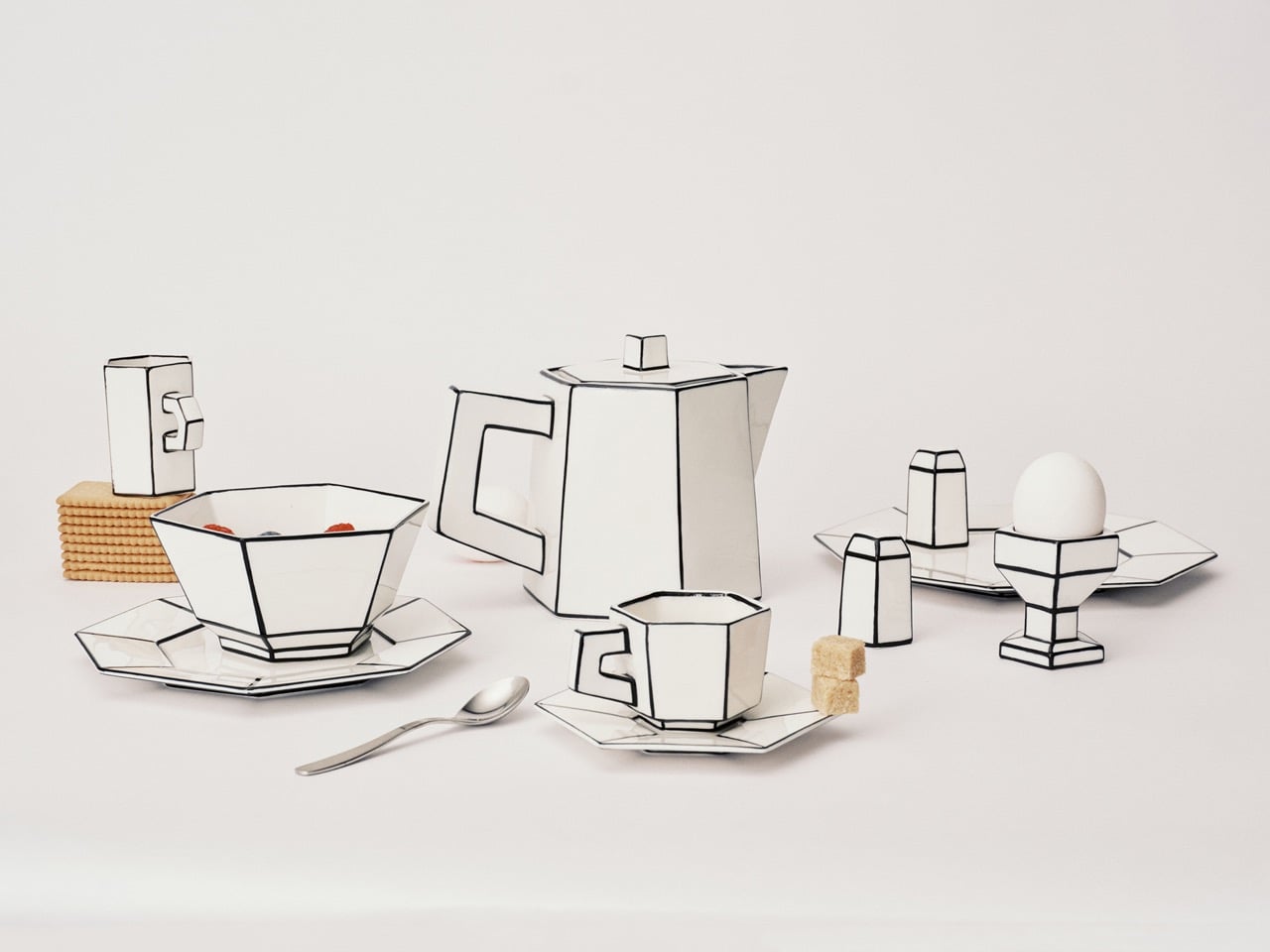
The potter’s wheel is the oldest mass-production machine humanity ever built, a spinning disc that let a single craftsman turn out dozens of near-identical bowls before lunch. That gift arrived with a tax written into physics, because anything formed on a wheel is a profile revolved around a central axis, exactly like a shape cut on a lathe. Bowls, cups, vases, and plates all inherit the same radial DNA, which is why round has quietly ruled tableware across every civilization that ever touched clay. Serax’s Carte Blanche collection abandons the axis completely, swapping revolved curves for faceted, folded geometry that no wheel could ever spin. It then pulls a second trick, flattening the porcelain visually until a solid cup reads as a drawing of one.
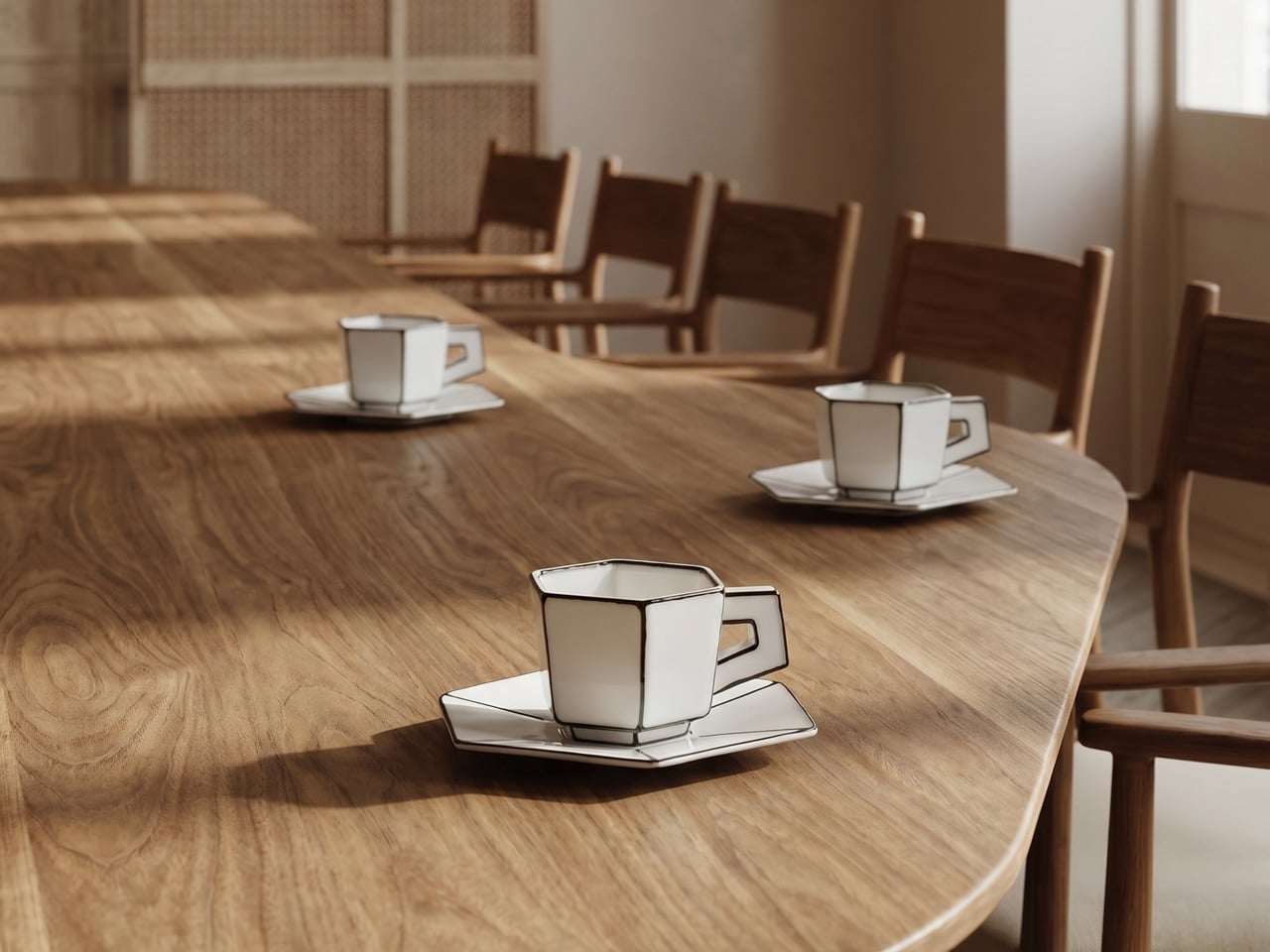
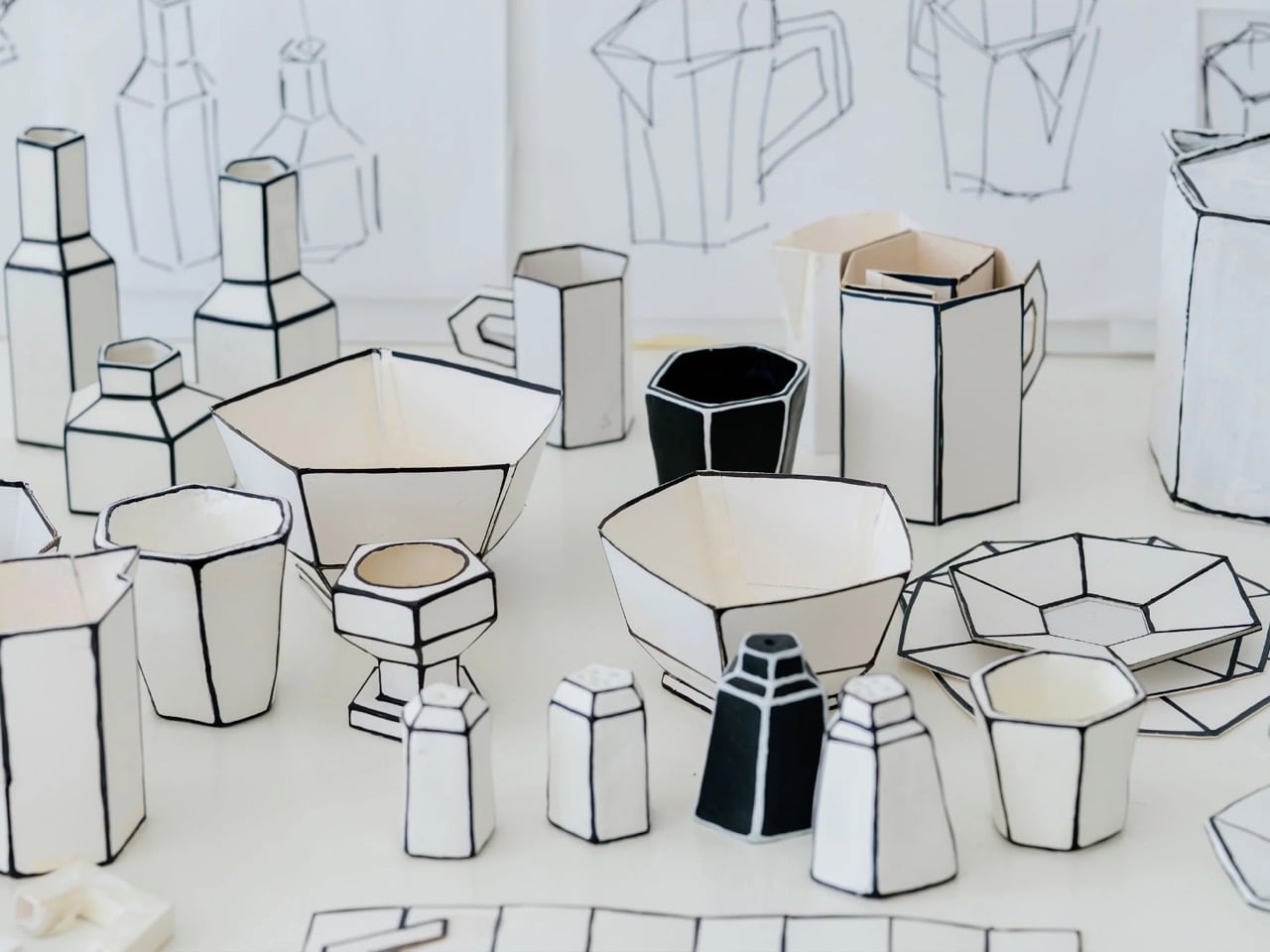
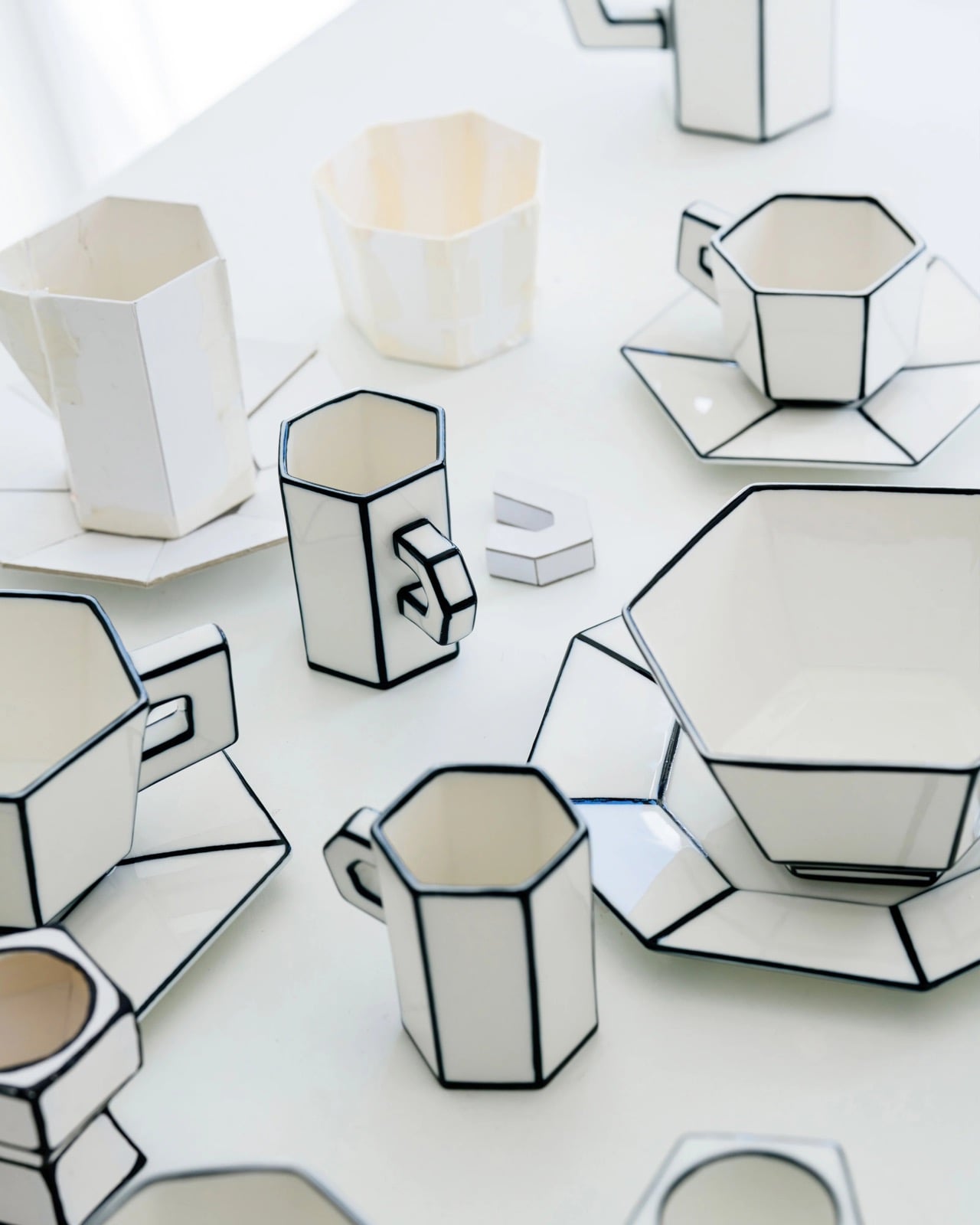
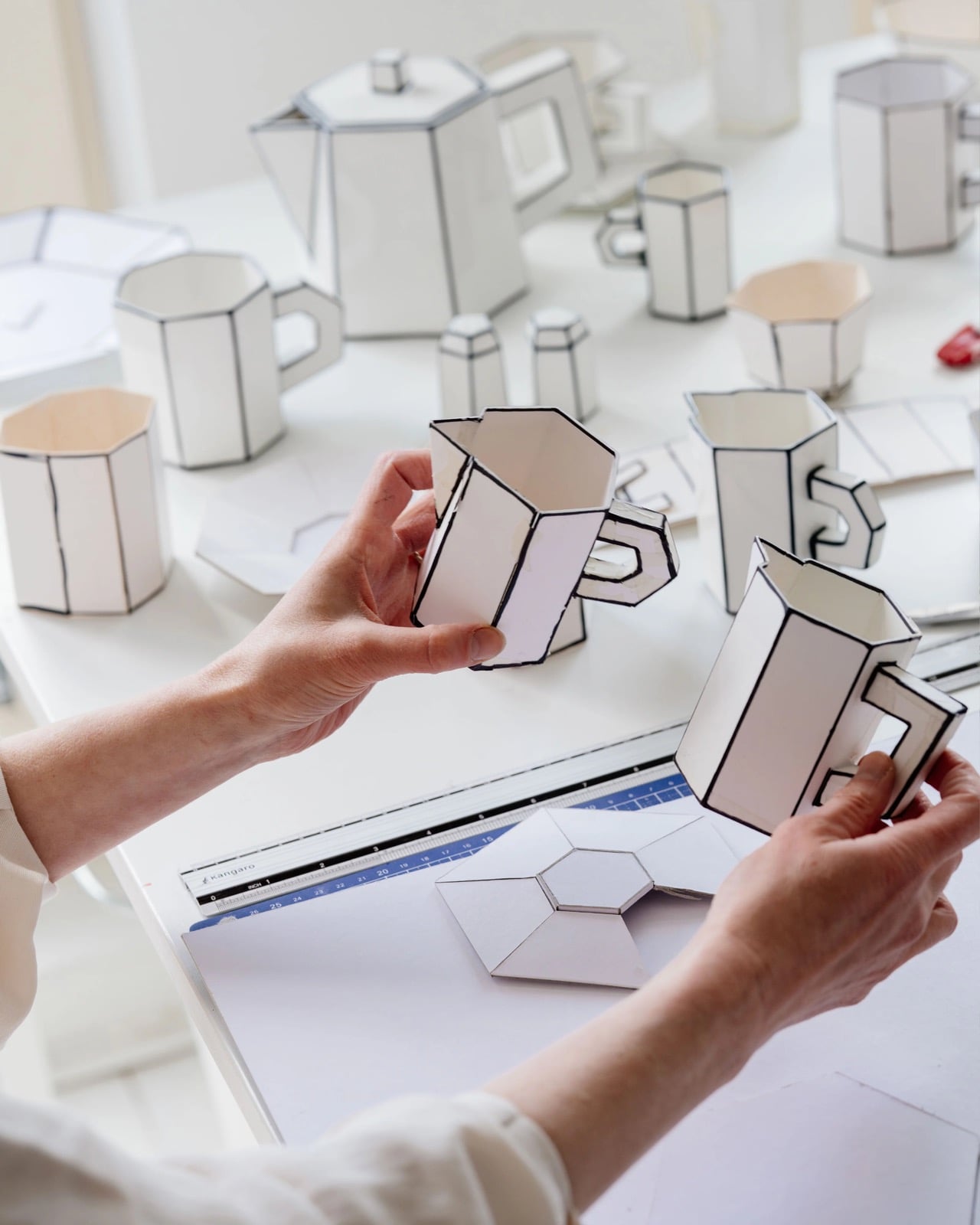
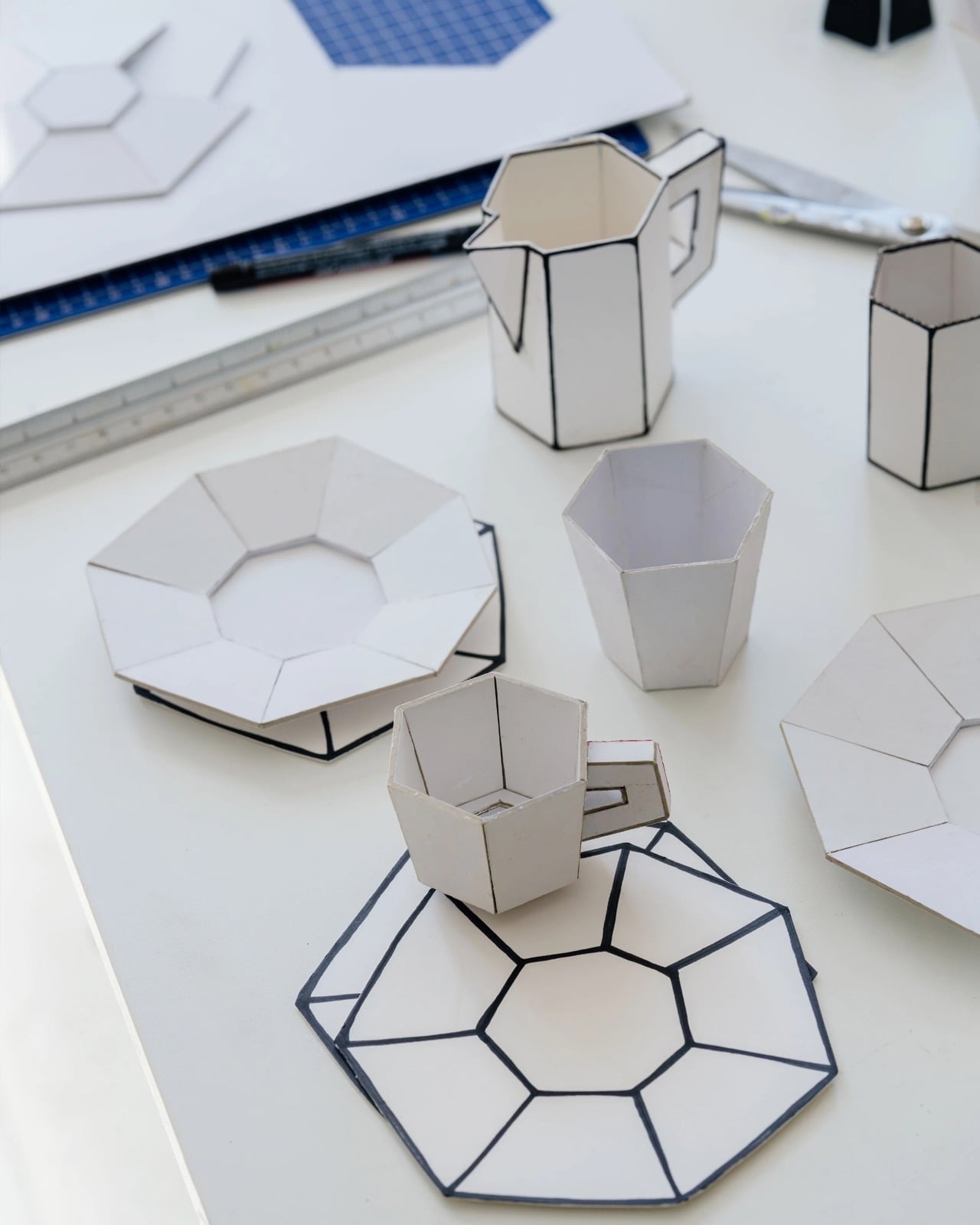
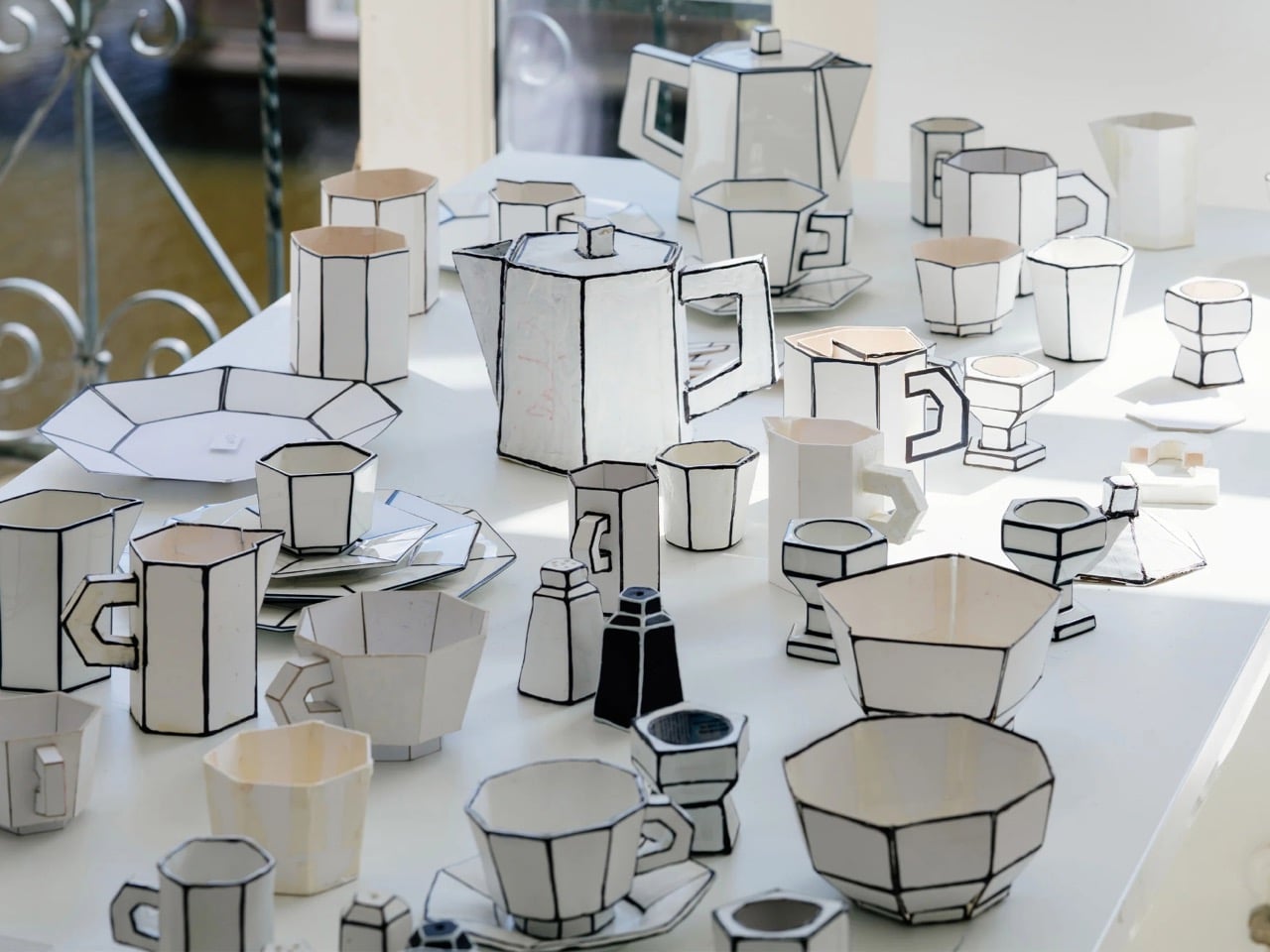
Dutch designer Annebet Philips developed the range with Belgian brand Serax, and she began the whole thing in cardboard rather than clay. She cut childlike shapes with deliberately uneven edges, treating the blank page and the humble cutout as her starting brief, which the name Carte Blanche translates almost literally. Those paper prototypes became the design language itself, their creases and wobble carried into glazed porcelain instead of being sanded into anonymity. Hand-painted black lines trace every fold and seam, lending each cup, saucer, and teapot the flattened quality of ink on paper. The collection opened as a coffee and tea service, espresso through milk jug, before expanding into plates, a breakfast bowl, an egg cup, and a salt and pepper set.
Designers: Annebet Philips and Serax
Ceramics is the most stubbornly three-dimensional of the applied arts, since clay has mass and casts a shadow no matter how thin you throw it. Carte Blanche fights that condition with pure graphic force, using a heavy black outline to convince your eye it is reading a two-dimensional sketch rather than a glazed object with genuine volume. The octagonal facets do half the work, catching light in flat planes that refuse the soft gradient a rounded surface would hand you. Photographed straight on, a cup collapses into what looks like a cartoonist’s line drawing, the handle reading as a doodled loop rather than a fired ceramic ear. Philips is forcing a volumetric craft to impersonate the flat page it was first sketched on.
Trompe-l’œil (or ‘deceives the eye’ in French) ceramics have a rich recent lineage, and French artist Jacques Monneraud has built a following throwing porcelain so convincingly corrugated that studio visitors ask whether he has switched to actual cardboard. Monneraud freezes the material itself, pressing a handmade wooden tool into leather-hard clay to fake corrugation and mixing glaze to imitate strips of packing tape. Philips chases something else, freezing the gesture rather than the substance, the outline and the fold instead of the fibrous grain. Where Monneraud wants you fooled until you lift the piece, Philips wants you to register the drawing instantly and enjoy the contradiction. Both approaches prove that a black line, correctly placed, reshapes how we read an object more than any amount of sculpted volume.
YD watched the same optical idea scale up to 1,578 horsepower a few days ago, when Bugatti unveiled the one-off W16 Mistral “Blanc Éternel” wrapped in hand-painted black linework. That car traces the NURBS surface patches from its own digital model across a porcelain-white body, exposing the CAD wireframe that normally stays hidden inside the software. The effect is identical in spirit to Carte Blanche, a three-dimensional object drawn back down into black lines on white, geometry converted into graphic. One costs somewhere north of five million dollars and eulogizes a dying engine, the other holds your morning espresso and survives a dishwasher cycle. Both understand that a contour line is the fastest way to make a solid thing look like an idea of itself.
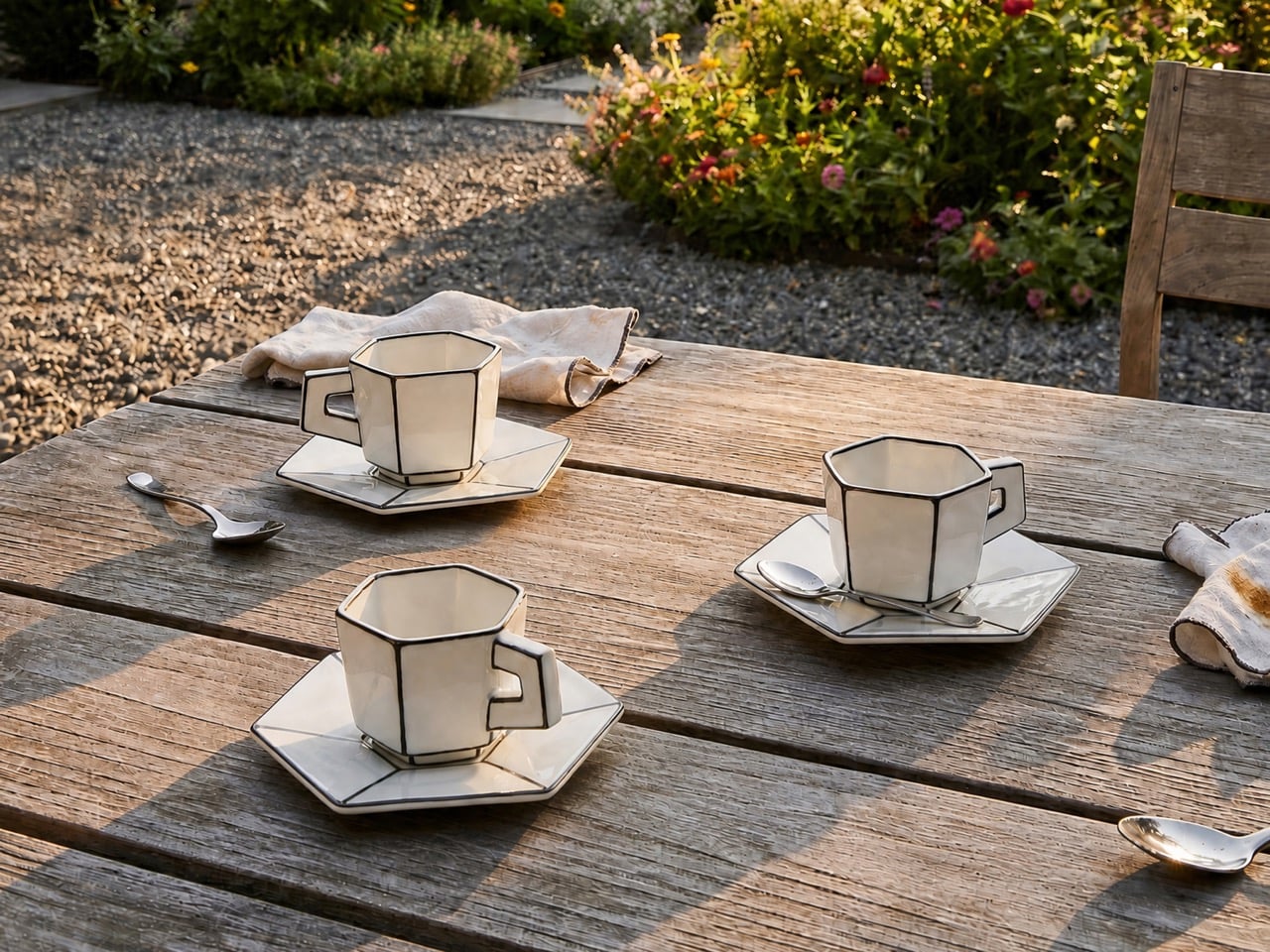
The illusion grows directly from how the objects were designed, the paper maquette preserved in glaze rather than discarded once the shape was set. Every line being painted by hand means no two pieces match exactly, so the industrial porcelain underneath still carries a one-off wobble. The pieces stay microwave and dishwasher safe, which keeps the concept from retreating into the vitrine where most trompe-l’œil ceramics eventually go to die. Philips has taken the two assumptions a potter’s wheel hardwired into the craft, that vessels are round and that vessels look solid, and quietly canceled both in a set you can actually eat off. That is a rarer achievement than the cheerful, cartoonish surface first lets on.