
For The Blind Who Don’t Know Braille
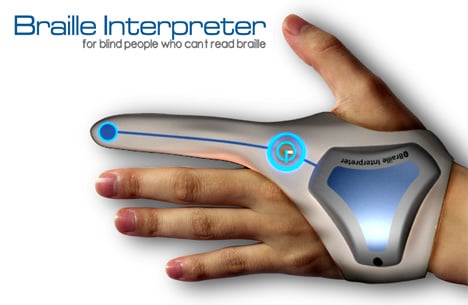
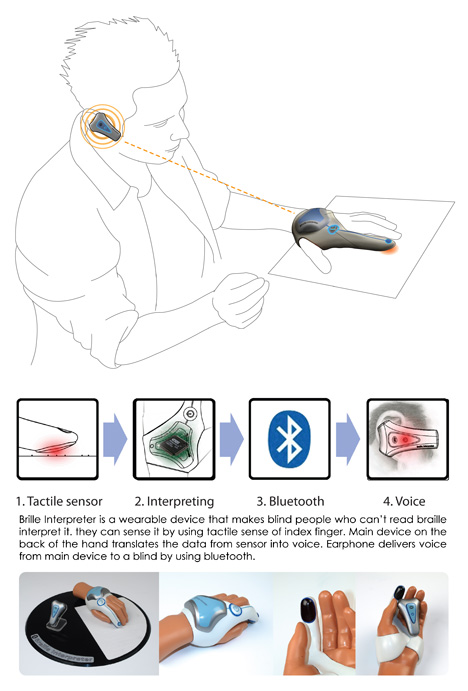
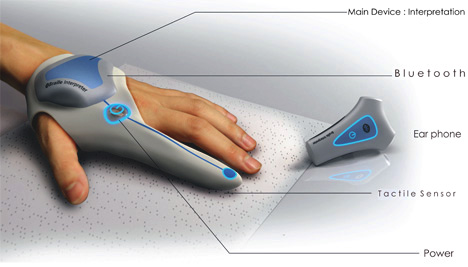
You are lucky my friend that you can read this post. Being sight-impaired is not a situation you want to be in. It gets even more complicated if you are blind and can’t even read Braille. Luckily there is some though process being invested in the Braille Interpreter, a single-finger glove that features a tactile sensor, a Bluetooth headphone and interpreting software.
The index finger portion of the glove hosts the said tactile sensor. Skim it over the Braille surface and it sends a feed to the main device housed on the back of the glove. Over here the feeds are interpreted and beamed to the headphone via Bluetooth as voice data.
Skim-Interpret-Hear Voice; nifty enough solution for those who can’t cope with Braille.
Designer: Hyung Jin Lim




49 Comments »
Eric says
If someone who’s had sight their entire life suddenly became blind this could be helpful. Maybe find another method of reading the braille or make the touch sensor extremely thin, so the person can still feel along. If they want to be able to read braille when the battery dies, they still need to learn it.
Maxime says
Very nice idea.
I think it would be a lot more interesting if you could put in a tiny scanner and make it read printed text (have to admit that I don’t know whether that size of scanner even exists outside James-Bond-world).
Then again, I suppose that would raise a whole bunch of new issues like detecting where the text starts for example.
wil from France says
brillant!
Gunnar Tveiten says
Why ? I mean, if you’ve got a single-finger-sensor with interpretation-logic and playback by voice from an in-ear unit; why not do the logical and sensible thing: Make the thing read normal printed text, instead of Braille ?
There’s 3 orders of magnitude more normal printed text out there than there is Braille. And most blind people can already read Braille, so the device is pretty useless for them.
In contrast, the same device, but adopted to read normal text, would be useful to more or less all blind people.
watchface says
Fair enough, but surely the advantage of Braille is that the blind can feel where text lies on a page, thus enabling them to read left to right line by line. If the definition of the braille wasn’t apparent there would be a margin of error in slipping into a line below or reading columns of text.
I think its quite a smart idea, agree with Eric though, it is important to learn braille sans tech.
Jorge says
In my country (Portugal), only a very little percentage knows how to read braille (know that from National statistics from Portuguese blind association, ’cause some paper i did for school). Unless you’re blind since your childhood, it’s very hard to learn.
And like Gunnar Tveiten said how do they figure without the tactile feel where does a phrase begin..
Jorge says
* And like Gunnar Tveiten said = Like watchface said…
Pzon says
Really Impressive! Love the idea…though it would be far easier, and efficient and probably cheaper to just learn Braille!
Pzon says
I think it would be far easier to learn Braille!
John Q says
great idea, but what of instead of doing the task for you and reading braille, this could be incorporated into the learning process?
Todd says
I really like this product, one of very few that is thought up from a need and applications standpoint, not just design. I think it would do great in the market.
becka says
great idea, brillant design.
Edgar Navarro says
That’s totally great!!!
derf says
stupidest idea of the year,
i work with blind people, one of the problem for people reading braille, is to find braille documents.Now i’ll be difficult to find a expensive glove…..
is so easier to vocalize classical document with syntheziser and scanner…
thank’s for the joke !!!!
Jason says
I must agree with Maxime, reading text (not braille) would be far more useful for a blind person that doesn’t read braile. The one advantage that braille has is it’s easier to follow the string of text.
To overcome this with a text-reading gadget, it would need to scan entire paragraphs and/or pages at a time and then read back the interpreted and stored information. It would be difficult to do with a glove-like reader, but definitely possible. Great idea, thanks for the post!
Eric says
I think most people could agree though that you would still need to know braille to avoid issues of: “Oh crap I left my automatic reader at home,” -or- “Oh crap my batteries died.” Then what?
Gunnar Tveiten says
Actually, making the thing capable of accurately scanning normal printed text doesn’t sound all that tricky. I can think of two methods;
One, you could imagine the fingertip-part has a scanner on the underside and a square cm of the braille-output-stuff ontop, that way you could “feel” your way along the line, even without being capable of seeing it. Infact this would also make it possible for you to for example “feel” a map or a photo, and could thus be independently useful.
The other way would be to give audio-feedback for “too high” and “too low”, given that most lines of text tend to be pretty straight, only moderate feedback is needed to keep the finger on track.
derf says
perhaps you are thinking about this:
http://www.top-braille.com/en/characteristics/TOP-BRAILLE/Caracteristiques-du-dipositif-de-lecture-pour-non-voyants-et-amblyopes.html
but there is a problem, like you don’t reag a word letter after letter a blind people doesn’t read braille letter after letter…
the information come from the moving hand and the deformation of the skin… so learn braille or prefer synthesizer it’s a perfect solution.
anu says
hi,this is really a very good product.but can you please tell me its price??
daniel says
i have 2 years work for blind people. I usually made calculator for blind people,talking keyboard 4 blind people. n this device can very helpfull because it’s not easy to understand braille for sightless people
7 says
amazing dude
Soylent says
That seems crazy.
If you’re going to resort to that, why not just skip the braille completely and get your books and documents in audible form? If you can’t get them in directly in audible form, get them as digital text and then use software to spit out a badly voice-synthesized interpretation.
Trackbacks