
Put the Pedal to the Medical
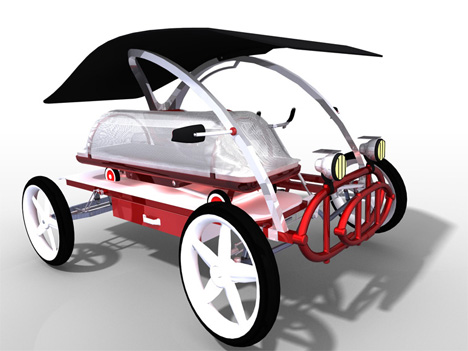
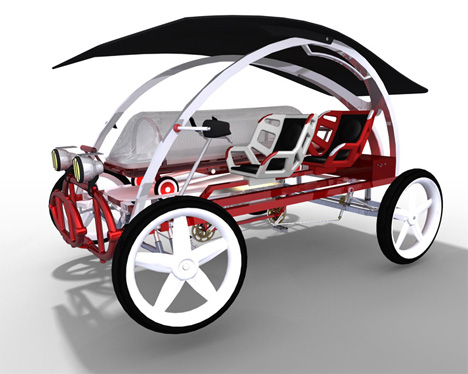
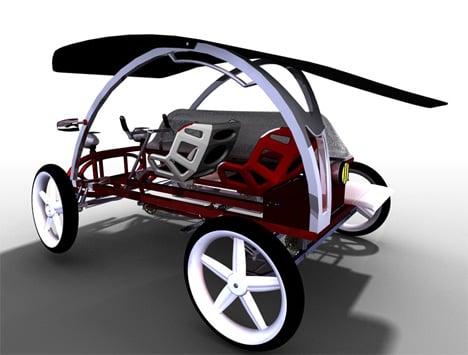
Ok, no Flintstones jokes please…this is serious business. Africans in rural areas often need ways to traverse vast distances to seek immediate medical attention. Most of the time a traditional ambulance or even any motorized vehicle is simply not available. Designer Benoît Angibaud addresses this issue with his “Jaambaaro” pedal car design. The Jaambaaro is literally a pedal-car with a stretcher, driven by two persons pedaling and assisted by electrical power generated from solar energy. Made of salvaged materials, and will hopefully fuel the local economy through localized manufacturing, thus making this vehicle not only sustainable but also fun for the kids. Yaabaadaabaadooo!
Designer: Benoît Angibaud




20 Comments »
carl says
in rural african areas how would they afford such a device.? solar panels are not cheap.
Def says
reminds me of some disney film, where they race around the world. I think it was the car of the evil guy.
But is an eye catcher
Lim says
ERRR…… Since you say it is in rural area, africa and “Most of the time a traditional ambulance or even any motorized vehicle is simply not available”
I dont think the final outlook of the design here is justifying. Dude that huge solar panel thing is expensive, money is an important issue here. And i think it will be very tiring for the 2 person to cycle that huge metal thing ! Talking about light weight material ? Also not cheap.
I feel there is a need for much more thinking for the fabrication of this design and by the end of the day, does it really practical to the needs and capability of the rural african.
Design is just not about can do this and that.
zippyflounder says
oh come on, its over designed, over built and over done for the market and the job….lash 2 3 speed bikes with fat tires togeather and be done with it….think of the end user for a change.
enoo says
I agree with the 2 commenters above.
Solar panels are expensive, so I doubt that this kind of device could be more available than an old car.
Maybe without all the expensive parts it would work … and in the end you got just what zippyflounder described.
bobby says
as mentioned before, this will be very expensive. I love bikes and human-powered transport and commute 15+ miles a day by bike, but the truth is that a used toyota truck would make a far more economical ambulance than one of these.
Gann says
This is a great idea, but I’d secure that solar panel/sail a little better.
DeadWriter says
Anybody remember that scene from Sliders where an ambulance was being pulled by horses.
I think it’s a good concept. Perhaps a version for other materials. In Asia, mopeds and bicycles are packed sky high with goods, so there might be a market for this.
TH says
I agree with previous commentators. Why on earth would anyone want this stupid thing that you need to pedal to travel those “vast distances” rather than, say, a real ambulance? I’m sure that even an ambulance emeritus would be easily refurbed for the purpose with less money it takes to even dream up these ridiculous gimmicks.
JR_portugal says
Hi
“Design is just not about can do this and that.”
Comment by Lim
I completely agree, but in this case, the solution could be far from the exelent, but this is reasoned design, and very ambitious idea.
I think that more work for simplify, and some tests could result in a great design
james says
Obviously, the designer has never been to rural Africa. What will actually happen is that the car will be immediately taken apart as soon as the aid-workers leave, and sold for scrap.
Michael says
Another case of form over function. The vehicle is wide, wheras many places without motor transport are narrow paths suitable for walking and bike riding. The patient is in a greenhouse, where they can broil in the sun. In spite of the large solar panel, the pedalers are unsheltered, so they are free to bake in the sun and be soaked in the rain.
What can this expensive thing do that an electric bike with a trailer costing 100th as much can’t.
Only one thing, look real pretty…
Benoît says
Hello, I’m Benoît Angibaud,
First of all, some pics are not sufficient to understand my project. We can’t discuss about Jaambaaro without considering the context and without considering how it has been designed.
This vehicle has been designed in partnership with two NGOs “Médecins du Monde” and ENDA. I decided to work on this subject after travelling several times in Africa and after previous projects with ENDA Ecopole in Senegal and also in Guinea Conakry. So I know health problems in rural regions.
Jaambaaro is a first necessity solution and works with telemedicine. Jaambaaro leave the village and at the same time an ambulance leave the hospital so they do just a part of the road. Thus, it reduces time of transportation from villages to hospitals.
Some parts of Jaambaaro (especially technical parts as solar panels) are developped for NGOs and bought by those organizations and the others materials came from local countries. The vehicle is designed to be built directly on African countries.
Benoît says
Hello, I'm Benoît Angibaud,
First of all, some pics are not sufficient to understand my project. We can't discuss about Jaambaaro without considering the context and without considering how it has been designed.
This vehicle has been designed in partnership with two NGOs “Médecins du Monde” and ENDA. I decided to work on this subject after travelling several times in Africa and after previous projects with ENDA Ecopole in Senegal and also in Guinea Conakry. So I know health problems in rural regions.
Jaambaaro is a first necessity solution and works with telemedicine. Jaambaaro leave the village and at the same time an ambulance leave the hospital so they do just a part of the road. Thus, it reduces time of transportation from villages to hospitals.
Some parts of Jaambaaro (especially technical parts as solar panels) are developped for NGOs and bought by those organizations and the others materials came from local countries. The vehicle is designed to be built directly on African countries.
Trackbacks