10 Paradigm Shifting Battery Concepts
The quest to make batteries last longer has led to some interesting concepts. The focus haa narrowed mainly to two areas: capacity and recharge. Here is a look at 10 paradigm shifting battery concepts, many with some added whacky functionality.
10) The Wind Up Battery by Qian Jiang
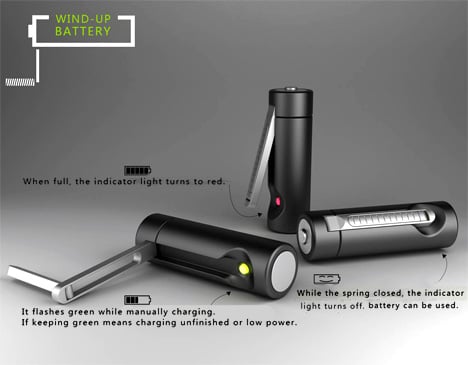
As the name suggests, the Wind Up Battery includes a hand crank to rev it up with juice. Just in case you don’t have the electric point in handy to do the honors.
9) Pushup Mint Battery #2 by mintselect @ mintpass
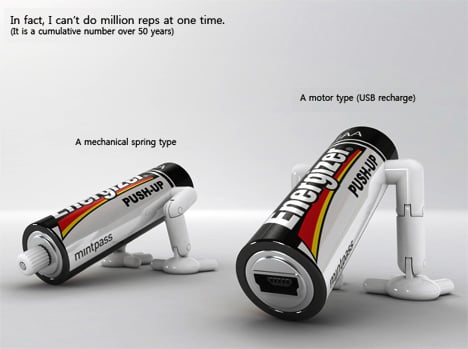
Mintpass is know for their realistic life form products and this cute Pushup Mint Battery #2 is another fine example. It recharges via a USB port or with winding.
8 ) Hungry Batteries by Mac Funamizu
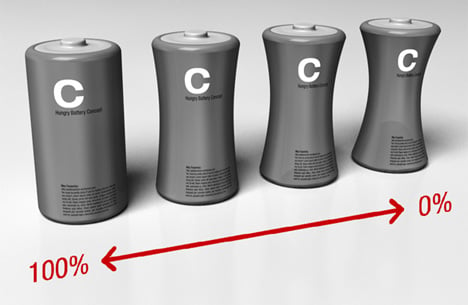
As their power dwindles, the Hungry Batteries change their form and reduce in size. The new svelte look is easier to pop out and act as a visual indication that their juice has run out. Clever!
7) IF Battery Concept by Qian Jiang & Yiying Wu
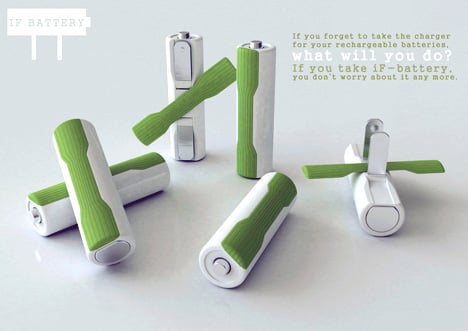
The IF Battery doesn’t require a charging station like traditional rechargeable batteries. It has a two-pin prong concealed to one side that pop out when you need to recharge it.
6) DAB Digital Radio by Anton Webb
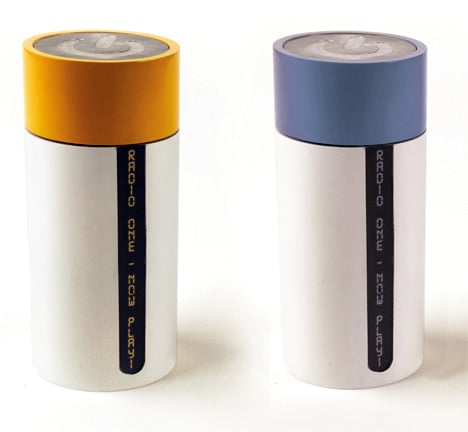
Technically this is not a battery but a kitchen radio under guise, nevertheless it’s a clever design with Dieter Rams’ principles kept in mind. Good Design is as little design as possible!
5) Salt&Pepper Cell by Antrepo Design Industry
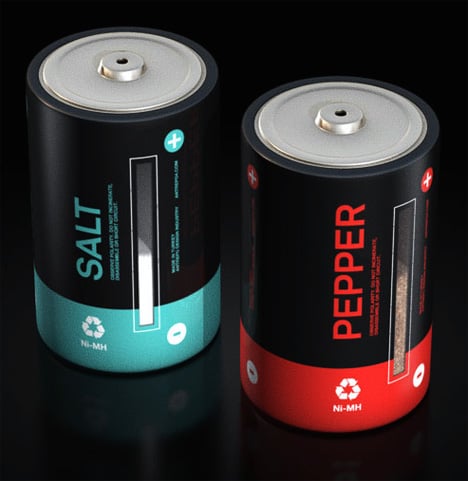
A part of the “I’m not product series”, the D size battery Salt&Pepper Shakers are a playful take on the real thing. It is a very clever design that includes minute details like the indicative power strip on the sides, which correlate to the amount of spices left in the shakers.
4) AtoD Rechargeable Battery by Pyeong Joo Goh, Jong Seung Choi & Ji Soo Hong

One size fits them all, presenting the AtoD Rechargeable Battery, which goes from AA to C to D sizes in a jiffy! The body is constructed out of Memory Foam and can be squeezed to any size. I simple adore its versatility.
3) Switch Battery by Ren Tong & Luo Jie
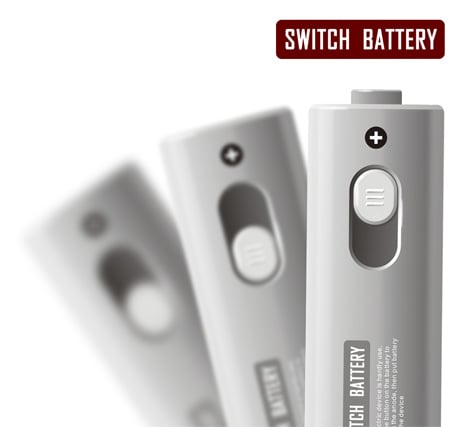
We all know that unused batteries lose their charge overtime, although it’s a slow process. Nevertheless, if we were to add a switch to the battery just to prevent the current loss, wouldn’t the planet be a happier place? Of course, it would!
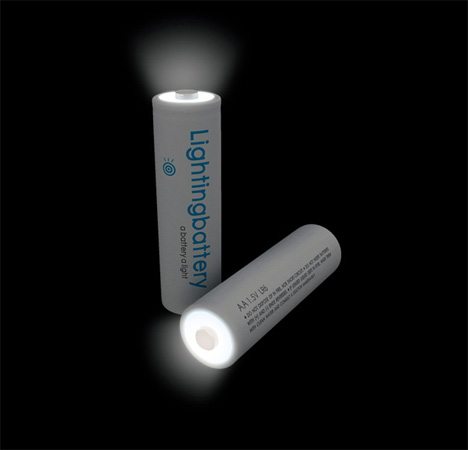
Innovative AA & AAA batteries that include a minitype LED within the body, that converts it to a handy flashlight! I’d love to see a working prototype of this.
1) Icon Battery by Essential TPE

What can I say about this iconic battery for the iPhone; it’s a real product and I’ sure its feels as groovy as it looks in these images!


13 Comments »
AndyL says
Ok, ….
3, 8 betray a fundamental misunderstanding of the item being 'redesigned.'.
1, 4 will drastically reduce the lifespan of the battery, making them of questionable usability.
5,6,9 are not actually batteries, but other items made to look like batteries.
7, I'm not sure if this one is possible, but it's only of marginal usefulness. Besides that it's poorly designed (In USA The green part would cover the adjacent outlet!), and will significantly impact battery life.
2,10 are interesting. And may even be useful in certain situations, but again this will come at the expense of longevity.
The single most important feature of a real battery is that, except for certain cheap, larger cells, every possible cubic millimeter is packed energy producing chemistry. Removing any of that will diminish the battery's lifespan, reducing the battery's ability to achieve it's primary purpose. Any design that does not acknowledge that fact fails.
thezeb says
Aside from the ones that aren't batteries, whoever came up with these designs has absolutely no idea how batteries work.
Art is not the same as design. These are not 'paradigm shifting' concepts. They are pretty pictures.
Articles like this take away from the real, difficult, work people are doing to maximize battery power and efficiency.
TheReviewer says
And almost none of these are realistic, maybe save for the one with pop-out prongs.
thezeb says
Actually that one is probably the most unrealistic. You have to convert AC to DC in order to charge the battery. Not only would that take up most of the battery space (assuming future technology, right now the AC to DC converter is larger than the battery), the battery would also heat up to dangerous temperature.
AndyL says
Ok, ….
3, 8 betray a fundamental misunderstanding of the item being 'redesigned.'.
1, 4 will drastically reduce the lifespan of the battery, making them of questionable usability.
5,6,9 are not actually batteries, but other items made to look like batteries.
7, I'm not sure if this one is possible, but it's only of marginal usefulness. Besides that it's poorly designed (In USA The green part would cover the adjacent outlet!), and will significantly impact battery life.
2,10 are interesting. And may even be useful in certain situations, but again this will come at the expense of longevity.
The single most important feature of a real battery is that, except for certain cheap, larger cells, every possible cubic millimeter is packed energy producing chemistry. Removing any of that will diminish the battery's lifespan, reducing the battery's ability to achieve it's primary purpose. Any design that does not acknowledge that fact fails.
thezeb says
Aside from the ones that aren't batteries, whoever came up with these designs has absolutely no idea how batteries work.
Art is not the same as design. These are not 'paradigm shifting' concepts. They are pretty pictures.
Articles like this take away from the real, difficult, work people are doing to maximize battery power and efficiency.
TheReviewer says
And almost none of these are realistic, maybe save for the one with pop-out prongs.
thezeb says
Actually that one is probably the most unrealistic. You have to convert AC to DC in order to charge the battery. Not only would that take up most of the battery space (assuming future technology, right now the AC to DC converter is larger than the battery), the battery would also heat up to dangerous temperature.
Alex says
The main problem with the home batteries (for home entertainment devices, kids toys, kitchen electric devices and so on) is that even if the devices are off they still discharge due to the electrochemical process inside. Best possibly advice is to take out the batteries from devices which we don’t use for longer periods of time and store them in a cool or a very cool place.
Trackbacks