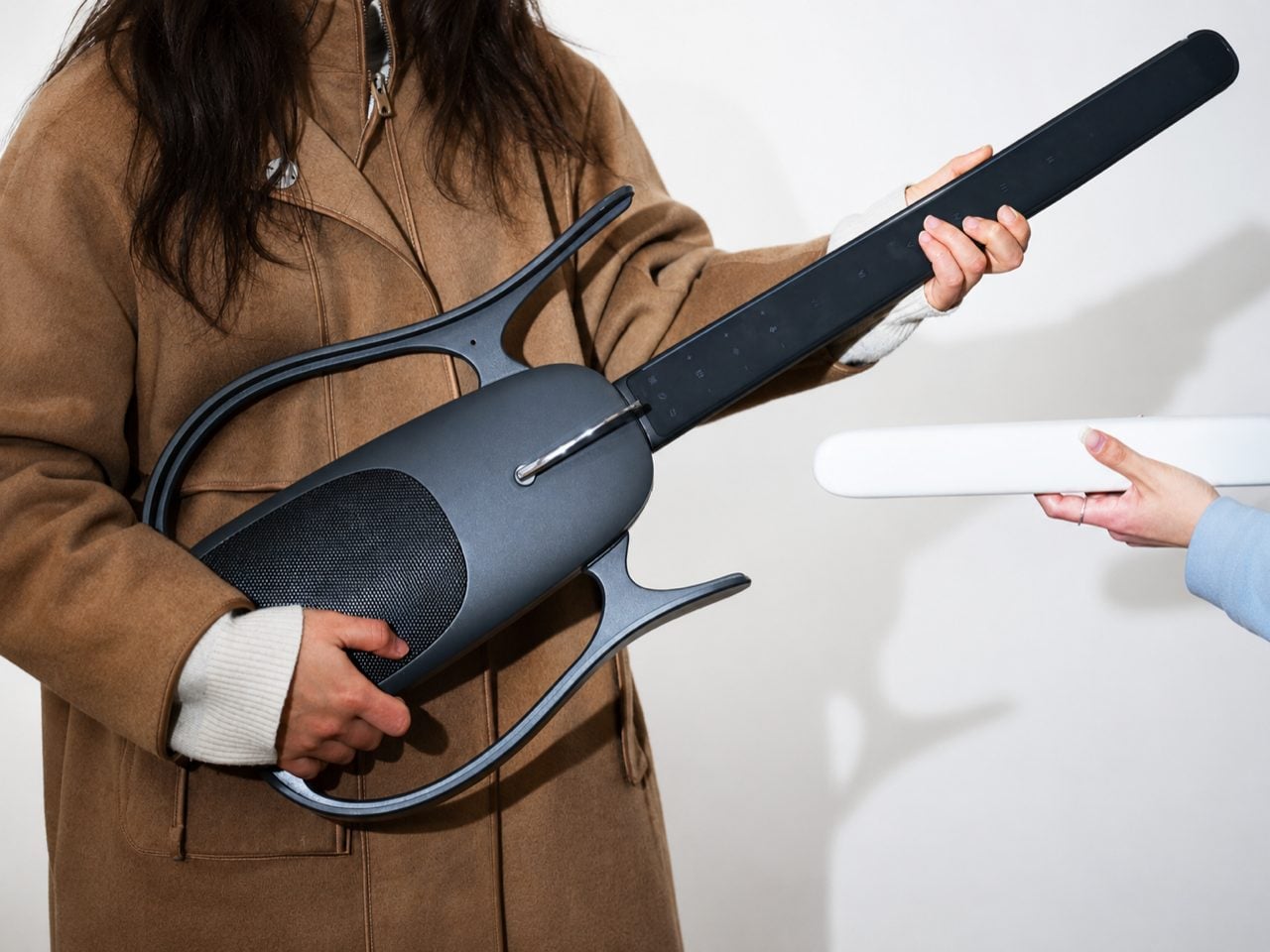
Look at RIFFMATE for a second and try to name what is missing. No strings. No fretboard bristling with metal wire. No solid slab of tonewood. What remains is the silhouette of an electric guitar sketched in mid-air, a skeletal frame that holds the double-cutaway outline everyone recognizes while hollowing out almost everything inside it. Those sweeping arms curving off the body trace exactly where a guitar’s shoulders and horns would sit, and then they float, framing empty space instead of filling it.
It takes real confidence to design an instrument by subtraction, and the RiffmateGT01 pulls it off with a straight face. Built by Shanghai’s Wo Tan Ni Chang Technology with industrial design from LKK Design Beijing, it collapses the guitar into two pieces, a slim touch-strip neck and a central pod holding the speaker, electronics, and acoustic chamber. The neck wears Roman numerals from I to VII where frets used to sit, and you play it by touch rather than by plucking steel. An AI layer shapes the sound and flattens the brutal learning curve that sends most beginners quitting by their fourth barre chord.
Designers: LKK Design Beijing
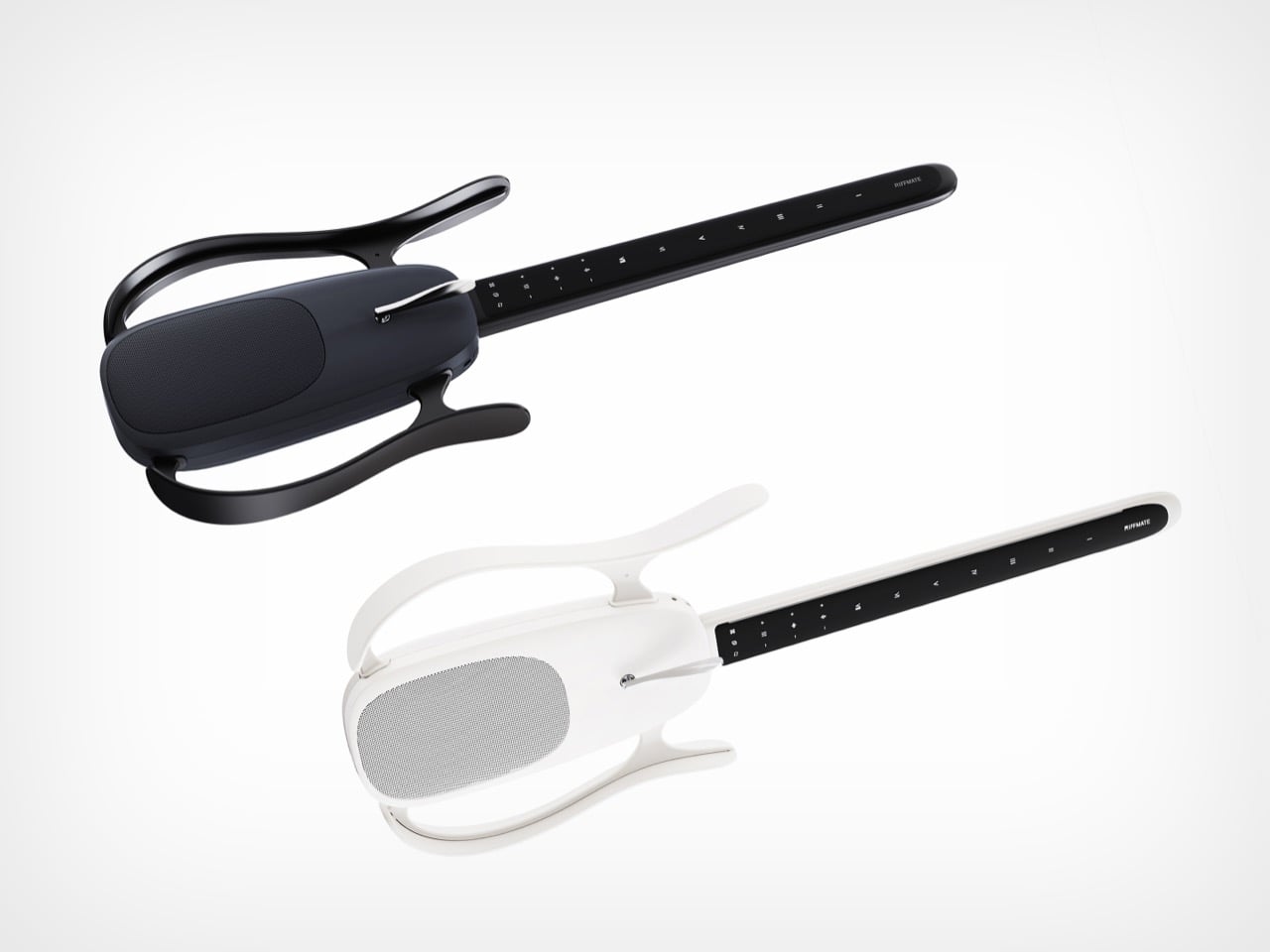
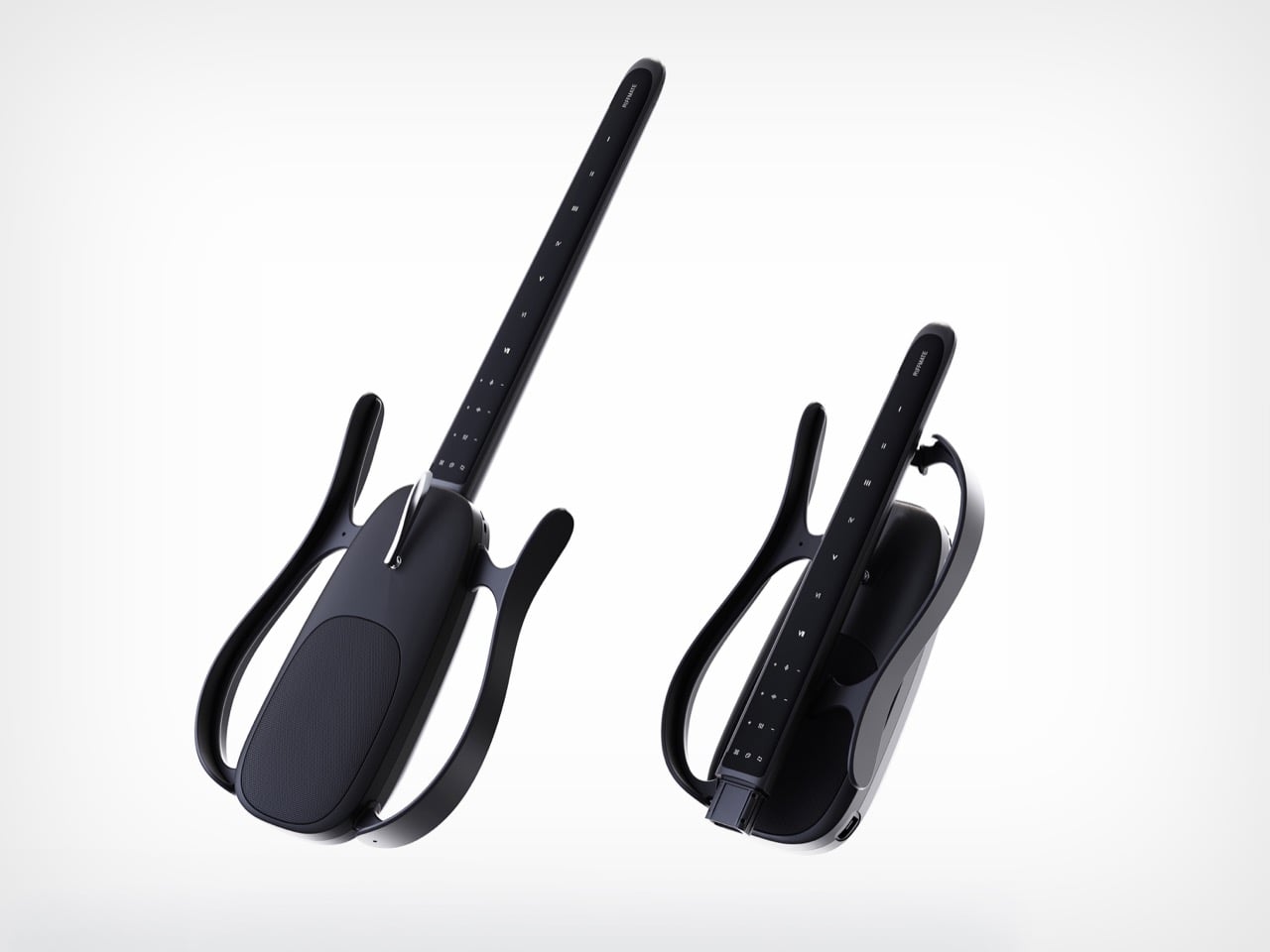
One-key disassembly lets the neck separate from the body, so the whole instrument folds into a small carry-on bag and clicks back together in seconds. Anyone who has wrestled a guitar into an overhead bin understands why that matters more than it sounds. The shells pop off too, which is where the personality lives, with RIFFMATE rendering in matte black, crisp white, a purple gradient, sunshine yellow, a blue-to-silver fade, and a warm walnut finish. Swapping those panels lets owners recolor the instrument or replace a scuffed part, stretching its lifespan instead of sending it to landfill. Modularity turns the guitar from a fixed object into a system that grows and changes with the person holding it.
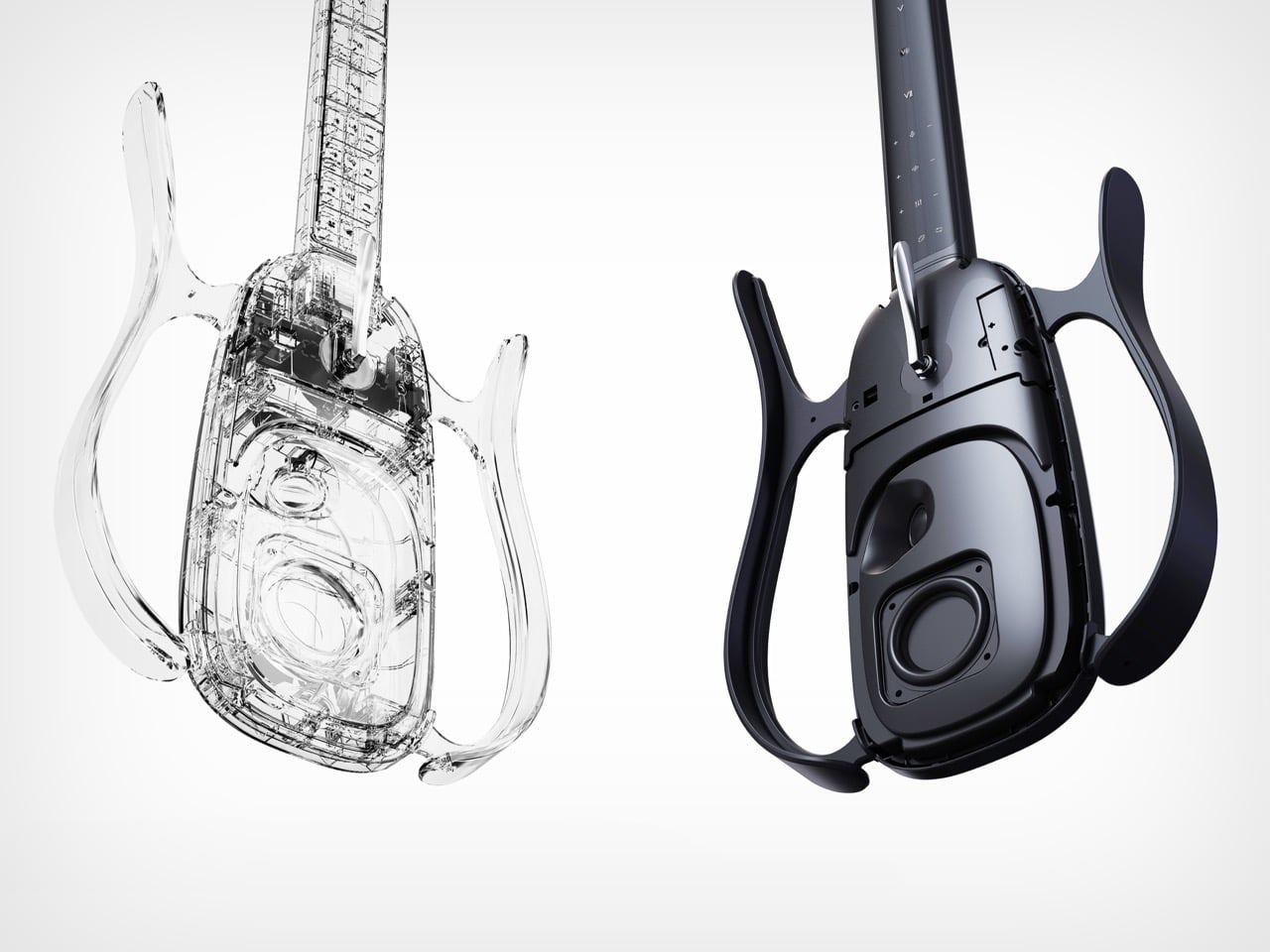
The transparent render exposes a properly engineered acoustic cavity inside that central pod, with dedicated internal channels feeding a front-firing driver. That makes RIFFMATE self-amplifying, able to fill a room without an external amp or a tangle of pedals. The body wears a matte frosted texture over soft, rounded contours, sitting closer to a well-resolved Bluetooth speaker than to a slab-bodied Stratocaster. Those friendly surfaces read as age-agnostic, pitched at a curious ten-year-old and a lapsed forty-year-old guitarist alike. The whole object invites handling, exactly what an instrument built to lower the stakes should do.
Smart guitars have inched toward this moment for years, and LAVA did much of the groundwork by wrapping carbon fiber around a built-in touchscreen and turning the instrument into a full software ecosystem. RIFFMATE pushes that lineage somewhere stranger, questioning whether a guitar needs strings or a body at all, and joining a small wave of stringless designs rethinking the form from scratch. The honest caveat is that this remains award-stage industrial design, so we are judging intent and renders rather than a shipping spec sheet. As a vision, it lands as one of the boldest reinterpretations of the guitar to cross my desk in a while. Whether Wo Tan Ni Chang can build the object as beautifully as LKK drew it is the question worth watching.