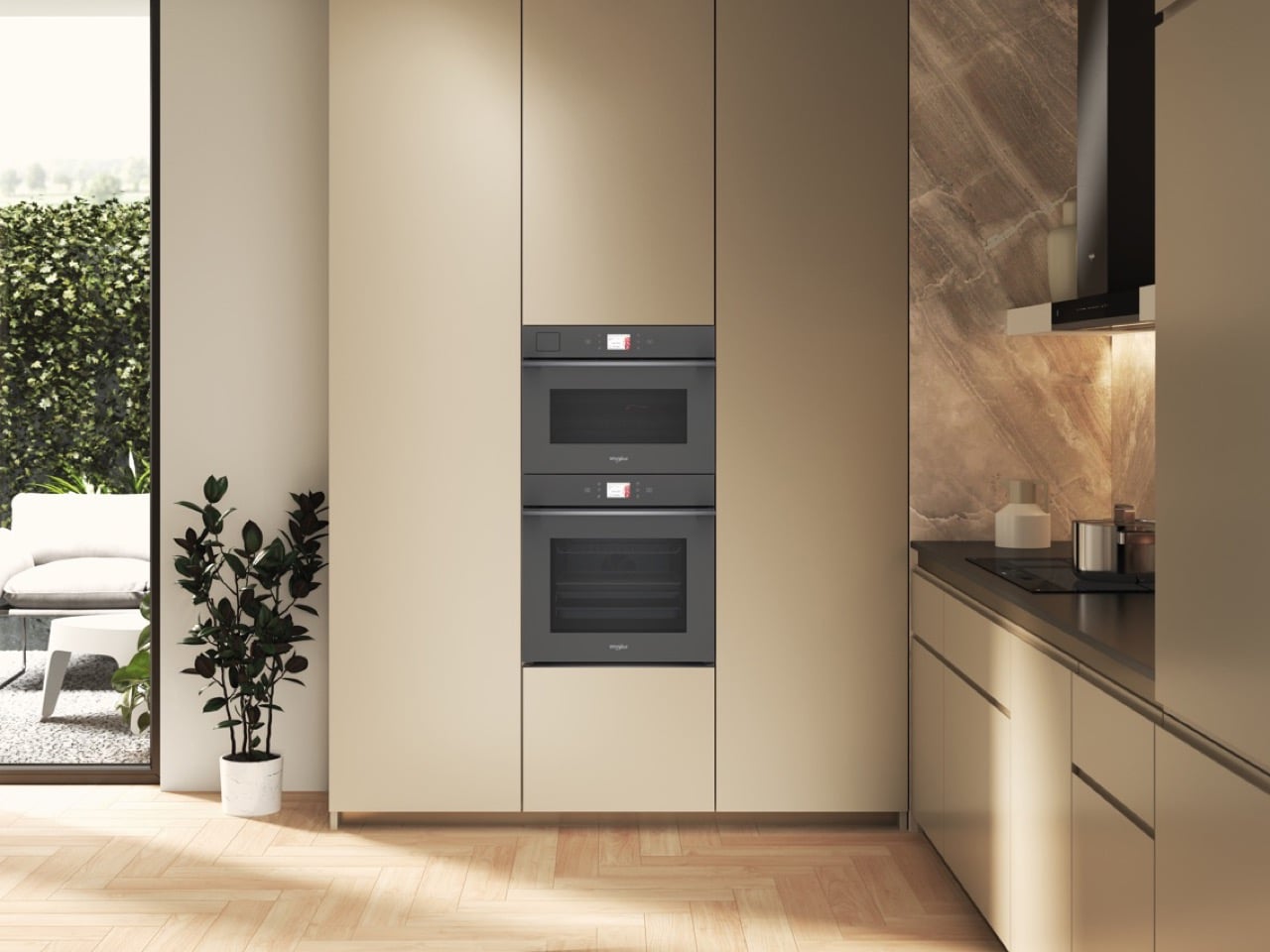

Here’s a fun rule of thumb: the less effort something takes to use, the more effort someone spent making sure it works. Good waiters make service invisible. Good editing makes a movie feel like it was never touched. Good design, generally, hides its own homework. Weirdly enough, that exact rule is now showing up in kitchen appliances, of all places. Whirlpool has spent the last few years chasing that kind of invisibility, building ovens and hobs that do more while asking you to do less. Its new premium lineup for Europe is basically one giant bet that simplicity is the hardest thing in the room to engineer.
That bet has a name and an address. The name is 6TH SENSE, the sensor-driven backbone tying together Whirlpool’s W Collection Kitchen Suite, a built-in range of ovens, hobs, dishwashers and fridges. The address is Cassinetta di Biandronno, a 60-year-old campus in northern Italy where design studios, food scientists and materials labs work out exactly how much invisible effort a “simple” appliance actually requires. The suite got its biggest showcase yet at EuroCucina 2026 in Milan, where Whirlpool shared a pavilion with sister brands Beko, Hotpoint and Bauknecht for the first time. It’s part of a wider premium push across a European built-in market worth around 6 billion dollars in 2024, expected to clear 9 billion by 2030. Turns out making an oven feel effortless takes a small army.
Designer: Whirlpool Global Industrial Design Centre, Cassinetta di Biandronno, led by Massimo Pedrazzini
The five-hour chocolate test that explains the whole strategy
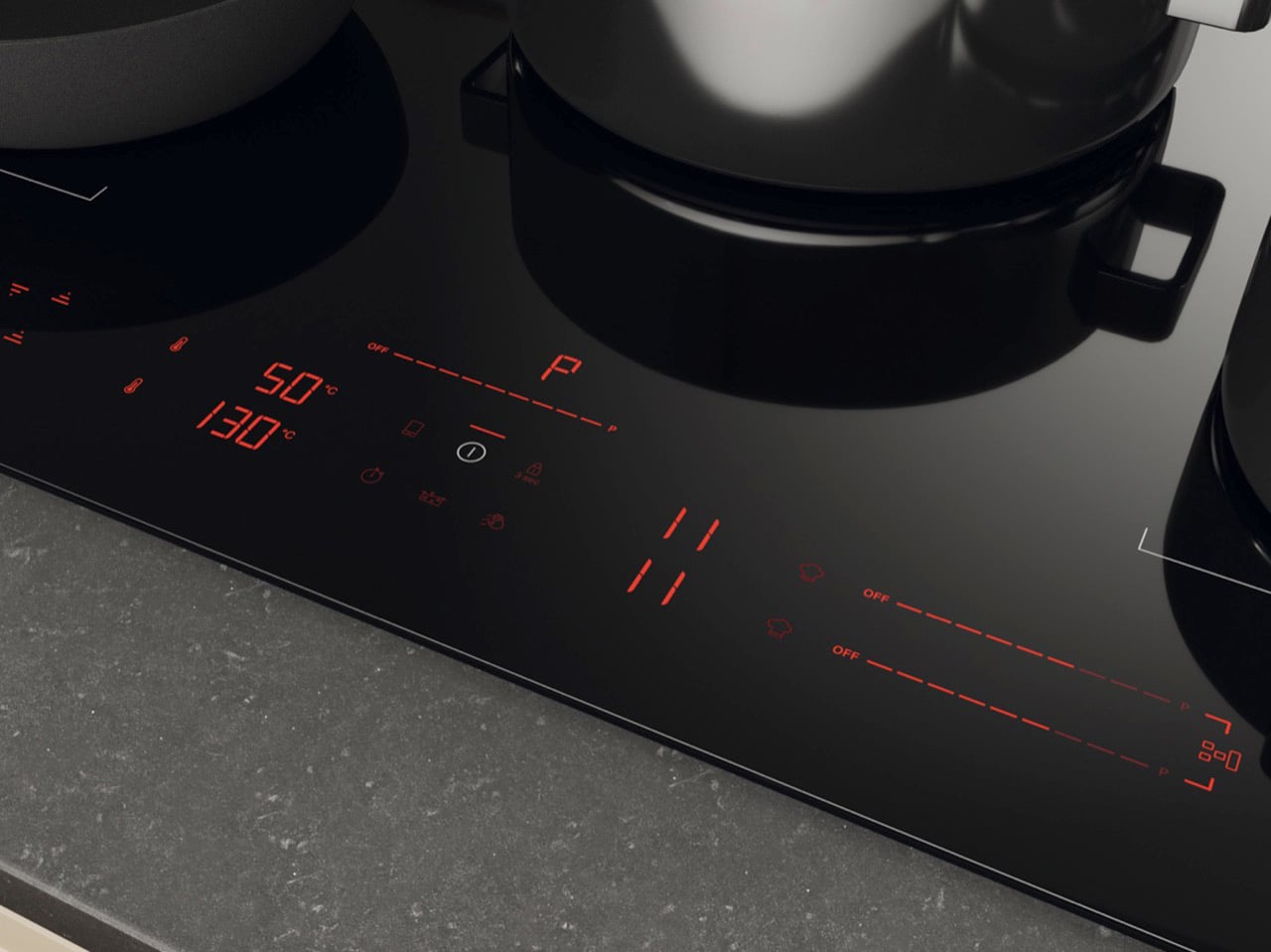

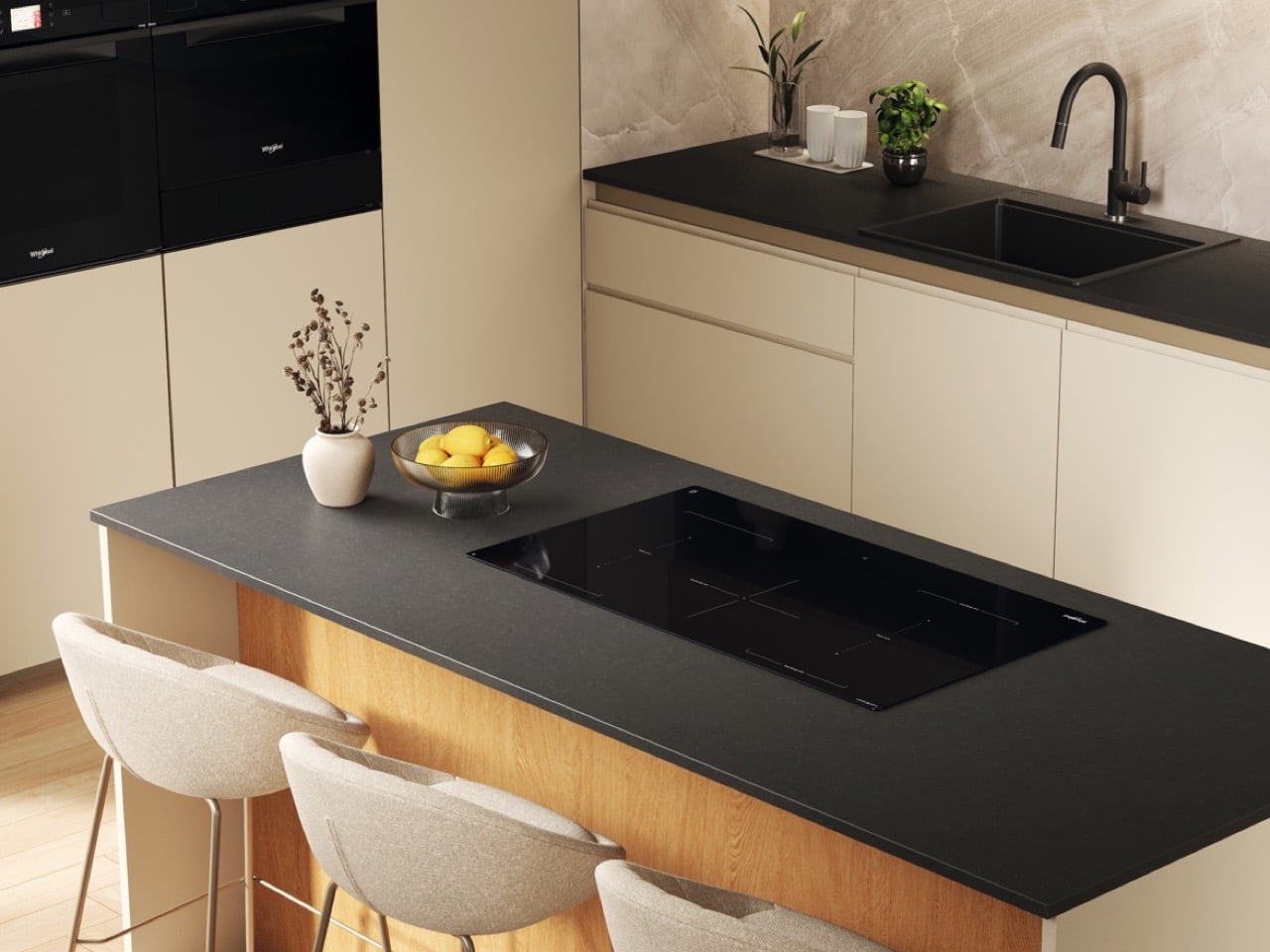
A pan of chocolate sat melting on a Whirlpool induction hob for five straight hours during the brand’s EuroCucina demonstrations, and came off glossy, smooth and completely unbroken. HeatControl is the reason, letting you set an actual target temperature between roughly 113°F and 392°F (45 to 200 degrees Celsius) in small increments instead of guessing at a power level between one and nine. Conventional induction asks you to translate “gentle simmer” into an abstract number, then keep wandering back to check whether you guessed right. HeatControl deletes the translation step. Its Hide & Touch interface goes one further and disappears entirely when the hob is switched off, leaving black glass and nothing else to look at.
The oven that switches itself off before you remember to check it
The self-supporting Food Sensing Probe tracks the internal temperature of whatever sits in the 73-liter cavity, and once your target is reached, the oven ends the cycle by itself. You pick a doneness, walk away, and the appliance handles the endgame. Cook4 runs the same logic sideways, cooking up to four dishes at once without flavors migrating between them, which Whirlpool says saves up to 72% of the time and 53% of the energy of doing them in sequence. The test behind that number involved cooking a full meal twice, a tart, roast potatoes, lasagna and chicken pasta, once simultaneously and once one after another. Pizza Party stretches it to four fresh 12-inch pizzas in roughly 15 minutes, preheat excluded.
Beko called it the invisible kitchen, and Whirlpool took it a layer deeper
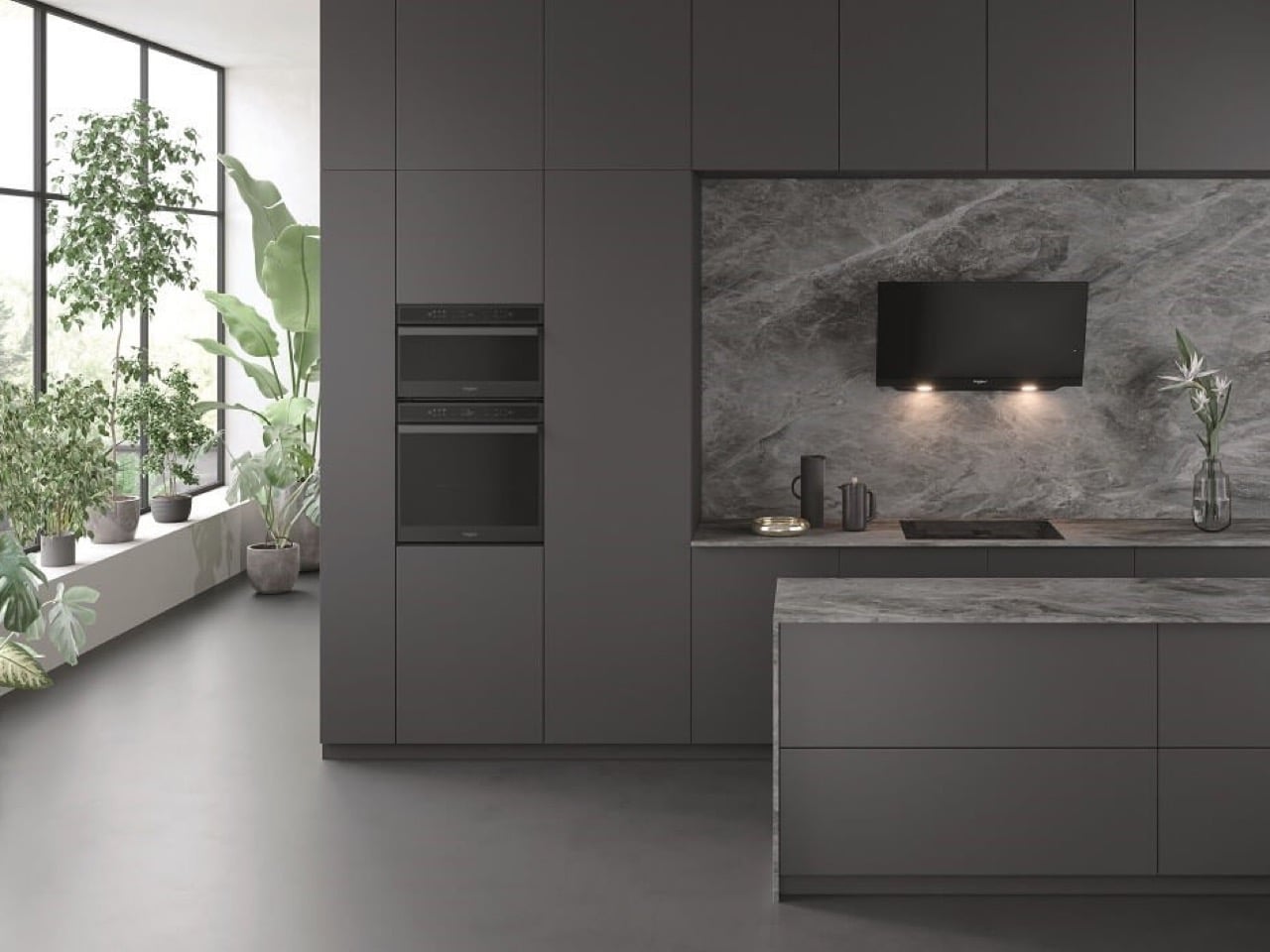
Beko named the theme of its EuroCucina pavilion the invisible kitchen, applying the phrase to hardware: flush surfaces, concealed hinges and handleless doors, all arranged under an undulating textile canopy designed by Mario Cucinella Architects. The staging was genuinely lovely, with each brand assigned its own palette, cream for Whirlpool against navy, terracotta and mineral for the others. Whirlpool then ran the same idea one layer deeper than the cabinet fronts. Visual invisibility is the easier half of the job, and plenty of the handleless minimalism sold as quiet luxury stops there while still asking for constant attention. Making the interaction disappear is the harder version of that idea, and it is the one the W Collection actually attempts.
Why removing a dial costs more engineering than adding one
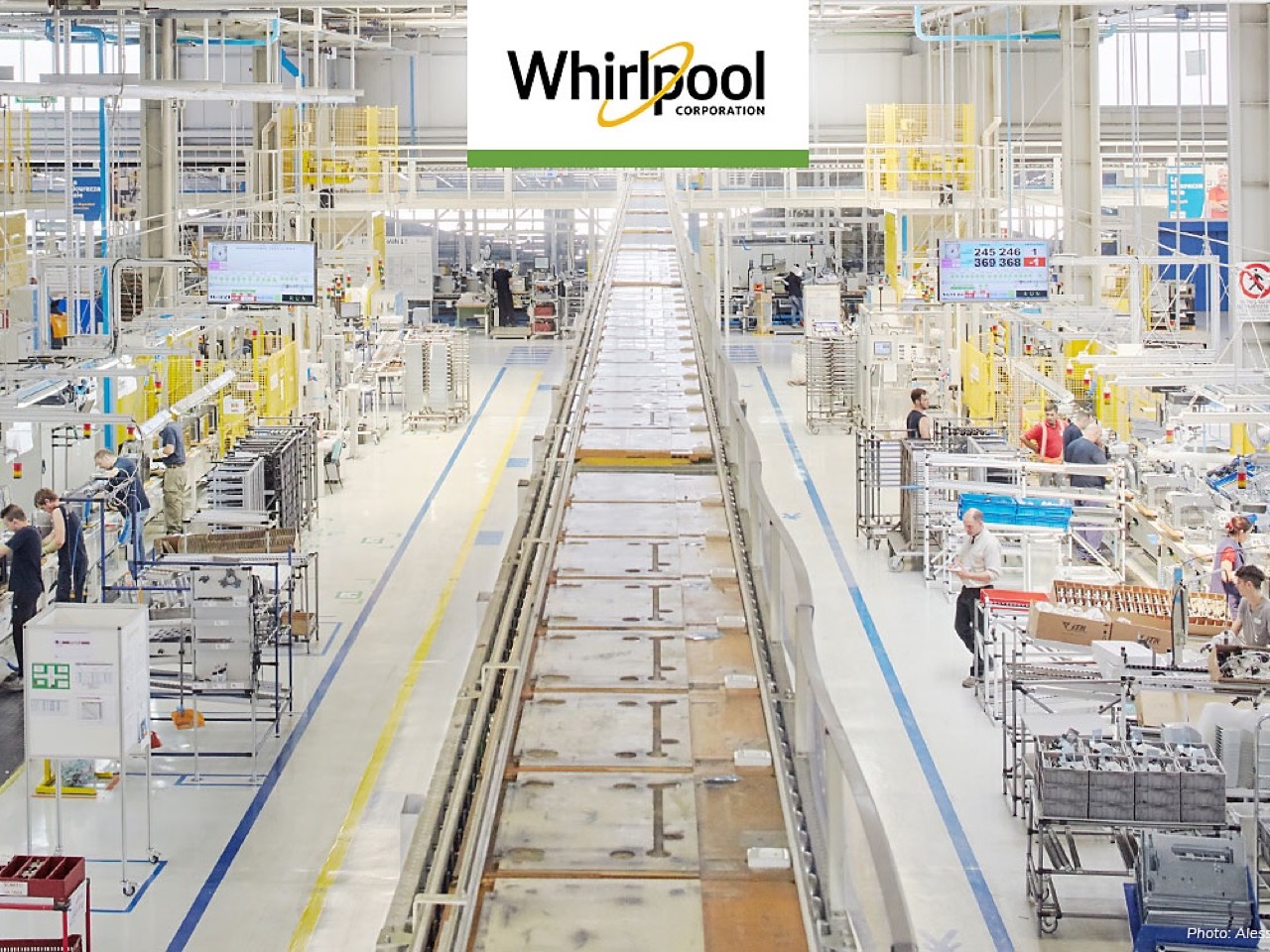
Every decision an appliance makes on your behalf is a decision someone else had to get right in advance, permanently, for millions of households and every recipe they might attempt. A power dial hands that responsibility to you. A temperature target absorbs it. That absorption is why a story about simplification keeps leading back to a 1.25-million-square-meter campus founded in 1965, where Whirlpool runs three production plants alongside industrial design, cooking R&D, food science and materials research. Roughly 1,480 people work there, with an average tenure of 19 years, which is its own quiet argument about how long this kind of knowledge takes to accumulate.
The design studio that reached for light instead of another screen
Massimo Pedrazzini leads a 31-person team at Cassinetta spanning industrial design, CMF, UI, ergonomics and prototyping, working from hand sketches through CAD and rendered finishes to physical models. Their brief for the latest built-in cooking platforms included a new cavity, a redesigned door mechanism, an internal divider to improve energy efficiency, and light used as the element that guides a user through cooking. That last one is the tell. Handed an opportunity to add another display, the team reached for illumination instead, a guidance layer that communicates without requiring anyone to read. The UX group behind it pulls from psychology, ergonomics, interaction design and product design, and still builds multitouch screens when a product genuinely earns one.
The lab that measures browning so you don’t have to stand there watching
Food Technology landed at Cassinetta in 2003 as a discipline connecting appliance engineering to how food physically behaves, studied chemically, nutritionally and microbiologically. The team measures color, browning, crispness and texture through objective methods, which is the only honest way an oven can decide something is done. MaterialsLAB handles the parallel job on surfaces, and its output shows up as MatteProtect, a matte induction finish Whirlpool claims is around three times more scratch resistant than standard ceramic glass while hiding halos and fingerprints. CleanProtect, a nanotech hob treatment, targets cleaning without detergents at all. X-Lab closes the loop with robotics, machine vision and additive manufacturing, bridging research and the actual production line.
The industry is split, and Whirlpool picked the harder side
Hisense turned up at CES 2026 with a smart induction range carrying a seven-inch cooktop display and AI agents coordinating timing between oven and stovetop, an opposite bet placed with equal confidence. One camp is adding a screen to the hob while the other removes the one already sitting there. AEG reached Whirlpool’s conclusion independently, launching four products at IFA 2026 built around never babysitting an appliance again, which suggests a genuine movement rather than one brand’s marketing angle. Even within Beko Europe the instincts vary, since sister brand Beko’s HomeWhiz platform makes energy and water use more visible per cycle. Whirlpool committed to attention as the scarce resource, and committed across an entire suite.
Who this suits, and why the intelligence sits where it does
Sensor-led cooking fits anyone who treats dinner as something to get done well rather than a craft to practice, which honestly describes most weeknights in most houses. Cooks who enjoy the fiddling lose nothing, because HeatControl exposes exact temperatures and the 6TH SENSE menu can be ignored entirely. There is a second point in Whirlpool’s favor that became obvious this summer, when Weber switched off the June Oven’s AI camera and turned a $999 appliance back into a box that heats. Intelligence running on the device ages considerably better than intelligence running on somebody’s server. Whirlpool’s sensing lives in the hardware you paid for.
Appliance marketing has spent a decade answering what a machine can do, and that answer stopped being interesting somewhere around the fridge with a television bolted to the door. The more useful question now is how much of that capability you are never asked to supervise. Whirlpool’s answer required a 60-year-old Italian campus, four laboratories and a team of 31 designers to arrive at a hob you can comfortably walk away from. Measured in effort spent per decision removed, that ratio looks gloriously lopsided. Measured by what makes a kitchen pleasant to actually live in, it might be the only ratio worth counting.

