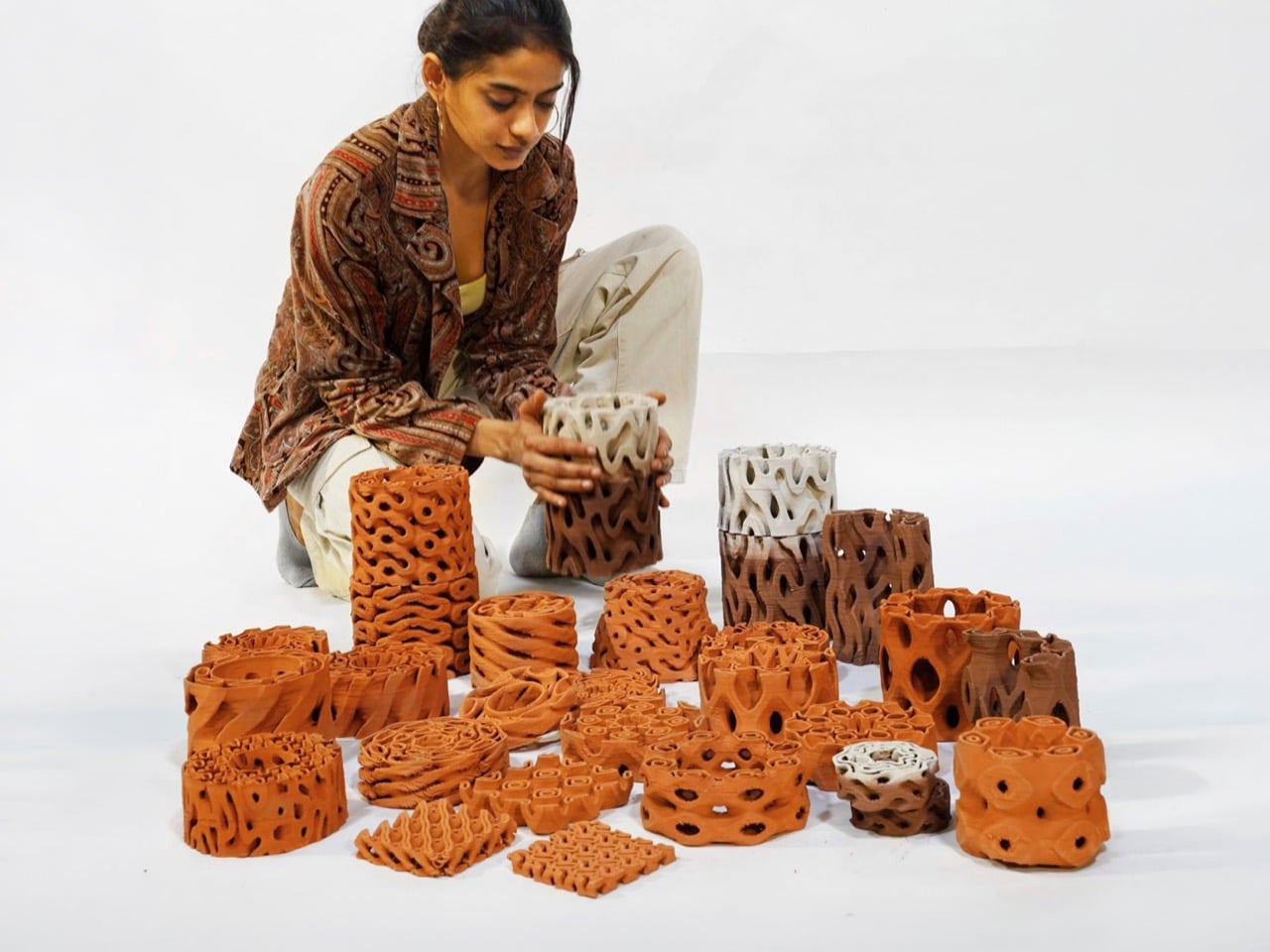
What would it look like for a building material to behave more like a living organism? Rameshwari Jonnalagedda has been sitting with that question, and Minimal Matter is her answer in clay. Drawing on the mathematics of minimal surfaces, geometries that appear in soap films, leaf veins, and cellular membranes, she has developed a system of 3D-printed terracotta forms that adapt to context the way natural structures adapt to environment. Each piece is porous and open-ended, capable of functioning as a thermal surface, an ecological habitat, or a structural element depending on how its geometry is tuned. The work is produced through additive manufacturing, which allows for continuous variation without additional cost or complexity. The forms look ancient and computational at once, as though the earth had been asked to solve an equation and answered in terracotta.
Jonnalagedda frames the work as a framework rather than a product, a set of conditions from which form continues to emerge long after the printer has stopped. The structures are designed to host moss, insects, air, and light, becoming more themselves over time rather than less. There is something almost philosophical in that proposition, the idea that a designed object could have an open-ended future, that it might weather and colonize and shift rather than degrade. Most materials we build with are fighting time. Minimal Matter is cooperating with it.
Designer: Rameshwari Jonnalagedda
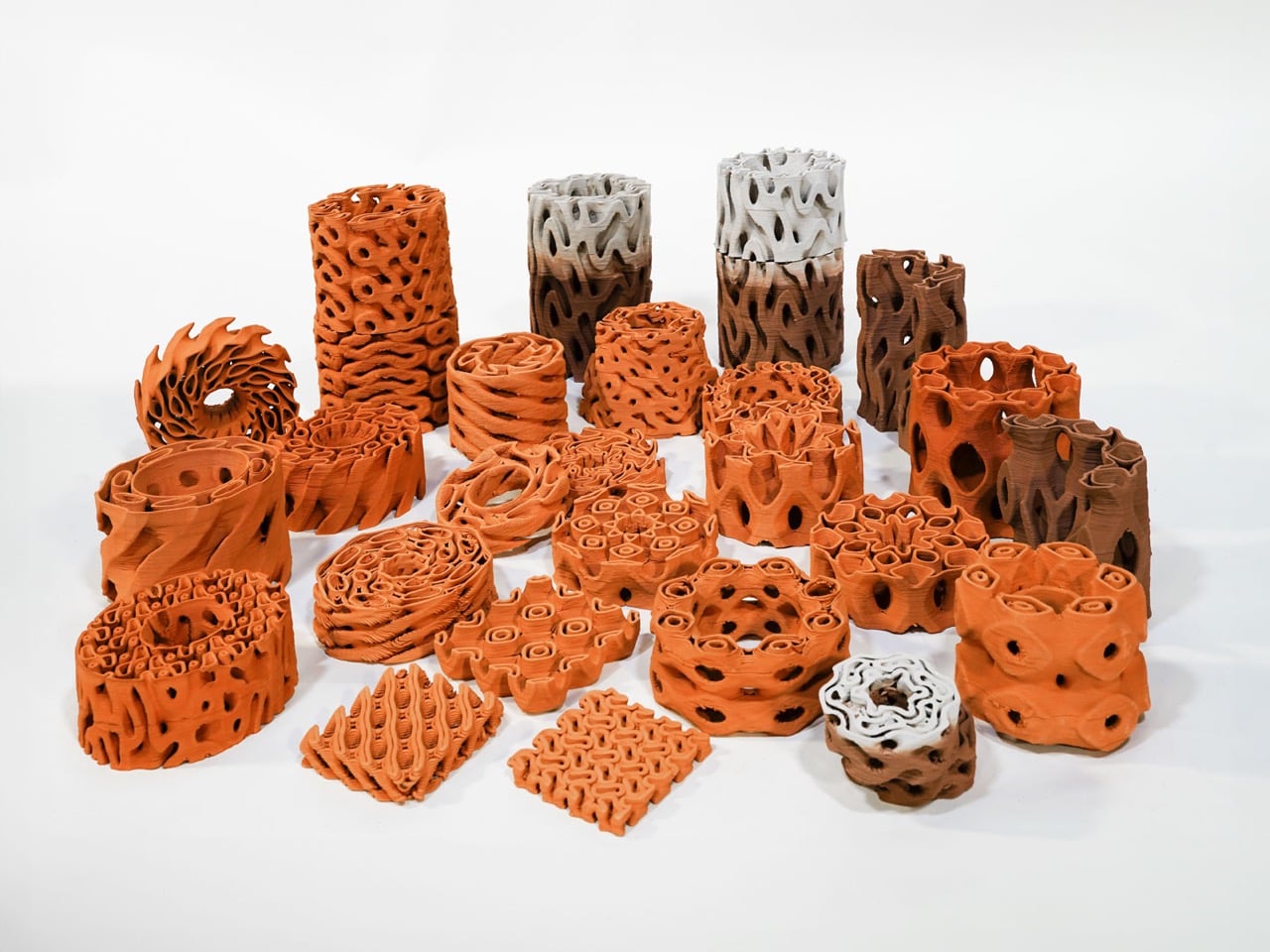
I keep thinking about the Sagrada Família when I look at these pieces, which is admittedly a strange place for the brain to go when confronted with palm-sized terracotta modules. But Gaudí spent his life studying natural load-bearing geometries, catenaries and paraboloids and hyperboloids, and insisting that nature had already solved the structural problems architects were torturing themselves over. Jonnalagedda is working in a completely different register, scale-wise and ambition-wise, but the underlying conviction is the same. The math is already there. Your job is to listen to it.
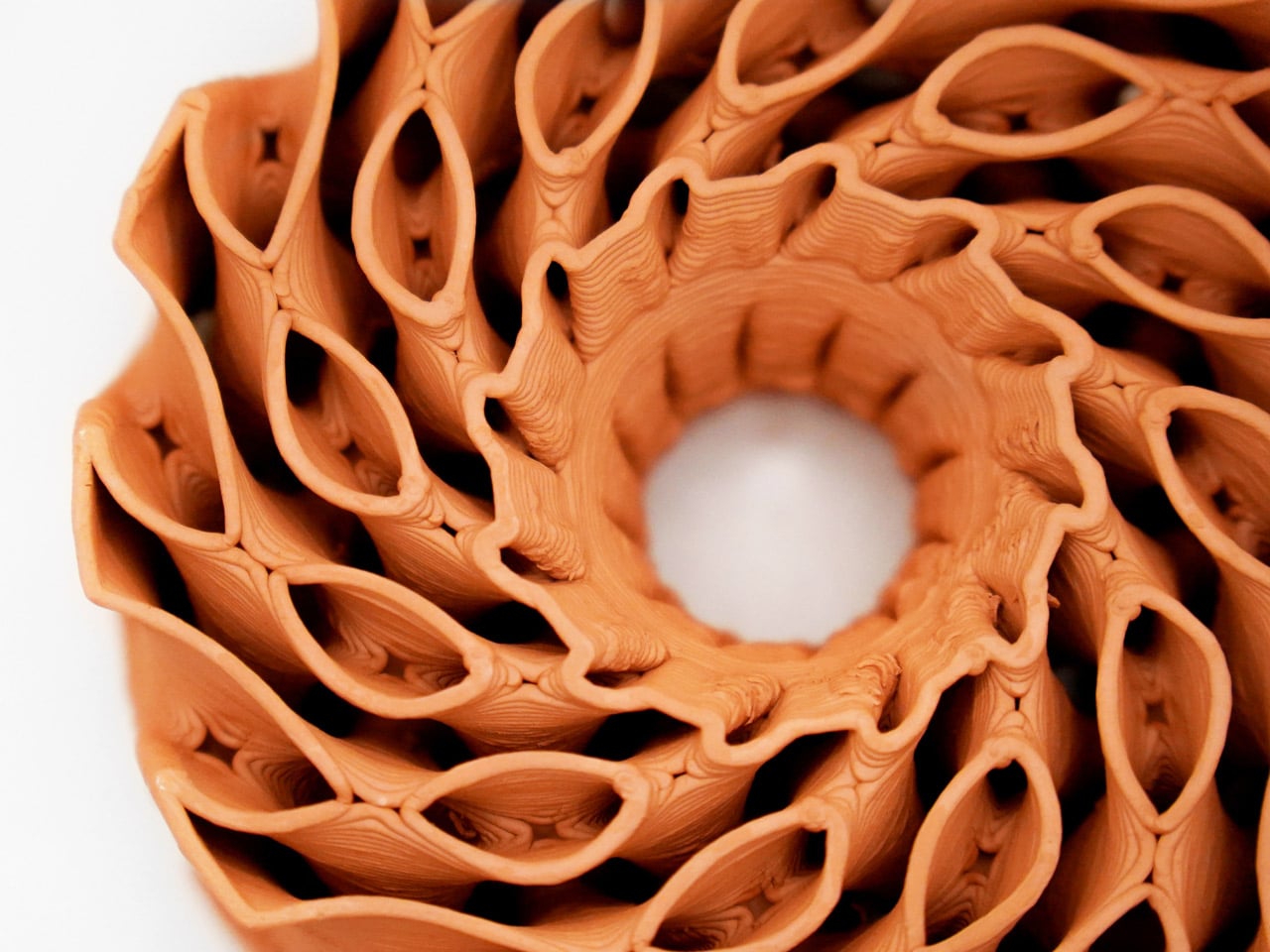
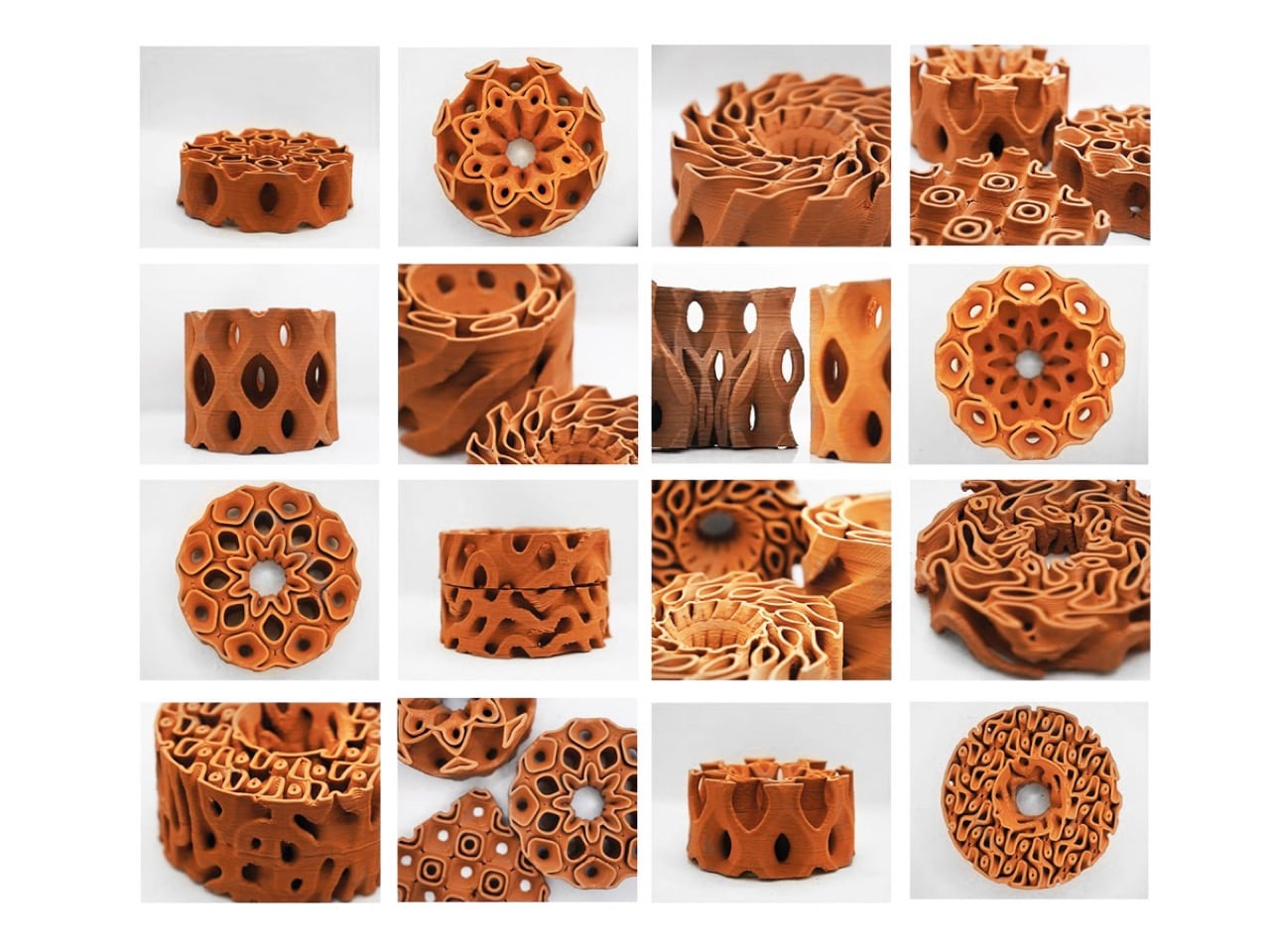
What makes Minimal Matter visually arresting, beyond the obvious formal beauty of the pieces, is the way the layering from the 3D printing process becomes part of the surface language. Close up, each form reads almost like topographic contour lines, the deposit of clay recording every decision the algorithm made. You can see the logic of the geometry in the material itself, which is rare. Most 3D-printed objects try to hide their process, with sanding, acetone baths, or even tweaking the build settings to reduce ‘steps’ from showing. These celebrate it, and the terracotta’s warm ochre tone makes the whole thing feel less like a prototype and more like something excavated.
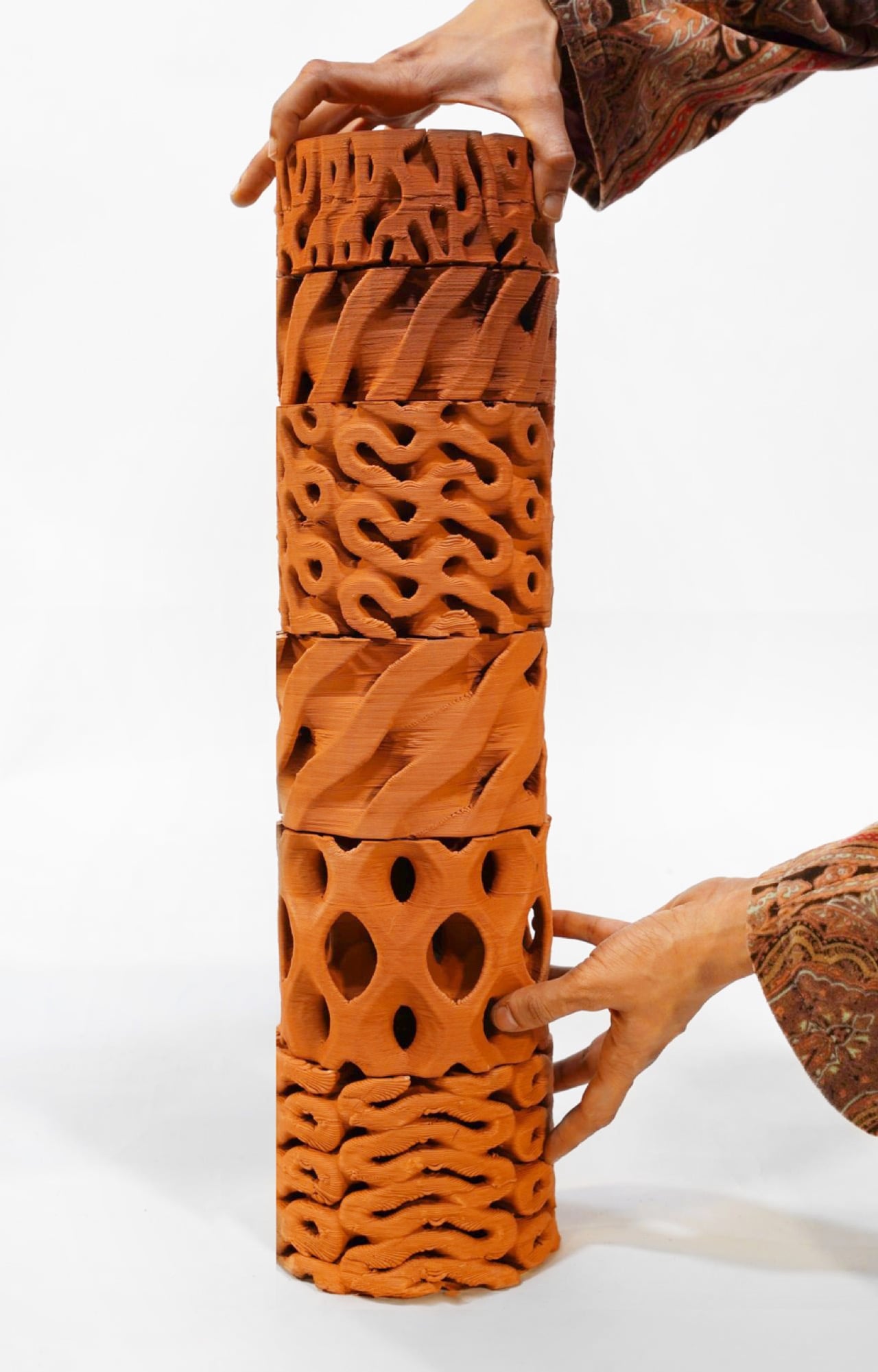
Individual pieces stack, combine, and reconfigure, which means the system scales without losing coherence. A single module functions as a sculptural object on a desk. Four stacked become a column. Spread flat across a surface, they start to read as landscape. This scalar flexibility is genuinely hard to achieve in material design, and Jonnalagedda pulls it off by keeping the underlying geometry consistent while varying the expression at the surface level.
The work points somewhere larger than a single award category can contain. Jonnalagedda is asking a question that the construction industry has been too busy pouring concrete to consider: what if the things we build were grown into place rather than imposed upon a site? What if a wall could host an ecosystem, a surface could regulate temperature through its own geometry, a material could become more itself the longer it was left alone? Minimal Matter, recognized in the Young Talents category at the Design Intelligence Award, doesn’t answer all of those questions, and it doesn’t need to. It just makes them impossible to ignore.
SHARE