
Bike Powered Bus Rides!
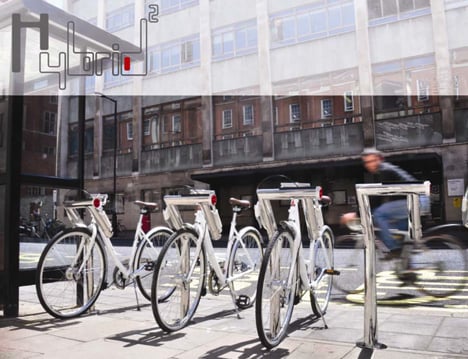
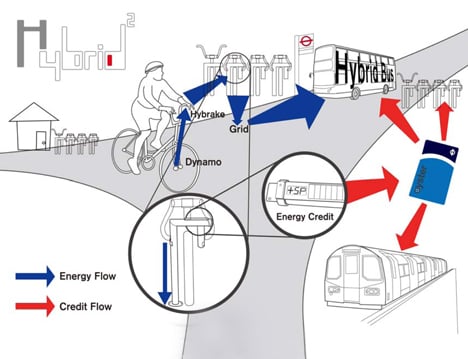
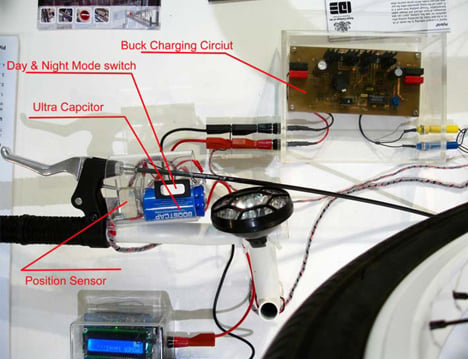
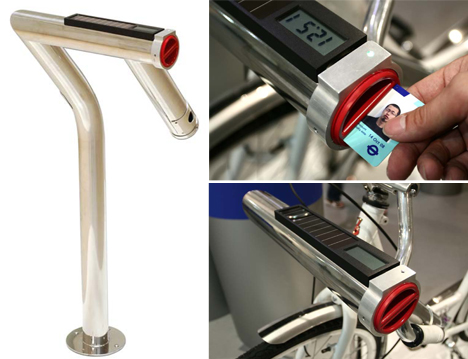
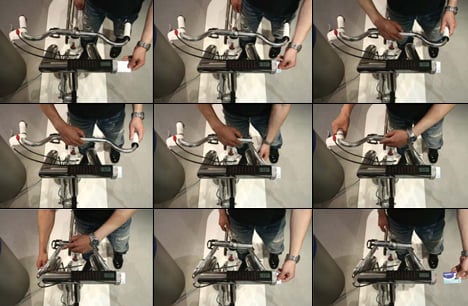
You heard that right! What do we want? Power. How do we get it? Dynamos! What we’ve got here is a public-rental bicycle concept that uses a pretty simple dynamo in the wheel combined with some circuitry in the bike that generates a generous amount of power that’s then saved on the bike until it’s parked. Once the bike is returned to its rental spot, parked, hooked up, it provides power to the nearby hybrid bus system!
These bikes are barked in their stalls, locked up right near the public bus station. This way not only is it easy to transfer power generated by the bikes to the busses, the bikes are easy to access by commuters.
The best part about this is the card. Your personal ID card allows you to possibly ride the bus for free. How? Generate enough energy! You gain credit on your card for the amount of energy you’ve generated on your bike ride. And you get exercise! No down side!
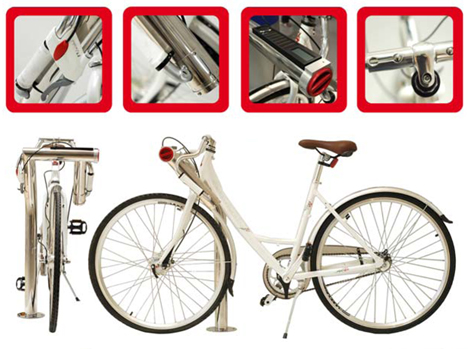
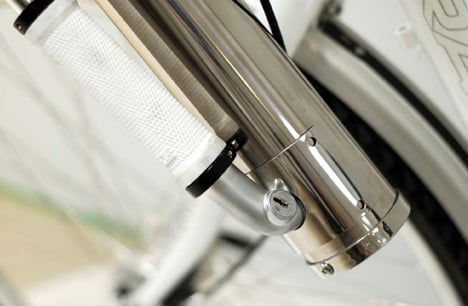
Bonus – there’s also an amazing lock system on the bike. Watch the video to hear the business from Chiyu Chen himself!
Designer: 陳祁侑 Chiyu Chen


64 Comments »
Mateusz says
That is one of thy greatest ideas I have ever heard. I’m completely before it a hundred percent.
But just one suggestion; could there possibly be a more suitable and attractive redesign to the bike? It appears quit prehistoric for what it says it can do.
With modern day engineering in aerodynamics, this bike can become a lot more cost effective and giving better performance.
Chiyu Chen says
I’m too lazy to design a new bike…hahaha
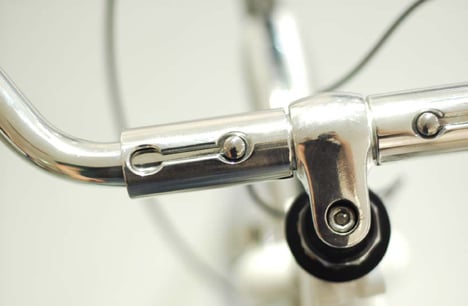
Thank you very much for your advice really. This is a proposal using existing technology for concil owned bike hire scheme for our near future. So one of my criteria is reto-fit exisiting public bike with components slightly different to standard ones, for example, Velib Paris. Then we may reduce the cost of energy for manufacturing and of investment. According to this, the less I change, the better. Thus everything I design is on the handlebar including the handlebar itself.
I might design a new bike if using Hydrogen as the energy form to be stored in the bike. Howeveer, the effuciency of the existing technology is still too low. So please kindly bear with the bike actually sponsored by Raleigh. Classic, isn’t it?
Jean Pierre Merelle says
Excellent, votre initiative est un acte humaniste de haut niveau.Ce genre de projet, mérite notre considération citoyenne. Merci pour votre contribution!
Ja says
I appreicate the idea particularily the system itself. We generate energy from different ways (not only the cycling) and we can be credited and use it back as fee when travel. It is a good try.
Chiyu Chen says
Thank you for your appreciation. As energy we (as human being)can generate is just too small to deal with. How to gather? Where to apply? Every human power product on the market may share these two questions in common. Actually, I’m not really into energy issues. Just try to prove that designers can do something positive instead of only making green statement to raise social awareness when facing to environmental issues.
anonymous says
That miniature ultracap won’t store enough energy to move the bus’ motor between poles. This is a terrible idea, and is physically impractical to the point of impossibility.
Chang Yi says
It probabaly depends on how we define the statement “Energy stored in the ultacap can move the bus’ motor”. If we can see the big picture, though one signle bike ride can’t contribute a lot, what about 50000 bike rides per day? I can see this project may not focus only on how much energy people can generate. (human power is nothing comparing the mass produced electricity)Instead, the benefit of the whole intergrated system through retro fitting basic infrastructures for public bike schemes might be significant. (energy plus + energy minus) Good combination of technology and design.
anonymous says
No. The ultracap stores thousandths of the energy of one small rechargeable battery. The rechargeable battery stores thousandths of the energy needed to move the bus. Even if someone rode 50,000 times in a day, you’d move the bus a few feet.
If you wanted to actually do this, you’d need a much larger generator than the miniature 6W hub dynamo (perhaps a 500W motor/generator that weighs 20 or so lbs), a large battery (another 30 lbs), and a very long, very tiring commute. Then you might be able to earn yourself a free bus ride with a few months of heavy pedaling. A small car has a 40kW engine – let’s be conservative and say that the bus requires that much power to move. Let’s also say that 40 people ride the bus, meaning that 1kW is necessary to do your part. That means that for an hour long bus ride, you’d need to pedal an 80 pound bike for 2 hours to generate enough energy. This is assuming that everything is made of magical space material that has 100% efficiency.
The numbers have all been tilted in favor of the design of course, in real life, the bus engine is bigger, the components have significant losses, 40 people don’t ride the bus at once, and nobody wants to pedal an 80 lb bike.
Chiyu Chen says
Hi Mr./ Mrs Anonymous. I do appreciate your knowledge in engineering.
If we say 5W avarage output (3W from normal mode + 15W from regenerative braking), 40 mins average cycling time (you need to return the bike within 40 mins to keep the stability of sevice), we may need something which can store 823 Farards. Which is about 3 ultracap I use from Maxwell(310 Farads each). And there will be 60000 extra bike rides/day estimated after the bike hire scheme launched in London. Energy these people generate will be around 300kW(accumulation), which can feed a Hybrid bus with 240hp electric motor to run 3 hrs/day(norally, only half horsepower needed to run the routine). Not much as we all know.
Then we may talk about the future in 20 years time. When more and more hybrid or electric vehicles on the street, how we going deal with the energy in the battery going down really quickly in the 90% of time/day without running. Can we discharge electricity in electric vehicles in the peak time at higher price to feed the need of public transportation system and then buy energy back in out peak time, low price. We may need an infrastrcutures on the street working like electricity vending machine. Can the bike docking station play this role?
Then that’s think about bike hire scheme. If we are going lauch a bike hire scheme, 3 basic elements we may need to invest, Bike Stands, bikes, and dynamos. Two extra things I add, ultracap with 30 years longivity with 10£, and one PCB board with 50p.
A well planned future can usaully reduce the cost of making up. By launching a bike hire scheme, we set up a smart grid, electricity vending machine/ bike stand, interface/service. We can see how the future look like, can’t we? (Though quite few technical problems of energy conversion, transmitting, storage)
This project is just a step closer the dream world. Thank you very much for your input indeed. We may discuss more.
anonymous says
You’re mixing up power and energy. Your calculation is approximately correct, however be sure to state 300kWh, not 300kW. This google search will do the calculation for you and get the units correct – http://www.google.com/search?hl=en&rls=org.mozilla%3Aen-US%3Aofficial&hs=GFT&q=60000*0.5+*+900+farads+*+%286+volts%29^2+in+kilowatt+hours&btnG=Search&aq=f&oq=&aqi=
However, a similar calculation shows how much energy each bike can store – 0.5 * 900 farads * (6 volts)^2 in kilowatt hours = .0045kWh, which means that you’re not earning a free bus ride anytime soon if the bus uses 90kW. It’d take you on the order of 500 bike rides to have one free trip.
The credits thing is a nice idea, however, don’t you think that the energy spent building this system would be better off building a single wind turbine that’s easier to maintain and far cheaper?
Gunnar Tveiten says
This is a net energy-sink. There’s quite a few problems with this;
First, getting people to bike more is indeed a good thing, but is putting extra weight, cost and effort into biking really the way to do that ?
Second, the extra energy going into the production of this huge infrastructure completely dwarves the energy collected. What is the sense of spending 10Kwh to collect 0.1Kwh ?
Third, it’s hugely impractical. The energy has to be transfered and stored multiple times, each time at great cost, and with associated losses. That’s just stupid. Even if the two first problems didn’t exist, it’d still make more sense to just inject the energy into the local grid and use it immediately. (which would cause some powerplant somewhere to have to work SLIGHTLY less hard, thus polluting less)
Chiyu Chen says
Thank you for your input. Please kindly have a look of my precious comment. This projest in only few products designed. It’s a system. Might be diffuclt for Mr. Editior to go more detail. The reason I plce bike station next to bus station is to have possbility to feed hybrid buses when passing by. But the enegy supply actually is not only from human power. Human power is just a top-up. By doing this, we may create the value for the energy cyclist generte through converting electricy into petrol.
Your suggestion is really good. Thank you.
Michael Hoskins says
It’s a neat idea; I especially like the “hybrid” braking system. I wish I could find a use for the decelerative energy wasted through friction while braking when biking. It’s just too bad it’s far too small an amount to be useful to anything larger than, say, a lighting system for the bike.
Chiyu Chen says
Indeed, energy is engineering hardcore. Finding an application is far more diffuclt than generating. Thank you for your appreciation.
Chiyu Chen says
Indeed, interms of human power, findling an application is far more difficult than generating. Thank you for your appreciation.
Gunnar Tveiten says
Human power is not useless. It’s useless for powering *buses* and other devices that gobble megajoules by the truckload.
But there’s a class of devices that need only milliwatts to run, and where *not* having to recharge them regularily is nevertheless a tremendous benefit.
A jacket that charges mobile-phones and mp3-players put in a pocket when you walk, for example, would be a supercool thing. No, it’s not a *huge* deal to have to recharge your phone or mp3-player every few days, but it’d be better still to not have to.
This works because a mobile phone uses less than a single watt, which is something you can easily leech from human power. (be that a bike, body-heat or something else)
Chiyu Chen says
In the concept, human power tops up the energy supply of electricity vending machine(Bike Stand). It’s small really, but we are not expecting buses can run only by human power. The reason I apply this “bridge” is that the more energy we can pick from commuting from point A to point B, the more use of petrol we can reduce. And then we can reward users by the price of petrol they save. The title “Bus powering bike” is exaggerated by the editor.
“A jacket that charges mobile-phones and mp3-players put in a pocket when you walk.” In terms of market and usability, it may work. However, you may think the question you asked earlier, “What is the sense of spending 10Kwh to collect 0.1Kwh ?” What came to your mind when you question this issue?
The balance of energy input for manufacturing and energy output is acutually my first filter at very begining. Without this, this project may ends up with another fragile green statement. This is my MA project for my degree at RCA. A project can fit what people can expect to happen may not what I want to achieve, for example, designing a jacket for Nike to co-brand with I-POD.
Concering the energy balance, ideas like personal power generators are something that we need to eliminate. Human are not making regular movement for 12 hr/day. We need have a product that allows thousands and thousands people to use. “A Public Platform” is one of the design strategy.
What a designer can do when we face to environmental issues? What an engieer can contribute? What a polititian can do? This project is something that we all can refine and even come up something better. It is actually really good to discuss with experts like you. Please kindly give more comments if you feel like. Thanks.
erico pierotto says
Cool!
aa says
a question: how much power can one person make until to get on to a bus for free? I mean human can only make ca. 15W by riding, if at the same time to save energy during the ride, he will get tired quickly. And the bus driving using much more power, 100kw?
Chiyu Chen says
Thanks for your question. I’ve roughly estimated the offset to determine if the incentive is enough for users. These paragraphs are part of my report. Please kindkly give me input if you feel something wrong. Thank you.
Hybrid 2 provides users energy credit offset when they return bicycles back to the docking point. These credits can be used for transferring other public transportation means or for the next hire.
In the actual experiment I’ve done with Mr. Halimi in Electronic Engineering, Imperial College, bicycle dynamo motors can deliver 233J to Maxwell ultra capacitors within 5 minutes at 15km/hr speed through best-performed circuit I’ve designed so far. This indicates that within 40 minutes, which is the maximum time for hire a single bike, an individual is able to generate approximate 1.8MJ. According to the report, The Route to Cleaner Buses 2003, made by Energy Saving Trust, all batteries on a hybrid power bus charged during peak time rates cost 0.045 British Pound per kilo-meter, and energy use per km of a hybrid bus is 1.59MJ. We can see every single bike ride can at least earn 5 pence if we only compare the human power with the electricity for hybrid power buses. We can imagine users may bring more benefits in terms of reducing petroleum used to power electric engines on hybrid buses.
The credit offset may encourage more potential users to involve Hybrid 2 and public transportation system and then reduce more energy from their original transportation means.
Gunnar Tveiten says
Chiyu ! If you generate 233J in 5 minutes, then in 40 minutes you generate 1.8kJ, not 1.8MJ.
So no, you don’t make 5 pence with such a ride, you make 0.005 pence — or put differently you need to take 200 such rides to earn a single pence.
I’m sorry, but designing stuff like this really doesn’t work without atleast a rudimentary understanding of physics.
The Hub says
Do you have to use these bikes? Can’t you modify your own… with the dynamo…. and plug in that way, gives more freedom in the system
Recumbent Bike says
Seems like an interesting idea. But you eliminate a lot of your potential audience because they can’t balance or don’t fit on a once size fits all bicycle. So how do you leverage your technology into multiple models of bikes that different size people will/can ride?
cani says
The new Marguerite parking is a compact mechanism that offers enough parking space for numerous bikes in a limited space.
Taking a cue from nature, French designer Yoann Henry Yvon
has tossed up an innovative parking design for bikes in ever-expanding cities of the developed as well as the developing world. Featuring several rows of bike holders, resembling petals surfacing from a centerpiece, the ‘Marguerite’ bike parking rack is a compact but functional parking solution for urban areas. The petals, located on the spokes, work like holders and grip the bikes firmly.
http://www.behance.net/Gallery/MARGUERITE-bike-rack/147158
Trackbacks