
Cutting Board Woes
A surefire way of sanitizing your kitchen cutting board is to add chlorine to the rinsing water every once in a while; sadly who’s got the time for it! We basically soap it thoroughly and rinse it off hoping that the bacteria are washed away and are not having a picnic out there! About 76 million cases of food-borne illness, most of which are caused by bacteria inhabiting uncooked food or contaminated cooking surfaces, are reported every year. Hopefully the UV enabled Alkeo will not let us become another statistic.
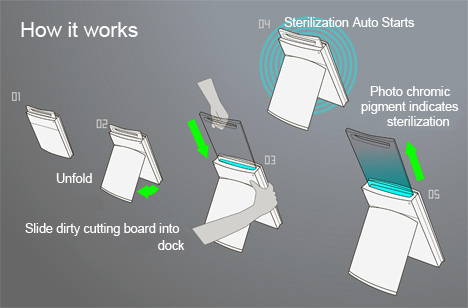
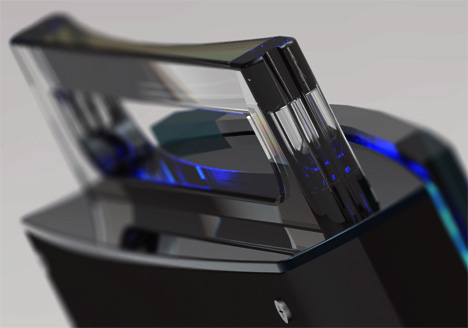
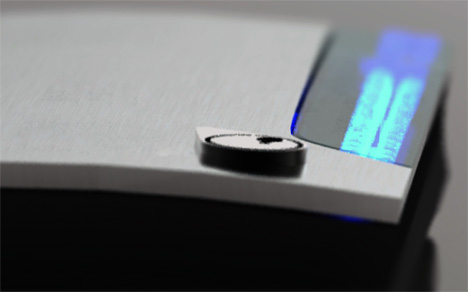
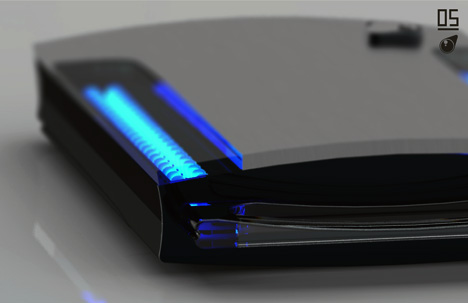
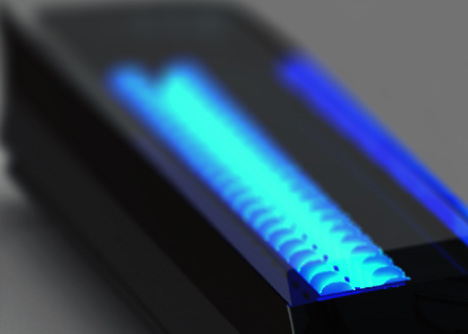
Although many consider plastic boards to be safer bet, the truth is that maintaining a hygienic cutting board is difficult. Alkeo is a kitchen-top device that uses a medical-grade germicidal UV lamp to destroy bacteria and viruses on the sturdy polycarbonate cutting board that accompanies it. Basically, after you’re done with your chopping, you simply push the board through the slot on top of Alkeo and let the UV do its destructive action. Although this device may give you the satisfaction of a sterilized cutting board, it may be wise to follow the adage “When in doubt, throw it out”; when considering discarding an old board.
Designer: Joe Brussel



24 Comments »
Lamah says
If I’m sliding a dirty chopping board into it as suggested, the inside of that thing is going to get totally filthy. If the board is damp (and it will be), you’ll end up with a little pool of food forming inside the bottom of the cleaner. What provisions does the design make for this?
Kidder says
I think the concept is pretty sound. Chopping board hygiene is very important. Consider that when you use a board for a while you end up with tiny grooves in the surface. These grooves could easily allow raw food stuffs to be essentially embedded in the board and become a bio-hazard.
Lamah makes a good point that you would not put a dirty board into the device, because you’d end up with bits of food stuck inside. I think this design would make more sense as a storage rack rather than a cleaning device. Clean the boards as normal using soap and water, then dry on a regular drying rack. Then place the board in the UV device for storage. I would probably configure the device to give good dose of UV when the board is inserted and turn off the UV until the next time the board is inserted.
I think this concept should be expanded to include other kitchen utensils, especially the ones that contact raw food stuffs regularly (such as knives and cooking spatulas). Just add more slots to the device to slide in your other utensils. It wouldn’t look much different from a regular knife rack (other than maybe looking very futuristic!)
Lamah says
I think if the design combined both the drying rack and sterilization part it would be perfect: Drain at the bottom?
Kelly Hayden says
I find this to be a rather useless invention. There are already a billion kitchen appliances on people’s counters for all of their cooking and cleaning needs. I would not want to add another with such a specific and limited use. That being said I do like the idea of cleaning with UV. I think it would be best implemented after a drying cycle in a dishwasher or make it a standalone setting so you don’t have to wash the dishes that are not dishwasher safe. You can just set it to UV and not worry if the dishes will be ruined.
designcomps says
There are various health reports to suggest that exposure to a certain amount of bacteria helps maintain a strong immune system. if you were to nuke every bacteria what would happen when they evolve to live through the uv light? im not saying live like a pig, but is this design really a solution to anything?
ryan says
another case of solving a problem that doesnt exis
Émile Essent says
You can also get wooden boards, the wood will get rid of bacteria overnight.
Carl says
true, i have heard that the sap is a natural anti-bac
Henrique Staino says
Well, that being so, take a dump on a wooden board, let the wood do its magic, and lick it the next day.
confucius says
What you get up to in your own time Henrique is your own business.
Although a nice design and solid concept its just not feasible.
The good ‘ol wooden chopping board kills bacteria, just needs a wash often enough and there is no risk of contamination.
Im reminded of the age old story from the 1960’s space race. The Americans spent millions of dollars developing a pen that would work upside down in zero gravity, the Russians on the other hand, used a pencil.
Henrique Staino says
All I can tell you is that ANVISA – Kind of a brazilian FDA, and I mind you that Brazil can be VERY retrogradous in many aspects – forbids the use of wood in commercial and industrial kitchens. That being so, god can come down for the skies and tell me to use wood, I would prefer the good old altilen.
Adamski says
Maybe we had better start looking at the bacteria on the knives, utensils,pots and plates too..
Fortunately we already have a machine in the kitchen that already takes care of that..the dishwasher!
99.9994 percent(yes the figure is correct!)of bacteria are killed even on a quick program in a dishwasher, the figure is even higher for dishwashers with a special sanitize program.
Nice renderings Joe!
Adamski says
A mistake on the previous post (even though i wrote that the figure is correct..)
99.994 percent IS the correct figure!
Trackbacks