The Ship of Theseus is one of philosophy’s most enduring thought experiments: if you replace every plank of a ship, one by one, is it still the same ship? Researchers at the University of Michigan decided that rather than debating the question in a classroom, they’d build it. And then they’d unbolt it, swap the legs, and build it into something else entirely.
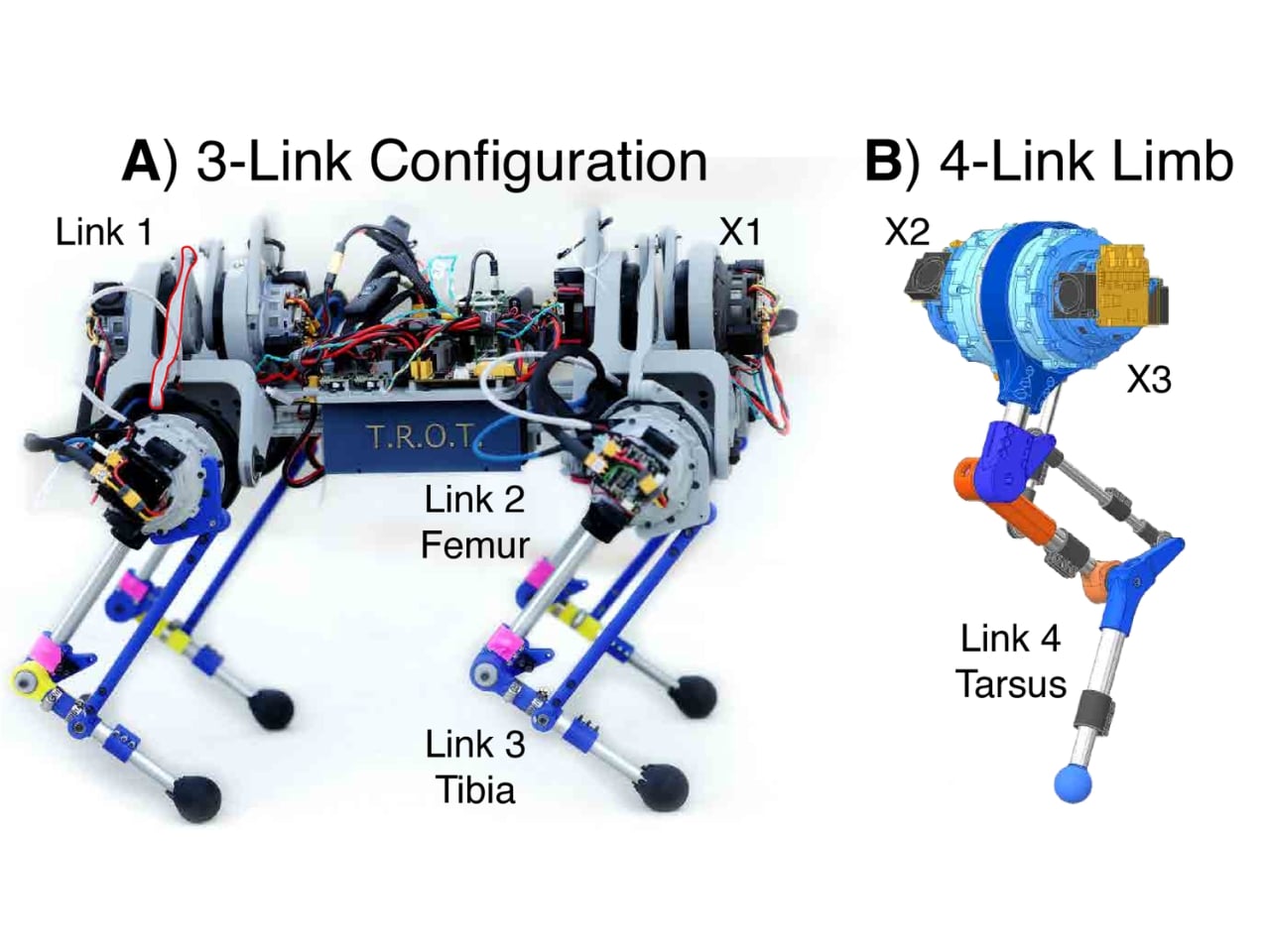
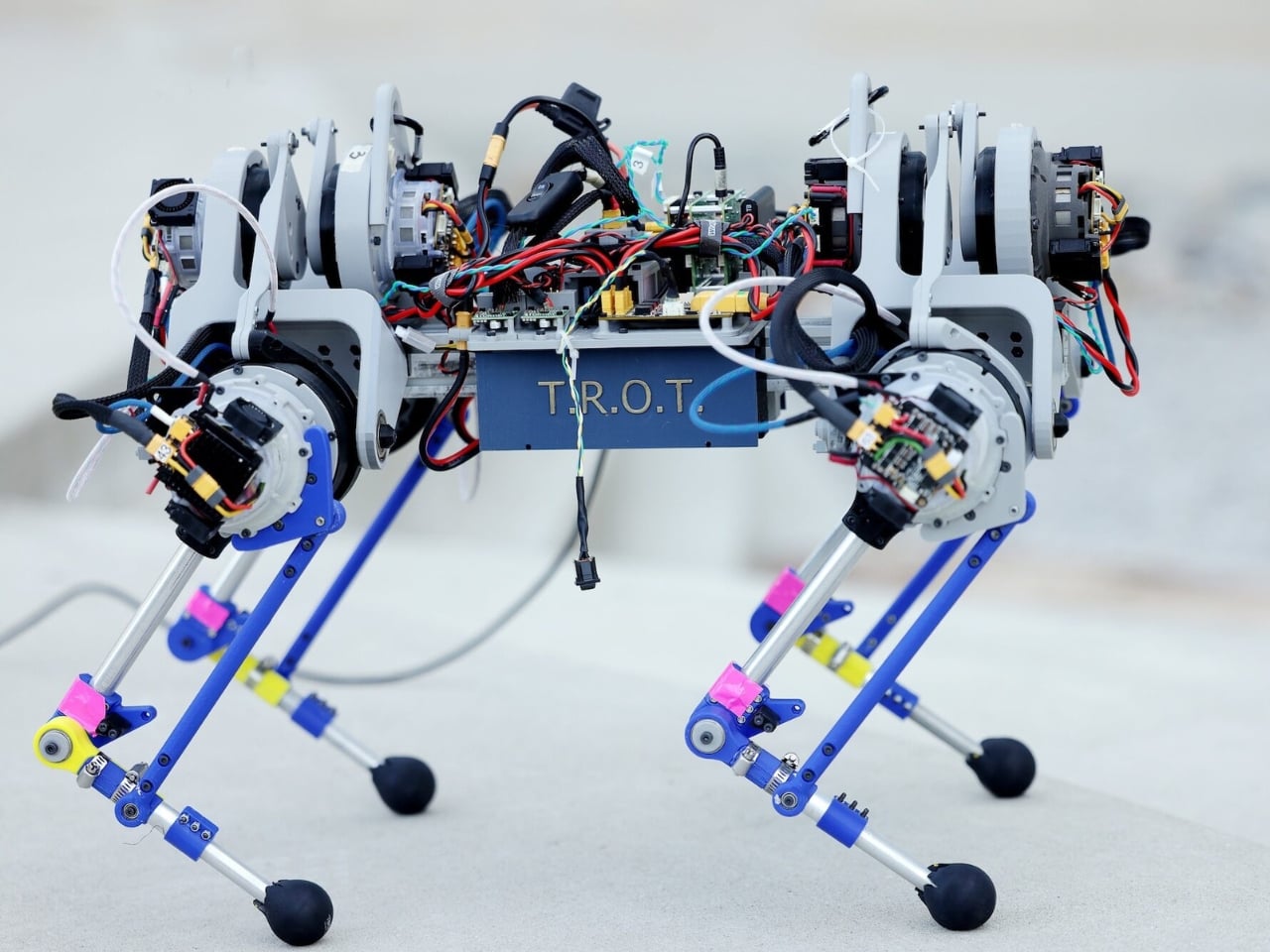
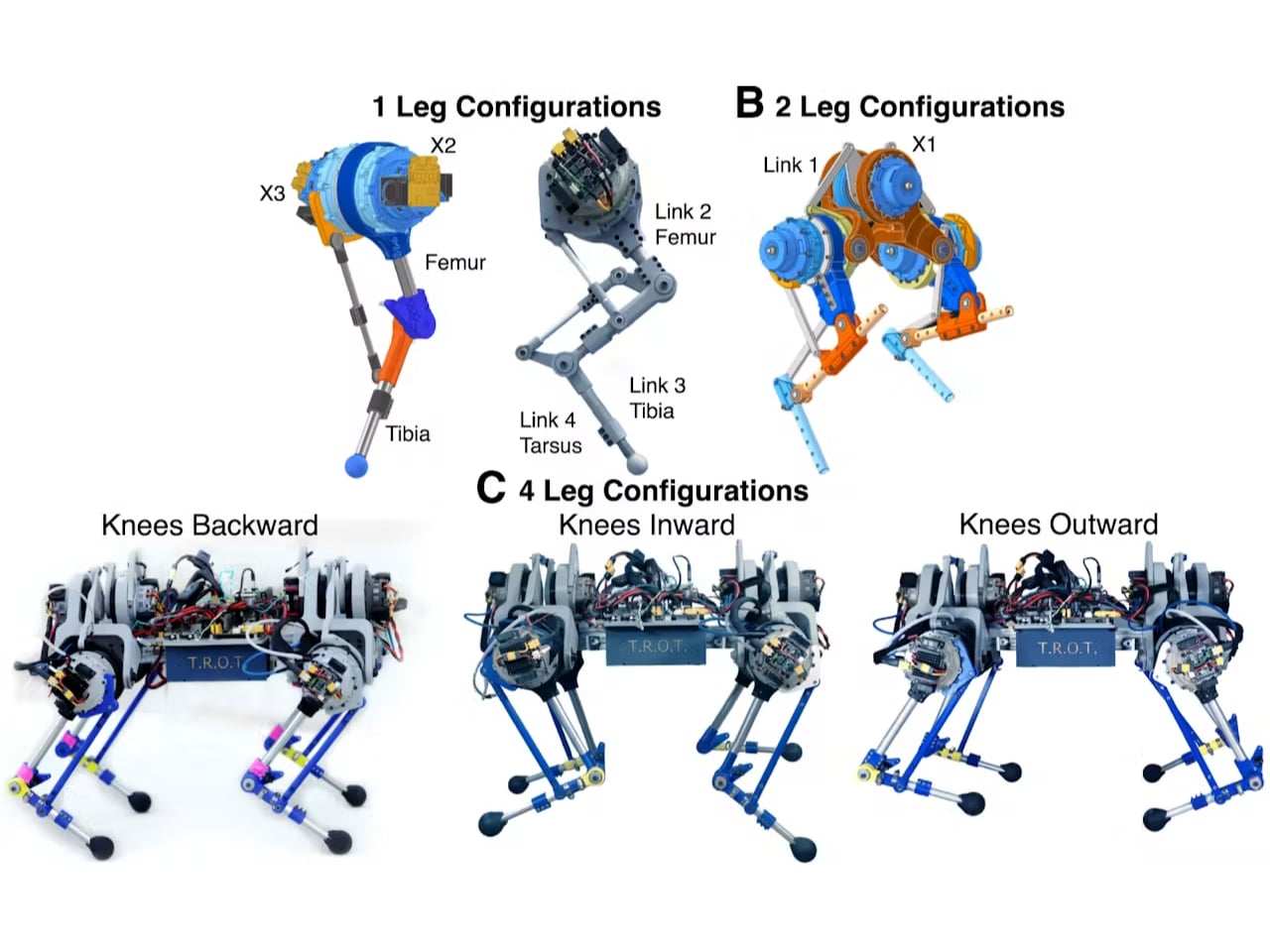
TROT (The Robot of Theseus) is a 10-kilogram, four-legged robot whose entire identity rests on impermanence. Its limbs unbolt. Its leg configurations swap between a two-link hopper, a three-link knee, and a three-link elbow orientation. You can rebuild the entire body plan over an afternoon and walk away with something that moves more like a gazelle than the dog-sized quadruped it started as. Same chassis. Same motors. About $4,000 in 3D-printed brackets and off-the-shelf parts. Its backdrivable motors even recover energy as they’re driven backward, mimicking the way tendons store and release force in a running animal.
Designer: University of Michigan
That $4,000 figure is worth sitting with. For context, Boston Dynamics’ Spot runs closer to $75,000. But TROT isn’t a budget Spot. It’s a different idea entirely. Where Spot is optimized for a fixed body plan and real-world deployment, TROT is optimized for being taken apart. It’s an experiment in the value of non-permanence, and that’s a much more interesting design brief than “make it do more things.”
The team, led by assistant professor Talia Moore, designed TROT to help biologists ask questions that physical animals can’t easily answer. What makes a cheetah fast isn’t just muscle. It’s also leg length, segment ratios, and joint geometry. Isolating those variables in a living animal is nearly impossible. But with TROT, you can swap out a femur extension, flip the knee orientation, and run the same locomotion test again the same afternoon, with consistent hardware and no ethical review board required. The robot has been used to compress roughly 60 million years of evolutionary locomotion variation into weeks of lab data. That’s the actual scientific utility, not a metaphor.
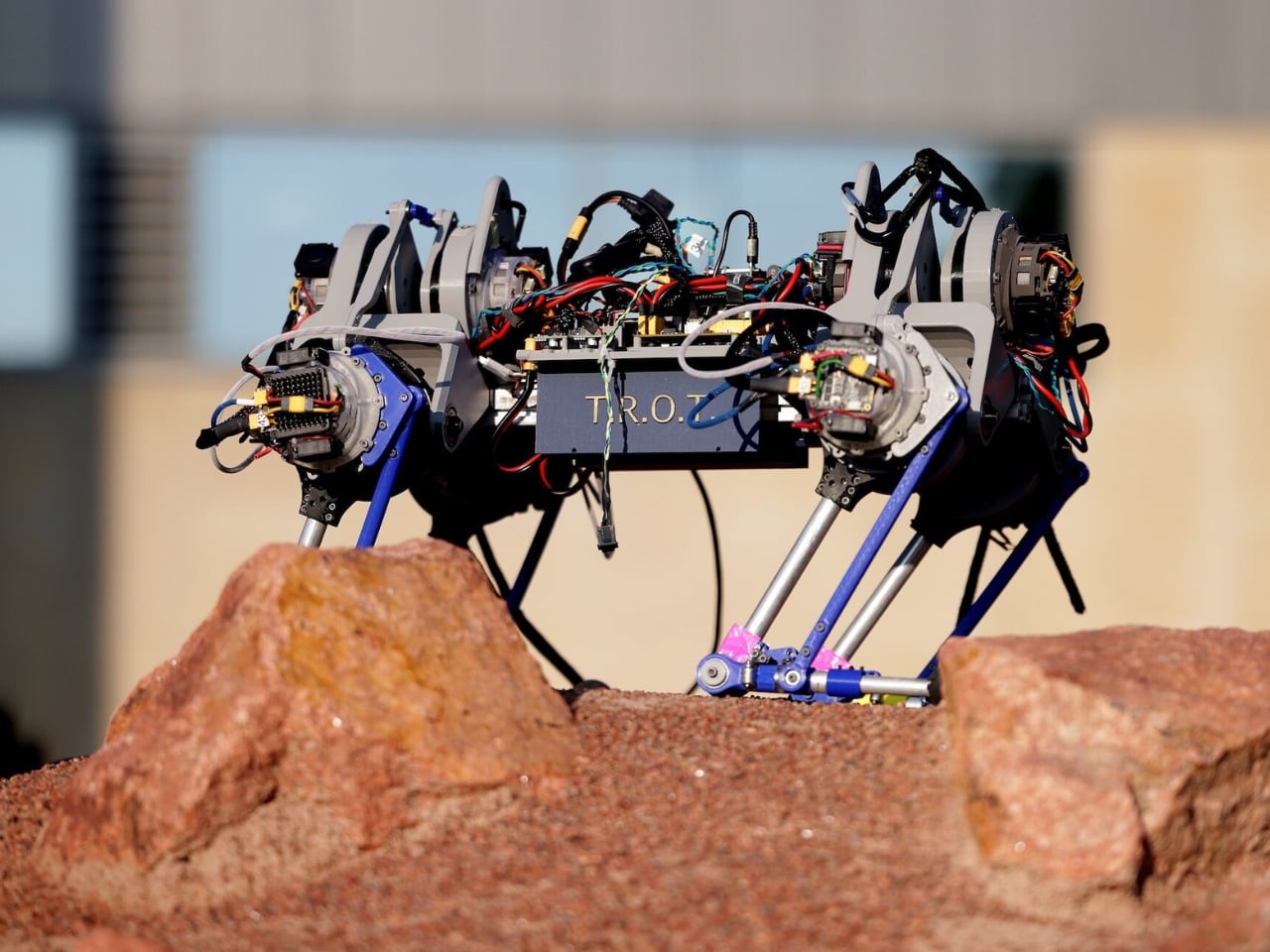
What tends to get under-reported in the science coverage is the design language itself. TROT’s visual aesthetic isn’t cleaned up or consumer-ready. You can see the 3D-print layer lines, the exposed wiring, the actuators bolted directly to the brackets. It looks like something built to be understood rather than admired, and I think that’s intentional. The exposed construction is a form of communication. It tells anyone looking at it: this is not precious. Change it. That’s a genuinely rare posture for a piece of research hardware.
The open-source dimension also runs deeper than posting a GitHub repo. The team released the CAD files, not just the control code. That’s a meaningful distinction. Code describes behavior; geometry describes intent. Sharing the brackets and print files means a biology lab at a smaller institution can reproduce TROT without needing a dedicated robotics engineering team. The knowledge transfer is embedded in the shape of the parts, and that changes who can participate in this kind of research.
TROT didn’t arrive alone. The first quarter of 2026 brought a quiet cluster of modular robotics research: Northwestern’s terrain-adapting writhers, a self-configuring quadruped paper in PNAS, and Nature’s SoftRafts, all landing within roughly eight weeks of each other. Robotin debuted a modular home robot ecosystem at CES 2026. Analysts have put the modular robotics market on track for $18.94 billion by 2029. None of this is coincidental. The field has been asking whether modularity in robotics could move past novelty. Q1 2026 looks like the answer arriving.
Most robots are designed to be finished. They ship in a fixed form, and any change is a cost: a repair, a retool, a failure. TROT is designed around the opposite logic. Its value increases each time a limb is swapped. Its usefulness is inseparable from its willingness to be reconfigured. Whether a robot that constantly changes its parts stays the same robot is still a philosophical question. Whether that approach produces better science, and better design thinking, is looking less and less like a question at all.