
If you’ve ever stared at one of Mondrian’s compositions and thought “this would make a great gear train,” congratulations, you think like a LEGO Ideas builder. The rest of us are just catching up. The Eternal Mosaic bridges the gap between abstract expressionism and mechanical engineering in a way that shouldn’t work but absolutely does, turning the rigid geometry of De Stijl into a functioning monument to exponential mathematics.
This 655-piece build contains a 46-stage compound gear reduction using 24-tooth to 8-tooth ratios at every step. When you compound that reduction across all 46 stages, you get a total ratio of roughly 9 billion trillion to 1. At a standard motor speed of 100 RPM, the first gear completes a rotation every 0.6 seconds. The final gear, embedded in a colorful Mondrian-inspired wall, will complete its first full rotation in approximately 90 trillion years. The universe is 13.8 billion years old. Do the math. This machine outlasts reality itself, and it does so while looking like it belongs in the Museum of Modern Art.
Designer: The Art of Knowledge
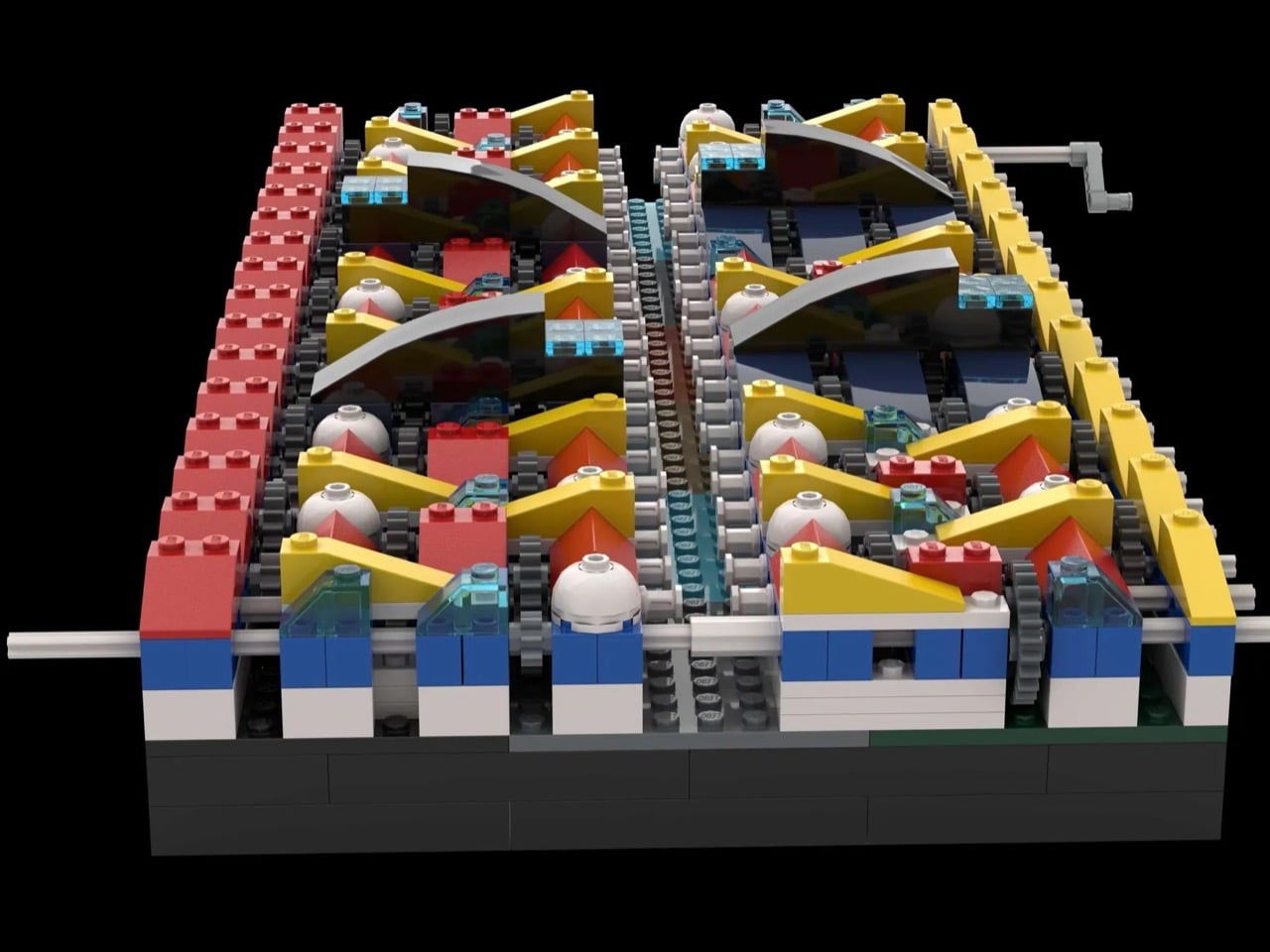
What makes this build technically fascinating is how it visualizes exponential decay in a way that your brain can actually process. The designer breaks down the timeline at key stages. Each of the 46 stages uses a simple 24-tooth to 8-tooth reduction, a 3:1 ratio that seems almost polite on its own. But compound that across 46 stages and the numbers become absurd. Stage 10 takes about 10 hours to complete one rotation, roughly a full night’s sleep. Stage 18 clocks in at around 75 years, an average human lifetime. By stage 24, you’re looking at 55,000 years, the entire span from the Stone Age to today. Stage 32 hits 4 billion years, the age of Earth itself. And then the final stage stretches out to 90 trillion years, which is 6,500 times longer than the universe has existed. Each gear is a canvas, a stepping stone through time rendered in primary colors.

The construction itself is a hybrid of LEGO Technic and System bricks. The gears themselves are pure Technic, frictionless axles and pins doing the mechanical heavy lifting. But the structure surrounding them is classic System bricks and slopes arranged in Mondrian’s signature palette of red, yellow, blue, black, and white. Each gear stage becomes a canvas, a shifting mosaic that layers industrial function with abstract art. It’s the kind of crossover that shouldn’t work but absolutely does, turning what could have been a dry physics demonstration into something you’d actually want on display.
The build uses efficient footprint design, packing all 46 stages into a relatively compact rectangular base. The gears are stacked vertically in places, layered horizontally in others, creating a dense mechanical core that feels more like a sculpture than a gearbox. The colored slopes and bricks aren’t decorative afterthoughts, they’re structural elements that support the Technic skeleton while creating that distinctive Mondrian aesthetic. It’s museum-quality kinetic art that also happens to be a functioning lesson in exponential mathematics.

The Eternal Mosaic is currently gathering votes on the LEGO Ideas platform, sitting at 55 supporters with 58 days left to hit the first milestone of 100 votes. If you want to see this beautifully strange collision of art and engineering hit the 10,000-vote threshold and get reviewed by LEGO’s internal team, head over to the LEGO Ideas website and cast your vote. Just don’t expect to see that final gear move in your lifetime. Or anyone’s lifetime. Or the lifetime of the cosmos itself.
SHARE