
Reading Braille Aloud
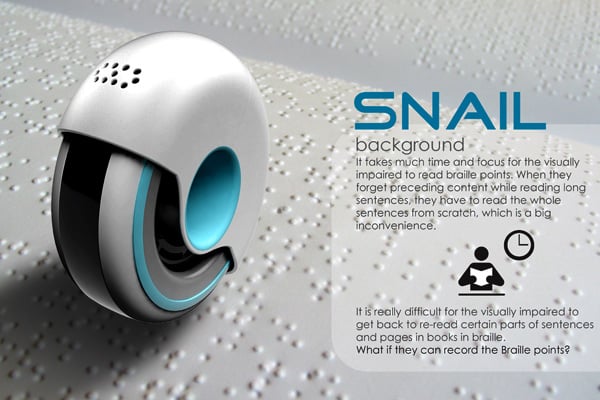
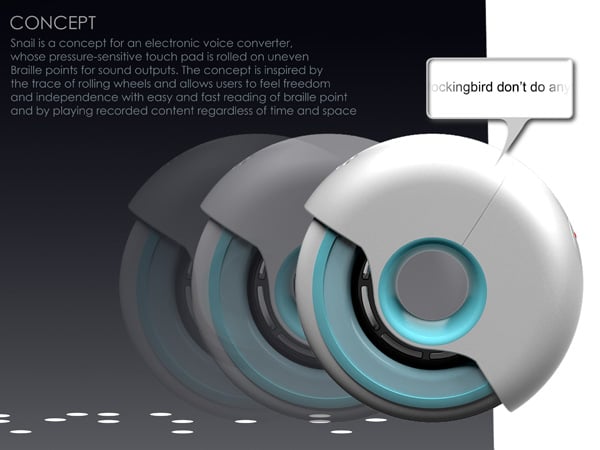
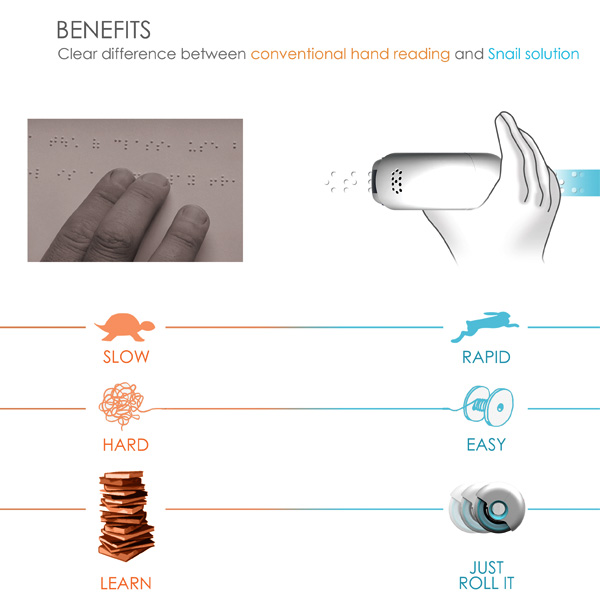
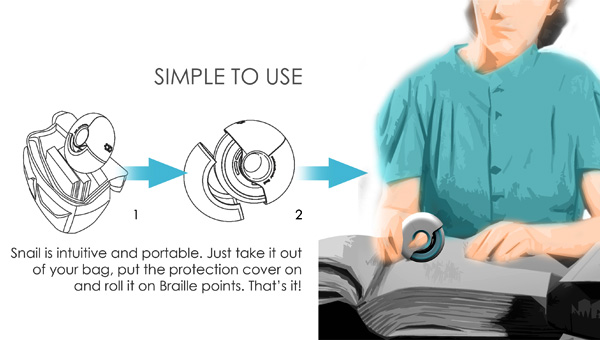
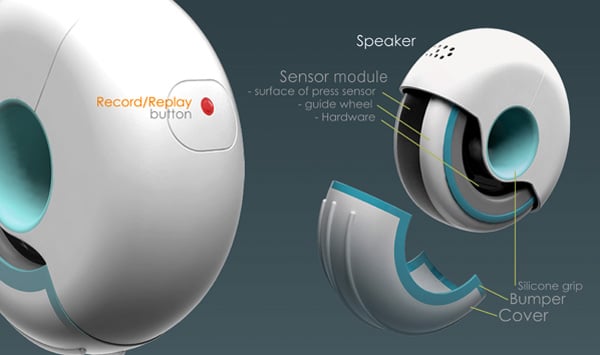
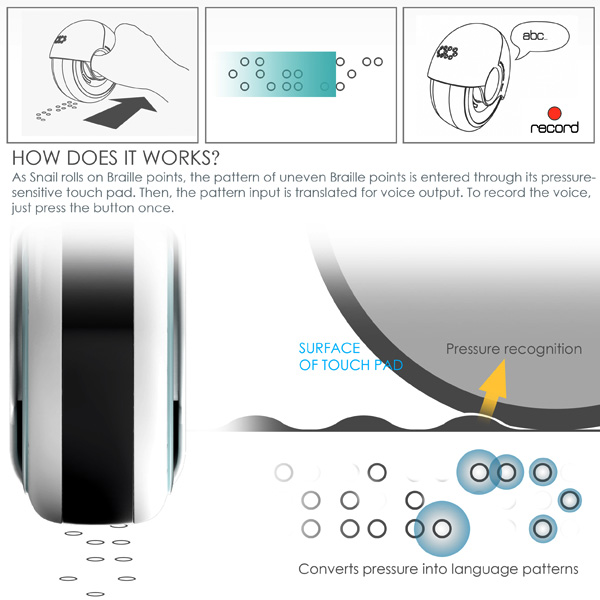
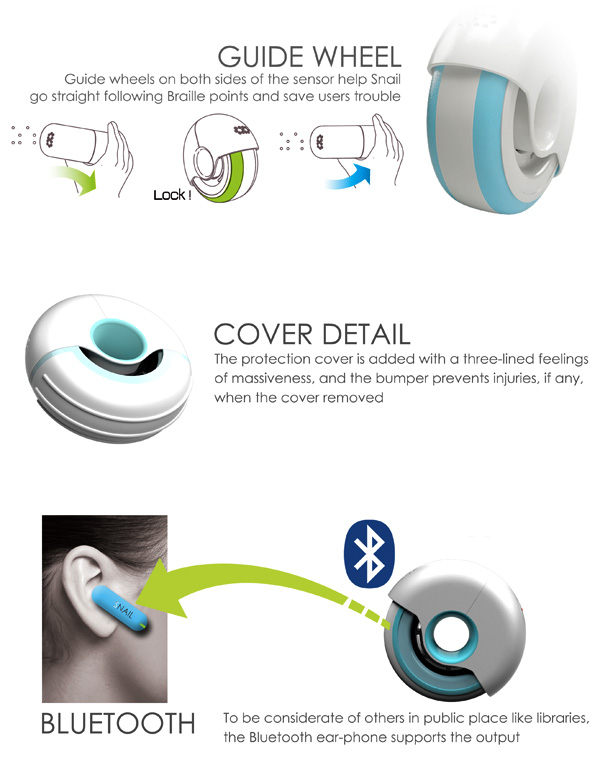
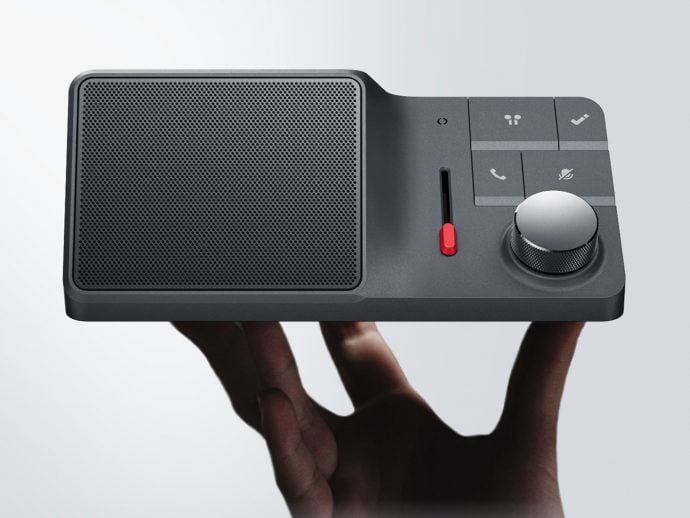
The Snail is a Braille reader that works smooth as silk on a surface that’s predictably bumpy! It can record the text as it reads for future playback and it even syncs with a Bluetooth headset so the visually impaired can listen to the book without disturbing others. Features like kinetic recharging and pressure sensitive reading make it the ideal companion for a bookworm!
Designer: Wonkook Lee



102 Comments »
Marie Laure Labrousse says
une petite idée géniale, j'aime qd la création sert à çà….
Dario Volaric says
How about modifying it to work like OCR on normal text? Problem is though that you would have to roll it perfectly on a line of text. However, same problem for braille. Without touching the braille with your fingers you will not know where the next line begins and how the line moves.
Jimmy C says
That doesn't seem like too much of a problem.They just have to feel the first letter in each line. The device locks so that it always goes in a straight line.
Justin L says
How does it lock to go in a straight line?
Not.Blind says
If you ever seen a blind person reading a book, they read it just as fast as normal people! Their sensitivity on their finger tips is amazing!!!!
With this device…It's not just that one straight line that creates complications for the blinds, it's the 20-40 straight lines on each page that you have to position the device to ensure it align correctly. Not to mention, the mechanical/electronic challenge on creating an accurate pressure sensitive device with no room for speaker (seeing the image), challenges on different book size alignment with the device…
Jimmy C says
Wow. This may be the most perfect concept I've ever seen on this site.
kam says
boring.. show me the new concept design!!
Ritha says
Really nice concept for helping blind people read books..!
Nonie Qinlei says
Cool, It’s such a delicate design concept. 5 Star!
barrionuevo says
Visual is so neat.Where can i buy that?
Bauski says
nowhere!
dAniel.A says
There's a little room for consideration BUT still a good idea. congrats Lee!
Marie Laure Labrousse says
une petite ide gniale, j'aime qd la cration sert ….
Dario Volaric says
How about modifying it to work like OCR on normal text? Problem is though that you would have to roll it perfectly on a line of text. However, same problem for braille. Without touching the braille with your fingers you will not know where the next line begins and how the line moves.
Jimmy C says
That doesn't seem like too much of a problem.They just have to feel the first letter in each line. The device locks so that it always goes in a straight line.
Justin L says
How does it lock to go in a straight line?
Not.Blind says
If you ever seen a blind person reading a book, they read it just as fast as normal people! Their sensitivity on their finger tips is amazing!!!!
With this device…It's not just that one straight line that creates complications for the blinds, it's the 20-40 straight lines on each page that you have to position the device to ensure it align correctly. Not to mention, the mechanical/electronic challenge on creating an accurate pressure sensitive device with no room for speaker (seeing the image), challenges on different book size alignment with the device…
Jimmy C says
Wow. This may be the most perfect concept I've ever seen on this site.
kam says
boring.. show me the new concept design!!
Ritha says
Really nice concept for helping blind people read books..!
Nonie Qinlei says
Cool, It’s such a delicate design concept. 5 Star!
barrionuevo says
Visual is so neat.Where can i buy that?
Bauski says
nowhere!
dAniel.A says
There's a little room for consideration BUT still a good idea. congrats Lee!
not.blind says
I think the designer might have never seen a blind person reading the Braille or talk to a person who needs to read this type of book. This device will work great for a normal person who wants to read the braille, but creates complication for the blinds to read the braille.
Bauski says
It's really scary how little efforty designers put into investigation of their concept's feasibility, practical use and need. So many flaws could be identified beforehand if they sat down and talked to different people (especially the target group) and get some feedback and perspective instead of going into rendering after the idea popped into their mind.
single dad says
Can't wait to see how these changes shake out. That's the fun part about technology – it's ever-evolving. No rest for the weary!
not.blind says
I think the designer might have never seen a blind person reading the Braille or talk to a person who needs to read this type of book. This device will work great for a normal person who wants to read the braille, but creates complication for the blinds to read the braille.
Bauski says
It's really scary how little efforty designers put into investigation of their concept's feasibility, practical use and need. So many flaws could be identified beforehand if they sat down and talked to different people (especially the target group) and get some feedback and perspective instead of going into rendering after the idea popped into their mind.
single dad says
Can't wait to see how these changes shake out. That's the fun part about technology – it's ever-evolving. No rest for the weary!
yankofan says
This is definitely something that was done without any research about the users that would be actually using the product. If you have just seen a single blind person read his book with his finger you'll be amazed how fast he does it. This just brings more problem to the user. First It's much more slower than their finger tips. Second, less accurate and hard to handle than their fingers. Also since you're converting braille into voice this would bring a lot of problems.
Reading (both for not-blind, and blind people) is a much faster thing than listening. You can just quickly go through key words and just understand the whole sentence. But once this converts to voice, thats something you can't get. Even if you roll the device faster, you'll get just a fast sqeeky voice that you'll never understand.
yankofan says
This is definitely something that was done without any research about the users that would be actually using the product. If you have just seen a single blind person read his book with his finger you'll be amazed how fast he does it. This just brings more problem to the user. First It's much more slower than their finger tips. Second, less accurate and hard to handle than their fingers. Also since you're converting braille into voice this would bring a lot of problems.
Reading (both for not-blind, and blind people) is a much faster thing than listening. You can just quickly go through key words and just understand the whole sentence. But once this converts to voice, thats something you can't get. Even if you roll the device faster, you'll get just a fast sqeeky voice that you'll never understand.
flow says
it might be a good idea but please no more braille concepts its everywere
sidekick says
brilliant! not only refine concept for blind person but also design well sorta futuristic style
flow says
it might be a good idea but please no more braille concepts its everywere
sidekick says
brilliant! not only refine concept for blind person but also design well sorta futuristic style
justme says
Why would a blind person use this? they read faster with their fingers. If a blind person needs such a device they better use audio books. And a seeing person wouldn't read a braille book with such a device since a regular book is much more compact
justme says
Why would a blind person use this? they read faster with their fingers. If a blind person needs such a device they better use audio books. And a seeing person wouldn't read a braille book with such a device since a regular book is much more compact
Ken Zangla says
I see limited use for this product. I am not sure why someone would use the Snail. If you can see, there is print. If you are blind, why convert text to braille and then use the Snail to read it. Converting a text to braille often renders a large amount of paper to carry around. If one has text, it seems that the preferred alternative format would be an electronic format, which could then be read by a number of devices. However, a new teacher, parent of a blind child, or beginner learner might be able to use it to check the work one has done.
Ken Zangla says
I see limited use for this product. I am not sure why someone would use the Snail. If you can see, there is print. If you are blind, why convert text to braille and then use the Snail to read it. Converting a text to braille often renders a large amount of paper to carry around. If one has text, it seems that the preferred alternative format would be an electronic format, which could then be read by a number of devices. However, a new teacher, parent of a blind child, or beginner learner might be able to use it to check the work one has done.
Dan W. says
It seems that most Braille readers would prefer to use their sense of touch for the reading. But a sighted parent could read to a blind child, or someone with neuropathy and losing their sense of touch might like it.
Dan W. says
It seems that most Braille readers would prefer to use their sense of touch for the reading. But a sighted parent could read to a blind child, or someone with neuropathy and losing their sense of touch might like it.
Marc Brenman says
If you're gonna invent and discuss stuff for the blind, your website should be accessible to screenreaders that the blind use.
Marc Brenman says
If you're gonna invent and discuss stuff for the blind, your website should be accessible to screenreaders that the blind use.
Trackbacks