Walking machines are hard. Really hard. Which is why most LEGO motorized builds stick to wheels or treads, and the ones that do attempt legs usually end up with something that shuffles more than it strides. But every so often someone figures out the mechanical magic trick that makes it work, and this six-legged walker currently on LEGO Ideas is one of those builds that actually delivers on the promise. The creator has managed to build something that moves with genuine fluidity, the kind where you can see the weight transfer from leg to leg.
The secret is in the gearing system. Rather than trying to program each leg’s movement independently, the build uses variable-speed gears that automatically adjust leg velocity based on where it is in the stride cycle. Slow and deliberate when the foot is planted, quick when it swings through the air. Combined with a vertical stabilization mechanism and shock-absorbing feet, you get something that can handle real terrain rather than just demonstration videos on smooth surfaces. It’s styled as a space exploration rover complete with a crew cabin and solar panels, leaning into that AT-AT aesthetic without directly copying it.
Designer: Alexis_MOCs_FR

Here’s the thing about making LEGO walk. You can throw servos at the problem and program every joint independently, which is how Boston Dynamics does it and why their robots cost more than a house. Or you can do what Theo Jansen did with his Strandbeest sculptures and let the mechanism itself figure out the gait. Jansen’s beach creatures run on wind power and pure geometry, converting constant rotation into this weirdly organic walking motion that makes you forget you’re watching PVC pipe and zip ties. That’s the approach Alexis_MOCs_FR took here, using two L motors and a gear train that does all the thinking mechanically. No Arduino, no sensor feedback loops, just smart engineering that exploits the physics of rotating linkages.

The look is peak 1970s futurism. White body panels, black structural framework, blue solar arrays, elevated cockpit with room for two astronaut minifigs. There’s a satellite dish up top because of course there is. The whole thing sits maybe 12 to 16 inches tall based on minifig scale, and all that gearing is completely visible. Some builds try to hide the mechanism under cosmetic panels, but here the exposed gear trains are the entire point. Watching the motion transfer from motors down through the variable-speed system and into the legs is genuinely mesmerizing, like those transparent mechanical watch movements that cost absurd money because people will pay to see the machinery work.
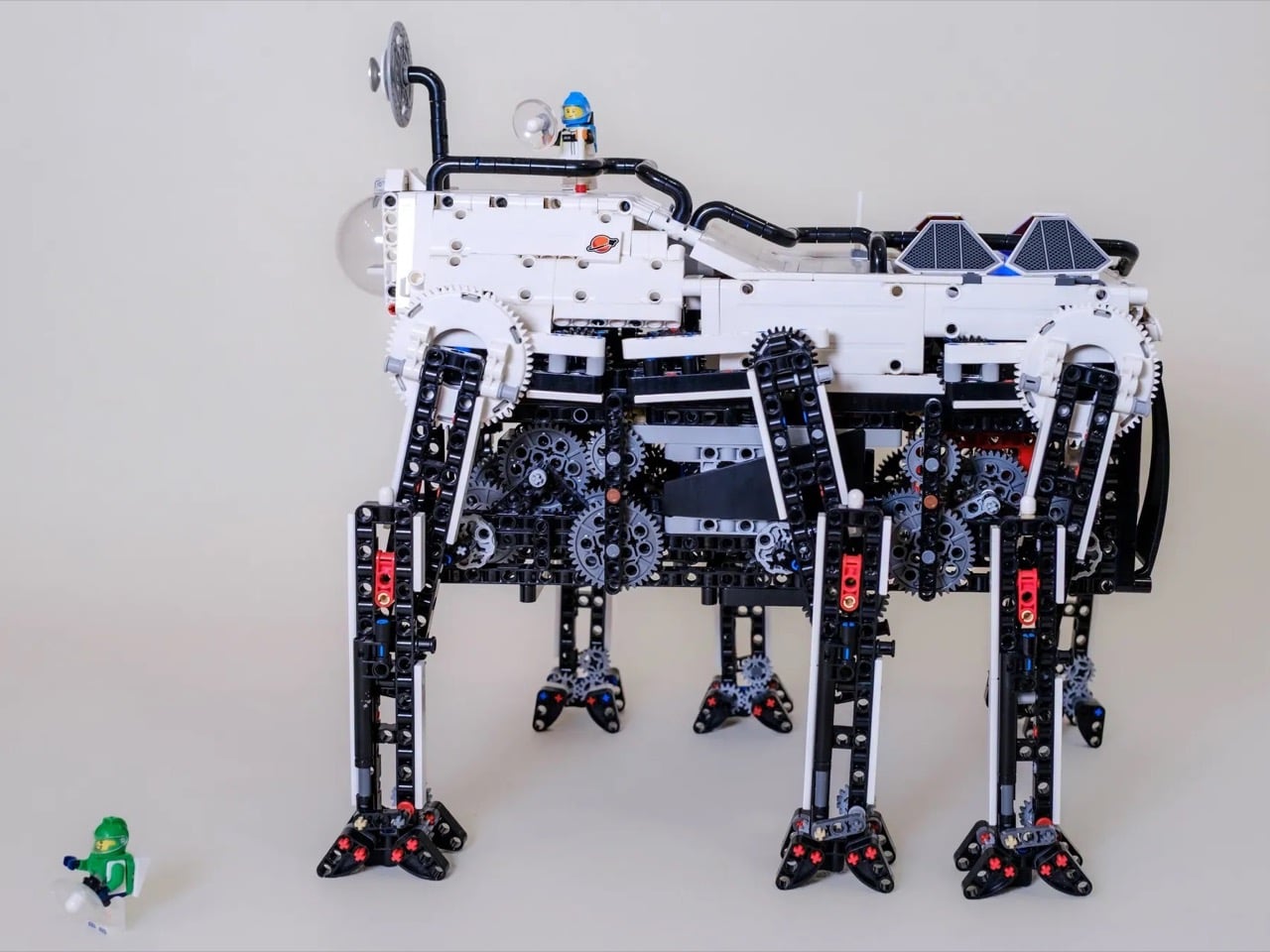
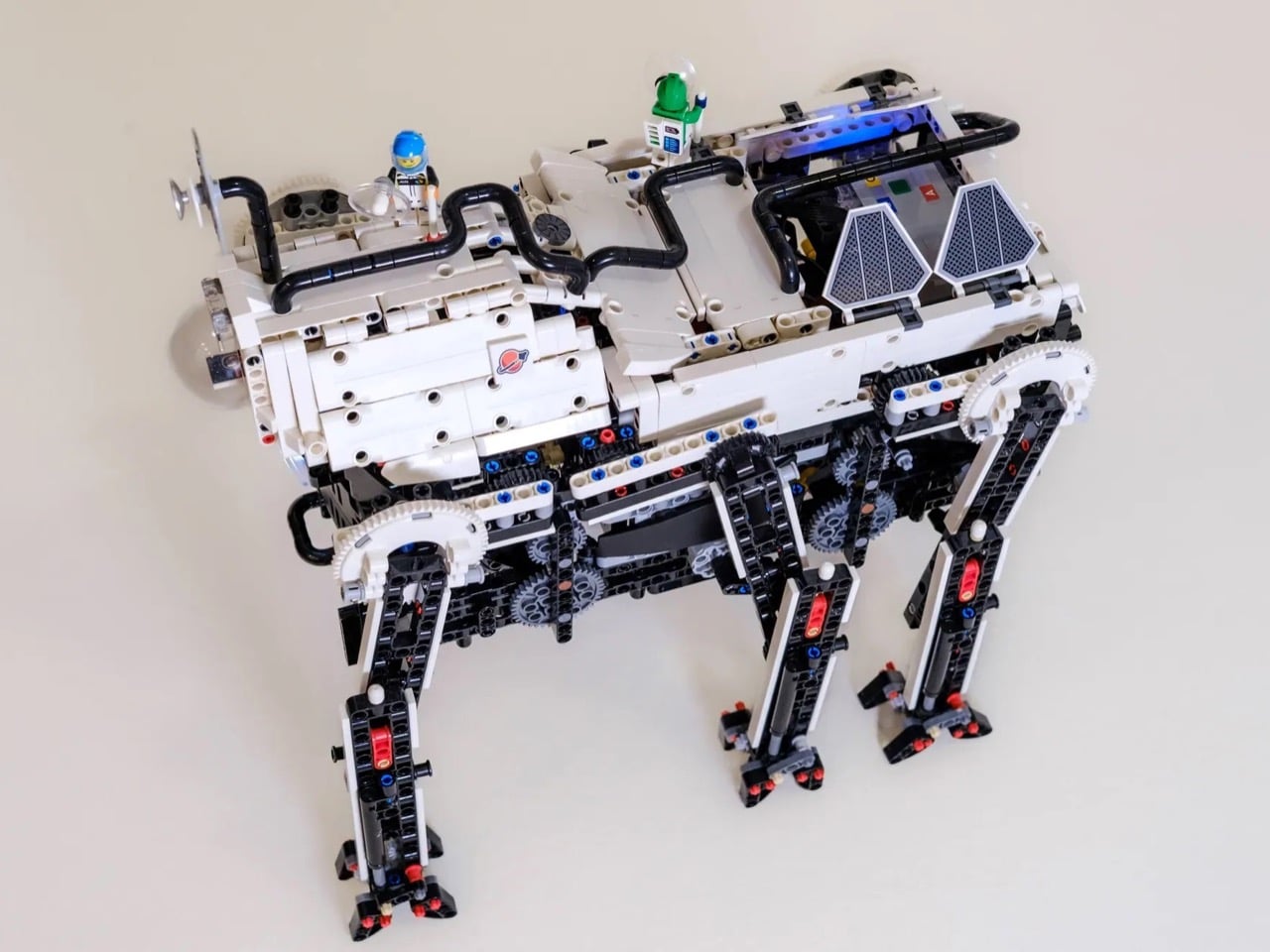
The vertical stabilization bit is where you can tell someone really understood the assignment. When your upper leg is swinging through a 60 or 70 degree arc, keeping the foot flat on the ground becomes this annoying trigonometry problem. Most people either accept some wobble or add complexity with extra actuators. This build has a sliding element in the lower leg that compensates for the angle automatically. Upper leg tilts, slider adjusts, foot stays vertical. It’s passive, it’s reliable, and it’s the kind of solution that only works because someone actually prototyped this thing instead of just CAD modeling it and calling it a day.

High-stepping gaits hit hard. You’re lifting legs way off the ground and slamming them back down at whatever speed your motors can manage. Without damping, every impact rattles through the structure and either knocks gears out of alignment or turns the whole thing into a vibrating mess. Custom shock absorbers at each foot solve this, which is why the creator can apparently run it over rumpled blankets and piles of Kapla blocks without it face-planting. The build is allegedly both lightweight and robust, which sounds like marketing speak until you consider that you need enough mass for stability but not so much that momentum tears the gear teeth apart during direction changes.

The project is currently in its very early stages, with 424 more days to gather votes and hit the next milestone. If it gets to the coveted 10,000 mark, LEGO actually reviews it for production. The Technic lineup has been pretty safe lately, lots of supercars and construction equipment but not much that pushes mechanical boundaries. This thing demonstrates actual engineering innovation, the kind where someone solved hard problems with clever solutions instead of just adding more motors. If you want to see it become a real set, go cast your vote on the LEGO Ideas website!