Most illustration that deals with human-animal hybridity treats it as a problem to be solved, a boundary to be crossed or defended, a transformation caught mid-process. Yamazuki Mari refuses this framing entirely. Her figures don’t struggle with their condition. They wear it.
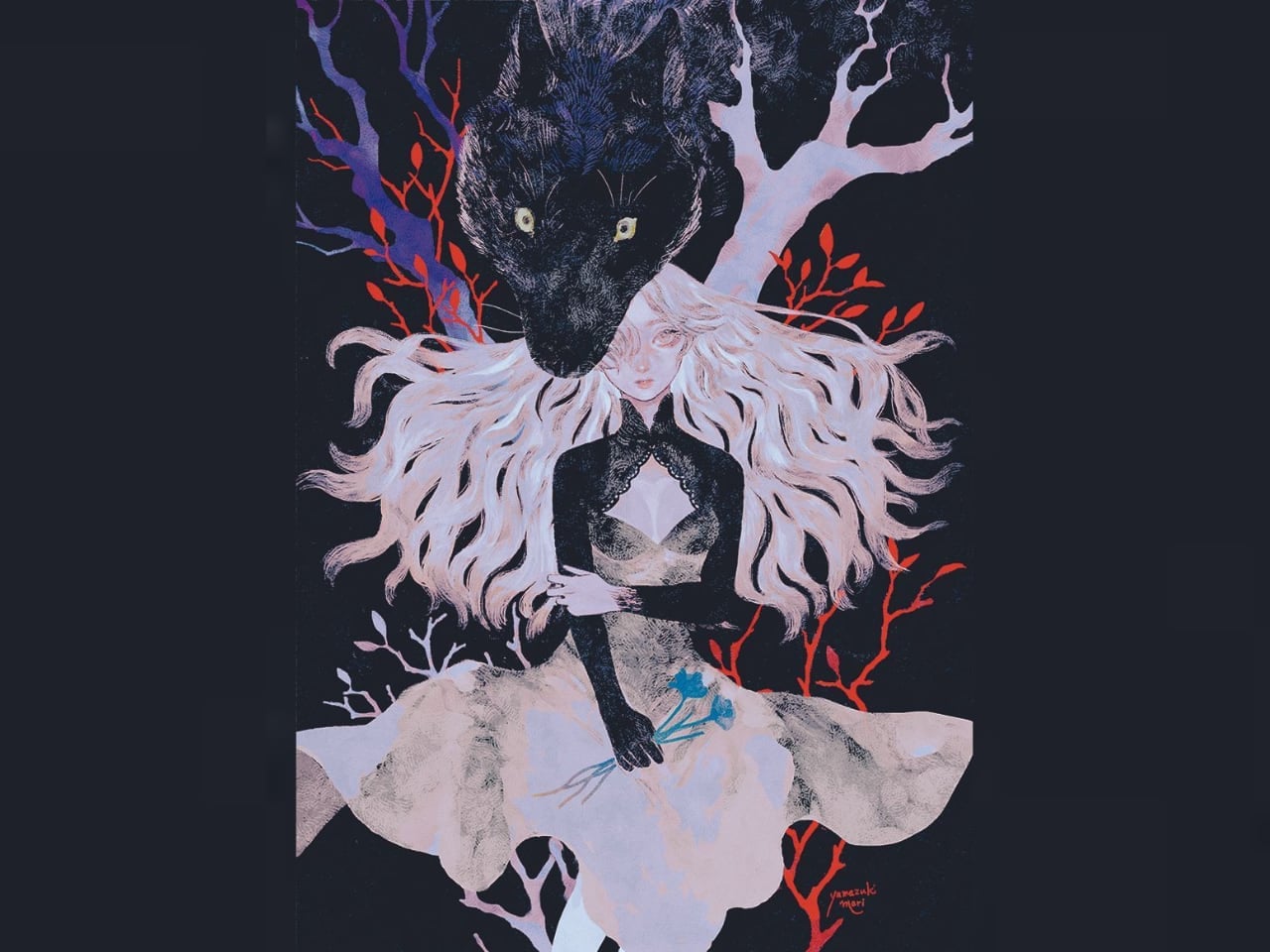
A woman stands before a massive black wolf, their bodies aligned so precisely that the creature reads less as a separate entity and more as an extension of her silhouette. No tension exists between them. No drama of possession or escape. Mari positions the wolf head directly above the woman’s own, along the same vertical axis, creating a visual grammar of doubling rather than confrontation. The relationship feels ceremonial, almost devotional, with the wolf serving as guardian rather than threat.
What makes this work distinctive isn’t the subject matter but the formal clarity she brings to it. Against deep black backgrounds, her figures emerge in pale creams and icy blues, coloring deliberately muted to let compositional geometry carry emotional weight.
Surface as Signal
Mari builds atmosphere through material choices that reward close attention. Fine crosshatched textures give her digital work a tactile quality suggesting engraving or woodcut, linking contemporary illustration to centuries of folk art tradition. When color does assert itself, it arrives as intrusion: coral red branches cutting through darkness like warning signals, their sharpness creating tension against the soft gradients of hair and fur.
Her background in graphic design shows in the disciplined relationship between figure and ground. Black backgrounds create ceremonial weight. White backgrounds create clinical clarity. Neither choice is neutral, and the shift between them across her body of work creates a tonal range that color specification alone can’t achieve.
By introducing fine grain and crosshatching into digital illustration, Mari creates a surface quality that resists the smoothness associated with computer-generated imagery. The textures read as handmade even when they’re not, and this material fiction supports the folkloric atmosphere her subjects require. The wolf’s fur carries the same visual density as the woman’s hair, unifying disparate biological forms through shared treatment.
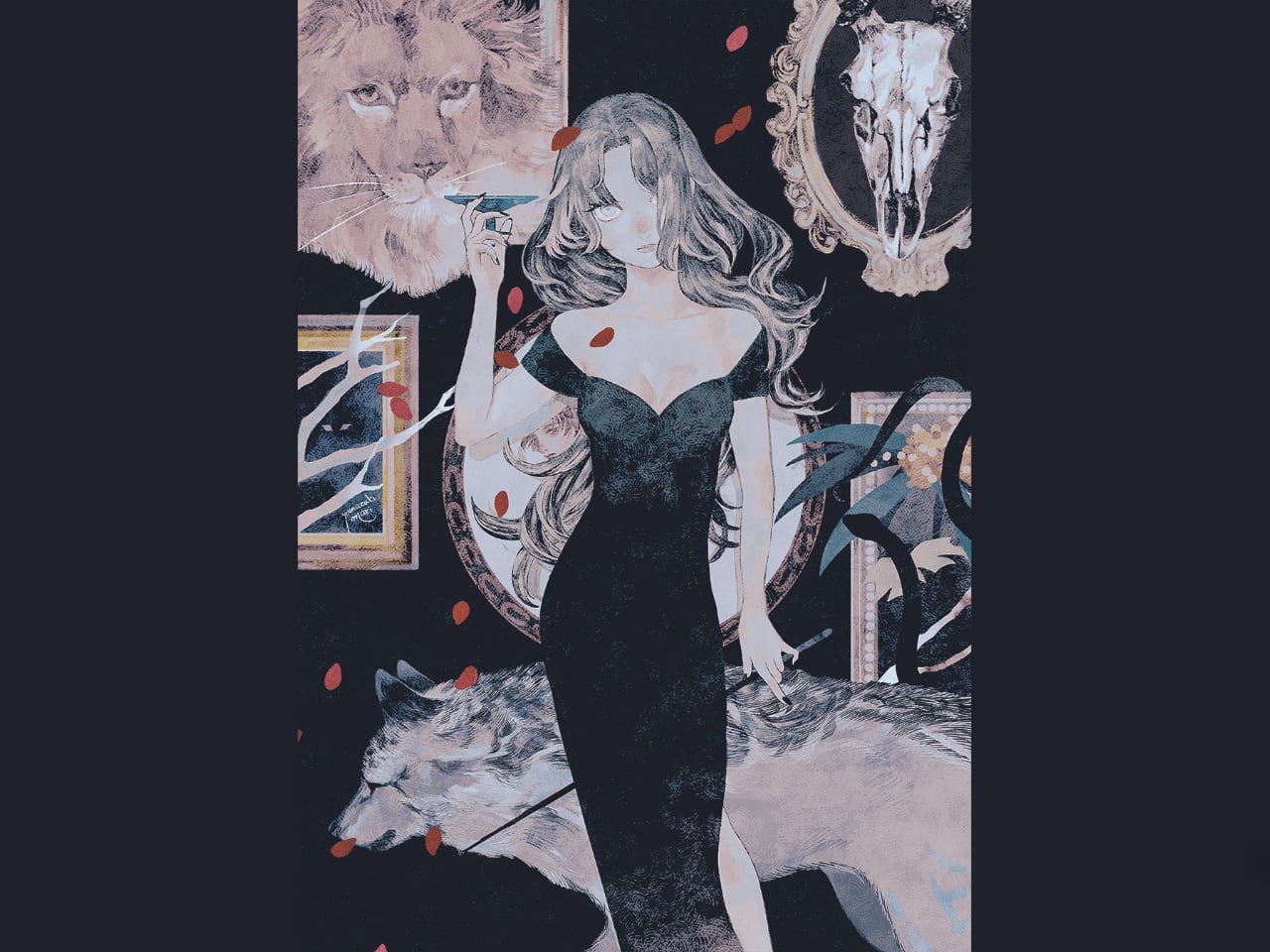
Color operates with similar intentionality. Limited palettes prevent the images from reading as naturalistic while specific hues, coral red against midnight blue, winter gray against bone white, carry cultural associations that enrich the viewing experience without requiring explicit narrative. Red as warning, white as purity or death, black as depth or the unconscious: Mari leverages these associations without being constrained by them.
Stillness as Strategy
Stillness in Mari’s work isn’t absence of movement but rather the deliberate suspension of it.
Her compositions feel frozen at the instant before something happens, and this temporal ambiguity becomes a structural principle. The woman and wolf don’t move because they exist outside of narrative time. They occupy a space where transformation has already occurred and no further change is necessary. Traditional fantasy illustration often relies on dynamism to generate interest, filling the frame with action that guides the eye along predictable paths. Mari inverts this expectation. Her figures hold their positions, and the viewer must do the work of discovering the relationships between elements.
The result is an experience closer to portrait study than narrative illustration, where the reward comes from sustained attention rather than immediate comprehension.
Motion as Rupture
Her second piece abandons stillness entirely, and the contrast illuminates what the first image withholds. A human figure fuses with a lunging wolf in mid-leap, their bodies stretched forward in parallel lines of urgent motion. The wolf’s jaws are open, its eye wide with instinct, and the scene pulses with predatory energy that the first composition suppressed.
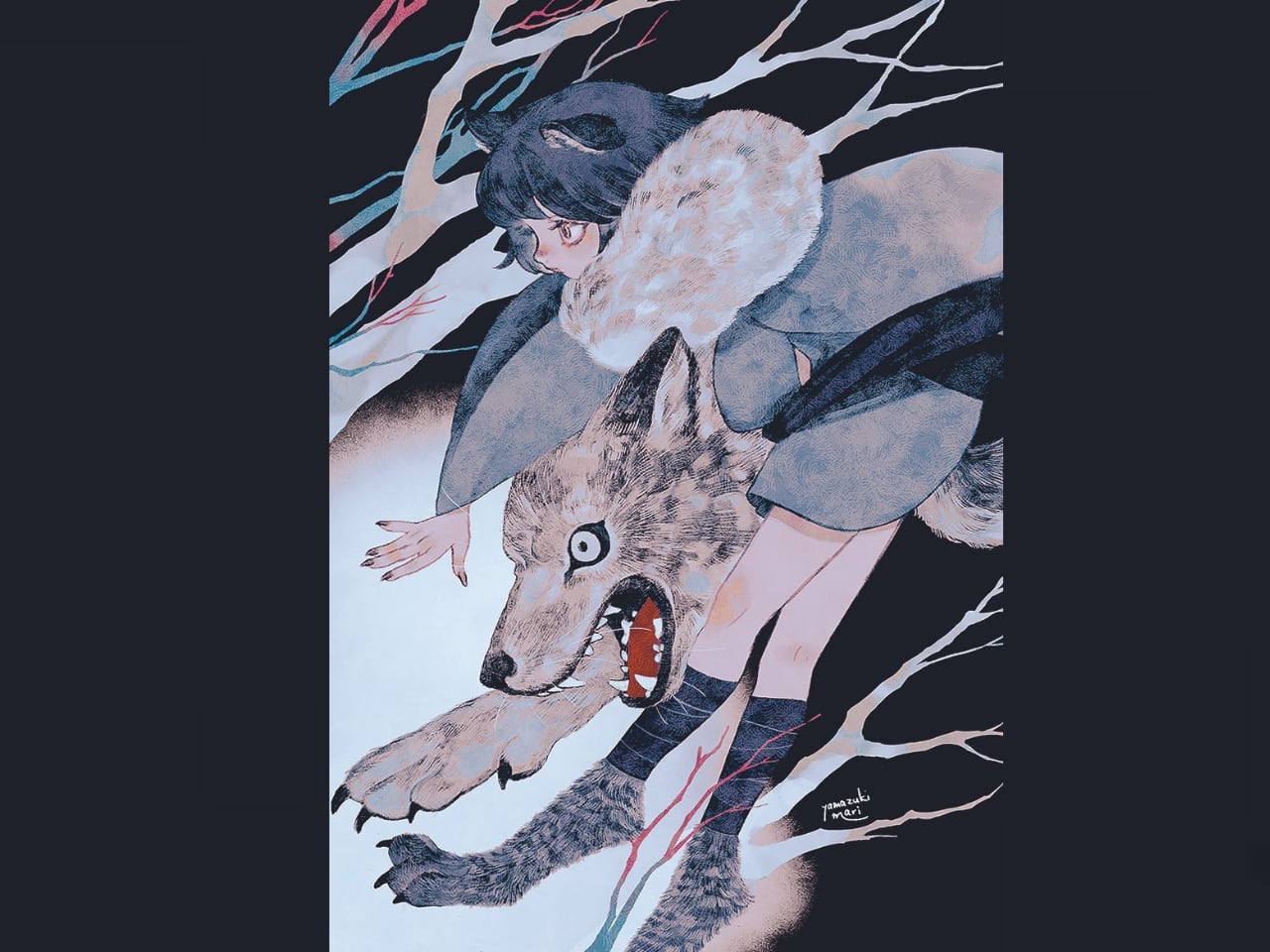
Cool grays and winter whites dominate the palette, replacing ceremonial blacks with something closer to raw weather. Sharp white branches frame the movement like cracked ice. The grainy textures that felt archival in the static piece now read as velocity blur. Same technical vocabulary, entirely different emotional results.
What the motion reveals is the cost of transformation. Static imagery presented hybridity as achieved and peaceful. Dynamic imagery shows it as ongoing and violent. These aren’t contradictory statements but rather complementary views of the same condition: the wolf is both guardian and hunter, protector and predator, and the human figure rides that duality rather than resolving it.
Mari doesn’t choose between interpretations because choosing would reduce the complexity her work investigates.
Tenderness Without Sentiment
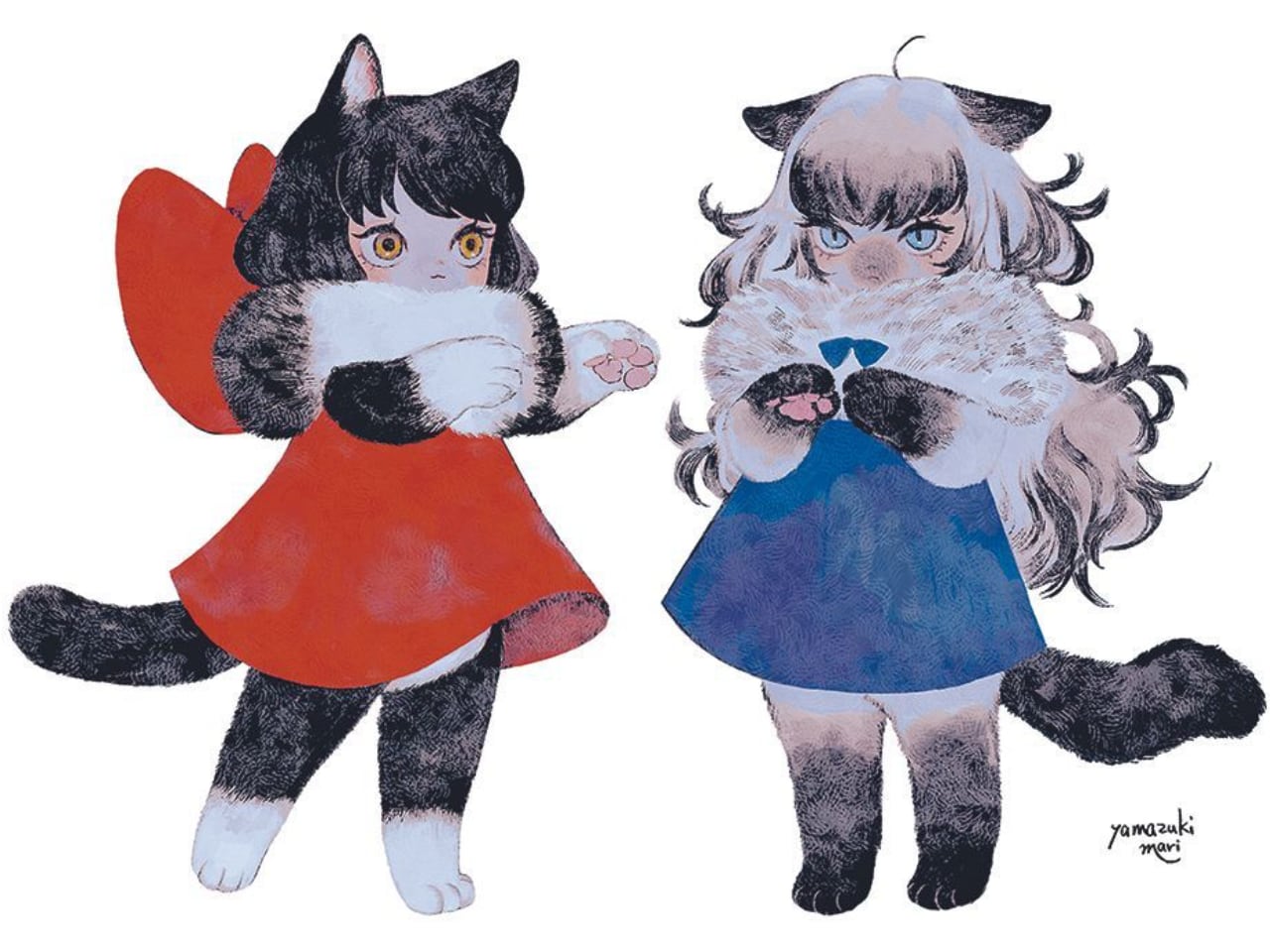
Her final piece pivots toward something that resembles cuteness but refuses to commit to it. Two small catlike figures stand side by side against a clean white background, their rounded forms and oversized fur collars giving them a plush, doll-like presence. One wears red, the other blue. The color dialogue emphasizes individuality within obvious companionship.
Simplicity here is deceptive. These figures share the hybrid logic of the wolf pieces, with feline ears, tails, and paw-like hands rendering them not quite animal and not quite human. Their expressions are subdued rather than cheerful, and this restraint prevents the image from tipping into pure whimsy.
Mari names them May and Mii, the Nekochi, describing them as inseparable companions ready for playful mischief. The characterization suggests personality and relationship, but the visual treatment maintains distance. She doesn’t animate their mischief or show them in action. Like the woman and the wolf, they simply exist in their hybrid state, present to the viewer without performing.
Grammar of Integration
Across all three works, Mari establishes a consistent visual grammar for depicting hybridity. Human and animal elements don’t compete for dominance within the frame. They occupy the same compositional space with equal formal weight, aligned along shared axes, rendered with equivalent levels of detail.
Neither element reads as metaphor for the other.
The wolf isn’t the woman’s inner nature made visible. The woman isn’t the wolf’s civilized aspect. They exist together as a unified presence that simply happens to contain both forms. This approach distinguishes her work from transformation imagery in the Western fantasy tradition, where hybridity typically signifies conflict, corruption, or metamorphosis in progress. Mari’s hybrids carry no implication of instability. They aren’t becoming something else. They’ve already become, and the images document that completed state with the formal precision of taxonomy rather than the drama of mythology.
Cultural lineage matters here. Japanese visual traditions have long accommodated hybrid beings without requiring them to resolve into single identities. Kitsune, tanuki, and other shapeshifters populate folklore not as monsters to be defeated but as neighbors to be negotiated with. Mari draws on this heritage while filtering it through contemporary illustration sensibilities, producing images that feel simultaneously ancient and digitally native.
What the Hybrids Suggest
Most depictions of human-animal fusion carry anxiety about boundary dissolution, about losing the characteristics that define human identity.
Mari’s figures express no such concern. They wear their hybridity as comfortably as the Nekochi wear their fur collars, as a feature of existence rather than a problem to be solved. This comfort may be the most radical aspect of her visual language. In a design context where character illustration often relies on conflict, transformation, or aspiration to generate viewer engagement, Mari offers figures who’ve arrived at a place of integration and simply occupy it.
The wolf doesn’t need to devour the woman. The woman doesn’t need to tame the wolf. The Nekochi don’t need to choose between their feline and humanoid aspects.
For illustrators working in character design, the approach suggests an alternative to narrative-driven imagery. Not every character needs to be caught mid-journey. Some can simply exist, fully realized, inviting the viewer to spend time in their presence rather than anticipate their next transformation. Mari’s hybrids model this possibility with quiet confidence, their stillness a form of visual authority that movement would only diminish.