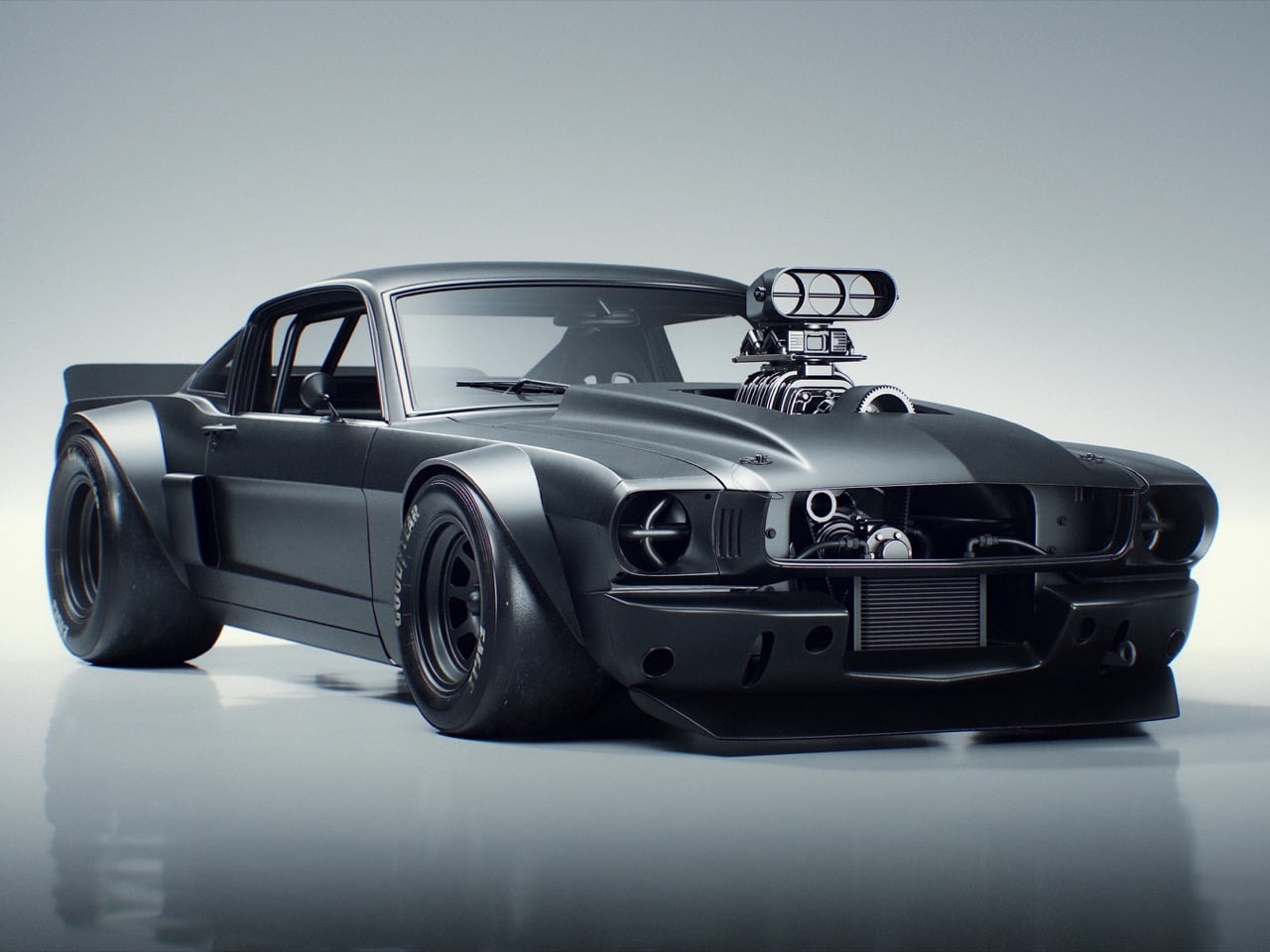

Ford sold a million Mustangs in its first 20 months, which means there were plenty around to modify, and people have been doing exactly that for about six decades now. The latest version comes from Brazil, courtesy of 3D artist John Rendering, and it might be the most unhinged one I’ve seen this year. His 1965 Ford Mustang V8 Restomod is a full CGI build that turns the classic fastback into a satin black street brawler. A chrome supercharger pokes through the hood, the fenders swell out to cartoon proportions, and the front end skips the grille entirely. Hoods, apparently, now come with a sunroof.
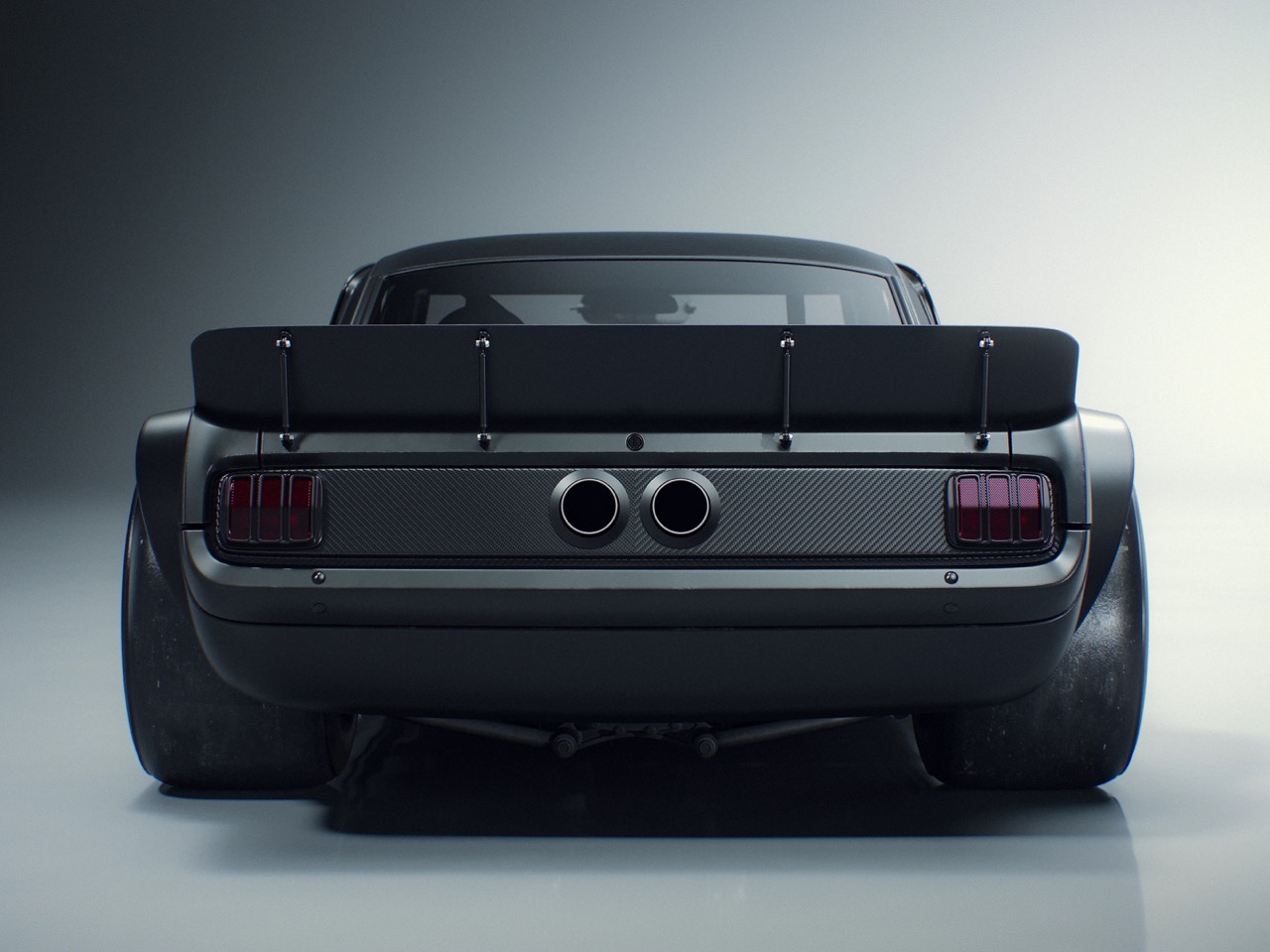
Skipping the grille leaves a direct view into the engine bay, so the V8’s pulleys and hoses become the car’s actual face. It’s a gutsy move, a little like a skeleton watch for muscle cars. Down low, a cooler sits in a new valance above a deep splitter, and the hollowed-out headlight buckets look like they’ve switched careers to ducting. Around back, a flat spoiler blade sits on four slim stays above a carbon fiber panel and twin center-exit exhausts. The classic three-bar taillights stay, tinted smoked red, which is about the only polite gesture this car makes toward 1965.
Designer: John Rendering
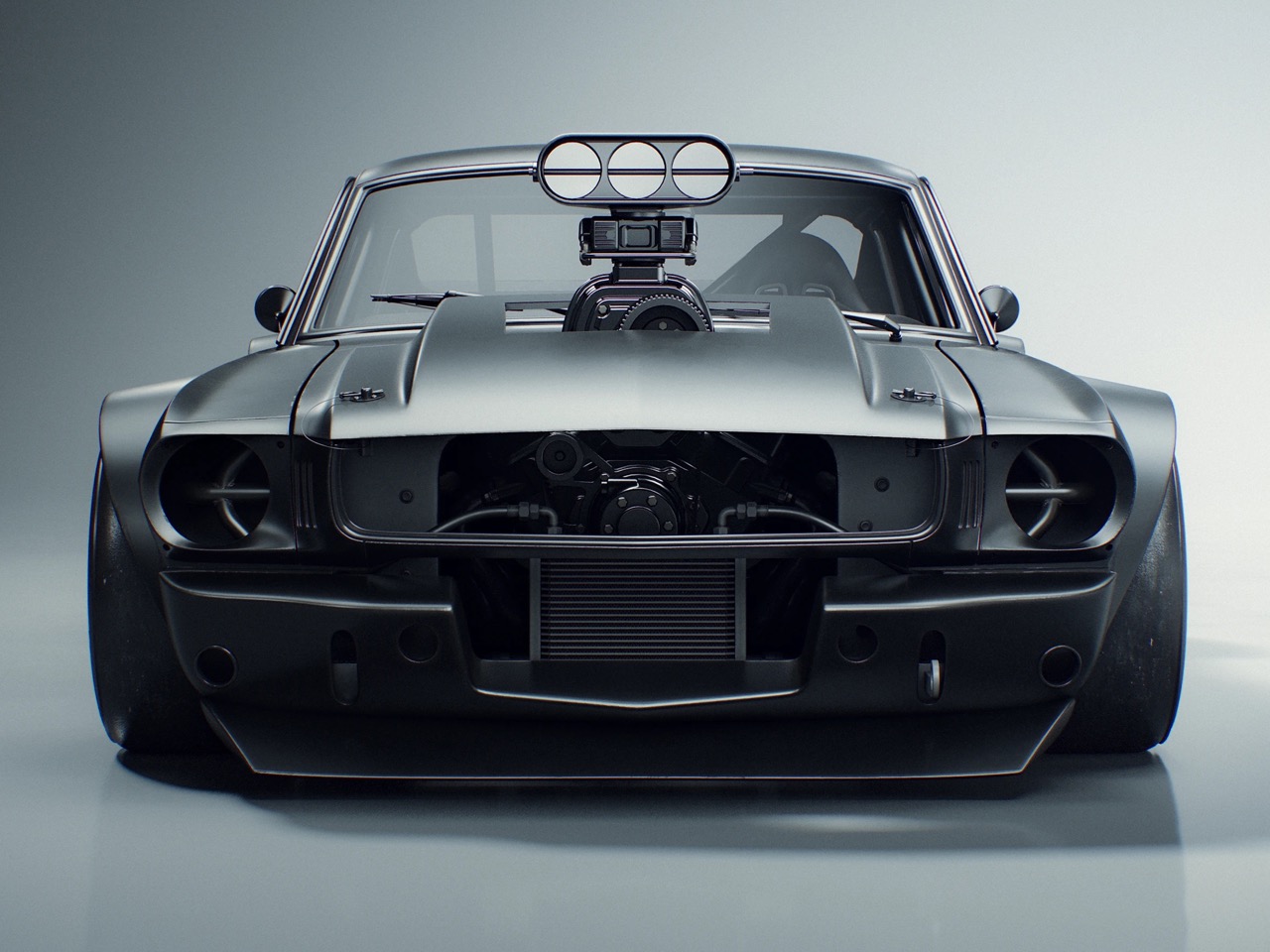
That chrome supercharger traces back to a diesel bus engine. In 1938, GM bolted Roots blowers onto its Series 71 two-stroke diesels, which needed forced air because a two-stroke has no separate intake stroke. The “71” meant 71 cubic inches per cylinder, so the six-cylinder unit became the famous 6-71. After World War II, cheap surplus blowers flooded the market, and dry lakes racers and drag racers started perching them on top of V8s. Today, NHRA Top Fuel cars still run blowers based on that same GMC design, scaled up to 14-71 dimensions. John’s version, with its finned casing and triple-barrel scoop, carries all that history on the hood like a family heirloom with a bad attitude.
The box-style overfenders bolted to all four corners owe more to Japanese tuner culture than to Detroit. John’s Behance portfolio includes a Hakosuka Skyline drift car from 2022, and that same widebody instinct shows up here, with flat-faced arches that look bolted on rather than sculpted in. A rocker blade runs between them, and a deep splitter juts out ahead of the front valance. The stance is dropped so low that the rocker blade nearly kisses the floor. Goodyear Eagle lettering on the tires and black race wheels pull the car back toward the American drag strip, with a big assist from that blower. It’s a Tokyo body kit riding on Pomona drag rubber, and the two get along surprisingly well.
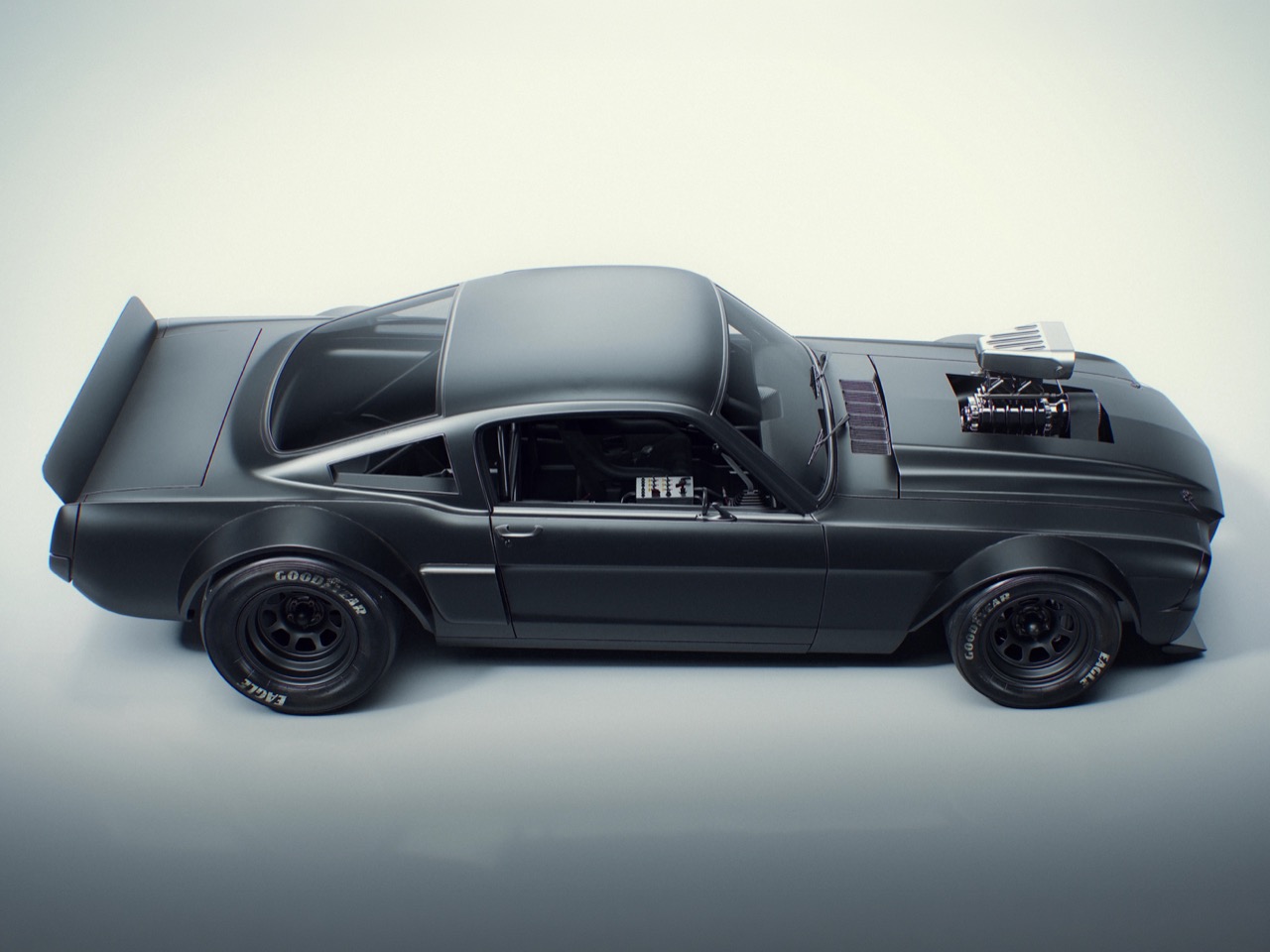
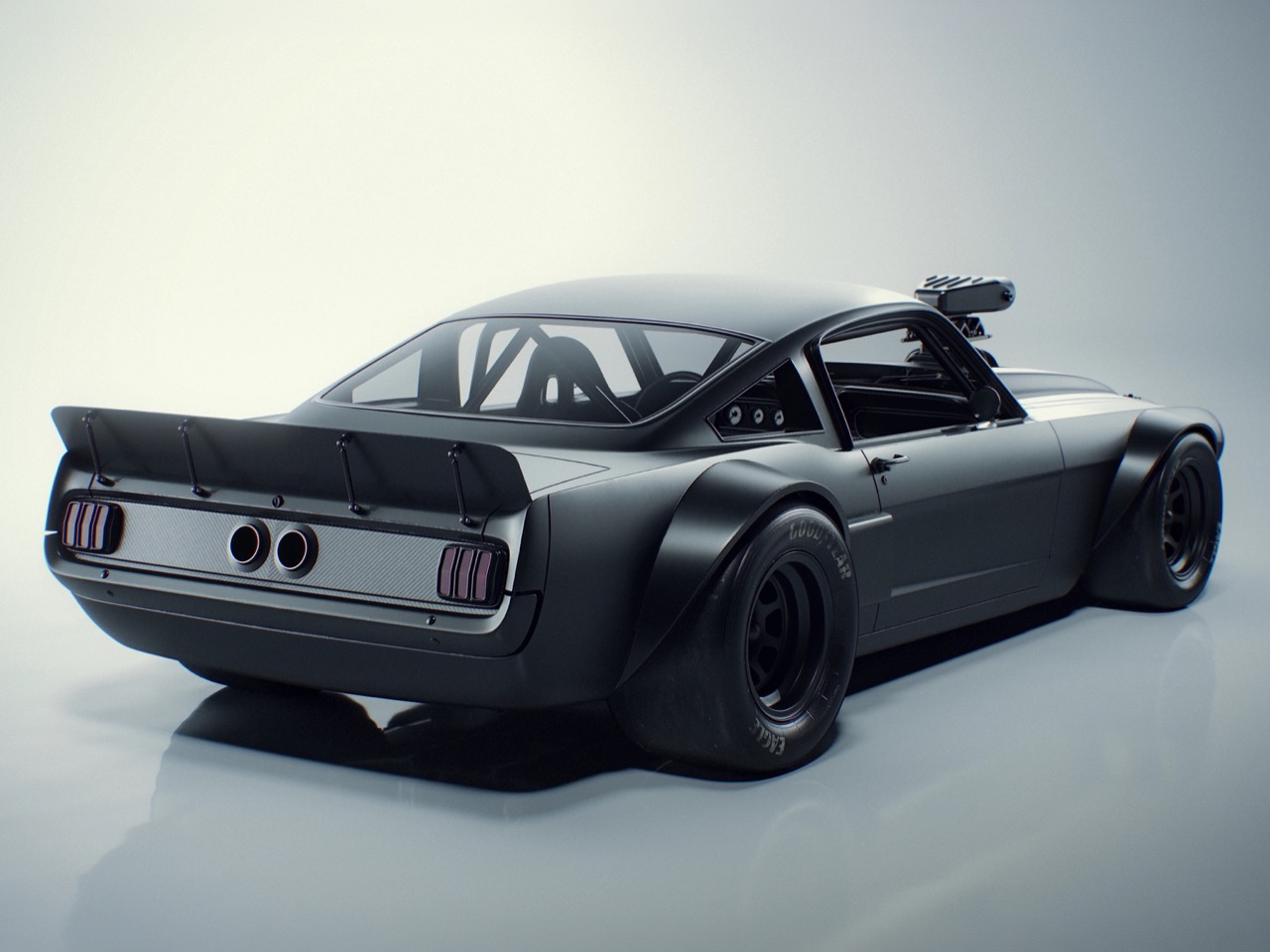
Under all that attitude sits the Mustang Fastback 2+2, which Ford started building on August 17, 1964, priced from $2,553. Its sweeping roof tucked the trunk under one long line, earning comparisons to the Corvette Sting Ray and Jaguar E-Type. The 1965 Shelby GT350 was offered only as a fastback, which cemented this body as the performance Mustang. Ford’s design studio under Joe Oros shaped the car, with Gale Halderman’s sketch serving as the basis for the whole first generation. John keeps that roofline intact, along with the long hood, short deck, and three-bar taillights. Those cues do so much identification work that he gets to mess with everything else.
Ken Block’s Hoonicorn, the 845-horsepower 1965 Mustang from Gymkhana 7, is the yardstick every widebody ’65 gets measured against. ASD Motorsports, RTR, and Block’s Hoonigan team spent two years building it around a 410-cubic-inch Roush Yates V8 and a Sadev all-wheel-drive gearbox. It was a notchback built to slide sideways, inspired by DTM racers, WRC cars, and the toy cars Block played with as a kid. John’s fastback chases a different fantasy, something closer to a Saturday night at the drag strip. The Hoonicorn wore its menace in livery and rally hardware, while this car relies on blackout paint and one shiny blower. Both are loud. They’re just loud in different accents.

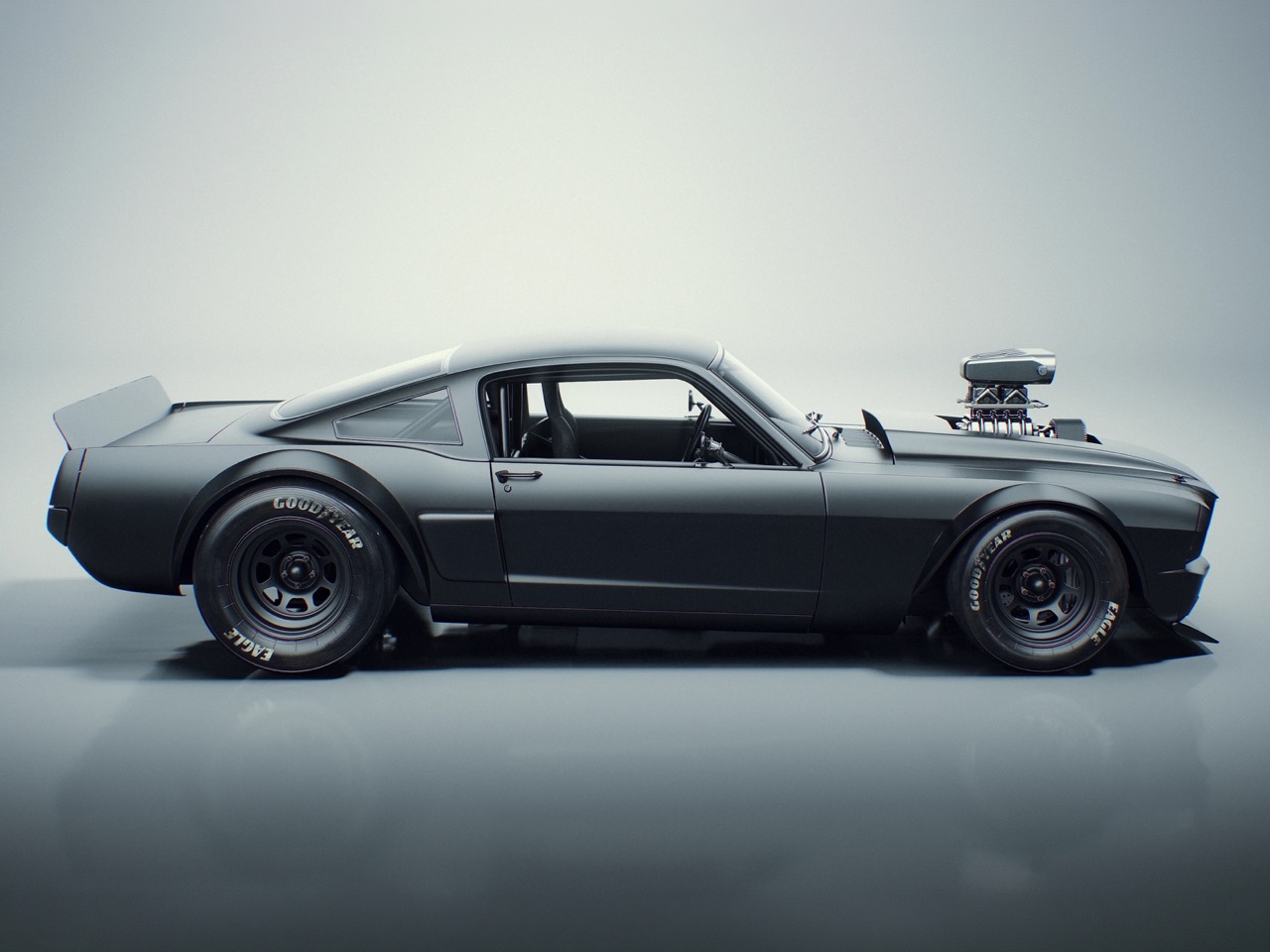
Every one of these images is CGI, staged in a seamless gray studio that lets the satin black surfaces show off their reflections. John’s earlier projects list Autodesk 3ds Max and Corona Renderer as his tools, and the soft, even lighting here suggests the same playbook. Black cars are notoriously tricky to render, yet every crease on this one still reads clearly. If I could change one thing, it’d be the rear spoiler. The flat blade on four slim stays fights the fastback’s taper and feels borrowed from a modern time-attack car. A ducktail lip like the one on Classic Recreations’ carbon-fiber 1967 Shelby GT500 would keep the line and still look mean.
Six decades and millions of Mustangs later, the first-gen fastback has been restored, restomodded, drifted, and given the blacked-out widebody treatment more than once, from AltraConcept’s Boss 302 restomod to this satin black cartoon of a ’65. That says a lot about the original 1965 shape. It can survive box flares, a missing grille, and a supercharger sticking through the hood, and it still reads as a Mustang from across a parking lot. John’s version only exists on Behance for now, which is probably for the best, since it would need a very understanding neighborhood. Still, somewhere a shop owner is staring at these images and pricing out a 6-71. I’d put money on it.