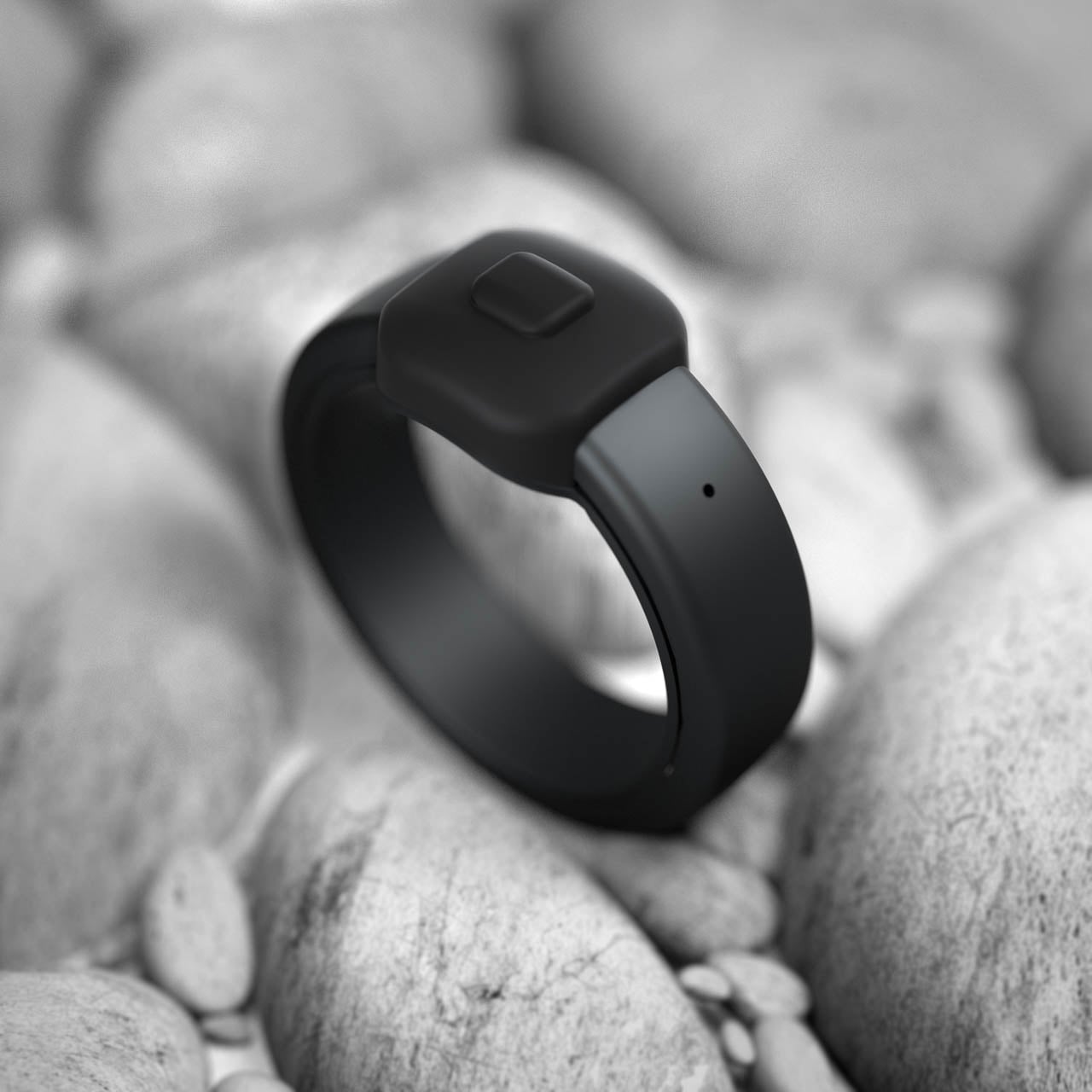
A ring that does nothing but listen. In a category defined by biometric excess, the Pebble Index 01 arrives with radical minimalism: one button, one microphone, no display, no haptic motor, no health sensors whatsoever. Eric Migicovsky, the designer who created the original Pebble smartwatch before selling it to Fitbit, has returned with a device that treats subtraction as its primary design gesture. The result is a stainless steel band that costs $75 and exists for exactly one purpose: catching thoughts before they vanish.
The Form Language of Refusal
Where contemporary smart rings pile sensors beneath the surface, the Index 01 presents a deliberately quiet silhouette. The body arrives in stainless steel with three finish options: a matte black that absorbs light, a polished silver that catches it, and a polished gold that warms skin tones. Sizing spans from 6 to 13, covering the full range of adult finger dimensions. Submersion tolerance extends to one meter of depth, accommodating daily encounters with water but drawing the line at sustained swimming. A single tactile control rises slightly from the band surface, positioned where the thumb naturally falls during a closed fist. The metal arrives cool against skin, then gradually matches body temperature until the ring becomes thermally invisible.

This external button represents the entire interaction vocabulary. Press and hold to record. Single press for a customizable action. Double press for another. The tactile click either happens or it does not. Migicovsky designed this mechanical simplicity to eliminate the software failure states that plague capacitive touch surfaces. A button pressed is a button registered. The interaction model carries the directness of a light switch, with none of the ambiguity that haunts gesture-based interfaces where a swipe might be a scroll or a tap might be a hold.
Material Decisions and Lifecycle Architecture
The battery architecture reveals the sharpest design trade-off. The power source borrows from audiological medicine: silver oxide chemistry, the same electrochemical foundation that enables hearing aids to operate for extended periods without user intervention. Under typical usage patterns, this chemistry sustains the Index for roughly twenty-four months. The cells accept no recharge. When electrochemical capacity exhausts, the object transitions from functional tool to recyclable material, and the replacement cycle begins at the standard retail threshold.

Migicovsky frames this as liberation from charging infrastructure. No dock to pack for travel. No percentage to monitor across the day. No dead device at the moment of need. The battery simply works until it does not. Pebble accepts spent units for recycling, though the environmental calculus of disposable electronics remains uncomfortable regardless of end-of-life handling. The choice prioritizes reliability over sustainability, a trade-off that will resonate with users who have missed critical moments because a rechargeable device died at the wrong time.
Onboard storage accumulates voice data during periods of wireless disconnection. The device operates autonomously at the moment of capture, holding content until the paired phone returns to communication range. This independence from continuous connectivity means the critical instant of thought preservation never depends on signal strength. Total storage capacity approaches fourteen hours of compressed audio before the power source reaches depletion.

The component inventory reads like an exercise in restraint: a single mechanical switch, a voice-optimized transducer capable of cutting through ambient noise, and nothing else. The absence of a vibration motor removes one failure point. The absence of a screen removes another. The absence of haptic feedback removes a third. Migicovsky constructed this architecture around a singular reliability thesis: fewer components mean fewer opportunities for malfunction.
Privacy Embedded in Architecture
The conversion pipeline executes entirely within the paired phone’s processor. Voice becomes text through a speech recognition system distributed under open licensing. A secondary language model, also running locally, sorts each capture into categorical bins: reminder, timer, or unstructured thought. The data path terminates at the device boundary. No packet crosses to external infrastructure. No server receives the content. The application code itself lives in public repositories, enabling inspection of every function that touches the user’s recorded cognition.
This transparency represents a structural commitment rather than a policy promise. The architecture makes privacy violation technically difficult rather than merely prohibited. Over 100 languages receive support for transcription, and the app retains both raw audio and text transcription as a practical backup for moments when ambient noise garbles the speech-to-text conversion.
The Cognitive Friction of Remembering
Three months of prototype wear revealed Migicovsky’s personal rhythm: between ten and twenty capture events per day, most compressed into windows of three to six seconds. Micro-utterances preserved before cognitive decay erases them. The friction point he identifies sits between idea formation and idea preservation: the gap between thinking something and writing it down often exceeds the retention window of working memory. The ring attempts to close that gap by reducing the capture gesture to a thumb press.

No phone to extract from a pocket. No app to open. No interface to navigate. The ring lives on the finger, perpetually ready, requiring only mechanical activation. Recording duration extends to five minutes for longer thoughts, though Migicovsky’s own usage suggests most captures are momentary. This design philosophy treats the human mind as the bottleneck rather than the technology. The device does not attempt to augment cognition. It simply catches output before it disappears into the noise of the next distraction.
The absence of a display removes the temptation to glance. No notifications pull attention away from the present moment. The ring offers no visual feedback during recording, only the physical sensation of the button depression and the knowledge that somewhere inside, a microphone is capturing sound. This sensory reduction forces trust in the device rather than verification of it.
Market Position Through Aggressive Restraint
The market already contains an alternative philosophy. Sandbar’s Stream Ring arrives at a quarter-thousand-dollar entry point, layers a subscription model at ten dollars per month for full functionality, and frames itself as a conversational AI presence worn on the hand. Delivery timelines stretch into the following summer. The Index inverts every variable: seventy-five dollars during the preorder window, ninety-nine after the March 2026 ship date, zero recurring fees, complete feature access from activation.

The value proposition rests entirely on whether memory capture alone justifies a ring on the hand. For users who want biometric tracking, the Index offers nothing. For users who want AI interaction, the device provides only a side door accessed through a specific gesture, and Migicovsky admits this feature will not work consistently. The honesty is refreshing in a category saturated with overpromise.
The organization behind the Index operates with five employees and no external capital. Migicovsky constructed this structure deliberately after the original Pebble trajectory concluded with a Fitbit acquisition that generated minimal founder returns. The Index embodies an opposing growth philosophy: constrained scale, margin sustainability from the first unit sold, price points accessible without the pressure of venture expectations demanding hyperbolic expansion curves.
Designing for Disappearance
The Index 01 succeeds or fails based on its ability to vanish from conscious attention. A health-tracking ring demands engagement: it provides data that requires interpretation. The Index asks only to be worn and pressed. The interaction surface shrinks to a single gesture repeated throughout the day.

Whether this reduction represents design clarity or feature poverty depends entirely on the user’s relationship with their own thoughts. Some people remember what matters. Others watch ideas dissolve before they can act on them. For the second group, the Index offers external memory that requires no charging ritual, no subscription fee, and no data uploaded to distant servers. The stainless steel band catches light. The button waits under the thumb. Somewhere inside, a microphone stands ready. The design statement is the emptiness itself: a ring that does almost nothing, executing that nothing with perfect reliability.