Design Mindset, Yanko Design’s weekly podcast, treats the creative process as something you can actively shape rather than something that just happens to you. Each episode digs into the habits, mental models, and practical tools that move designers from tentative to decisive, from endlessly tweaking to actually shipping work. Now in its fourteenth episode, the show is starting to feel like a standing studio critique in audio form, where process and mindset get equal billing with aesthetics. Powered by KeyShot, the series keeps returning to a simple idea: when designers can see their ideas faster and more clearly, they make better choices and take bolder risks.
This week, host Radhika Seth speaks with Reid Schlegel, Design Director at RS.D and educator at Parsons School of Design, whose career spans consultancy work at Smart Design and collaborations with brands like OXO. Reid is fluent in everything from loose Sharpie sketches to VR, CAD, and photorealistic rendering, but what really defines his work is how he teaches others to use visualization as a confidence engine. Not the confidence to defend a final deck, but the quieter confidence to show rough, uncertain ideas early. In episode 6 of Design Mindset, he unpacks how rapid visualization, from napkin sketch to KeyShot render, can quietly become the most important skill in a modern design career.
Download your Free Trial of KeyShot Here
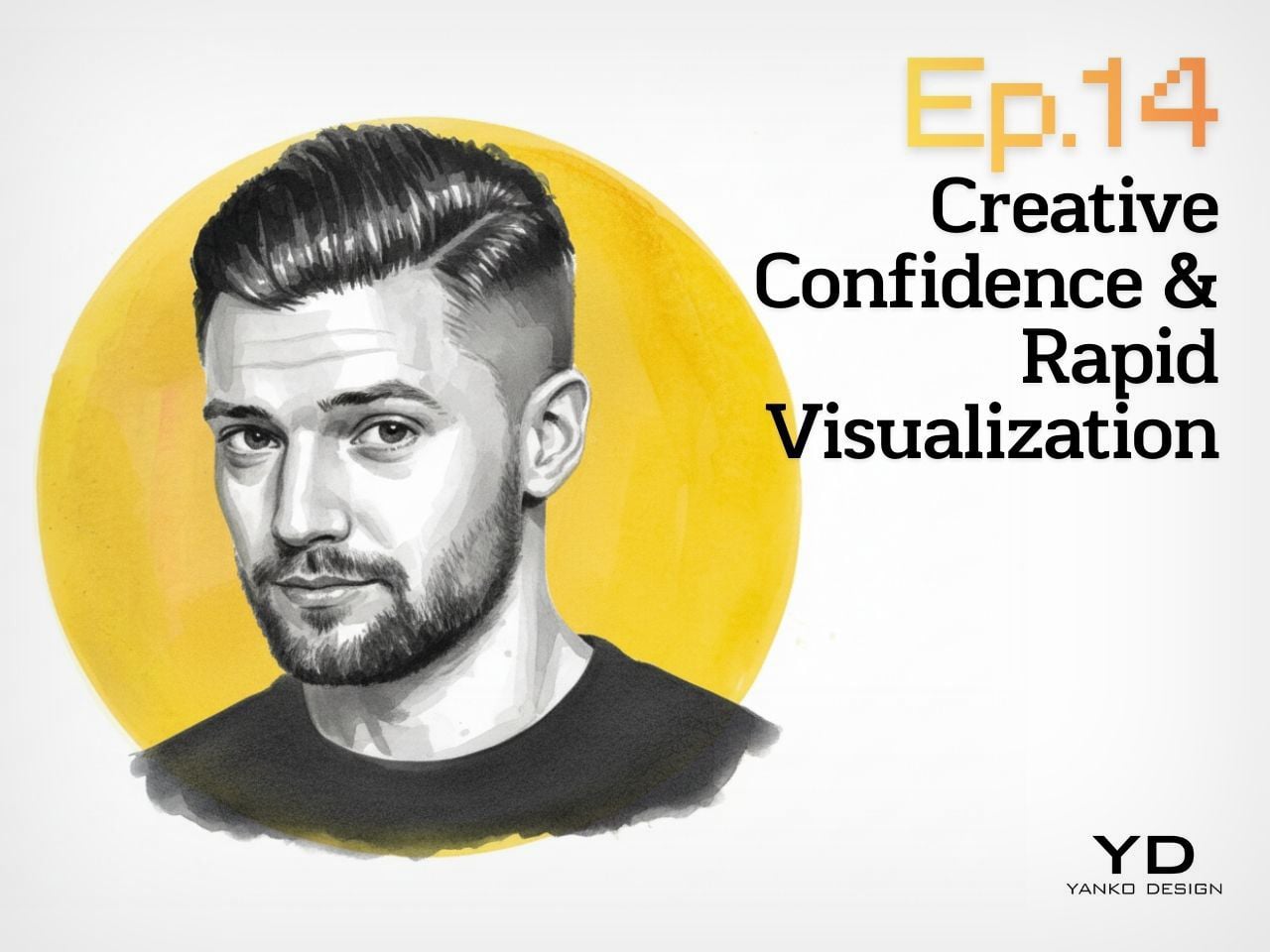
Seeing ideas sooner, not better, builds real creative confidence
Reid starts with a pattern he sees constantly in classrooms and studios. Designers are not short on ideas, they are short on the courage to externalize them before they feel polished. He describes watching students stall out inside their own heads: “They’ll have a brilliant idea in their head but they’ll spend weeks perfecting it mentally before they ever put pen to paper or pixels to screen. By the time they finally externalize it, they’ve already talked themselves out of half the good ideas. The magic happens when you see your ideas sooner, messier, more honestly. Because creativity isn’t about having perfect ideas, it’s about having the confidence to iterate on imperfect ones.” That shift in mindset turns sketching and rendering into tools for thinking instead of tools for showing off.
Once ideas are visible, the conversation changes. A wall of fast, imperfect sketches or rough models invites questions like which direction has the most potential, which combination might unlock something new, and what should be pushed further. In professional settings, especially in consulting where Reid has spent most of his career, the ability to generate many legible options makes you a better collaborator and a more resilient designer. A high volume of rough concepts creates more material for the team to build on together, spreads risk across multiple directions, and keeps everyone less attached to any single idea. Creative confidence grows from that rhythm of trying, testing, and adjusting, not from waiting for one supposedly flawless concept.

A Batman tool belt beats a single perfect process
A lot of younger designers still believe in a clean, linear pipeline: research, sketch, model, render. Reid is quick to call that a myth. Real projects are messy, and the designers who thrive are the ones who treat their skills like a Batman tool belt. “It’s not about being good at just sketching and rendering. It’s about having a wider toolkit. I kind of use the analogy of like Batman’s tool belt, where there’s a lot of different things that need to be used at different times.” On some days, the right move is a page of thumbnails. On others, it might be a crude clay massing model, a hacked cardboard mockup from Amazon boxes, or a loose “sketch CAD” blockout. The metric is not beauty. The metric is how quickly you can get something tangible enough to react to.
Reid encourages designers to be comfortable sacrificing early quality for speed, because that is how you work through the weak ideas while the stakes are still low. He also treats switching mediums as a deliberate tactic. When a problem feels stuck in CAD, picking up a pen or building a quick physical mockup can unlock a “quick win” that restores momentum. That change of medium nudges your brain into a different mode of thinking and often reveals new angles on the same brief. Instead of obsessing over one polished workflow, Reid wants designers to ask, in each moment, which tool will get them to a useful insight fastest, then move on once that insight has been captured.
Paper sketching still feels like wizardry in a digital room
Despite his comfort with digital tools, Reid is unapologetically bullish on paper. Quick, low fidelity sketching on paper remains his go to for early ideation and for live sessions with clients. The reason is not nostalgia. It is transparency. When you sketch in front of someone, they can see the thinking appear in real time. That has a powerful effect on trust. As he puts it, “If you can do a sketch on the table in front of a client, they will look at you like you’re a wizard and you’ll instantly get their respect and they’ll trust you. If you’re the first person to show it to them, you’re like the gatekeeper that all of a sudden allowed them to level up. So quick sketching is super invaluable.”
In workshops or stakeholder reviews, a spread of loose paper sketches invites people to point, circle, and combine. The work feels approachable. No one worries about “ruining” a finished render with a suggestion. That is why Reid talks about early outputs as “sacrificial lambs.” Their job is to be tested, challenged, and discarded if needed, not to survive untouched. A handful of super polished digital images, by contrast, can freeze the room. Critique starts to feel like an attack on something that already looks finished. By keeping the fidelity low in the early stages, designers protect their own willingness to explore and their clients’ willingness to engage honestly.

From overnight renders to minutes fast feedback
The episode spends time on how rendering technology has changed the tempo of design work. Reid remembers starting out at Smart Design when rendering was slow and often an overnight task. That lag created friction. Teams hesitated to render too early because each pass cost so much time. Today, tools like KeyShot produce photorealistic versions of rough models in minutes, which means designers can use rendering as part of the exploratory phase rather than saving it for the end. When you can see a form in believable lighting and materials almost immediately, you can catch proportion issues, surface problems, or brand mismatches long before they become expensive.
Reid is careful to point out that this speed comes with a risk. When designers jump into CAD and high fidelity rendering too early, they tend to lock in too soon. Once a model has hours invested in it, it becomes harder to throw away, even if the core idea is weak. His answer is to treat early CAD and early KeyShot passes like any other sketching medium. They are temporary, disposable, and meant to be killed if they are not moving the project forward. Used in that spirit, fast rendering becomes a way to shorten feedback loops and ground decisions in visual truth, rather than a trap that turns every file into something too precious to question.
Career momentum from transparency and fast, flexible output
When Radhika asks how all of this translates into career success, Reid focuses on two themes: efficiency and openness. In consulting environments, timelines are tight and briefs evolve quickly. Designers who can flex across sketching, models, CAD, and rendering, and who can choose the right tool for each moment, simply handle more work without burning out. “It just means you’re an efficient team member. My entire career has been consulting and consulting is a rapid environment where you have to execute quickly or else you just won’t be able to keep up with the demand and the workload.” That kind of efficiency is not about cutting corners. It is about not over investing in fidelity before an idea has earned it.
On the human side, Reid urges junior designers to practice radical transparency instead of hiding their struggles. He points out that managers can usually see when someone is floundering, and that teams and clients are incentivized to help you succeed because your success is tied to the project’s outcome. Asking for help early allows leaders to design a development plan with you, rather than quietly losing confidence in your abilities. When things click, creative confidence feels, in his words, “empowering” and “warm inside.” It is the sense that your work was understood, that it resonated with the room, and that you are moving in the right direction. For a field built around solving problems and creating delight for others, that feeling is one of the most reliable rewards of the job.
Design Mindset, powered by KeyShot, returns every week with conversations like this, tracing the connection between how designers think, the tools they use, and the work they put into the world. Episode 6 with Reid Schlegel leaves you with a simple, practical challenge: see your ideas sooner, in more ways, and with less fear of being imperfect.
Download your Free Trial of KeyShot Here