Man Meets Machine
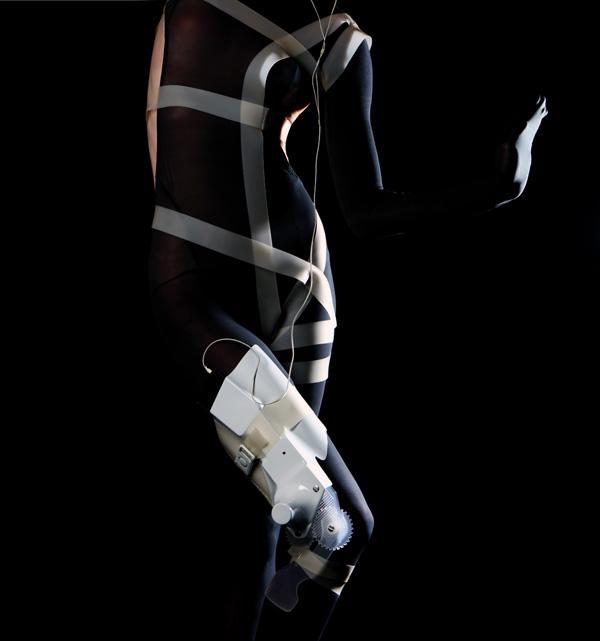
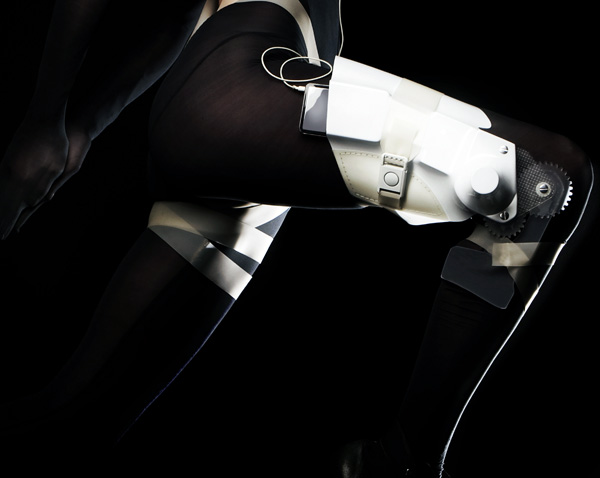
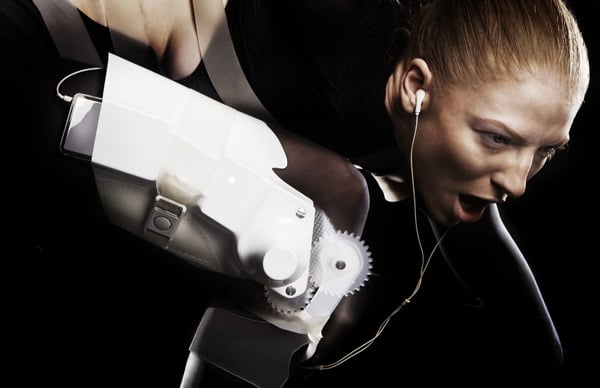
Tusk may be a little ahead of its time, but still utilitarian at its core. With a little help from some rotary dynamos, rectifiers and linear regulators, the Tusk adapter harvests the energy expelled by the user’s regular walking cycle and redirects the energy to any portable device, making the user, in essence, the battery and charger at once.
Designer: Jerry Mejia


14 Comments »
David J Lowe says
Great concept. I have always wondered why they don’t apply this theory to gyms. Think of all the energy people generate in an hour long workout. You could light a room for a while with that. Even better would be to take this energy generated in the West and send it to poorer countries.
edddd222 says
Nice, job, one point of criticism I would eliminate the gears, human joints have more degrees of freedom. it will be impossible to have the gears in interaction all the time. Especially if you want the user to stay comfortable. E.g. you could use a flexible lever that can bend but also pivots with the joint. Or maybe a weight that is shaking up and down with the runner’s movements.
If you only want to power an Ipod, you really don’t need much energy. you will always add extra resistance for the runner, so you might want to limit it as much as possible.
gurion says
An average human being has the power of about 70W, for shorter periods like training, let’s say it’s about 200W. So if one human being works out for one hour and the energy is harvested completely efficient (i.e. energy conversion efficiency = 1), the extracted energy would be 0.2 kWh per person per training.
Let’s assume, you have about 300 people a day training with machines you can harvest from (stepper, crosstrainer etc. but not treadmill), the collected energy would be 60kWh, and, for one year 21900 kWh. Average retail price in the US per kilowatthour is 9.8c, so 21900 kWh are worth 2146.2$. To have capacity for 300 people training per day, you need at least 25 machines (at full capacity utilization), so this would create a revenue of about 89.4$ per machine per year, which would be hardly enough to cover the investments needed to harvest this energy. Storage and use are not considered in this calculation, let alone export. So it doesn’t make any sense, neither environmental nor economical.
Kid says
^ Party pooper.
Rawwhale says
There are already dozens of gyms and reactive floors which use human movement for energy, check the Greenasium in San Diego for example.
We have the technology to harvest sun, heat or movement energy using nano-filaments in fabric. Using gears and dynamos is decades behind and would be almost impossible to move in. This is more of a steampunk doodle than an actual design.
Douglas says
This design is an exploration into harvesting energy for our own consumption and is a stepping stone for what can be.
Ken says
Having worn knee braces for ligament damage I can honestly say this will never work as an accessory while a single wall outlet remains to charge with. The shape of the thigh makes a $2000 custom fit brace ride down constantly as the thigh flexes. Designer, or should I say render artist, needs to try wearing anything attaching above and below the knee for a bit and realize it is uncomfortable even with a plaster mold made of your exact knee for a top of the line brace.
If one can make this actually comfortable to wear and not shift as the thigh expands and contracts, they have a far larger opportunity waiting in the medical knee brace market as it would be revolutionary. However the render is simple and offers absolutely no substantive resolutions to the many design issues so I am guessing negative to revolutionary from this notion. Also, military had working prototype of this concept several years ago and went in different direction.
I personally would have removed the white ’5th Element Lilu’ costume from the render. It looks like one must wrap the device around ones entire body starting at the… oh never mind.
Trackbacks