Sands Of Traffic Times!
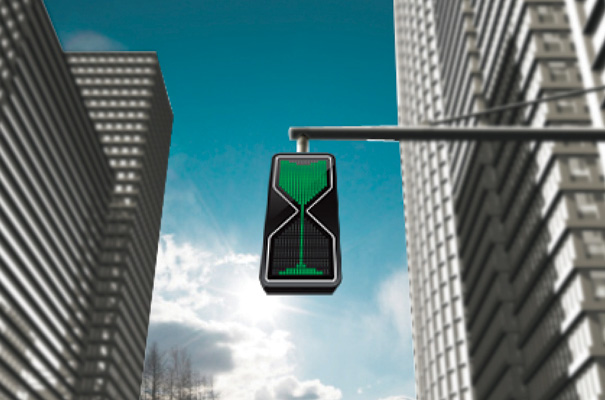
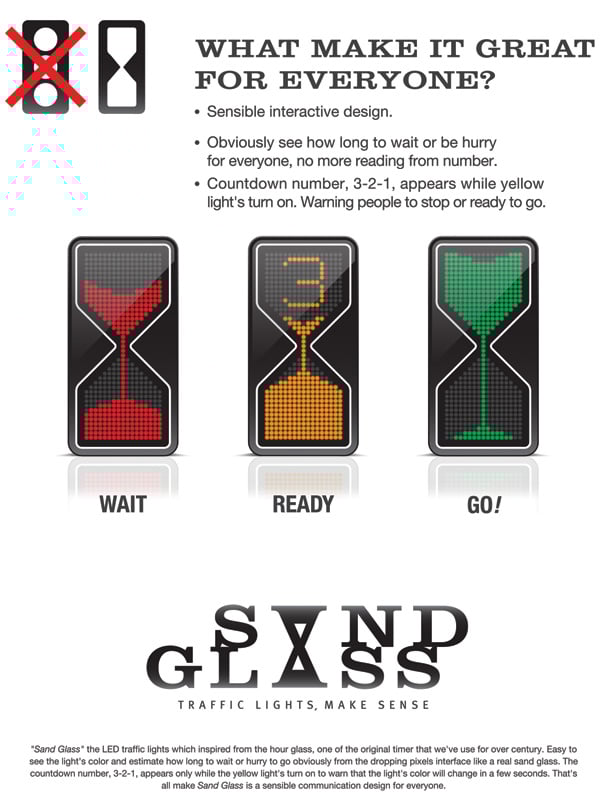
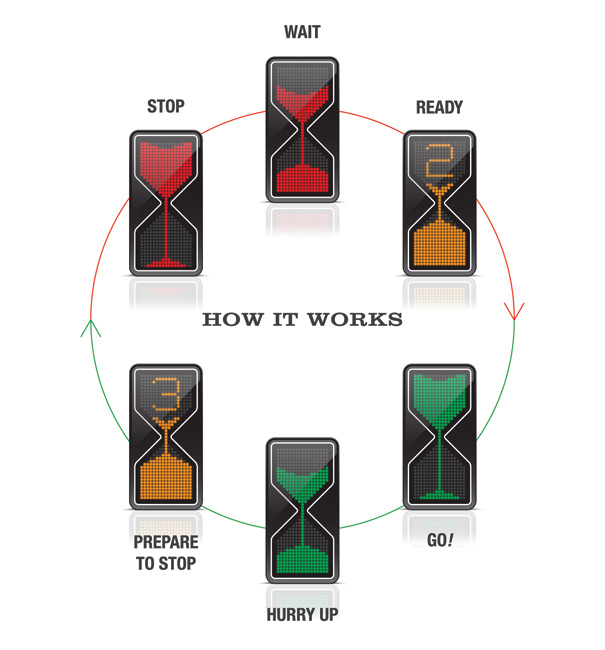
The Sand Glass is a new look at traffic lights. Surely people must be frustrated with the current design, which is why we have seen THREE DIFFERENT DESIGNS recently. Make this the fourth dimension using the sand-hour-glass as its model. LED lights trickle down to make an obvious statement, regarding the time left for the lights to change. Easy and intuitive.
Designer: Thanva Tivawong


381 Comments »
Petr says
Not safe at all! These things need to be simple, simplier that this. Red – orange – green… How simple is that? These light are very dangerous even though I like the design. And it could be hard to read it in rain / snow / from bigger distance…
AmyOhmy says
Red-orange-green is bar far the simplest, when you consider driver's have learned to react to this system. Any change would cause massive havoc. This design is certainly NOT the solution. There is no difference between Ready and Prepare to Stop! Some people would be accelerating through the light while other slammed on the breaks. Also a 'Hurry Up' signal sounds a little dangerous.
Paul says
What about color blind people ?
I'd like to see them hesitating at full speed between STOP and GO….
This is a proper solution : http://www.yankodesign.com/2009/11/30/a-better-un...
Things have sometimes a specific design for a good reason.
This is just a dead end concept….
Vick says
How do colorblind people understand current street lights then? Derp derp.
Jan kabaal says
they know that the top light is red, the middle one is orange and the bottom one is green. Easy as that.
Alex says
Is it? How would you handle that (in)famous Tipperary Hill intersection with the upside down traffic light?
fedevit says
less smugness more thinking pls.
current lights are placed in different positions just for this reason. Guess why we don't have any traffic light with a single circle changing color?!?
@salmonmoose says
Both designs are actually kind of stupid – in Australia we've removed a "get ready" light all together, for the exact reasons a timed stop is bad. For the average user it's fine, but for hoons it encourages a race mentality, it's safer to have a bit of a delay at the start of a green cycle, it gives some clearance to slow cars, bike and pedestrians, and forces the driver to pay attention.
A timer on the green, and the "prepare to stop" light would make some sense, although, would again encourage some drivers to speed up.
J.Emmett Turner says
Exactly. I am colorblind and it's bad enough that different municipalities have different color shades, which make it more difficult when you can't see the position. One improvement could be a lighted, possibly fading box around all three lights so that you can see the position at night from far away instead of just seeing a lonely light in a sea of blackness and staring intently for a change as you approach just to know the position. This often means staring at the light when you could be scanning the intersection!
Doug says
I like the innovation, but probably just a simple timer added to the existing stoplights is all that's needed, the same time often used for pedestrian crosswalks, but that could ideally be viewed from a distance, to allow caution when approaching a stale green light or ease of mind when approaching a fresh green light (with 10+ seconds on it).
Carol says
Hi Doug,
I agree with you
a3trion says
the simplicity of the existing lights is still better. simple improvement would be the red light blinking just before switching to green. just to give motorist a heads up. no need to replace existing ones too.
Tom says
Red blinking means the same as a stop sign, so unfortunatly your suggestion wouldn't work either. If you want to give drivers a "heads up" just tell them to pay attention to pedestrian signals. If it is a flashing hand you probably only have at most 13-25 seconds before the signal changes to clearance. Some ped heads even have digital countdowns on them already.
its2am says
Tom your remark somehow does not make sense, your asking drivers to pay attention to a signal that is not meant for them. However, I believe all ideas should be considered. Your remark does bring up an excellent idea; why not modify street lights to include a light that cautions the drive a cross walk has been requested to be used. A cross walk signal button would activate a warning signal attached to the stop light. True, there are painted lines but often they are not properly maintained.
Historically the signal has always been called a stop light. But its actually not. It is also a yield light and a go light. That's why I like stop signs, you stop, look and listen and go when it's safe. Whenever the power is out in my city people always seem to act just fine, even if the intersection is huge.
Get ready lights work great, they use them in Germany. The light was created for manual transmissions and saves a lot of time. In todays society they now act as "get off the phone, finish your texting and drive" signals.
cntsavepplfrmthmslvs says
1. Tom's remark makes perfect sense.
2. When the power is out, motorists are expected by law to treat all typically lighted intersections as all-way stops unless otherwise noted at the intersection or there is an official directing traffic.
3. this particular design looks neat, but will cause a lot of people to run the countdown to green light assuming that it is the countdown to red light.
4. If you're texting while you're driving, you should loose your licence and be charged with involuntary manslaughter. If you can't pull yourself away from your phone ride the bus.
andr says
Where I live motorists only tend to stop if they see a red or amber light. Which means when the power is out, very often they don’t properly do the “all-way stop thing”. Several years ago I witnessed a very horrific accident caused by this, and just yesterday we had a major intersection lose power from the wind and while most cars were doing it properly, two cars just barreled right through while I was waiting my turn to go.
J.Emmett Turner says
Umm… pedestrian crosswalks with electronic signals only exist at far less than 1% of all stop lights in the USA.
Demian says
Not much to say to what Petr, Paul and Doug already said.
Unsafe design, at best.
Damjan Stanković's design (indicated by Paul) deals with it in a more elegant way.
Alex says
@A3trion, The german system is better then blinking.
Red = stop
red+orange = start your engines
Green = go
orange (without red) = prepare to stop.
@Topic, as paul said, certain colourblind do not see the difference between red and green. This system will not work for them and theirfore it should not be implented.
adam says
looks like a wineglass
Ramses says
Why didn’t designers think of colorblind people…
I’d fire them…
Rebellionleader says
Using orange twice seems dangerous. How can someone who approaches the orange light know whether the lights are about to turn green of red? Other than that it looks pretty cool.
LankThompson says
agreed.
Matt says
+1
mugabo says
ambiguous yellow, huh?
Kamazinho says
Color blind doesn't mean black and white you morons. I am color blind and the combination of certain colors will make for some colors to dominate the other, making the weaker one "disappear" into the stronger color. That would not be the case in this design. We are still able the tell green from red!
JoeHonkie says
You have one of several types of color blindness and it doesn't cause you a problem with stoplights, good for you. There's a bunch of OTHER types of color blindness that cause a lot of problems with things like red vs. green. It's specifically why stoplights were designed the way they are in the first place.
Doug says
Except those with Red/Green color blindness.. the most common type…
bbdeezy says
my husband is colorblind with red/green being the most trouble he has….and he relies on the position of the lights (especially at night and in winter when their is alot of snow on the ground and he has light blindness fron the sunlight reflecting on the snow. I think they should just leave it alone. Our yellow light ALWAYS is just before it turns red so everyone knows it means slowdown…..but I do think it would be better to just do away with the yield light bc so many people do use it as a "speed up see if I can make it" light
Pete says
@Kamazinho:
Uh… There’s more than one type of color blindness ranging from trouble discerning certain colors(red/green, blue/yellow) to total black and white (though this is a rare condition), therefore other color blind people may find it more difficult to identify than yourself.
Tom says
While what you say is true, their are still other varitions of coloblindness that result in the need for both position and color on traffic indications. This design still voilates current (and logically, future) safety standards.
dgc says
My father is severe red-green color blind; he can tell the difference only if the saturation is sufficiently different and then only if he has some external information about which is which (i.e. someone tells him, or he assumes the light on top is red).
Benn says
It sounds like you have the most common form of colour blindness, anomalous trichromacy, which means you can see all colours, they are just slightly misaligned.
But that isn’t the only form of colour blindness, people with dichromacy and monochromacy actually wouldn’t be able to distinguish these colours. For about 3% of the population red, orange and green would all appear as similar shades of yellow, thus making this design unusable.
@ukslim says
"You morons", nice etiquette.
In fact monochromatic colour blindness, while rare, does exist. You have a less severe kind of colour blindness (so do I). We're lucky.
I know someone with no colour vision at all. It's interesting how he thinks differently about the world. For example, he enjoys walking in the countryside, but a bush full of brightly coloured flowers will not attract his attention.
Scott says
There are several types of colorblindness. On of the common, affects red-green. For example, if a person has deuteranopia, there is almost zero difference between classic red and classic green. Just because you have tritanopia doesn't mean that everyone does.
dikke joop says
Great from a design point of view, but usability wise it is flawed. There is no way to distinguish between the orange to red and orange to green states and most importantly as with all timed traffic lights there will inevitably be users who keep pushing the limits by taking off earlier because the traffic light tells them its about to become green. Possibly creating dangerous situations this way.
Johan says
We actually have a better solution over here for people on bike. Next to the actual lights, there's a vertical bar of LEDs which starts all lighten up and is ticking away LEDs to show people how long to wait. The LEDs will need to be bigger for usage on traffic lights hanging over the street, but I guess that's still the best alternative.
Reland says
I get a kind of Windows déjà vu…
Cellar says
I like this, I really do. I see, however, two major problems with that need solving if this is going to have a serious chance:
First, there is no way to see whether the orange light is about to go red or to go green. Find a way to express this. German lights, for example, use a green -> orange -> red -> red+orange -> green cycle.
Second, lights are top-to-bottom red-orange-green or sometimes just red-green, and they are that way for the simple reason that otherwise red/green colour blind people wouldn't know what the lights mean. For the same reasons you'll see no "horizontal" traffic lights in Europe. There's a case of a Dutch air force employee ending up in a car crossing an air strip while a fighter jet was landing because he was colour blind and that particular light had the green light on top. Disaster was narrowly averted, and afterward policies changed, but it is an important lesson. In general traffic there will be colour blind people, so you need to find a way to show them what's going on too.
I do like the general idea though.
Petr says
Not safe at all! These things need to be simple, simplier that this. Red – orange – green… How simple is that? These light are very dangerous even though I like the design. And it could be hard to read it in rain / snow / from bigger distance…
AmyOhmy says
Red-orange-green is bar far the simplest, when you consider driver's have learned to react to this system. Any change would cause massive havoc. This design is certainly NOT the solution. There is no difference between Ready and Prepare to Stop! Some people would be accelerating through the light while other slammed on the breaks. Also a 'Hurry Up' signal sounds a little dangerous.
Paul says
What about color blind people ?
I'd like to see them hesitating at full speed between STOP and GO….
This is a proper solution : http://www.yankodesign.com/2009/11/30/a-better-un...
Things have sometimes a specific design for a good reason.
This is just a dead end concept….
Vick says
How do colorblind people understand current street lights then? Derp derp.
Jan kabaal says
they know that the top light is red, the middle one is orange and the bottom one is green. Easy as that.
Alex says
Is it? How would you handle that (in)famous Tipperary Hill intersection with the upside down traffic light?
fedevit says
less smugness more thinking pls.
current lights are placed in different positions just for this reason. Guess why we don't have any traffic light with a single circle changing color?!?
@salmonmoose says
Both designs are actually kind of stupid – in Australia we've removed a “get ready” light all together, for the exact reasons a timed stop is bad. For the average user it's fine, but for hoons it encourages a race mentality, it's safer to have a bit of a delay at the start of a green cycle, it gives some clearance to slow cars, bike and pedestrians, and forces the driver to pay attention.
A timer on the green, and the “prepare to stop” light would make some sense, although, would again encourage some drivers to speed up.
J.Emmett Turner says
Exactly. I am colorblind and it's bad enough that different municipalities have different color shades, which make it more difficult when you can't see the position. One improvement could be a lighted, possibly fading box around all three lights so that you can see the position at night from far away instead of just seeing a lonely light in a sea of blackness and staring intently for a change as you approach just to know the position. This often means staring at the light when you could be scanning the intersection!
Doug says
I like the innovation, but probably just a simple timer added to the existing stoplights is all that's needed, the same time often used for pedestrian crosswalks, but that could ideally be viewed from a distance, to allow caution when approaching a stale green light or ease of mind when approaching a fresh green light (with 10+ seconds on it).
Pete says
People will be launching into the intersections earlier and staying in them later. CRASH!
a3trion says
the simplicity of the existing lights is still better. simple improvement would be the red light blinking just before switching to green. just to give motorist a heads up. no need to replace existing ones too.
Tom says
Red blinking means the same as a stop sign, so unfortunatly your suggestion wouldn't work either. If you want to give drivers a “heads up” just tell them to pay attention to pedestrian signals. If it is a flashing hand you probably only have at most 13-25 seconds before the signal changes to clearance. Some ped heads even have digital countdowns on them already.
its2am says
Tom your remark somehow does not make sense, your asking drivers to pay attention to a signal that is not meant for them. However, I believe all ideas should be considered. Your remark does bring up an excellent idea; why not modify street lights to include a light that cautions the drive a cross walk has been requested to be used. A cross walk signal button would activate a warning signal attached to the stop light. True, there are painted lines but often they are not properly maintained.
Historically the signal has always been called a stop light. But its actually not. It is also a yield light and a go light. That's why I like stop signs, you stop, look and listen and go when it's safe. Whenever the power is out in my city people always seem to act just fine, even if the intersection is huge.
Get ready lights work great, they use them in Germany. The light was created for manual transmissions and saves a lot of time. In todays society they now act as “get off the phone, finish your texting and drive” signals.
cntsavepplfrmthmslvs says
1. Tom's remark makes perfect sense.
2. When the power is out, motorists are expected by law to treat all typically lighted intersections as all-way stops unless otherwise noted at the intersection or there is an official directing traffic.
3. this particular design looks neat, but will cause a lot of people to run the countdown to green light assuming that it is the countdown to red light.
4. If you're texting while you're driving, you should loose your licence and be charged with involuntary manslaughter. If you can't pull yourself away from your phone ride the bus.
J.Emmett Turner says
Umm… pedestrian crosswalks with electronic signals only exist at far less than 1% of all stop lights in the USA.
Demian says
Not much to say to what Petr, Paul and Doug already said.
Unsafe design, at best.
Damjan StankoviÄ's design (indicated by Paul) deals with it in a more elegant way.
Alex says
@A3trion, The german system is better then blinking.
Red = stop
red+orange = start your engines
Green = go
orange (without red) = prepare to stop.
@Topic, as paul said, certain colourblind do not see the difference between red and green. This system will not work for them and theirfore it should not be implented.
adam says
looks like a wineglass
Ramses says
Why didn’t designers think of colorblind people…
I’d fire them…
Rebellionleader says
Using orange twice seems dangerous. How can someone who approaches the orange light know whether the lights are about to turn green of red? Other than that it looks pretty cool.
LankThompson says
agreed.
Matt says
+1
Kamazinho says
Color blind doesn't mean black and white you morons. I am color blind and the combination of certain colors will make for some colors to dominate the other, making the weaker one “disappear” into the stronger color. That would not be the case in this design. We are still able the tell green from red!
JoeHonkie says
You have one of several types of color blindness and it doesn't cause you a problem with stoplights, good for you. There's a bunch of OTHER types of color blindness that cause a lot of problems with things like red vs. green. It's specifically why stoplights were designed the way they are in the first place.
Doug says
Except those with Red/Green color blindness.. the most common type…
bbdeezy says
my husband is colorblind with red/green being the most trouble he has….and he relies on the position of the lights (especially at night and in winter when their is alot of snow on the ground and he has light blindness fron the sunlight reflecting on the snow. I think they should just leave it alone. Our yellow light ALWAYS is just before it turns red so everyone knows it means slowdown…..but I do think it would be better to just do away with the yield light bc so many people do use it as a “speed up see if I can make it” light
Tom says
While what you say is true, their are still other varitions of coloblindness that result in the need for both position and color on traffic indications. This design still voilates current (and logically, future) safety standards.
dgc says
My father is severe red-green color blind; he can tell the difference only if the saturation is sufficiently different and then only if he has some external information about which is which (i.e. someone tells him, or he assumes the light on top is red).
@ukslim says
“You morons”, nice etiquette.
In fact monochromatic colour blindness, while rare, does exist. You have a less severe kind of colour blindness (so do I). We're lucky.
I know someone with no colour vision at all. It's interesting how he thinks differently about the world. For example, he enjoys walking in the countryside, but a bush full of brightly coloured flowers will not attract his attention.
Myrtonos says
If he sees no colour at all, his visual acuity would be below the driving test line. But they do have excelent night vision though.
Scott says
There are several types of colorblindness. On of the common, affects red-green. For example, if a person has deuteranopia, there is almost zero difference between classic red and classic green. Just because you have tritanopia doesn't mean that everyone does.
dikke joop says
Great from a design point of view, but usability wise it is flawed. There is no way to distinguish between the orange to red and orange to green states and most importantly as with all timed traffic lights there will inevitably be users who keep pushing the limits by taking off earlier because the traffic light tells them its about to become green. Possibly creating dangerous situations this way.
Johan says
We actually have a better solution over here for people on bike. Next to the actual lights, there's a vertical bar of LEDs which starts all lighten up and is ticking away LEDs to show people how long to wait. The LEDs will need to be bigger for usage on traffic lights hanging over the street, but I guess that's still the best alternative.
Avery says
this it terrible….. you call yourself a designer? What professor advised you on this? wow.
DaveZ says
Another problem with LED based lighting – snow build up. Traditional bulbs generate heat and melt snow (in most cases). LEDs produce very little heat – so not as much melting will happen.
@ukslim says
This has caused problems in some parts of the world, simply because it was an overlooked factor. But it doesn't mean LEDs shouldn't be used.
The sensible response is, only in parts of the world were it snows, have a small heating element controlled by a thermostat. For much of the year, it will never switch on and never take power. When it's needed, it'll melt the snow and ice.
Darin says
Problem 1:
This is LESS effective than current lights for colorblind people.
Problem 2:
According to the diagram, The Red -> Green transition is the same as the Green -> Yellow transition. This will cause MORE accidents.
Problem 3:
Lights need to be attention GRABBING, but not attention HOLDING. Once we acknowledge the signal, we need to return our awareness to our surroundings, rather than keeping our eyes glued to a ticking clock like anxious schoolchildren.
Scott says
No reason to be a jackass, Kamazinho. Colorblindness takes many different forms. My father can’t see the difference between red and green and can tell when to go by whether the light is on at top, middle, or bottom.
How would you like to be crossing the intersection when my father is coming up to one of these red lights?
Theo says
Yanko already had the perfect traffic lights (made it into november 09s top designs… http://www.yankodesign.com/2009/11/30/a-better-un...
Emmy says
Being red-green color blind is far more common than you'd think (I've seen it as high as 7% of all males). My first thought was of a friend who explained to me that he knows the top light is the red-stop light and the bottom one is the green-go light. He can differentiate between the two.
@ukslim says
That 7% will apply to the kind of mild red/green colourblindness I have. I can easily distinguish a red traffic light from a green one. It's muddier reds and greens that look the same; and certain LEDs.
However, you're right that strong red-green colour blindness is common enough that traffic lights should cater for it.
Reland says
I get a kind of Windows dj vu…
Jeff Simpson says
In Israel they have the normal Red/Yellow/Green lights, but they operate subtley differently:
Green -> Yellow -> Red (this part is normal)
when it's about to go green, it goes Red+Yellow for awhile, then goes green.
No new light pole needed, just a new controller. The only problem is, people get used to it, so if you're not already off your brake pedal by the time it's red+yellow, people will honk at you to go before the light is even green.
Nicole says
I like this idea!
MatthewDS says
I'm colorblind, and I use the location of the light (top, middle, bottom) to figure out what the signal is. This concept would be deadly.
Carol says
I personally do not think that we need any more than 3 colour signals,(in the combinations that are already in existence ) different shapes might help the colour blind of our society. simple is better, especially as most people try to race the lights anyway, the new designs may help. Only 3 please. Everybody seems to in a rush these days unnecessarily.
Cellar says
I like this, I really do. I see, however, two major problems with that need solving if this is going to have a serious chance:
First, there is no way to see whether the orange light is about to go red or to go green. Find a way to express this. German lights, for example, use a green -> orange -> red -> red+orange -> green cycle.
Second, lights are top-to-bottom red-orange-green or sometimes just red-green, and they are that way for the simple reason that otherwise red/green colour blind people wouldn't know what the lights mean. For the same reasons you'll see no “horizontal” traffic lights in Europe. There's a case of a Dutch air force employee ending up in a car crossing an air strip while a fighter jet was landing because he was colour blind and that particular light had the green light on top. Disaster was narrowly averted, and afterward policies changed, but it is an important lesson. In general traffic there will be colour blind people, so you need to find a way to show them what's going on too.
I do like the general idea though.
George says
I think it's an owesome idea, this is the future of traffic lights, we can not just stop thinking of new fresh ideas because of few people who can not tell the difference between red and green they shouldn't be driving in the first place.
If you think about it adding the yellow in between the red to green and green to red it make more sense. Get ready to stop and get ready to go very simple. If you can not understand a simple function like this then you have a problem.
Myrtonos says
Good thinking George:
*Colour deficiency varies widely, and green-weak people would have no trouble at all in this case. Only daltonistis (red-blind and green-blind) would have this issue, and as far as I know, not just their ability to read traffic lights but their overall awareness of their surroundings is affected. Red-weak peolpe can distinguish traffic lgiht to but red, especially pure red, looks dimmer to them. Driving with protanomally or protanopia is equivelent to a blood alchohol level between 0.05% and 0.08%.
*Archromatopsia, where people only see black, grey and white is really rare. These people also have sub-optimal visual acuity (not correctable to 20/20) as a direct result of lacking colour receptors, so if optimal visual acuity is a requirement for a driver's license, archromatopes would be effectively excluded from driving.
Derek says
If I come upon a yellow light, how will I know whether to prepare to stop or prepare to go?
Tom says
Not only is the second orange dangerous for the reasons noted in above above, it would also (I'm assuming) take the place of the all red phase within the signal cycle, which is a safety feature intended to allow the intersection to clear before the green indication comes on. Implementing this indication would greatly increase traffic accidents in my semi-professional opinion. Drivers are simply not going to stop running red lights, no matter how you change things.
Incedently back in the ancient times of traffic signals, the phasing proceeded the same as this proposal (Green-Yellow(Orange)-Red-Yellow(Orange)-Green…etc.). This was deemed unsafe and thus changed to what we're familiar with today.
More important than the blatant design flaws is the fact that no signal controller I know about would be able to run this complex of a indication. One of the most important features of the current traffic indications are their simplicity; this is the opposite of a simple design.
Tom says
Actually, come to think of it, all my before points are moot.
This wouldn't work simply because signals aren't pre-timed. The more vehicle demand there is the more green there would be. The hourglass would have to stop or "refill" for each vehicle extention (i.e. whenever any vehicle crosses the detection loops or enters the video detection zone.)
Simply put, even if there were no other design flaws, this indication would only be able to be used with pretimed signals, which are themselves extremely rarely used in this day and age, nearly every modern intersection is either semi-actuated or fully actuated.
Clearly the designers looked only at form and completely ignored function. Fail.
tom says
yep. when dealing with safety, 'complexity' gets a big thumbs down
Pete says
People will be launching into the intersections earlier and staying in them later. CRASH!
Jimmy says
You can't tell if it's counting down to red or if it's about to go green, guess it means gun it no matter what
Sandra Gonzalez says
Nice but usesless. If your are in a car driving, it will distract you from the actual focus of attention, THE ROAD!! You got to design things to make other things SAFER, not CUTER!!!
Sandra Cristina Gonzalez Uslar says
BTW, Kamazinho, the colour i'ts not the point… it's the way it's shows it, more like "living trough a videogame" than in contact with the actual true of life… one thing is was the color tells you, and the other it's that you always have to look for a drunk driver in the road!!!
cRaZy408MaMa says
I like the idea/design from an artist's point of view, with only one critique, though. I don't understand why there would be a numerical count down between the change from red to green-that could definitely lead to dangerous confusion. We currently only have a Yellow light between green to red to warn people to slow down, why not keep it that way? As for a3trion's suggestion regarding blinking lights, we have, here in California, a similar set-up for the pedestrians that also works for drivers that pay attention to patterns. When it is time for them to cross at a crosswalk, illuminated numbers count down then a red "stop" hand blinks a few times before going to a solid glowing hand. When the blinking hand stops the green light also changes to yellow, warning moving traffic to stop. The blinking hand is functional for more than pedestrians, though. It is also an indicator to waiting traffic to be ready to go. Unfortunately, not all pedestrian signs change automatically. Some have to still be triggered by someone pressing a button….
Mel says
"Color blind doesn't mean black and white you morons… We are still able the tell green from red! "
Right, tell that to my grandfather. There are several different types of colorblindness and different severities within them. Some do okay with red/green, some do not. He's among the latter.
Avery says
this it terrible….. you call yourself a designer? What professor advised you on this? wow.
DaveZ says
Another problem with LED based lighting – snow build up. Traditional bulbs generate heat and melt snow (in most cases). LEDs produce very little heat – so not as much melting will happen.
@ukslim says
This has caused problems in some parts of the world, simply because it was an overlooked factor. But it doesn't mean LEDs shouldn't be used.
The sensible response is, only in parts of the world were it snows, have a small heating element controlled by a thermostat. For much of the year, it will never switch on and never take power. When it's needed, it'll melt the snow and ice.
Darin says
Problem 1:
This is LESS effective than current lights for colorblind people.
Problem 2:
According to the diagram, The Red -> Green transition is the same as the Green -> Yellow transition. This will cause MORE accidents.
Problem 3:
Lights need to be attention GRABBING, but not attention HOLDING. Once we acknowledge the signal, we need to return our awareness to our surroundings, rather than keeping our eyes glued to a ticking clock like anxious schoolchildren.
Scott says
No reason to be a jackass, Kamazinho. Colorblindness takes many different forms. My father can’t see the difference between red and green and can tell when to go by whether the light is on at top, middle, or bottom.
How would you like to be crossing the intersection when my father is coming up to one of these red lights?
Theo says
Yanko already had the perfect traffic lights (made it into november 09s top designs… http://www.yankodesign.com/2009/11/30/a-better-un...
Emmy says
Being red-green color blind is far more common than you'd think (I've seen it as high as 7% of all males). My first thought was of a friend who explained to me that he knows the top light is the red-stop light and the bottom one is the green-go light. He can differentiate between the two.
@ukslim says
That 7% will apply to the kind of mild red/green colourblindness I have. I can easily distinguish a red traffic light from a green one. It's muddier reds and greens that look the same; and certain LEDs.
However, you're right that strong red-green colour blindness is common enough that traffic lights should cater for it.
Myrtonos says
Do you mean common enough relative to car usage rates? That 7% are actually colour-weak rather than colourblind. Most common is green-weakness (Deuteranomaly) and the second most common is red-weakness (Protanomaly). With Deuteranomaly, dark greens look black. Many people with this anomaly often don't know about it until they have their colour vision checked.
anon says
So what do you do if you look up and see a yellow countdown if you didn't see what came before it? Get ready to go or stop?
tom burge says
right- one means you can finish speeding across, and the other means don't go yet. Geez- THAT won't cause any problems… <rolls eyes>
Pete says
@Kamazinho:
Uh… There’s more than one type of color blindness ranging from trouble discerning certain colors(red/green, blue/yellow) to total black and white (though this is a rare condition), therefore other color blind people may find it more difficult to identify than yourself.
Jeff Simpson says
In Israel they have the normal Red/Yellow/Green lights, but they operate subtley differently:
Green -> Yellow -> Red (this part is normal)
when it's about to go green, it goes Red+Yellow for awhile, then goes green.
No new light pole needed, just a new controller. The only problem is, people get used to it, so if you're not already off your brake pedal by the time it's red+yellow, people will honk at you to go before the light is even green.
Greg Arcade says
What if someone approaches an intersection with no people waiting at it, and all they see is the yellow light, say after a right turn or something? I see this causing accidents. Do we really need a 'get ready' segment? people need to get ready to speed across the intersection? Terrible.
Nicole says
I like this idea!
virus-T says
What about people who are color blind?
yabol says
One small but important detail. LED lights have to be heated in winter, because they really don't heat themselves and don't melt snow or ice like ordinary lights do.
MatthewDS says
I'm colorblind, and I use the location of the light (top, middle, bottom) to figure out what the signal is. This concept would be deadly.
Carol says
I personally do not think that we need any more than 3 colour signals,(in the combinations that are already in existence ) different shapes might help the colour blind of our society. simple is better, especially as most people try to race the lights anyway, the new designs may help. Only 3 please. Everybody seems to in a rush these days unnecessarily.
Carol says
Hi Doug,
I agree with you
philoman says
@Kamazinho:
"There are many types of color blindness. The most common are red-green hereditary photoreceptor disorders, but it is also possible to acquire color blindness through damage to the retina, optic nerve, or higher brain areas. " … The different kinds of inherited color blindness result from partial or complete loss of function of one or more of the different cone systems. When one cone system is compromised, dichromacy results. The most frequent forms of human color blindness result from problems with either the middle or long wavelength sensitive cone systems, and involve difficulties in discriminating reds, yellows, and greens from one another. They are collectively referred to as "red-green color blindness", though the term is an over-simplification and is somewhat misleading. Other forms of color blindness are much more rare.
(http://en.wikipedia.org/wiki/Color_blindness)
gry mmo says
beautiful traffic lights
cosmix says
Aesthetically very nice, but from a usability point of view, existing traffic lights are definitely superior: simplicity, colour-blindness etc.
Derek says
If I come upon a yellow light, how will I know whether to prepare to stop or prepare to go?
Tom says
Not only is the second orange dangerous for the reasons noted in above above, it would also (I'm assuming) take the place of the all red phase within the signal cycle, which is a safety feature intended to allow the intersection to clear before the green indication comes on. Implementing this indication would greatly increase traffic accidents in my semi-professional opinion. Drivers are simply not going to stop running red lights, no matter how you change things.
Incedently back in the ancient times of traffic signals, the phasing proceeded the same as this proposal (Green-Yellow(Orange)-Red-Yellow(Orange)-Green…etc.). This was deemed unsafe and thus changed to what we're familiar with today.
More important than the blatant design flaws is the fact that no signal controller I know about would be able to run this complex of a indication. One of the most important features of the current traffic indications are their simplicity; this is the opposite of a simple design.
disenador says
It's really sad that designers are trying to "design" things with no research and not understanding past solutions!
I cannot see any other reason why it the author ommited all best features of current traffic lights just to make a pretty unusable graphics. This is not what modern design should be…
darkcookie says
I’m colorblind. And yes, @Kamazinho, I’m able to tell green from red. But in some conditions it would be hard for me if the difference between the lights is only the color and not the location or shape of the lights. And there are people who have a worse form of colorblindness than the two of us, Kamazinho.
This here is a much better design for traffic savety:
http://www.autoblog.com/2010/06/18/traffic-light-...
The timer may be implemented in the way Paul proposed or using the german system (I’m german).
darkcookie says
One more comment:
>This here is a much better design for traffic savety:
> ;http://www.autoblog.com/2010/06/18/traffic-light-as-redesigned-for-the-color-blind/
The shapes should be different than in this design study:
Shapes should be:
Square (Red) – Stop
Triangle (Yellow) – Attention
Round (Green) – Go
This would be a large security improvement at light, where you can’t see the order of the lights.
Ray says
They already do this in Montreal. A GIS for "montreal traffic lights" will show them.
Tom says
Actually, come to think of it, all my before points are moot.
This wouldn't work simply because signals aren't pre-timed. The more vehicle demand there is the more green there would be. The hourglass would have to stop or “refill” for each vehicle extention (i.e. whenever any vehicle crosses the detection loops or enters the video detection zone.)
Simply put, even if there were no other design flaws, this indication would only be able to be used with pretimed signals, which are themselves extremely rarely used in this day and age, nearly every modern intersection is either semi-actuated or fully actuated.
Clearly the designers looked only at form and completely ignored function. Fail.
tom says
yep. when dealing with safety, 'complexity' gets a big thumbs down
Jimmy says
You can't tell if it's counting down to red or if it's about to go green, guess it means gun it no matter what
Sandra Gonzalez says
Nice but usesless. If your are in a car driving, it will distract you from the actual focus of attention, THE ROAD!! You got to design things to make other things SAFER, not CUTER!!!
Sandra Cristina Gonzalez Uslar says
BTW, Kamazinho, the colour i'ts not the point… it's the way it's shows it, more like “living trough a videogame” than in contact with the actual true of life… one thing is was the color tells you, and the other it's that you always have to look for a drunk driver in the road!!!
Benn says
It sounds like you have the most common form of colour blindness, anomalous trichromacy, which means you can see all colours, they are just slightly misaligned.
But that isnât the only form of colour blindness, people with dichromacy and monochromacy actually wouldnât be able to distinguish these colours. For about 3% of the population red, orange and green would all appear as similar shades of yellow, thus making this design unusable.
cRaZy408MaMa says
I like the idea/design from an artist's point of view, with only one critique, though. I don't understand why there would be a numerical count down between the change from red to green-that could definitely lead to dangerous confusion. We currently only have a Yellow light between green to red to warn people to slow down, why not keep it that way? As for a3trion's suggestion regarding blinking lights, we have, here in California, a similar set-up for the pedestrians that also works for drivers that pay attention to patterns. When it is time for them to cross at a crosswalk, illuminated numbers count down then a red “stop” hand blinks a few times before going to a solid glowing hand. When the blinking hand stops the green light also changes to yellow, warning moving traffic to stop. The blinking hand is functional for more than pedestrians, though. It is also an indicator to waiting traffic to be ready to go. Unfortunately, not all pedestrian signs change automatically. Some have to still be triggered by someone pressing a button….
Mel says
“Color blind doesn't mean black and white you morons… We are still able the tell green from red! ”
Right, tell that to my grandfather. There are several different types of colorblindness and different severities within them. Some do okay with red/green, some do not. He's among the latter.
tom burge says
before 'fixing' the current system, explain to me why it's 'broken'. What we have now seems clear and fine. Put more energy into solving problems that actually need it.
anon says
So what do you do if you look up and see a yellow countdown if you didn't see what came before it? Get ready to go or stop?
tom burge says
right- one means you can finish speeding across, and the other means don't go yet. Geez- THAT won't cause any problems…
Greg Arcade says
What if someone approaches an intersection with no people waiting at it, and all they see is the yellow light, say after a right turn or something? I see this causing accidents. Do we really need a 'get ready' segment? people need to get ready to speed across the intersection? Terrible.
v says
kamazhino.. You done know too much for being colorblind. I cannot distinguish reds from greens
virus-T says
What about people who are color blind?
yabol says
One small but important detail. LED lights have to be heated in winter, because they really don't heat themselves and don't melt snow or ice like ordinary lights do.
philoman says
@Kamazinho:
“There are many types of color blindness. The most common are red-green hereditary photoreceptor disorders, but it is also possible to acquire color blindness through damage to the retina, optic nerve, or higher brain areas. ” … The different kinds of inherited color blindness result from partial or complete loss of function of one or more of the different cone systems. When one cone system is compromised, dichromacy results. The most frequent forms of human color blindness result from problems with either the middle or long wavelength sensitive cone systems, and involve difficulties in discriminating reds, yellows, and greens from one another. They are collectively referred to as “red-green color blindness”, though the term is an over-simplification and is somewhat misleading. Other forms of color blindness are much more rare.
(http://en.wikipedia.org/wiki/Color_blindness)“ target=”_blank”> ” target=”_blank”>(http://en.wikipedia.org/wiki/Color_blindness)
gry mmo says
beautiful traffic lights
cosmix says
Aesthetically very nice, but from a usability point of view, existing traffic lights are definitely superior: simplicity, colour-blindness etc.
disenador says
It's really sad that designers are trying to “design” things with no research and not understanding past solutions!
I cannot see any other reason why it the author ommited all best features of current traffic lights just to make a pretty unusable graphics. This is not what modern design should be…
darkcookie says
I’m colorblind. And yes, @Kamazinho, I’m able to tell green from red. But in some conditions it would be hard for me if the difference between the lights is only the color and not the location or shape of the lights. And there are people who have a worse form of colorblindness than the two of us, Kamazinho.
This here is a much better design for traffic savety:
http://www.autoblog.com/2010/06/18/traffic-light-...
The timer may be implemented in the way Paul proposed or using the german system (I’m german).
Steven says
People don't need a "ready to go" light. It will just encourage them to jump the gun and start going before it's green. This will cause them to get into accidents with people who are racing to get through the light before it turns red (or even afterward as some people end up doing)
stumblore says
two words.
color. blind.
apenzott says
Four Points:
1) Change the countdown on the READY light to RED COUNTDOWN.
2) Use this in addition to the classic three-light signals.
3) When signal is in demand mode (few cars on the road, activated by vehicles) don't show downward stream indicating the flow of time.
4) Use this only at very busy intersections (sports arenas, large airports) where there are guaranteed to be cars queued up and stopped at the intersections.
darkcookie says
One more comment:
>This here is a much better design for traffic savety:
> ;http://www.autoblog.com/2010/06/18/traffic-light-as-redesigned-for-the-color-blind/” rel=”nofollow”> ” target=”_blank”>;http://www.autoblog.com/2010/06/18/traffic-light-as-redesigned-for-the-color-blind/
The shapes should be different than in this design study:
Shapes should be:
Square (Red) – Stop
Triangle (Yellow) – Attention
Round (Green) – Go
This would be a large security improvement at light, where you can’t see the order of the lights.
Ray says
They already do this in Montreal. A GIS for “montreal traffic lights” will show them.
koblenza says
wait, i don't get it. when it's counting down in yellow, you don't know if it's going to be red or green next?? how is that safe at all?
tom burge says
before 'fixing' the current system, explain to me why it's 'broken'. What we have now seems clear and fine. Put more energy into solving problems that actually need it.
v says
kamazhino.. You done know too much for being colorblind. I cannot distinguish reds from greens
Dr. Cygnus Paradox says
Great idea – the only consideration I would make is regards the yellow segment of the light cycle. At the countdown to green, have the number in green and when the yellow is cycling to red have that number in red so folks coming to the light will know where it's going
Steven says
People don't need a “ready to go” light. It will just encourage them to jump the gun and start going before it's green. This will cause them to get into accidents with people who are racing to get through the light before it turns red (or even afterward as some people end up doing)
stumblore says
two words.
color. blind.
apenzott says
Four Points:
1) Change the countdown on the READY light to RED COUNTDOWN.
2) Use this in addition to the classic three-light signals.
3) When signal is in demand mode (few cars on the road, activated by vehicles) don't show downward stream indicating the flow of time.
4) Use this only at very busy intersections (sports arenas, large airports) where there are guaranteed to be cars queued up and stopped at the intersections.
koblenza says
wait, i don't get it. when it's counting down in yellow, you don't know if it's going to be red or green next?? how is that safe at all?
Aaron Mark says
They can tell which one is lit up.
Dr. Cygnus Paradox says
Great idea – the only consideration I would make is regards the yellow segment of the light cycle. At the countdown to green, have the number in green and when the yellow is cycling to red have that number in red so folks coming to the light will know where it's going
Pedro says
Don't like 'em.
Because people could rush when "it is almost green". Now we just get "green" instead of "very ready for green" and could be dangerous, since people sometimes still pass trhough "just red" light.
rdee says
Existing traffic lights works perfectly… reckless and irresponssible drivers are the ones causing accidents.
AgentWoods says
Cute, but very problematic. At least 7% of all males are red-green color blind. You've taken away any spatial cues (left/right, top/bottom) they might use to differentiate between "Stop" and "Go".
Aaron Mark says
They can tell which one is lit up.
JimmySlo says
I don't believe this is really even on the table. I think they're just winding people up. If this was legit, do you think they would let a glaring typo through like, "What Make It Great For Everyone?" It's the opening header! Come on, this is a joke!
Pedro says
Don't like 'em.
Because people could rush when “it is almost green”. Now we just get “green” instead of “very ready for green” and could be dangerous, since people sometimes still pass trhough “just red” light.
rdee says
Existing traffic lights works perfectly… reckless and irresponssible drivers are the ones causing accidents.
AgentWoods says
Cute, but very problematic. At least 7% of all males are red-green color blind. You've taken away any spatial cues (left/right, top/bottom) they might use to differentiate between “Stop” and “Go”.
yaang says
We have colored numbers counting down. The uppermost one is red and the lowest one is green. This way you know which number represents what even though you're colorblind. I don't think reading 2 digits numbers are confusing for anyone who is legally allowed to have a drivers permit.
Jonathan Martell says
Just great!!!! very good design!…
JimmySlo says
I don't believe this is really even on the table. I think they're just winding people up. If this was legit, do you think they would let a glaring typo through like, “What Make It Great For Everyone?” It's the opening header! Come on, this is a joke!
yaang says
We have colored numbers counting down. The uppermost one is red and the lowest one is green. This way you know which number represents what even though you're colorblind. I don't think reading 2 digits numbers are confusing for anyone who is legally allowed to have a drivers permit.
Jonathan Martell says
Just great!!!! very good design!…
rozliczanie nfz says
I think there should be only counter (no animation)
rozliczanie nfz says
I think there should be only counter (no animation)
Lazarus says
Current signals work for the color blind but this new idea may not work for those who can’t see the difference between red and green.
Baggins says
1: Color blind people
2: This encourages people to speed up to 'beat the lights'
Other than that, awesome looking idea, just sucks that people would ruin it for you.
Lazarus says
Current signals work for the color blind but this new idea may not work for those who can’t see the difference between red and green.
Baggins says
1: Color blind people
2: This encourages people to speed up to 'beat the lights'
Other than that, awesome looking idea, just sucks that people would ruin it for you.
@atornblad says
This exists in Denmark: http://wwwdelivery.superstock.com/WI/223/1566/200... http://wwwdelivery.superstock.com/WI/223/1566/200...
Marcel says
Really love the design, but I see a lot of people speeding through during the yellow light while screaming "THERE'S STILL ONE PIXEL LEFT!"
BenAlabaster says
Assuming for a moment that this is not a hoax… which is possible, and aside from the more obvious issue of colour blindness whereby the visual cue of not being able to tell now if it’s red or green; When the light is amber, you have no way of telling if it’s amber going red or amber going green which will cause people to act even more erratically than they do now. In fact, why do you need amber at all? When the red runs out, it goes green, when green runs out it goes red – as it is people run the amber light all the time, so what’s the point in even having it? If people know that it goes red when the timer runs out, they’ll run to beat it whether it’s green or amber leaving little if any point for differentiation? Just delay the opposing traffic signal by a second or two so that it doesn’t go green until a second or two after this light turns red
This still leaves the colour blindness issue. So how do you overcome the issue between red/green colour blindness? If you’re going to change the whole paradigm of the way traffic lights work, why are you stuck on the red/amber/green paradigm? We’re only conditioned to think that red is a stop colour because stop signs and stop lights are red; equally, we’re only conditioned to think of green as a go colour because the green light means go… it’s not like we would otherwise psychologically link the action with the colour. In Halifax, Nova Scotia each of the lights is shaped to give additional verbal cues – this could play into your design.
I like the concept you’re presenting, but it’s slightly flawed in its presentation. With a little more thought though, I think you could have something valuable.
Myrtonos says
Is that concept really flawed just because it deos not suit a small minority or males? I do note that most cars can carry four or five people and that not everone is disadavgated without a car. Or do believe in sometmes allowing priority for colorblind licenees? What I mean by that is, if two or more licensees are travelling in the same vehicle, one of them has to drive with the rest being carried as passengers.
For example, if the licensees who knows the road better gets to drive, then it colud be said that precedence belongs to the licensee more familiar with the road.
Josh says
Only the red timer makes sense and is safe. Some people already speed up to get through the yellow light to beat the red, but with a green timer you get the same thing sooner and longer in order to beat the yellow. A yellow timer makes the problem worse because people will be willing to run the yellow light longer and closer to the red.
Only the red timer is any good because it might relieve impatience by letting drivers know how much time they need to wait. It might also reduce the chance of some drivers being unaware of the light changing, since they know how much time will pass until the light turns green. That way, the change isn't a surprise and the impending change is less easily forgotten about.
Andrea says
While I like the idea this would be terrible for people with Color Blindness.
@atornblad says
This exists in Denmark: http://wwwdelivery.superstock.com/WI/223/1566/200... http://wwwdelivery.superstock.com/WI/223/1566/200...
Marcel says
Really love the design, but I see a lot of people speeding through during the yellow light while screaming “THERE'S STILL ONE PIXEL LEFT!”
BenAlabaster says
Assuming for a moment that this is not a hoax… which is possible, and aside from the more obvious issue of colour blindness whereby the visual cue of not being able to tell now if it’s red or green; When the light is amber, you have no way of telling if it’s amber going red or amber going green which will cause people to act even more erratically than they do now. In fact, why do you need amber at all? When the red runs out, it goes green, when green runs out it goes red – as it is people run the amber light all the time, so what’s the point in even having it? If people know that it goes red when the timer runs out, they’ll run to beat it whether it’s green or amber leaving little if any point for differentiation? Just delay the opposing traffic signal by a second or two so that it doesn’t go green until a second or two after this light turns red
This still leaves the colour blindness issue. So how do you overcome the issue between red/green colour blindness? If you’re going to change the whole paradigm of the way traffic lights work, why are you stuck on the red/amber/green paradigm? We’re only conditioned to think that red is a stop colour because stop signs and stop lights are red; equally, we’re only conditioned to think of green as a go colour because the green light means go… it’s not like we would otherwise psychologically link the action with the colour. In Halifax, Nova Scotia each of the lights is shaped to give additional verbal cues – this could play into your design.
I like the concept you’re presenting, but it’s slightly flawed in its presentation. With a little more thought though, I think you could have something valuable.
Myrtonos says
Is that concept really flawed just because it deos not suit a small minority or males? I do note that most cars can carry four or five people and that not everone is disadavgated without a car. Or do believe in sometmes allowing priority for colorblind licenees? What I mean by that is, if two or more licensees are travelling in the same vehicle, one of them has to drive with the rest being carried as passengers.
For example, if the licensees who knows the road better gets to drive, then it colud be said that precedence belongs to the licensee more familiar with the road.
Josh says
Only the red timer makes sense and is safe. Some people already speed up to get through the yellow light to beat the red, but with a green timer you get the same thing sooner and longer in order to beat the yellow. A yellow timer makes the problem worse because people will be willing to run the yellow light longer and closer to the red.
Only the red timer is any good because it might relieve impatience by letting drivers know how much time they need to wait. It might also reduce the chance of some drivers being unaware of the light changing, since they know how much time will pass until the light turns green. That way, the change isn't a surprise and the impending change is less easily forgotten about.
Andrea says
While I like the idea this would be terrible for people with Color Blindness.
andr says
Where I live motorists only tend to stop if they see a red or amber light. Which means when the power is out, very often they don’t properly do the “all-way stop thing”. Several years ago I witnessed a very horrific accident caused by this, and just yesterday we had a major intersection lose power from the wind and while most cars were doing it properly, two cars just barreled right through while I was waiting my turn to go.
me.myself says
over-designed.
the current design is much much more functional than this, as there is additional positional (top middle bottom) or shape (circle, square diamond, stop/wait/go, hand/walking person) information in the current designs.
sorry, it looks cute, but it is a very poor idea.
me.myself says
over-designed.
the current design is much much more functional than this, as there is additional positional (top middle bottom) or shape (circle, square diamond, stop/wait/go, hand/walking person) information in the current designs.
sorry, it looks cute, but it is a very poor idea.
Guest says
Just…no. If a driver is looking for more than a glance at the traffic light, they are not observing the other drivers, obstacles, and pedestrians around them. It already takes conscious and unconscious coordination to drive through an intersection. Adding DEGREES of red, green, etc. just seems to be asking drivers to make another decision when just seeing the light should already be triggering a response. That additional split-second of deciding another DETAIL about their response is all it would take to create hesitation, bad decisions, and accidents. Walk/don't walk signs are a great place for this kind of technology, but traffic lights (in my opinion) are better kept simple. Red, you better be stopping or stopped. Yellow, if you're past the 'point of no return' they teach in driving school, then clear the intersection; if you can safely stop, then prepare to stop. Green, if the intersection is clear, then go; if not, then wait and go. Red light runners typically ignore the role of the yellow light. And getting people 'ready' to go immediately on green might encourage entering the intersection without the necessary two second pause to make sure the intersection is actually clear. Red light runners aren't going to stop running red lights…and green light jumpers, raring to go because the yellow light told them to put their foot on the gas, would likely become even more of a hazard than they already are. Yeah, I analyze stuff.
Guest says
Just…no. If a driver is looking for more than a glance at the traffic light, they are not observing the other drivers, obstacles, and pedestrians around them. It already takes conscious and unconscious coordination to drive through an intersection. Adding DEGREES of red, green, etc. just seems to be asking drivers to make another decision when just seeing the light should already be triggering a response. That additional split-second of deciding another DETAIL about their response is all it would take to create hesitation, bad decisions, and accidents. Walk/don't walk signs are a great place for this kind of technology, but traffic lights (in my opinion) are better kept simple. Red, you better be stopping or stopped. Yellow, if you're past the 'point of no return' they teach in driving school, then clear the intersection; if you can safely stop, then prepare to stop. Green, if the intersection is clear, then go; if not, then wait and go. Red light runners typically ignore the role of the yellow light. And getting people 'ready' to go immediately on green might encourage entering the intersection without the necessary two second pause to make sure the intersection is actually clear. Red light runners aren't going to stop running red lights…and green light jumpers, raring to go because the yellow light told them to put their foot on the gas, would likely become even more of a hazard than they already are. Yeah, I analyze stuff.
What-if-colour-blind says
This is a bad project, because you shit on the heads of the colour-blind people!!! Think a bit, man…
What-if-colour-blind says
This is a bad project, because you shit on the heads of the colour-blind people!!! Think a bit, man…
FormFollowFunction says
Cute. This is what we might get if we let art majors design our infrastructure. In addition to all the safety concerns stated above, how would it work in coordinated operation when the controller doesn't know how long until that phase goes to clearance? What about emergency vehicle pre-emption? Transit priority? Try to learn about the system a little before you start messing with it.
FormFollowFunction says
Cute. This is what we might get if we let art majors design our infrastructure. In addition to all the safety concerns stated above, how would it work in coordinated operation when the controller doesn't know how long until that phase goes to clearance? What about emergency vehicle pre-emption? Transit priority? Try to learn about the system a little before you start messing with it.
tuffew says
no..no..no.. never try to fix something that ain't broken. cool designs should not enter important life-or-death situations, where good, proven solutions already exist. Drivers do not want to stare at the traffic light and admire the nice graphics, you want to understand the situation within a few tenths of a second as an instinct. And clearly, this design forgot the colour blind peaople totally as mentioned before.
tuffew says
no..no..no.. never try to fix something that ain't broken. cool designs should not enter important life-or-death situations, where good, proven solutions already exist. Drivers do not want to stare at the traffic light and admire the nice graphics, you want to understand the situation within a few tenths of a second as an instinct. And clearly, this design forgot the colour blind peaople totally as mentioned before.
GalaxyTab2 says
Companies of various sizes employ electrical engineers, who they rely on heavily for their engineering needs. Although extremely educated, many electrical design engineers lack familiarity with numerous aspects of the custom LED lighting industry. The reason is obviously that the industry is in its infancy, and continues to evolve at a high-speed pace.
Motorola Xoom says
How cool is this! Whether or not the Sand Glass design could be adopted as a traffic light replacement remains to be seen… Or is it adopted anywhere? I haven't heard of it. However, giving drivers a better clue when the lights are about to change is certainly a welcome gesture. Hails to the designer!
GalaxyTab2 says
Companies of various sizes employ electrical engineers, who they rely on heavily for their engineering needs. Although extremely educated, many electrical design engineers lack familiarity with numerous aspects of the custom LED lighting industry. The reason is obviously that the industry is in its infancy, and continues to evolve at a high-speed pace.
Motorola Xoom says
How cool is this! Whether or not the Sand Glass design could be adopted as a traffic light replacement remains to be seen… Or is it adopted anywhere? I haven't heard of it. However, giving drivers a better clue when the lights are about to change is certainly a welcome gesture. Hails to the designer!
adesivou says
Great post!
adesivou says
Great post!
Xoom says
Great idea! However, wouldn't it to some extent be dangerous when implemented because might be tempted to start a few seconds before time…
LCDTV aanbieding says
@tuffew; <quote> And clearly, this design forgot the colour blind peaople totally as mentioned before.</unquote> But that's the case with the one we have right now, isn't it?!
Xoom says
Great idea! However, wouldn't it to some extent be dangerous when implemented because might be tempted to start a few seconds before time…
LCDTV aanbieding says
@tuffew;
GalaxyS2 says
It does make sense that this might be dangerous, but that seems just the kind of mindset that doesn't realize the dangers of the current solutions we use in everyday life. I don't think that should be the course of action when implementing good solutions. Great idea in any case!
GalaxyS2 says
It does make sense that this might be dangerous, but that seems just the kind of mindset that doesn't realize the dangers of the current solutions we use in everyday life. I don't think that should be the course of action when implementing good solutions. Great idea in any case!
tab 10.1 says
a very original idea! no matter what everyone wines about around here… hails to the designer!!
tab 10.1 says
a very original idea! no matter what everyone wines about around here… hails to the designer!!
DOwnload says
This is what we might get if we let art majors design our infrastructure. In addition to all the safety concerns stated above, how would it work in coordinated operation when the controller doesn't know how long until that phase goes to clearance? What about emergency vehicle pre-emption? Transit priority? Try to learn about the system a little before you start messing with it.
GalaxySii says
It looks awesome! There's similar systems in the Netherlands with little LED lamps in a circle giving an indication of waiting time… but they're so wildly inaccurate that they might as well not have put them there in the first place.
OptimusBlack says
Great ideas usually are followed by severe discussion. But they're still great ideas!
DOwnload says
This is what we might get if we let art majors design our infrastructure. In addition to all the safety concerns stated above, how would it work in coordinated operation when the controller doesn't know how long until that phase goes to clearance? What about emergency vehicle pre-emption? Transit priority? Try to learn about the system a little before you start messing with it.
GalaxySii says
It looks awesome! There's similar systems in the Netherlands with little LED lamps in a circle giving an indication of waiting time… but they're so wildly inaccurate that they might as well not have put them there in the first place.
OptimusBlack says
Great ideas usually are followed by severe discussion. But they're still great ideas!
megan says
That has to be the most ridiculous thing I've ever seen.
magnet link says
That additional split-second of deciding another DETAIL about their response is all it would take to create hesitation, bad decisions, and accidents. Walk/don't walk signs are a great place for this kind of technology, but traffic lights (in my opinion) are better kept simple. Red, you better be stopping or stopped.
download torrent says
I am color blind and the combination of certain colors will make for some colors to dominate the other, making the weaker one “disappear” into the stronger color. That would not be the case in this design. We are still able the tell green from red!
Myrtonos says
I suppose you have “weakness” to a particular colour, not blindness, possibly deuteranomally.
Angel Flirt says
Being red-green color blind is far more common than you'd think (I've seen it as high as 7% of all males). My first thought was of a friend who explained to me that he knows the top light is the red-stop light and the bottom one is the green-go light. He can differentiate between the two.
Myrtonos says
The relation between top and stop and bottom and go. Most of that 7% have weakness to a colour, not blindness. Blindness to a colour is quite rare. Most colourweaks can make a clear distinction between red, yellow and green. When all other variables are equal, colour normal/weak peolpe are simply more aware of their surroundings than truely colour defficient people.
Samsung Galaxy S3 says
They seriously need to put some design thoughts in for people who are colorblind!
چاپ says
Great ideas usually are followed by severe discussion. But they’re still great ideas!
Reply
Galaxy S2 says
While I like the idea this would be terrible for people with Color Blindness.
iPhone 5 says
Great idea! However, wouldn’t it to some extent be dangerous when implemented because might be tempted to start a few seconds before time…
Tessa says
Love the idea! Nice discussion too. But what about colorblind people indeed??
پمپ انتقال بتن says
It looks awesome! There’s similar systems in the Netherlands with little LED lamps in a circle giving an indication of waiting time… but they’re so wildly inaccurate that they might as well not have put them there in the first place..
طراحی وب سایت says
Great ideas usually are followed by severe discussion. But they’re still great ideas!
iPhone 5 kopen says
True, but this idea is worth implementing. Is there any news on what will happen with this idea?
Management trainingen says
Excellent design. I think traffic lights can be improved very well. With Led and new designs it makes it much more comprehensive for colourblind people.
Katie says
I don’t like the idea of having two types of yellow lights… like get ready to stop, get ready to go, etc… I can see a few idiots getting confused.
Albert says
What about Color Blind People??
cephyr says
hey guys, nice idea, but theres one mistake
i fixed it
http://g27.img-up.net/?up=trafficligvth0.jpeg
Bob says
YES. i agree with you. the only detail that was missing should have been what you fixed. i honestly think that this is a pretty great idea. it’s really original.
mark says
Actually I’ve been in places where the Yellow light comes on with the red on still lit. this indicates that the light will turn green soon.
More to the point … the green light is on the yellow comes on with the green then the green goes out followed by Red
Honza says
OK, but it is Little People’s work in Tipperary Hill…
Dagaanbieding says
What about colorblind people?
Robbert says
This is a huge problem. Not only for colorblind people, but also when the sun is shining directly on the LEDs. It’s also much more expensive.
Phil says
It is a very beautiful design.
However, I think one common concern is people going because they know the light is about to change. If you have no pre-warning you just wait until it changes then go. I does work well.
data recovery says
This blog has a great appearance.I have admired it several times.The blogger has presented his thoughts in a different way.
Robert Sumner says
I like the idea, but the red light is not safe. Would suggest using the top of the light to host the red and to keep the red on. Maybe simulate a pour that is not additive.
With the green light, you can have it all green. And instead of “hurry up,” make the top green & the bottom yellow.
When the yellow light comes on, make it all yellow. Then make the top yellow and bottom part red when drivers should be stopping. Then revert both top and bottom to red.
Whatever the red does, it should do so with no ambiguity whatsoever. Total red at the bottom and a red radar-like readout at the top could simulate traffic flowing toward cars stopped or slowing down for the red light.
There is no question that at least have the red light should be red at all times.
I think this would make the design safer and more appealing.
The idea of the hourglass certainly gets one’s attention, but I think it would build too much suspense and prime drivers to gun the accelerator pedal in anticipation.
Luke says
The hourglass will not work, too different from the current standard. Too many people to retrain! Also it is a bad idea to have yellow hourglass countdown before both red and green lights. This alone would cause many accidents as impatient drivers guess incorrectly.
Luke says
The hourglass will not work, too different from the current standard. Too many people to retrain! Also it is a bad idea to have yellow hourglass countdown before both red and green lights.
Trackbacks