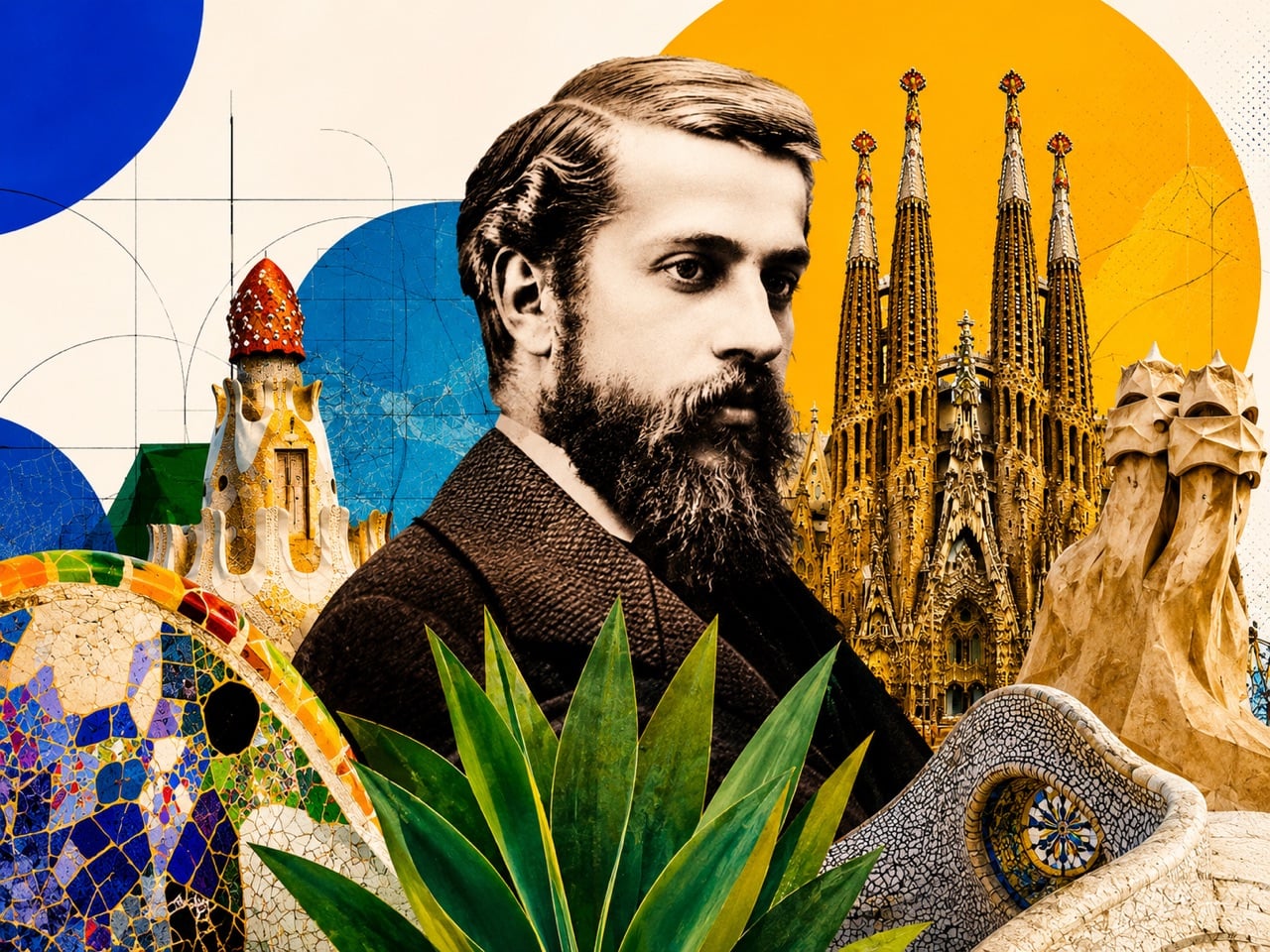
How does an architect collaborate with gravity? What happens when a building’s support system is designed to branch and spread weight just like a forest canopy? These are the kinds of questions that drove Antoni Gaudi’s work. He approached architecture with the mind of a natural scientist, seeking to understand the fundamental forces that shape the world and then allowing those forces to generate his forms. His work poses a challenge to the conventional separation of engineering and aesthetics, of structure and ornament.
For Gaudi, the curve of a hanging chain held the secret to a perfect arch, a simple solution of pure tension that could be inverted to create a form of pure compression. This was his method: observe a principle in the physical world, understand its logic, and translate it into an architectural system. The result was an architecture that feels alive because it follows the same structural truths as living things. His buildings are not just inspired by nature; they are participants in its logic.
Think of nature as your structural engineer
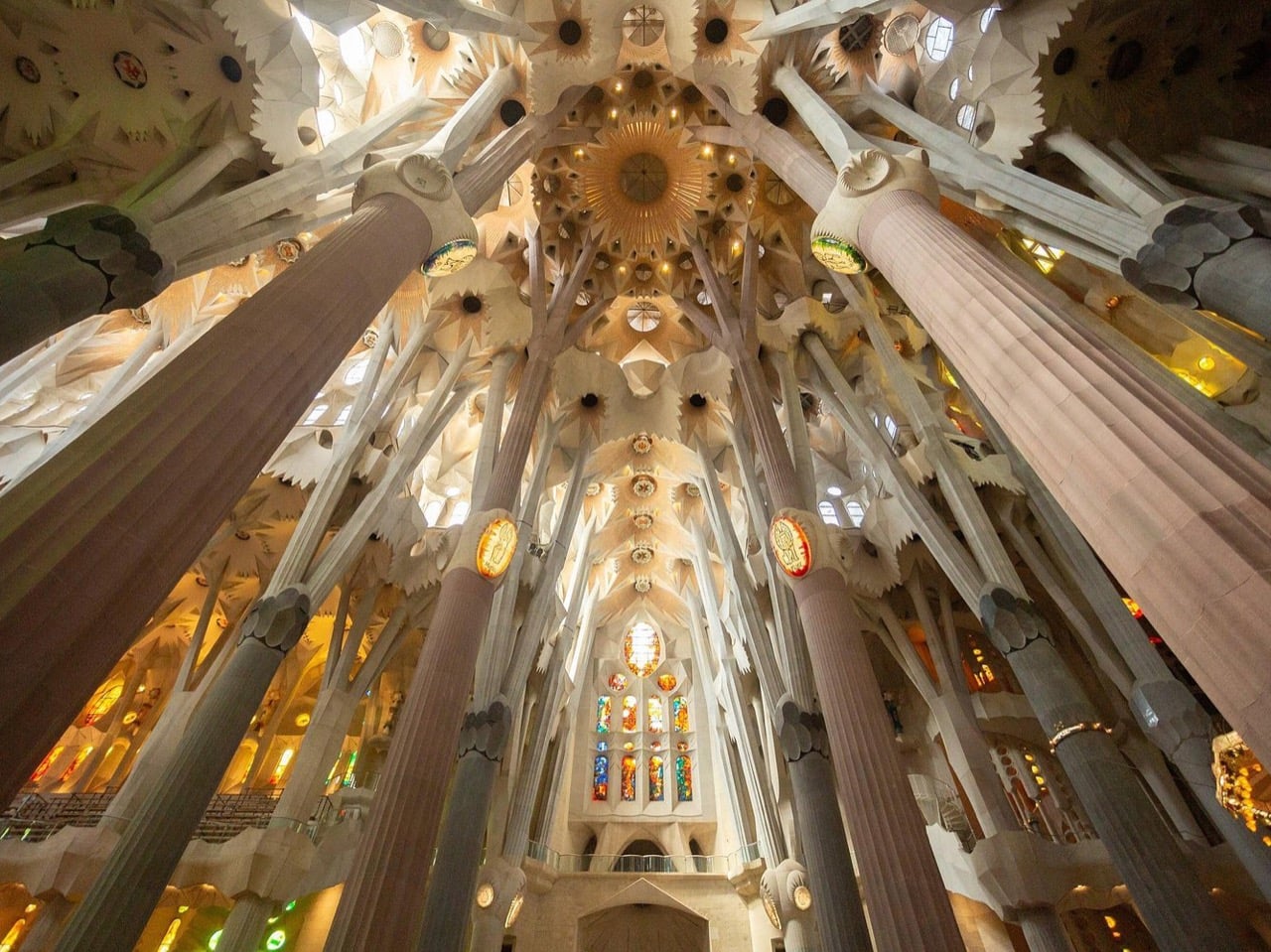
The inside of the Sagrada Familia takes inspiration from a forest, with tree trunks holding the canopy-like ceiling up
The natural world is a library of solved problems. A tree trunk thickens at its base and its roots spread wide to resist wind and carry its own weight. A skeleton uses hollow bones to achieve maximum strength with minimum material. A seashell grows in a logarithmic spiral, a pattern of expansion that maintains its proportions at every scale. For Gaudi, these were not just beautiful shapes to be copied for decoration. They were demonstrations of profound structural intelligence, blueprints for how to build with efficiency and elegance.
This principle is most breathtakingly realized in the interior of the Sagrada Família. The massive stone columns that support the central nave do not rise straight to the ceiling. Instead, they lean and branch out near the top, forking like the boughs of a tree to distribute the immense weight of the vaults. The effect is that of a colossal stone forest, but the design is pure structural logic. Gaudi performed years of analysis on the load paths, ensuring each column and branch was precisely angled and sized to carry its load down to the foundation. He was not imitating a forest; he was borrowing its engineering.
By deriving his forms from the functional principles of nature, Gaudi created a sense of organic coherence that is absent in much of modern architecture. His buildings feel less like objects assembled from parts and more like organisms that have grown into their final form. The undulating facade of Casa Milà, known as La Pedrera or “the stone quarry,” seems to have been eroded by wind and water over centuries. This effect comes from an architecture that responds to imagined natural forces, creating a dynamism that feels both inevitable and alive.
Treat Geometry as a Living Language
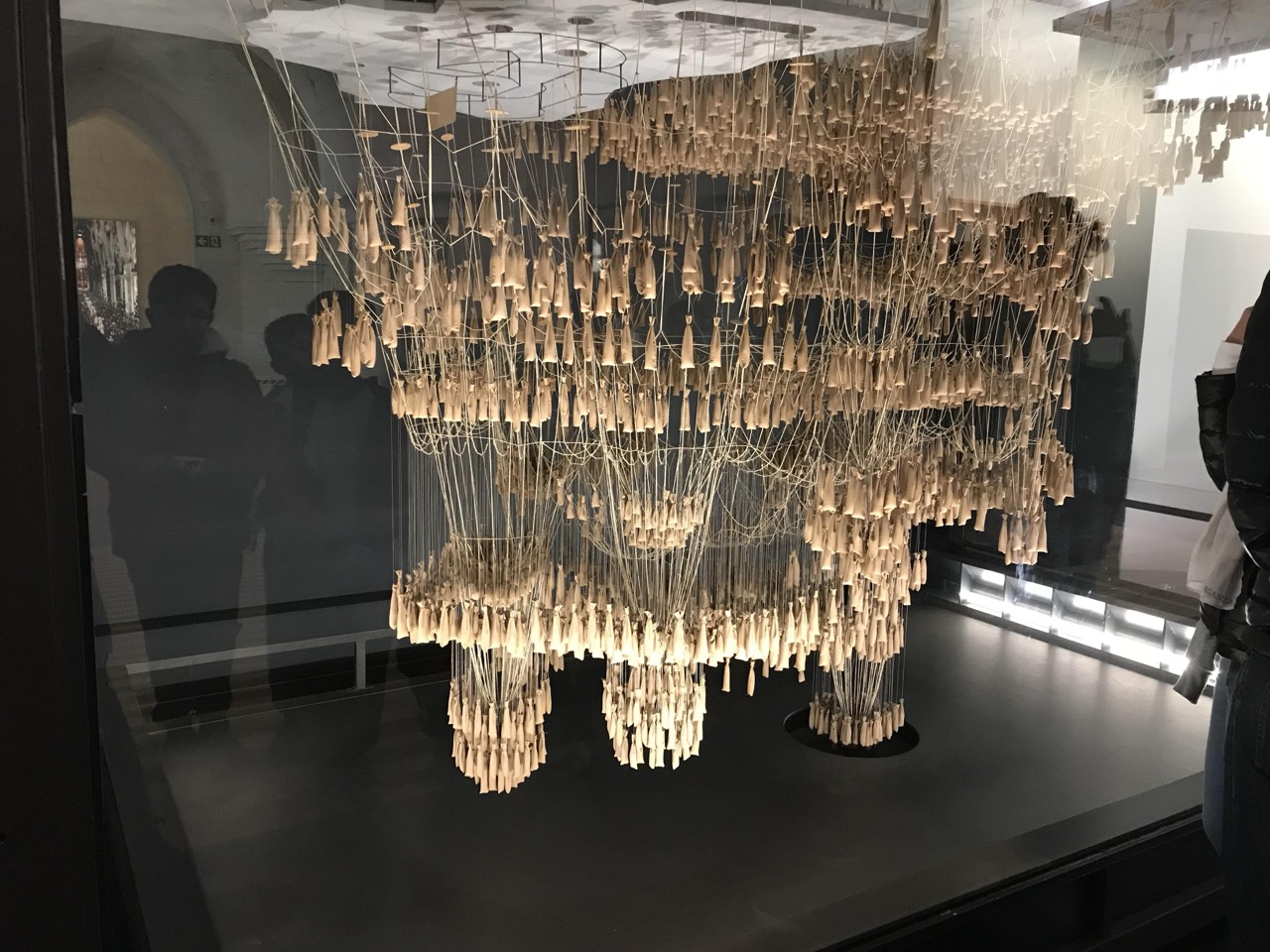
Gaudi used gravity to plot the parabolic curves that would make the spires of the Sagrada Familia
It is tempting to view Gaudi’s work as purely intuitive, the product of a wild and untamed imagination. This perception, however, overlooks the rigorous mathematical discipline that underpins his most fantastical creations. He was a master of complex geometry, specifically a family of shapes known as ruled surfaces. These surfaces, which include hyperboloids, paraboloids, and helicoids, may sound complex, but they share a simple characteristic: they are curved forms that can be generated by moving a straight line through space.
This geometric toolkit was both poetic and profoundly practical. The massive windows and ceiling vaults of the Sagrada Família are perforated with hyperboloids. This shape allows light to enter and spread softly throughout the interior, avoiding harsh shadows and creating a luminous, even glow. The famous spiral staircases that feature in his work are helicoids, an elegant and efficient way to move through space. Because these complex curves could be defined by straight lines, they were also buildable. A contractor could construct the formwork for a seemingly impossible vault by using a series of simple, straight boards. This was practical genius, not just artistic vision.
This use of geometry formed another bridge between his architecture and the natural world. Ruled surfaces appear everywhere in nature, from the fibrous structure of muscles and tendons to the way soap films stretch between two rings. By employing this shared mathematical language, Gaudi created buildings that feel harmonious with the world around them. What looks dreamlike and organic in his work is often, upon closer inspection, geometrically exact and structurally optimized.
Think with Your Hands, Not Just a Pen
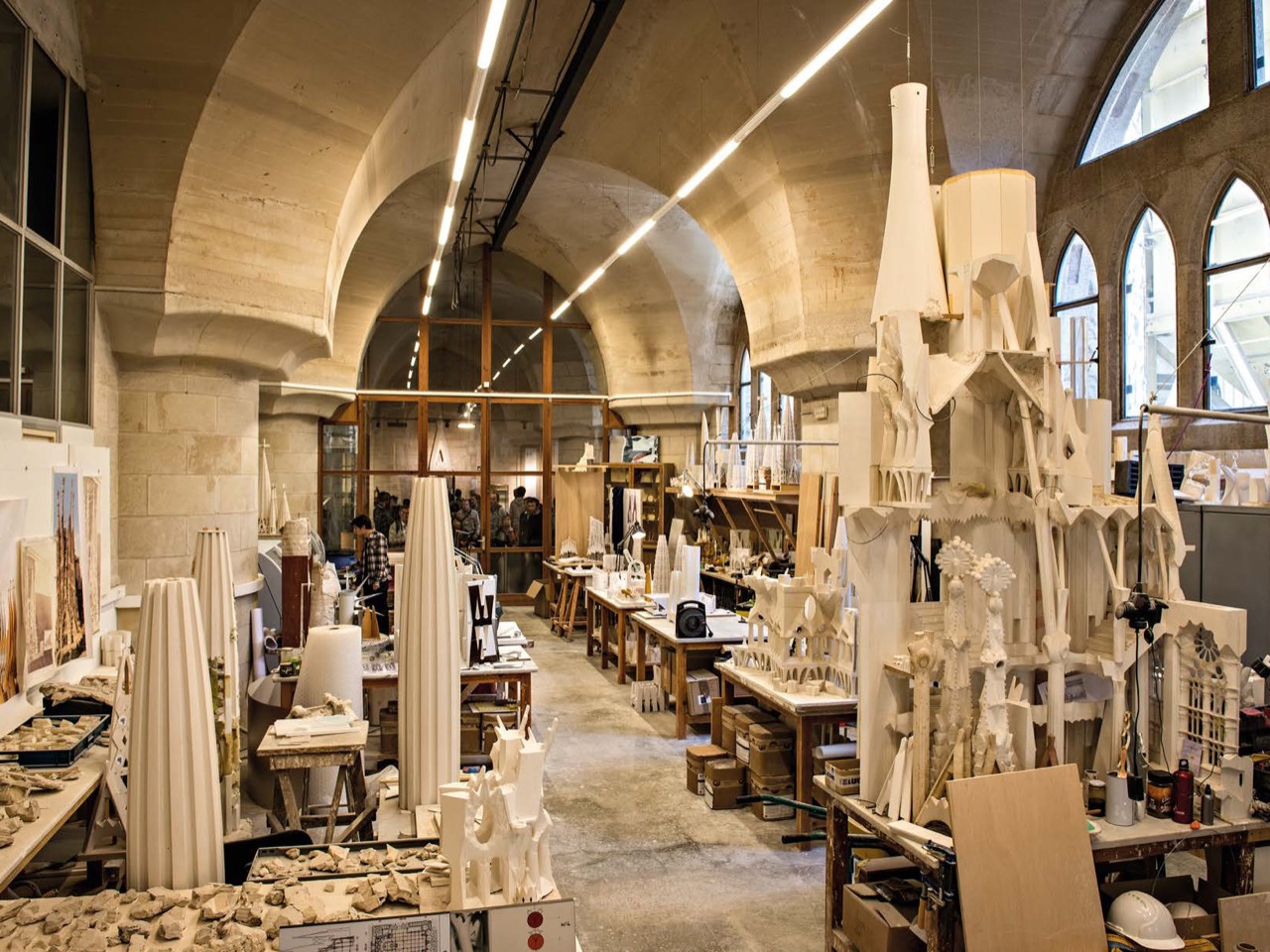
A look at Gaudi’s workshop, where he meticulously modeled with plaster before building
Traditional architecture has long been a discipline of two-dimensional representation. Buildings begin as plans, sections, and elevations, flat drawings that are later translated into a three-dimensional reality. Gaudi worked in the opposite direction. He was a sculptor of space who thought and designed in three dimensions from the very beginning. His workshop was filled not with blueprints, but with plaster, clay, and wire models. He believed that some problems of form, light, and structure could only be solved physically.
His famous hanging chain models are the most powerful example of this hands-on process, but his reliance on physical prototyping extended to nearly every aspect of his designs. He would sculpt plaster models of columns, vaults, and facades, iterating on their forms until they felt right both spatially and structurally. This allowed him to see how light would fall across a surface, how a space would feel as one moved through it, and how different forms would connect in a way that a flat drawing could never reveal. His was a process of discovery through making.
This method is precisely why his buildings feel so remarkably cohesive. The interiors and exteriors are not separate ideas assembled into a whole; they are part of one continuous, flowing volume. From the undulating facade of Casa Milà to the bone-like columns of the entrance to Park Güell, his work has a sculptural integrity that comes from being shaped in the round. He was not merely decorating a box. He was creating a complete, immersive spatial experience that was tested and refined through direct physical interaction.
A Building Should Tell a Story. Every Detail a Paragraph, Every Room a Chapter.
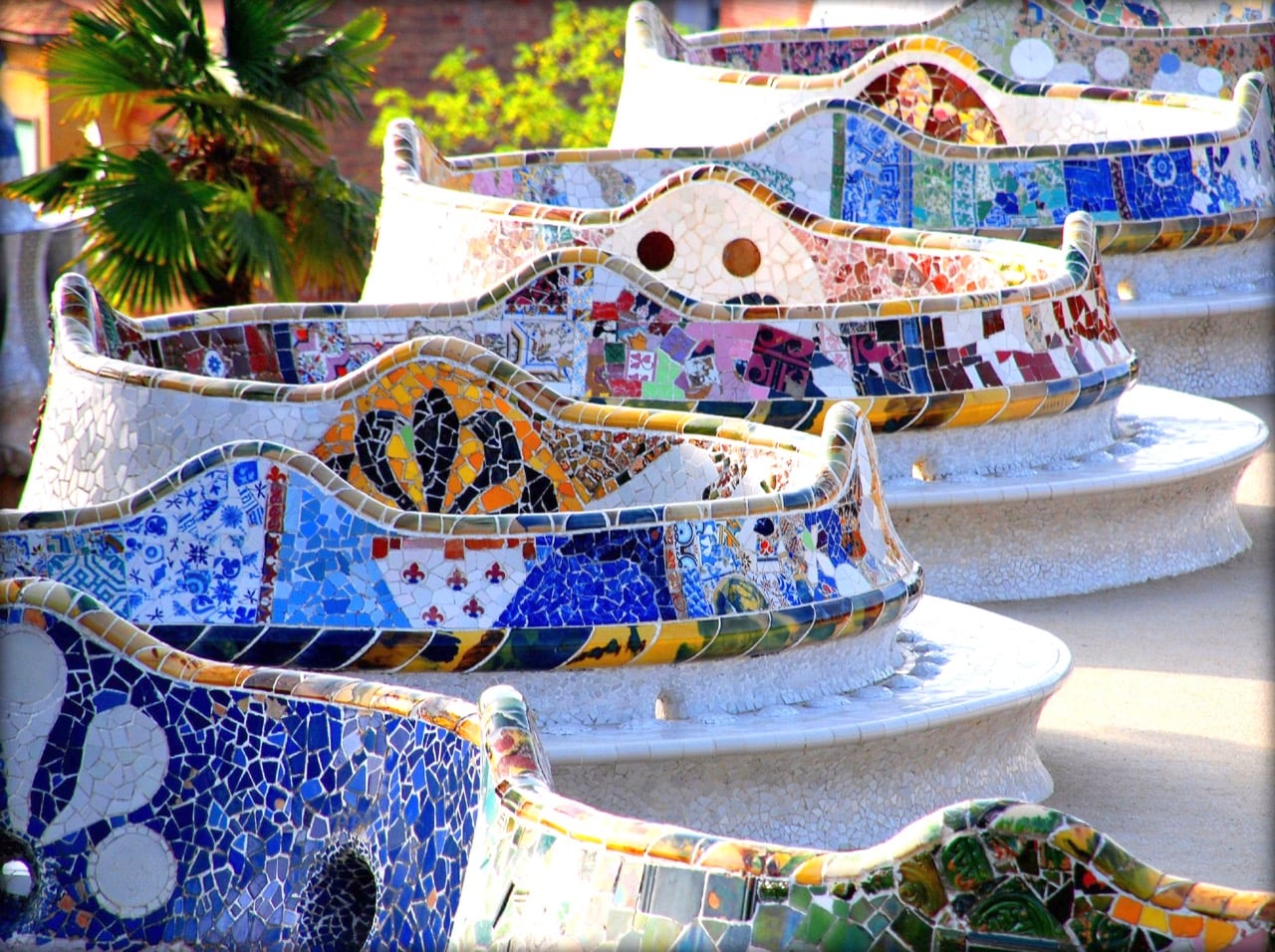
The Serpentine Bench at Park Guell is a massive, winding visual collage
For Gaudi, materials were not inert substances waiting to be shaped; they were expressive beings with their own character. He used stone for its weight and permanence, wrought iron for its ability to become a fluid, vine-like line, and ceramics for their capacity to capture light and color. The balconies of Casa Batlló are a perfect example, with their skeletal, bone-like stone supports and mask-like iron railings. The building feels less like a construction and more like a creature.
This material intelligence is on full display in his use of trencadís, the technique of creating mosaics from broken ceramic tiles. This was not just a decorative choice. It was an ingenious solution to the problem of cladding a complex, doubly-curved surface. Whole tiles would crack and fail, but a mosaic of broken pieces could flow seamlessly over any form. It was also an act of creative transformation, turning discarded tiles and plates from local factories into a vibrant, shimmering skin. The serpentine bench in Park Güell, a masterpiece of ergonomic design and public art, is brought to life by this technique.
These material and ornamental choices were never arbitrary; they were always in service of a larger narrative. Gaudi’s architecture is saturated with symbolism drawn from Catalan culture, Catholic theology, and the natural world. The entire facade of the Sagrada Família is a stone bible, with each portal dedicated to a different aspect of the life of Christ. The famous roof of Casa Batlló, with its iridescent, scale-like tiles and cross-topped turret, is a clear allusion to the legend of St. George and the Dragon, a powerful symbol of Catalan identity. The ornament is the story, fully integrated into the building’s form.
Borrow the Mindset, Not the Motifs
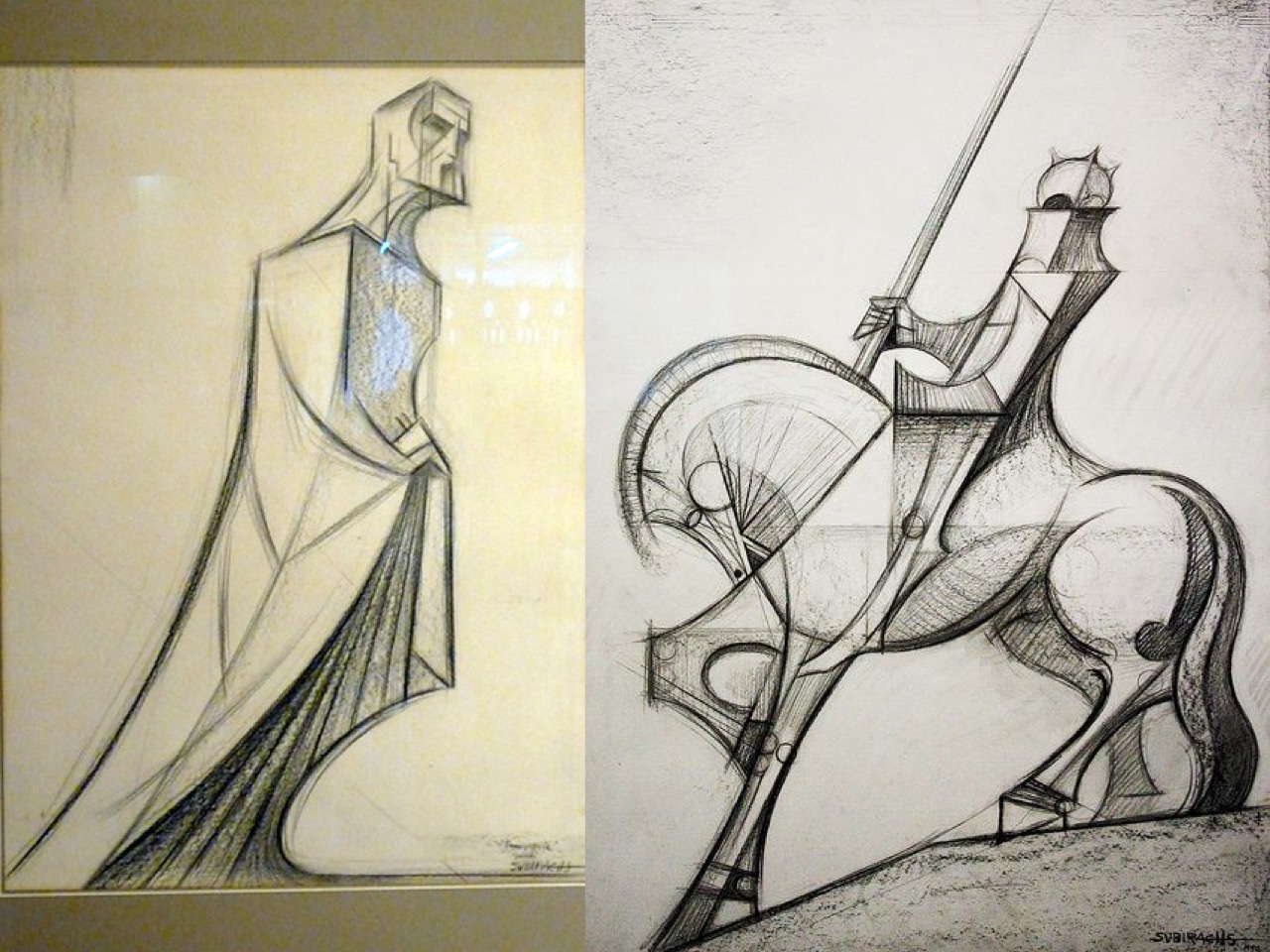
Gaudi’s sketches of sculptural details for the Sagrada Familia
The enduring power of Gaudi’s work offers profound lessons for designers today, but the greatest insights come from studying his process, not his style. To think like Gaudi is to ask deeper questions before beginning to design. It means studying the systems of the natural world, prototyping ideas physically, and allowing the properties of materials to guide the development of form. It means integrating structure, function, and meaning so completely that they become inseparable.
A superficial imitation of his work is a fundamental misreading of his genius, and nowhere is this temptation more apparent than in the age of artificial intelligence. AI image generators, when prompted to create something “in the style of Gaudi,” perform a sophisticated act of digital collage. They sample his signature motifs, the colorful trencadís, the skeletal balconies, the flowing lines, and recombine them into a plausible surface. The result might look like Gaudi, but it is an aesthetic echo, a skin-deep pastiche. What is absent is the intelligence, the why. The algorithm has no understanding of the catenary curve’s structural perfection, no concept of how a ruled surface can be used to sculpt light, and no sense of the narrative power behind his symbolism. It is a library of effects without a grasp of the causes.
To meaningfully think like Gaudi is a uniquely human act. It requires moving beyond the collage and embracing the cohesive system of thought that produced the work in the first place. The most unfortunate way to replicate Gaudi is to borrow his shapes without adopting his discipline. His work is a testament to the idea that the most expressive forms often arise from the most logical constraints. Gaudi’s ultimate legacy is his pursuit of a radical, integrated vision of design. In a world increasingly saturated with algorithmically generated images, his work serves as a powerful reminder that true creation is a unified whole. To think like Antoni Gaudi is to create something that feels less like an object that was built and more like an organism that has grown.