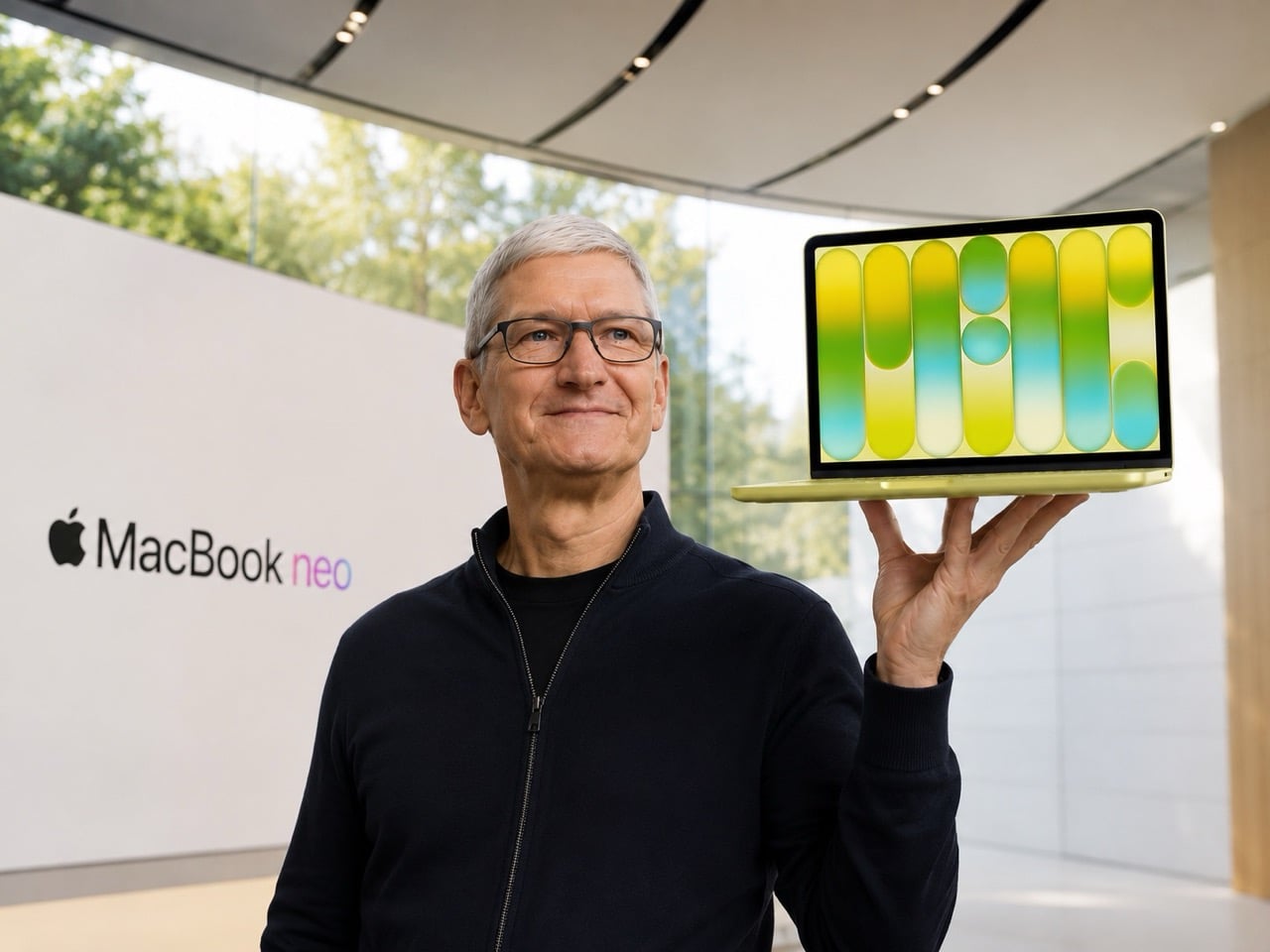

Apple has never been the company you turn to when you need a laptop on a budget. For decades, the entry ticket to macOS meant shelling out at least a thousand dollars, often significantly more, and that premium was non-negotiable. The “Apple Tax” was real, it was expensive, and Apple seemed perfectly content collecting it. Then in March 2026, the company did something it has almost never done: it launched a laptop for $599. The MacBook Neo landed with the kind of price tag that made people do a double-take, and based on how things have played out since, it appears Apple vastly underestimated just how many people were waiting for exactly this moment.
Tim Cook admitted as much during the company’s Q2 2026 earnings call in early May, stating that demand for the MacBook Neo has been “off the charts” and that Apple had fundamentally misjudged how many people wanted in. The company is now supply-constrained, shipping estimates have stretched to two or three weeks across all configurations, and Apple has quietly doubled its production target from an initial forecast of five to six million units to a staggering ten million for 2026 alone. Cook also revealed that the Neo drove the best launch week for first-time Mac buyers in Apple’s history, helping push Mac revenue to $8.4 billion in the second fiscal quarter and exceeding analyst expectations. For a product that was supposed to be a modest gateway device aimed at students and casual users, the MacBook Neo has become something closer to a cultural moment.
Designer: Apple

The MacBook Neo exists because Apple found a way to make a laptop cheaply without making it feel cheap, and the method they used is as clever as it is slightly devious. The device runs on a binned version of the A18 Pro chip from the iPhone 16 Pro, meaning it uses rejected processors with one malfunctioning GPU core that would have been discarded. Apple took those five-core chips, gave them a second life inside the Neo, and avoided spinning up a single new fabrication line. It was a stroke of economic genius that allowed the company to hit $599 without compromising build quality. The design borrows heavily from the MacBook Air with its aluminum unibody and color-matched keyboards, but ditches the notch for uniform iPad-style bezels. At $499 for education buyers, it positions the Neo squarely in Chromebook and budget Windows laptop territory, a market Apple has never seriously competed in before.
The brilliance of this strategy becomes clear when you look at what Apple is actually trying to accomplish. The MacBook Neo is not designed to be a high-margin profit driver. It is designed to be a gateway drug. Get a student hooked on macOS at $499, let them experience the ecosystem integration with their iPhone, introduce them to iCloud and Apple Intelligence and the seamless Handoff features that make working across devices feel like magic, and you have potentially created a lifelong customer. Cook himself framed it exactly this way during the earnings call, stating that Apple is focused on customers new to the Mac and customers who have been holding onto their machines for years. He also highlighted momentum in education, noting that some school systems are switching from Chromebooks and Windows PCs to the MacBook Neo at a systemic level. This is Apple playing the long game, absorbing lower margins today to capture market share and build brand loyalty that will pay dividends for decades.


That strategy, however, has created a problem Apple did not anticipate. The initial supply of binned A18 Pro chips, carefully stockpiled from iPhone 16 Pro production runs, was supposed to last through the first wave of demand. It did not. Apple burned through that inventory faster than anyone projected, and now the company faces a logistical nightmare. To meet the revised production goal of ten million units, Apple needs fresh A18 Pro chips from TSMC, and those chips are not going to be cheap. TSMC is currently running at limited spare capacity on its 3-nanometer process node, with AI-related orders consuming most of its output. The chips Apple orders now will be full six-core versions, not binned five-core rejects, and Apple will have to manually disable one GPU core to keep the specs consistent. This means higher per-unit costs even before accounting for any expedited manufacturing premiums TSMC might charge for rush orders.
Compounding the issue is the global DRAM crisis. Memory prices have been climbing steadily since the Neo launched, and the situation is getting worse. A
TrendForce report revealed that DRAM prices rose 57 percent in April 2026 alone, a staggering jump that has sent shockwaves through the entire tech industry. Samsung, one of the largest memory manufacturers in the world, is reportedly refusing to sell RAM to its own electronics division at competitive prices, prioritizing external contracts and higher-margin deals. Sony bumped PlayStation 5 prices. PC manufacturers across the board are raising prices or discontinuing lower-cost configurations. Apple, meanwhile, is trying to scale production of a $599 laptop at exactly the wrong moment in the supply chain cycle.

The company has already started making moves to protect its margins elsewhere. Apple quietly discontinued the $599 Mac mini with 256GB of storage earlier this month, pushing the starting price to $799 for the 512GB model. Taiwan-based tech columnist and former Bloomberg reporter Tim Culpan has suggested that dropping the $599 256GB MacBook Neo model is among the options Apple is weighing, which would make the $699 512GB configuration the new entry point. Culpan also floated the possibility that Apple might introduce new color options to soften the blow of a price hike, a classic marketing tactic that distracts from the financial sting by giving buyers something shiny to focus on instead.
What makes this entire situation fascinating is that it represents a genuine departure from Apple’s historical playbook. This is a company that has spent the better part of two decades training consumers to expect premium pricing and to accept that Apple products cost more because they are worth more. The MacBook Neo breaks that pattern. It is the first time in recent memory that Apple has positioned a product not as aspirational or premium, but as accessible. The iPhone 17e, Apple’s current budget iPhone, starts at $579, just twenty dollars less than the MacBook Neo, which tells you everything you need to know about how aggressively Apple priced this laptop.

The timing being good or bad depends entirely on your perspective. We are living through an era where affordable computing is becoming harder to access, not easier. Memory prices are spiking. GPU costs remain elevated. PC manufacturers are raising prices or cutting corners to maintain margins. Into this environment, Apple drops a $599 laptop that runs macOS, integrates seamlessly with iPhones, delivers legitimately good performance for everyday tasks, and does not feel like a compromise. Early benchmarks from Digital Trends show the MacBook Neo outperforming the M1 MacBook Air in Geekbench 6 tests. Photographer and video editor Tyler Stalman tested the device with professional workflows and concluded that editing 4K video on the Neo is totally manageable even with multiple apps running. Someone even got Cyberpunk 2077 running at over 30 frames per second on it, which is absurd for a fanless laptop built around a phone chip.
The competitive response has been telling. Asus co-CEO S.Y. Hsu called the MacBook Neo a shock to the entire PC market, admitting that manufacturers did not think Apple would launch something this affordable. He also tried to downplay the device by comparing it to a tablet and calling it a content-consumption machine, which is the kind of defensive posturing you only see when someone is genuinely worried. The reality is that the MacBook Neo threatens Microsoft’s dominance in the sub-$600 laptop market, a segment that has historically been Windows and Chrome OS territory.

Whether Apple can maintain the $599 price remains to be seen. Tim Cook’s comments during the earnings call suggest the company understands what is at stake. He said Apple is very focused on getting the Mac to even more people than it was reaching before, and that the company could not be happier with how things are going at the moment. That optimism feels earned, but it also feels fragile. The MacBook Neo succeeded because Apple found a way to make a genuinely good laptop at a price that defied expectations. If rising component costs force the company to walk that back, the magic dissipates. The $599 MacBook is a statement, a gamble, and a challenge to the entire industry. Apple bet that there was massive untapped demand for accessible computing done right, and the demand proved them correct. Now they just have to figure out how to keep building the thing people actually want to buy.

