
Design Mindset steps into episode 16 with a clear purpose: to understand how industrial designers are navigating a world where tools, platforms, and expectations keep shifting under their feet. Yanko Design’s weekly podcast, Design Mindset, powered by KeyShot, is less about design celebrity and more about design thinking, unpacking how decisions get made, how stories are built around products, and how technology is reshaping the craft from the inside out. Each week, a new episode premieres with designers who are actively pushing workflows, visuals, and experiences into new territory.
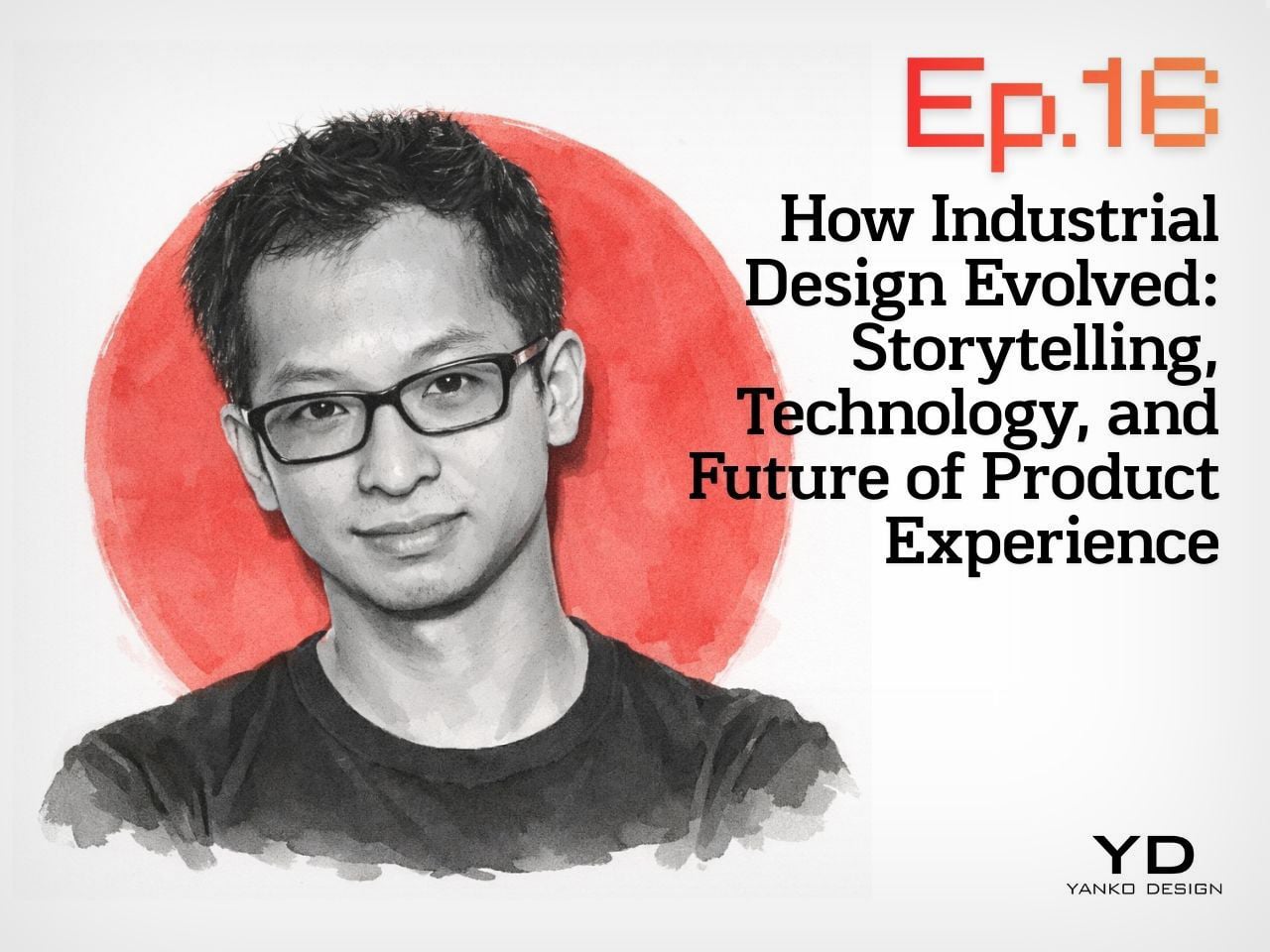
This episode features Benny Lee, Senior Design Manager of Technology and Strategic Partnerships at The Coca-Cola Company, and a practitioner who moves comfortably between mass production, digital ecosystems, and even film props. Trained as an industrial designer, Benny started at Coke in a traditional ID role while also leading visualization, bringing advanced 3D rendering into a company that was still heavily reliant on Photoshop and 2D assets. He now sits at the intersection of heritage and innovation, helping a 140 year old brand adopt real time visualization, AI, and new storytelling platforms without losing what makes Coca-Cola recognizable everywhere.
Download your Free Trial of KeyShot Here

Storytelling as the real job of industrial design
Benny treats industrial design as a storytelling discipline first and a styling discipline second. His training spans sketching, 3D modeling, rendering, and prototyping, but he frames each of these as a narrative tool rather than a technical checkpoint. Sketches, CAD, and renders exist to show what a product does, how it behaves, and how it should feel to use, not just how it looks on a white background.
Inside a large organization, that narrative focus becomes practical very quickly. He puts it plainly in the conversation: “Storytelling as an ID, you know, is important because it’s all about bringing this visual alignment of the actual product when you’re trying to get a buy in to sell in.” The job is to reach a point where the design communicates its intent on its own, without the designer in the room. Call to action areas, material breaks, and even lighting choices in a render become part of that silent story, aligning stakeholders around what the product is supposed to be.
When rendering becomes a thinking tool, not just a final output
When Benny joined Coca-Cola, much of the visualization work sat in a 2D world. Concepts were often built through Photoshop and static compositions, heavily intertwined with graphic design. He talks about the shift he helped drive quite directly: “I find it really quite an honor and a pleasure that I was able to bring 3D renderings into the practice here.” That move to 3D was not just about realism, it was about adding depth to how ideas are explored and communicated.
The key change is that rendering is no longer treated as the last step before a presentation. Tools like KeyShot become part of the exploration loop. Benny uses quick CAD setups and fast render passes to test light, material, and even simple motion, and to storyboard how a product opens, glows, or reacts in context. He describes this as a way to “fail fast, iterate faster,” and he underlines that “we don’t always just use renderings to create pretty visuals and a lot of times we’re using it to build new experience.” Visualization turns into a thinking environment, especially valuable when physical labs and prototypes are slow or limited.
Respecting a 140 year old brand while pushing it into new arenas
Designing at Coca-Cola means working around a product that barely changes. The formula in the bottle remains constant, so innovation happens in the ecosystem that surrounds it. Packaging systems, retail touchpoints, digital layers, and immersive experiences become the canvas where design can move, while the core product stays familiar.
Benny describes his role with a custodian mindset. He imagines the brand as a skyscraper built over generations, and his work as adding “layers of bricks” rather than ripping out foundations. That perspective shows up in how Coca-Cola experiments with new platforms. The company explores metaverse activations, NFTs, experiential installations, and AI driven storytelling, not as disconnected stunts but as new ways to retell the same product story for new audiences. The strategy, as he frames it, is to adapt the ecosystem and technology “to retell the product’s story” while staying true to the brand’s core character.
Mass production versus one off film props
Benny’s portfolio stretches across lifestyle accessories, consumer electronics, and concept work for films like the Avengers. On the surface, the process for these domains begins similarly, with sketching, modeling, and rendering. The divergence appears when the work hits reality. In consumer products, industrial design is tied to mass production, with all the constraints of tooling, factory collaboration, golden samples, logistics, and long term durability.
Film work operates under a different set of pressures. Concept art might start in tools like ZBrush with exaggerated, dramatic forms that look incredible on screen but are not remotely manufacturable in a traditional sense. Benny’s responsibility in those situations is to respect the creative vision while making it buildable. Props do not have to scale to millions of units. They have to survive a shoot and read correctly on camera. If one breaks, it can be rebuilt. That freedom shifts what is possible in form and material, but the throughline is still storytelling, captured in a few seconds of screen time instead of years of daily use.
Adapting to an ever expanding toolset without losing your core
Throughout the episode, Benny returns to the pace of change in design tools. Skills that were once specialized are now table stakes. Students are graduating with exposure to UI and UX, electronics integration, and AI enhanced workflows. He notes that “you have to wear so many hats,” and points out that traditional industrial design is becoming a “rare breed” precisely because the field has branched into web, mobile, service, and emerging tech work.
His response is not to chase mastery of every new tool, but to understand what each category can do and to build teams around that understanding. He emphasizes hiring people who are better than you at specific domains and managing the mix of skills rather than guarding personal expertise. In parallel, he argues that adaptation is now the most important traditional trait. The designers who thrive will be the ones who stay resilient, keep a story first mindset, and move fluidly between CAD, KeyShot, AI, and whatever comes next, while still grounding their decisions in how things work in the real world.
Design Mindset, powered by KeyShot, returns every week with conversations like this, tracing the connection between how designers think, the tools they use, and the work they put into the world. Episode 6 with Reid Schlegel leaves you with a simple, practical challenge: see your ideas sooner, in more ways, and with less fear of being imperfect.
Download your Free Trial of KeyShot Here