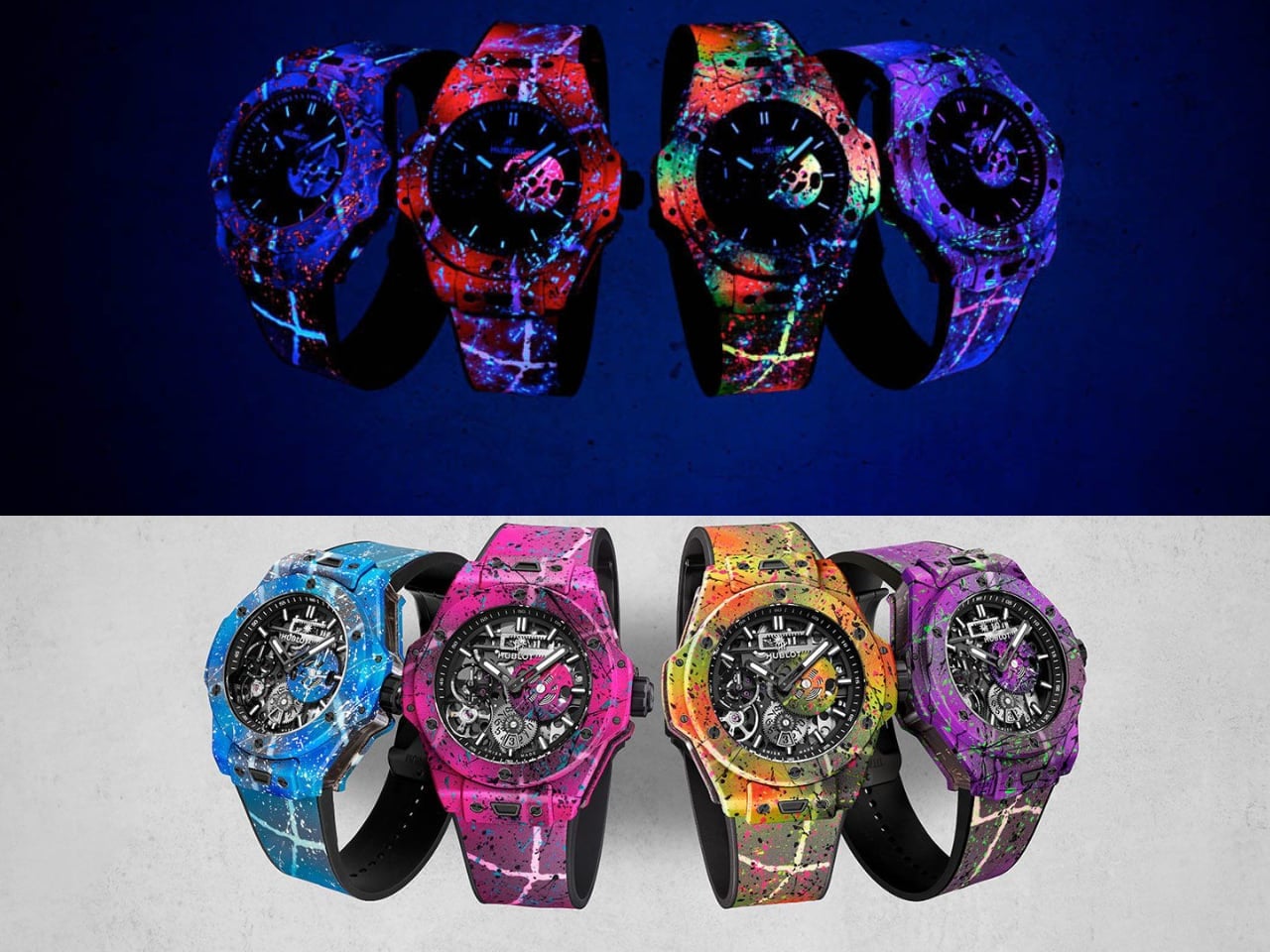

Imagine taking a chunk of concrete from a Miami street wall, complete with cracks and spray paint, and somehow turning it into a luxury watch. That’s exactly what Hublot has done with the Big Bang Meca-10 Street Art collection. The result is four watches that look like someone ripped pieces of graffiti-covered urban architecture and strapped them to your wrist.
Designer: Hublot
The idea sounds absurd until you see the execution. The cracks in the surface aren’t flaws. They’re designed that way, filled with glow-in-the-dark paint that shifts color depending on whether you’re standing in daylight, darkness, or under the ultraviolet lights of a nightclub. One watch becomes three different visual experiences depending on where you take it.
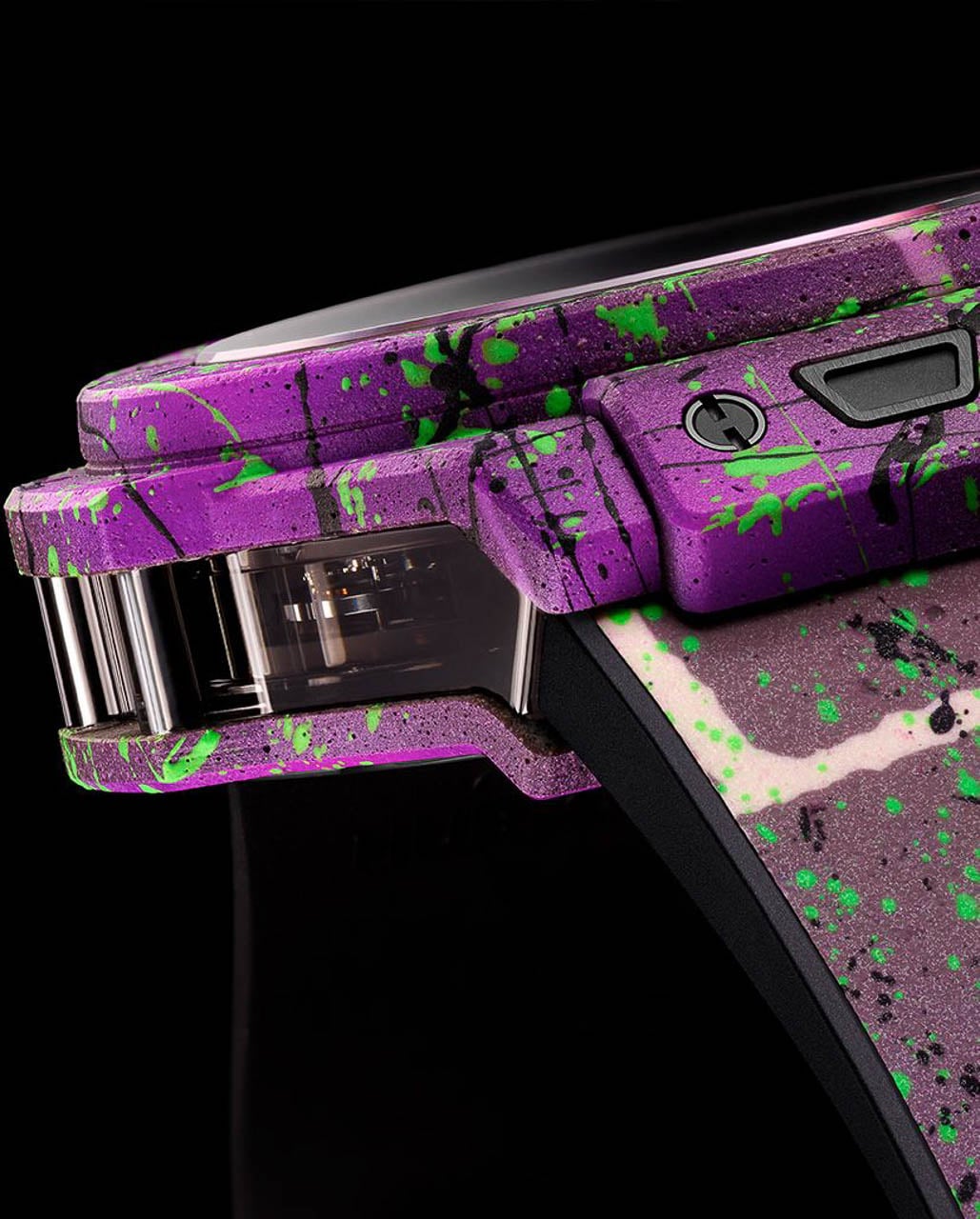
This isn’t just a watch wearing a costume. The concrete composite forms the actual structure of the case, meaning the material choice affects weight, texture, and how the watch feels against skin. Every crack pattern is unique because the material naturally fractures differently each time.
Why Concrete Makes Sense (Even Though It Shouldn’t)
Before going further: is that really concrete on your wrist? Technically, it’s a concrete composite rather than the stuff you’d pour into a building foundation. Hublot mixes actual cement with polymers and resin binders, so calling it a “concrete case” isn’t wrong, but watch nerds will correctly note that raw structural concrete would crumble the first time you bumped a doorframe.
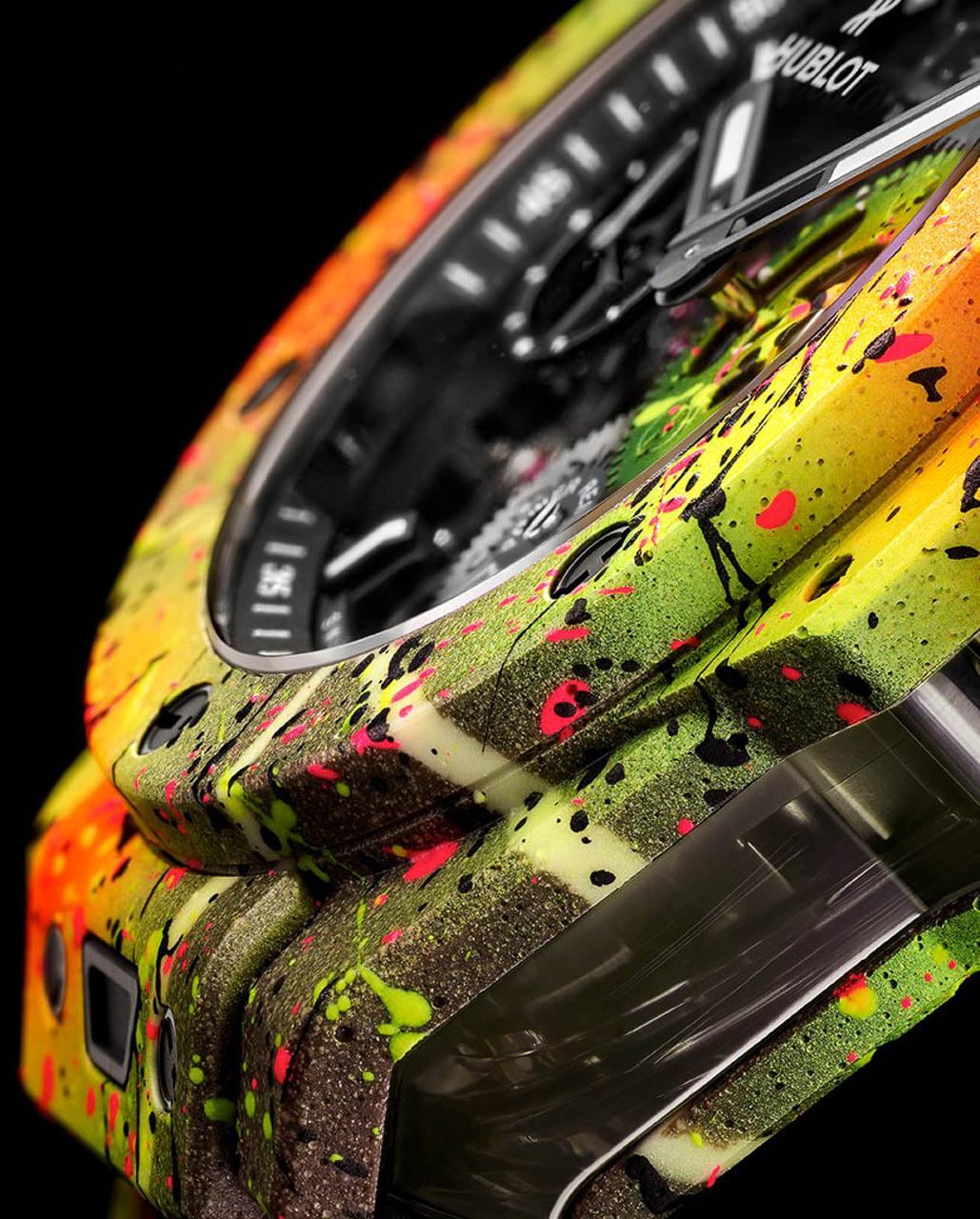

That said, the material still chips, cracks, and absorbs moisture in ways that make it seem like the last thing you’d want wrapped around delicate mechanical parts. Hublot approached the problem by treating concrete not as a building material but as a canvas that happens to be structural.
The bio-based epoxy resin mixed into the cement changes the rules. Traditional concrete relies on water evaporation to harden, leaving behind microscopic pores that weaken the structure over time. This composite skips that process entirely, binding the cement particles with plastic polymers instead. The addition of graphene creates a reinforcement network at the molecular level, boosting strength by roughly 15 to 20 percent compared to standard concrete while keeping the rough, porous surface texture that makes the material visually interesting.
What you end up with is a material that looks fragile but behaves like a proper watch case. The matte, weathered surface invites touch in a way that polished steel or ceramic never could. Run your finger across the face and you feel actual texture, tiny ridges and valleys that remind you this started life as construction material. The painted cracks catch light unevenly, creating shadows that shift as you move your arm. The weight sits noticeably on the wrist. At 44 millimeters across and over 15 millimeters thick, this isn’t a subtle timepiece. But the density feels purposeful rather than clumsy, grounding the visual chaos of the paint job in something physically substantial.
The Paint Job That Transforms Three Times
Street artist Saiff Vasarhelyi handled the hand-painting, layering splatter patterns and graffiti gestures across the concrete surface in a way that looks spontaneous but required careful planning to execute at this scale. Each of the four colorways targets a different slice of Miami’s visual landscape.
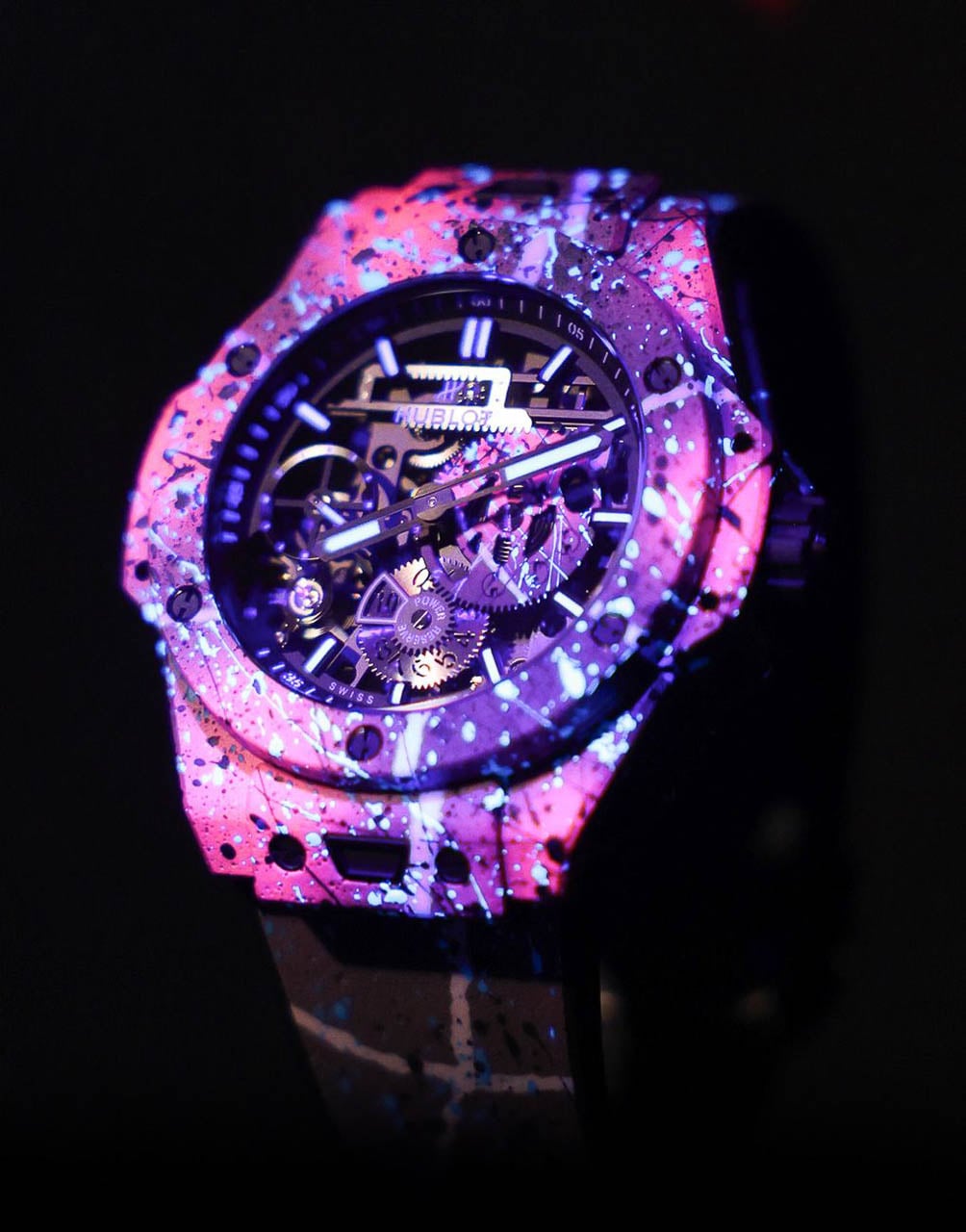

Magic City uses purple and green tones that glow pink under blacklight, capturing the neon palette of the city’s nightclub district. Vice pushes harder into hot pink with splashes of blue, channeling the saturated colors of club lighting after midnight. Big Water shifts to aqua and turquoise, evoking ocean tones and lit swimming pools at night. Sunshine goes warm, layering yellow, orange, and green in patterns that recall sun-faded murals and citrus groves.
The paint contains UV-reactive luminova pigments, which is a fancy way of saying these watches absorb light during the day and release it slowly in darkness. Whether this transforms the watch into wearable art or an expensive novelty depends on how often you actually find yourself under blacklights. But unlike typical watch lume that just makes hands visible at night, this application turns the entire case into a light source. The cracks glow along their full length, and the splatter patterns that looked chaotic in daylight suddenly reveal hidden geometry when the lights go out.
Under actual ultraviolet light, the effect intensifies again. Colors that appeared muted in normal conditions snap into vibrant intensity, and additional pigment layers that were invisible before suddenly appear. The watch literally changes appearance depending on the environment, which sounds gimmicky until you consider that Hublot launched these at Art Basel in Miami, where moving between gallery lighting, afternoon sun, and club blacklights happens multiple times per night.
The Mechanical Heart Underneath the Chaos
Strip away the paint and concrete, and you find the HUB1201 Meca-10 caliber, a movement Hublot introduced in 2016 specifically to showcase power reserve engineering. The name refers to the 10-day power reserve, meaning you can wind this watch on Monday morning and it will keep running until the following Thursday without additional attention.
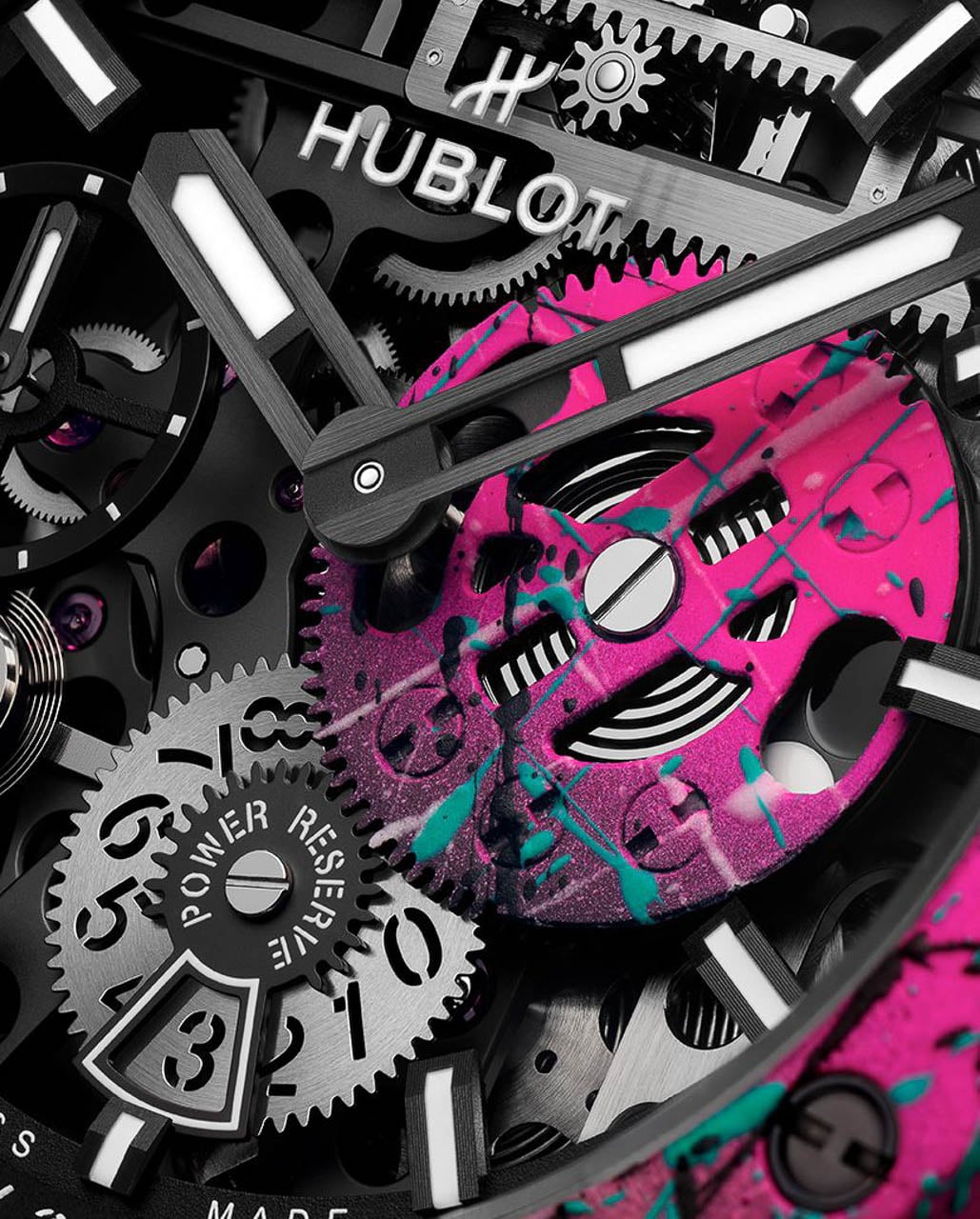
Most mechanical watches store energy in a single barrel, a coiled spring that slowly releases tension to drive the gear train. The Meca-10 uses two barrels working in parallel, effectively doubling the stored energy while keeping the watch thin enough to remain wearable. The trade-off is complexity. More barrels means more gears, more potential failure points, and more cost to service when maintenance time comes.
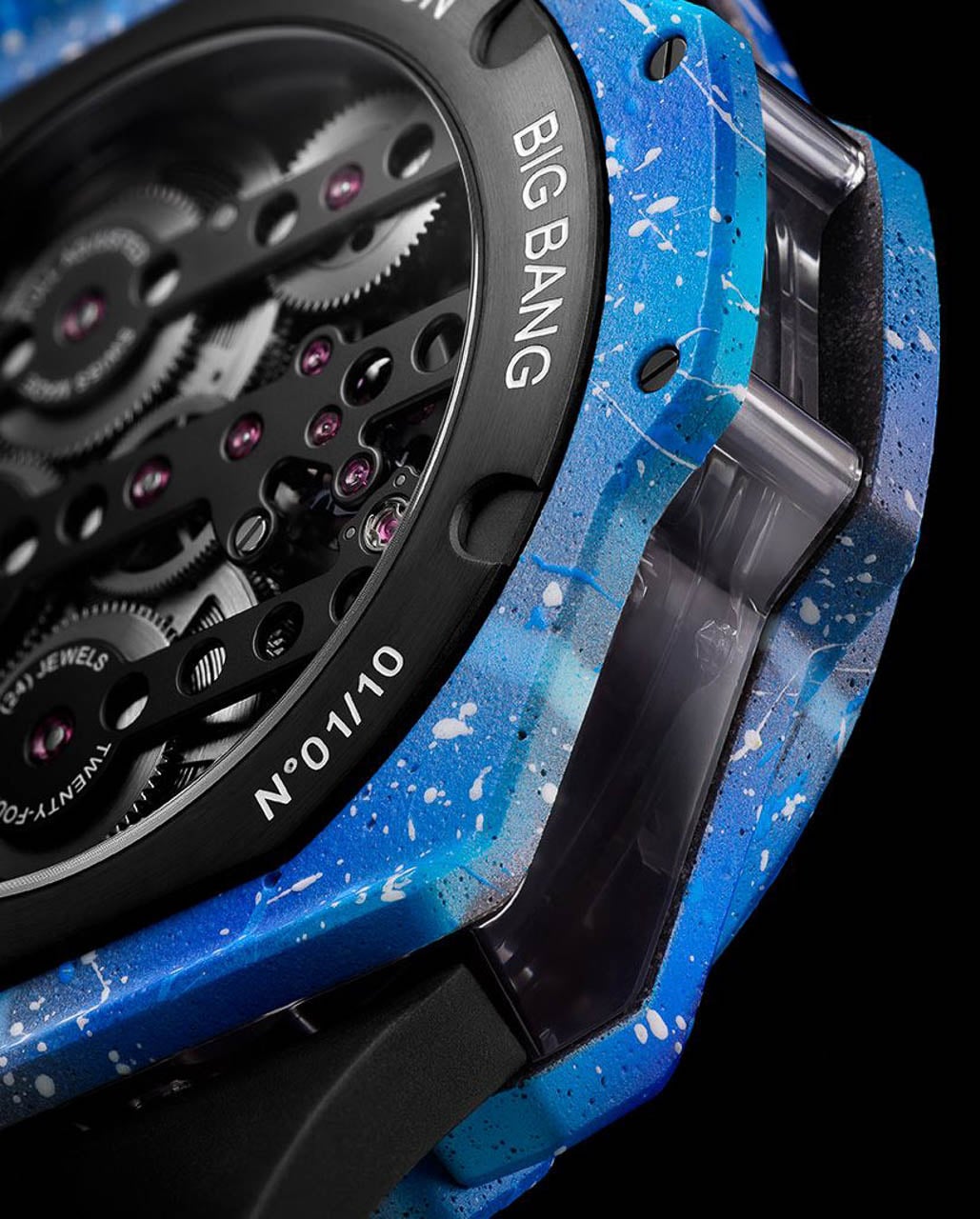
The power reserve display dominates the upper half of the dial through a rack-and-pinion system that looks more like industrial machinery than traditional watchmaking. As energy depletes over the 10-day cycle, a rotating disc gradually reveals a red warning zone that tells you winding time approaches. The mechanism is completely visible through the openworked dial, turning the act of checking remaining power into a visual experience rather than just a number readout.
Hublot finished the movement bridges in matte black for these editions, creating contrast against the silver metallic elements and making the painted splatter accents on the power reserve disc cover pop more aggressively. The balance wheel sits toward the front of the movement, oscillating at 21,600 vibrations per hour, visible through the smoked sapphire crystal that forms the case midband.
Who Actually Buys This
At $57,500 per watch with only 10 pieces of each colorway available through Hublot boutiques, these aren’t entry points into watch collecting. The price positions them as art objects that happen to tell time, targeted at collectors who already own multiple Hublots and want something that can’t be replicated.
The concrete composite material, the hand-painted surfaces, and the natural variation in crack patterns mean no two examples will ever look identical. This appeals to a specific collector psychology that values uniqueness over consistency, the same mindset that drives people to collect original artwork rather than prints.
The launch context reinforced this positioning. Hublot unveiled the collection during Miami Art Week at a party featuring a 50 Cent performance, targeting an audience that views watch purchases as part of a broader lifestyle statement. The watches were designed to look correct in that environment, where blacklight, loud music, and celebrity adjacency form the natural habitat.
Whether this represents the future of watchmaking or a temporary detour into spectacle depends on your perspective. Hublot has built its identity on exactly these kinds of polarizing releases, betting that the collectors who love them will love them intensely enough to offset the collectors who find them absurd. Twenty years into the Big Bang platform, the strategy keeps working.
The Design Verdict
The Big Bang Meca-10 Street Art collection succeeds by committing fully to its premise. The concrete isn’t a surface treatment applied to a conventional case; it’s the case, with all the texture, weight, and visual unpredictability that implies. The paint job doesn’t just decorate; it transforms the object depending on lighting conditions, giving owners a different watch for every environment.
The execution required solving genuine engineering problems around material strength, moisture resistance, and paint adhesion to rough surfaces. Other brands have pushed unconventional case materials, from Richard Mille’s forged carbon to Panerai’s carbotech composites, but none have attempted something this visually chaotic or deliberately fragile-looking. Hublot could have achieved a similar visual effect through ceramic printing or enamel work, but the tactile experience would have been entirely different. Touching these watches feels like touching urban infrastructure, which is either brilliant or terrible depending on what you want from a timepiece.
For readers who appreciate design as problem-solving, the collection demonstrates how material innovation can drive aesthetic outcomes that would be impossible to achieve through conventional means. For readers who appreciate watches as status objects, the limited production and five-figure pricing check those boxes efficiently. For readers who simply want to know what time it is, there are roughly 10,000 more practical options available.
Hublot knows exactly which audience it serves. The Big Bang Meca-10 Street Art exists for the third category of buyer: people who want their watch to start conversations, and who would rather defend an unusual choice than blend in with conventional taste.
Key Specifications
| Specification | Details |
|---|---|
| Case Size | 44mm diameter, 15.3mm thick |
| Case Material | Concrete composite with graphene reinforcement and bio-based epoxy resin |
| Movement | HUB1201 Meca-10, manual wind |
| Power Reserve | 10 days (240 hours) |
| Frequency | 21,600 vph (3 Hz) |
| Water Resistance | 50 meters |
| Price | $57,500 |
| Limited Edition | 10 pieces per colorway (40 total) |
| Colorways | Magic City, Vice, Big Water, Sunshine |
| Artist Collaboration | Saiff Vasarhelyi |