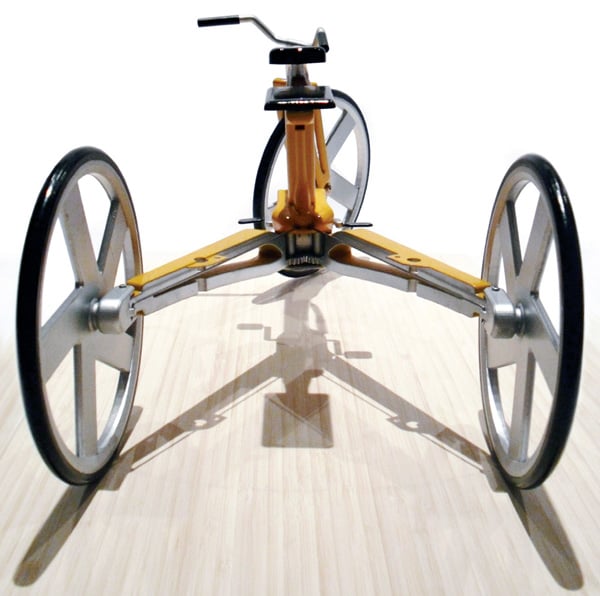
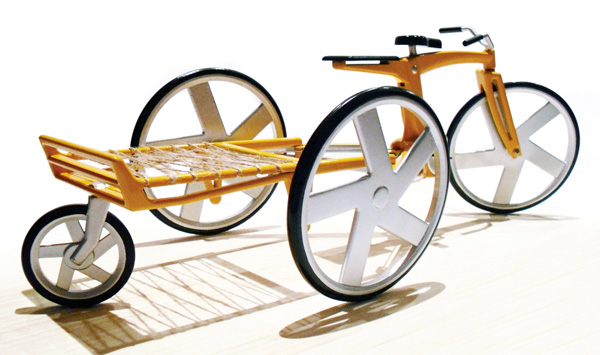
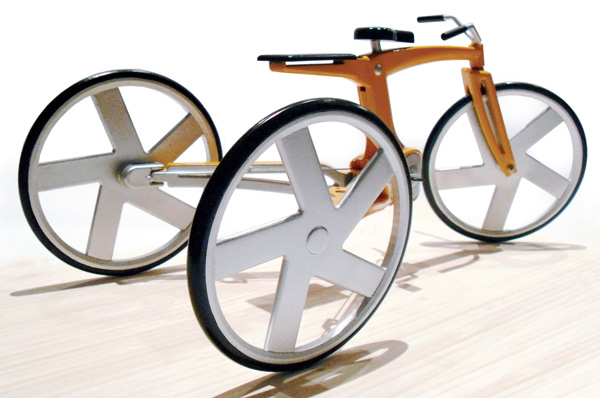
Featured in the top 20 for the 2011 International Bicycle Design Competition, the Greencycle 2 provides more than just basic transportation between point A and point B; it provides an environmentally sustainable, meaningful and overall beneficial solution to poorer countries. A series of G2s were created in the design process with core parts made from renewable resources such as bamboo, which is widely available in many 3rd world countries.
Human-centered research methods were used to capture knowledge and feedback from the target groups in order to shape and develop the design process, ensuring that the end-result would not only be acceptable but also culturally meaningful in a way that would strengthen the user’s relationship with it.
1. An extra wheel for stability – going from a two wheel to a three wheel design to create a triangular base that is stable and strong for heavy loads.
2. The ability to convert back to a two wheel configuration style when the terrain requires tight negotiation – like a narrow pathway through a padi field or poor road conditions as commonly found in Third World countries.
3. A splayed rear wheel base to provide a stable surface for load storage/ carrying which conventional bicycles don’t have.
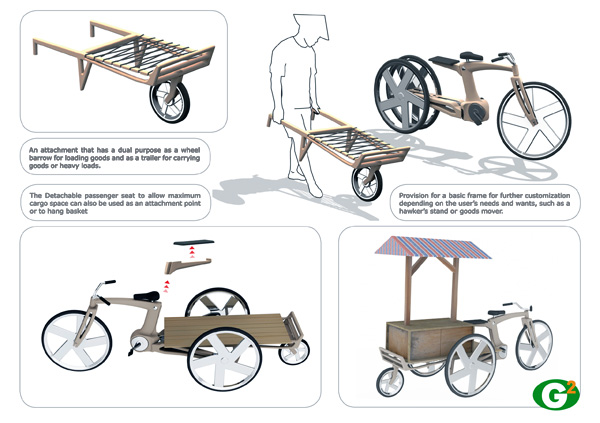
4. Provision for a basic frame for further customization depending on the user’s needs and wants, such as a hawker’s stand or goods mover.
5. A splayed rear design has given an opportunity for a further fixing point for additional attachments.
6. An attachment that has a dual purpose as a wheel barrow for loading goods and as a trailer for carrying goods.
7. An S-frame shape instead of a diamond frame shape to free up and create as much space for loading.
8. A strong central core acting as an anchor for other attachments, such as a people carrier.
9. A stronger wheel design.
10. Double front spokes to mimic the old style bicycle frame which has reinforced steel front forks.
11. A detachable passenger seat to allow maximum cargo space can also be used as an attachment point or to hang a basket.
12. The main frame components made from environmentally friendly composite bamboo based materials which can be molded to produce the desired form.
Designer: Paulus Maringka