
A Shelf Life Like No Other
WARNING: The following design may inspire self loathing, resentment and/or simple jealousy that you did not think of this first. Deal with it.
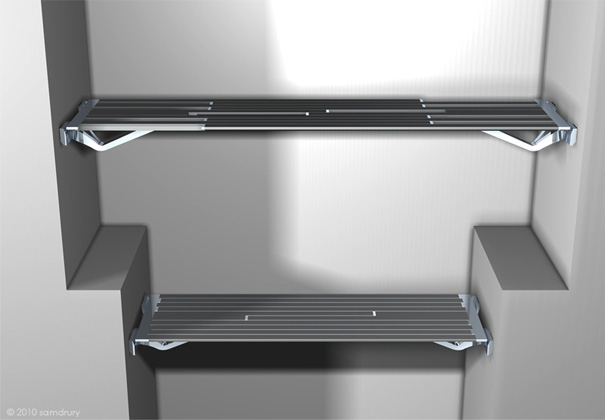
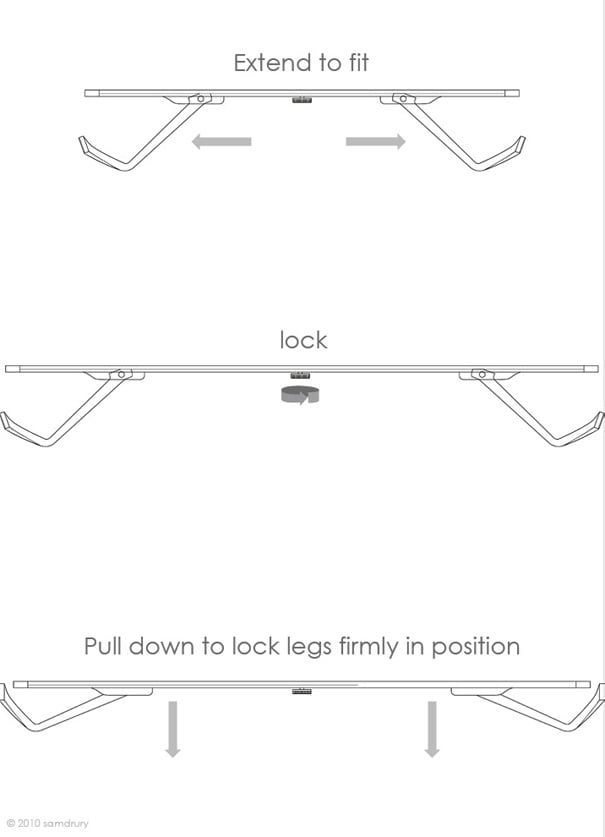
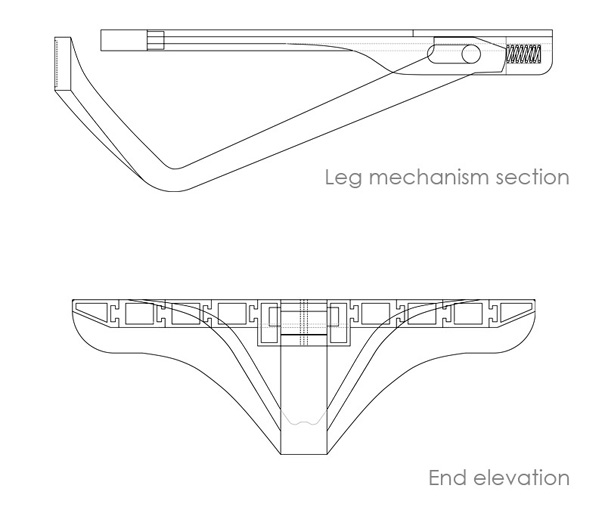
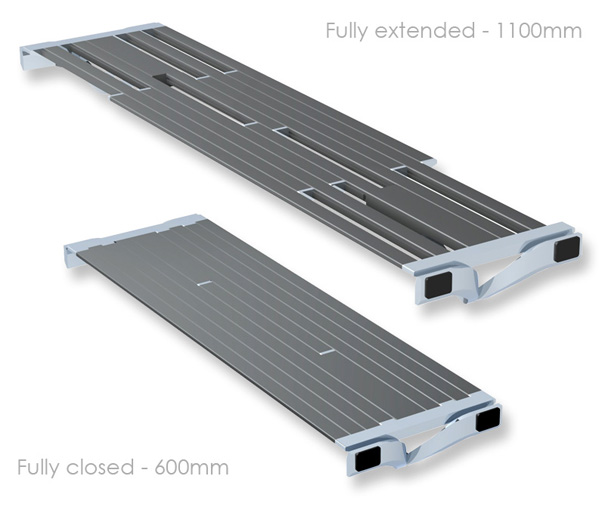
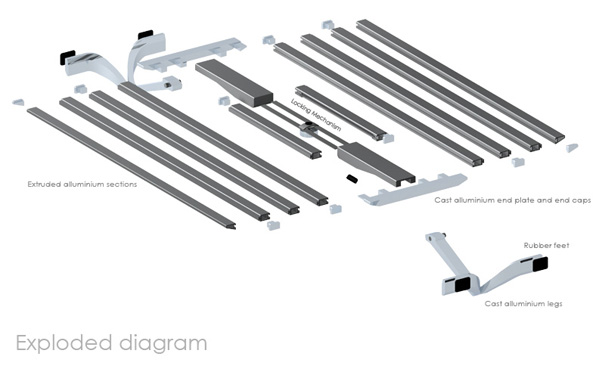
From the Yanko Obvious Files comes this latest creation from designer Sam Drury. The “Self Supporting Shelf” is a masterfully simple idea. It is a telescopic shelf that extends between two flat surfaces for a perfect fit every time. No screws, no nails no messy clean-up. The shelf can be moved at whim with zero damage to your walls. With its cam and cantilever mechanism, the more pulp fiction you pile on, the sturdier the shelf becomes. I can almost hear the late night TV commercials now.
Designer: Sam Drury






41 Comments »
Margot says
Looks perfect for renters who can’t alter their place too much. But is their data on how much it will hold? What are the limits of just how much you can load down a shelf like this?
Sam Drury says
It depends on the wall surface, but typically I’ve got prototypes to hold about 20Kg, which is more than a shelf load of books.
tudza says
I am amazed. I did a search on Google and did *not* find an existing product exactly like this.
Well done!
reality says
there is a simple reson why this does not exist. its way over complex in comparisson for the simple solution that exists. a well fitted wooden shelf cut to size would work well. This is another example of a effort shy society that pretends to care about the enviroment.
count up the components used here. they all need to be manufactured and assembled.
Ben says
The world would be a pretty boring place if we took the ‘wooden shelf’ option with everything in life. Also, it makes no claim to care about the environment – just the walls onto which it’s fitted.
ya says
I totally agree.
arctic_ocean says
I agree with reality’s statement.
Poit says
tell me, how often do you find a niche in a wall that’s between 60 and 110 cm wide and not good for anything except putting shelves in it?
Brent says
@poit: in San Francisco: all the time.
Great design!
Tom says
Quite often, alcoves either side of a fireplace found in the middle of a room* are around that size.
* extremely common in Victorian / Edwardian houses here in the UK
Richard says
Absolutely awesome. Being an habitual re-arranger, this would allow the flexability to changes layout around.
So when will it be mass produced ;o)
ricco says
wooden shelves are cheaper, simpler, more environmentally friendly and more versatile (this shelf can only be used between two existing wall sections, it cannot be used freestanding)
overall a vastly over-engineered solution that partially solves a ‘problem’ that doesnt really exist. And for a massively higher price.
Seriously, CAST aluminium components?! I have a pet hate for designers who simply tag on possible manufacturing processes without considering the capital investment required.
The designer needs to learn that a good piece of design is not just coming up with a product that does something in a new way, especially when current solutions are far simpler, cheaper and more available. Good design and engineering does not just consist of physical embodiment, it considers all aspects of production, development, manufacture and marketing.
Sam Drury says
Hi Ricco – thank you for your comments (indeed all of the comments here). I fully appreciate everything you’ve said and the fact that you’ve taken the time to write them up.
The self supporting shelf idea came about through the fact that while studying I had to move house every 6 months, from one rented accommodation to another where we were not allowed to drill into or indeed make any marks at all on the walls. It was from this scenario that I got my project brief, or problem to be solved.
I wanted a shelving / storage solution that would not only fulfill the above criteria, but also (as it was going to be in my room), look really good. I hope you’ll agree that it’s more interesting that a standard wooden shelf – indeed it can become a bit of a talking point.
It sounds a little selfish, but I designed it with the materials specified just for me. No doubt if I was lucky enough to have the possibility of getting the product mass produced, serious questions would need to be asked (as you did) with regards to materials, manufacture, safety(!). But for the design you see here I could afford the luxury of producing one off prototypes made to look how I wanted them to look.
You might be interested to see a short video of the shelf itself in ‘action’ (apologies about the sound being out of sync, something to do with the encoding):
http://www.youtube.com/watch?v=3GMIvtlqhTU
Sam
chris f says
@ricco take yourself seriously much? i assume you’re writing from a public computer so as to minimize electronic waste. what am i saying? of course you are! here’s a piece of advice: spend less time criticizing, and more time creating. the design is brilliant and requires a strong material. i want one!
karl says
yeah, but if you did find that kind of niche i reckon you would want a real shelf in it
Ben says
Hi Sam, I like your idea.
You made a lot of people jealous!
It is the Ferrari of shelves – and some people like Ferrari’s – other people? – They like wooden soap boxes. I wonder how many trees they still want to cut down for their simple/cost effective shelves. Cutting down trees is apparently environmentally friendly – just a thought.
Hope you make a lot of money with your idea!
MrBusRider says
Lumber can be sustainably harvested, and locally sourced materials for the "boring shelves" are by far more environmentally sound than the plastics and aluminum that need to be shipped and intensely manufactured. I think the design is awesome but it does miss out on the growing need for accessibility. I don't live in an urban area but aren't small spaces (i.e. places that need this shelf) are usually inhabited by people without a lot of money? I'm really not trying to challenge/piss anybody off. But these comments embody the idea that we can just buy something to fix our problems by buying something, when the actual design was somebody being creative and making their own unique problem a solution.
MrBusRider says
Lumber can be sustainably harvested, and locally sourced materials for the “boring shelves” are by far more environmentally sound than the plastics and aluminum that need to be shipped and intensely manufactured. I think the design is awesome but it does miss out on the growing need for accessibility. I don't live in an urban area but aren't small spaces (i.e. places that need this shelf) are usually inhabited by people without a lot of money? I'm really not trying to challenge/piss anybody off. But these comments embody the idea that we can just buy something to fix our problems by buying something, when the actual design was somebody being creative and making their own unique problem a solution.
andy harding says
sorry but I thought of this in 1989 – I even gave a demo to university of bath students extolling its virtues and got some to stand on it to demo its strength – sadly along with a few other of my ideas I ran out off the necessary funding to keep a patent going – maybe you can do better?
Euan says
Up front costs:
Sand casting pattern: $30,000
Dies for plastic die casting: $200,000
Sourcing parts: $50,000
Setting up a factory in China: $100,000?
Total: $370,000 at least
Cost per unit (at Chinese labour rates):
Sand casting including cost of aluminium: $10
Casting polishing: $5
Die casting including cost of plastic: $40
Assembly $20
Total: $75 per unit at best guess
Add shipping and retail markup and your looking at $200 shelf price. Would need to be around $300 if you wanted to turn over a profit. So after selling around a few thousand you would cover your set up costs. I work in product design engineering, and these figures are only best guesses. Best of luck, hope you succeed.
Euan says
Up front costs:
Sand casting pattern: $30,000
Dies for plastic die casting: $200,000
Sourcing parts: $50,000
Setting up a factory in China: $100,000?
Total: $370,000 at least
Cost per unit (at Chinese labour rates):
Sand casting including cost of aluminium: $10
Casting polishing: $5
Die casting including cost of plastic: $40
Assembly $20
Total: $75 per unit at best guess
Add shipping and retail markup and your looking at $200 shelf price. Would need to be around $300 if you wanted to turn over a profit. So after selling around a few thousand you would cover your set up costs. I work in product design engineering, and these figures are only best guesses. Best of luck, hope you succeed.
Would look nice on my wall :) says
Out of curiosity, is there an explanation of the physics for it?
Would look nice on my wall :) says
Out of curiosity, is there an explanation of the physics for it?
ELMANCO says
Non mi convince molto.
Il progetto ingegnoso, ma espandendo la mensola compaiono dei buchi e non so quanto sia resistente.
fajas colombianas says
How much weight could that shelf hold? and could you explain the physics behind this?
john miller says
great idea should hold as much weight as the walls would support
TonyM says
Where Can I get one, or two or more?
TonyM says
Where Can I get one, or two or more?
Paul says
A real shelf is good when You can do whatever You want with the walls…but the owner of my flat does’t let me make any holes, so the shelve would be perfect!
That’s just what I was regretting not to have in shops – such shelve that would fit the walls and without any sign on them when leaving the flat! But it must be cheap enough so that it costs less than any bookcase – in my opinion people that change flats a lot are mostly studens, so they should afford it!
Michel says
I can tell you this would have been a life saver at my old place. I had a chimney and I tried to fit shelves between the chimney and walls. A carpenter friend of mine had to redo the shelf 3 times before it fit perfectly.
Trackbacks