For first responders, the performance of their equipment directly impacts their ability to execute their tasks. A fireman’s back-mounted pack exemplifies this need for optimal design. The demands are extreme – the heavy pack must fit the body perfectly and distribute the weight evenly in order to minimize the feeling of bulk and mass. The current backpacks firefighters carry typify the “one size fits all” mentality. Evolving this to the next step requires a fundamentally new approach to the design process.
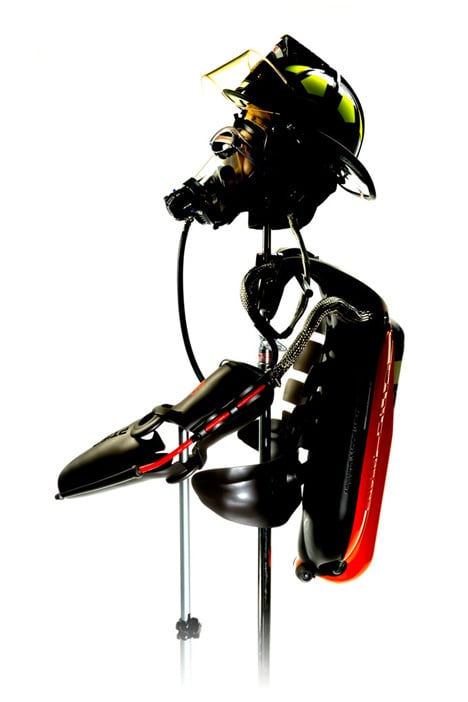
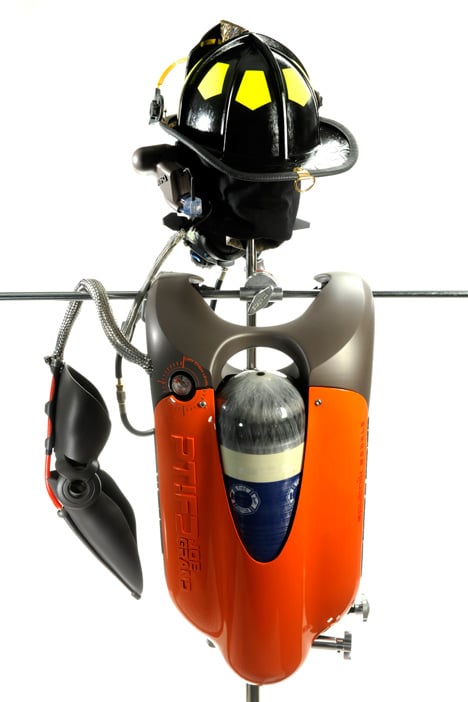
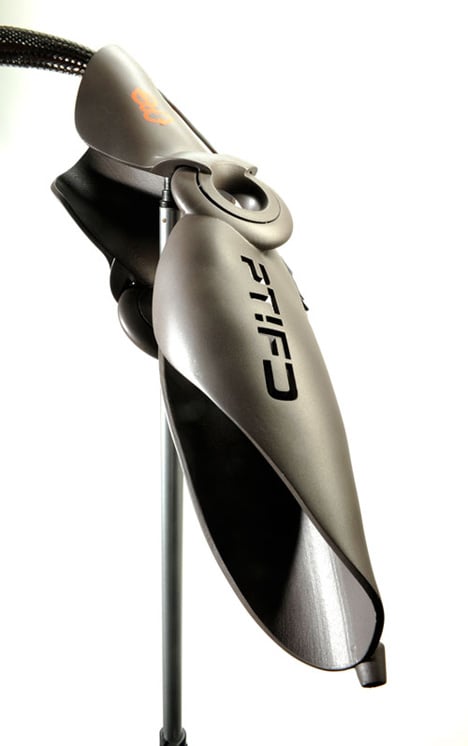
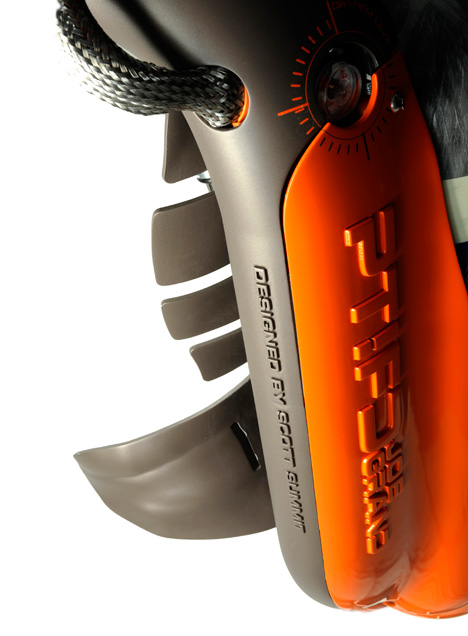
Future firefighters will have a slipstream backpack called the PyroPack that fits tightly against the back. Plates of armor would extend down their arm, giving them protection from falling objects with a drychem nozzle located at the wrist to snuff out spot fires.
THE PROCESS
The stocking-clad bodies of the show’s hosts were scanned by CyberFX, using a Cyberware laser scanner. Once surfaced, the now-digital body is introduced into a Pro/Engineer model comprising both fixed geometric entities which would remain unchanged per instantiation, and trimming surfaces, which serve to define portions of the body that ultimately be fabricated as body-mating contours. The body surface is offset, sliced, and joined with the existing CAD geometry, and a bespoke pack is instantly, automatically created. The user’s individual bone structure, body asymmetries, and spine curvature all drive the final resulting geometry. The design compensates for flexure in spinal areas that need to twist or adjust to body movement. Anticipated shape changes, particularly around the waist, were designed to be especially flexible, so that the geometry would never confine the user should they gain weight. The design incorporates captive parts – hinges that connect the arm components as well as a ball-and-socket connecting hip belt to pack frame. This allows the hips to move in their ‘figure 8’ motion as the user walks, while still supporting the weight from the pack.
DIGITAL FABRICATION
Now in digital format, the shape needs to be actualized. Traditional CNC machining cannot create the thin walls, the extensive undercuts, the interlocking mechanisms nor the hollow cable and hose conduits that the PyroPack requires, especially not considering the time and budget requirements demanded by the project. Selective Laser Sintering was selected for the process, and a flame-retardant polyamide was the chosen material.
And EOS P730 laser-sintering machine is able to handle the large physical size of the backpack. The material used is polyamide – a strong, light, durable polymer, infused with flame retardant. The resulting parts are dusted off and ready for final assembly with the internal components and ready for use.
The arm ‘armor’ is similarly fabricated with interlocking upper and lower arm parts, with an integral hose extending from elbow to wrist, allowing the firefighter to spray dry-chem ‘Spiderman style’. Like the backpack, this is designed based on trimmed offsets of the user’s arm scan.
Completing the product suite is a headset, comprising a sintered clamshell case housing electronics and thermal imaging camera. A waterclear SLA slider component allows the user to deploy a heads-up display in smoky environments. This was achieved by mounting a display into a spherical gimbal, fabricated of 17-4 stainless using DMLS. Although these parts were not geometrically complex, the rapid turnaround time required by the filming schedule drove the process choice.
SHOWTIME
The pack was attached to the show’s host, and he navigated a smoky room guided only by the heads-up display. He then extinguished a fire using the ‘arm hose’, attached to the drychem extinguisher located within the pack. All the while, he marveled at how he barely noticed the weight or bulk of the heavy pack.
The Pyropack portion of the episode received relatively little airtime, ironically, because it came together exactly as anticipated. And since suspense was an unwritten requirement of any televised story, the success of RM undermined its achievements.
Cost: Each pack would cost around $7K, likely lower as machines improve speed and resolution. This is comparable to the cost of a current pack, which comprises many welded parts and low-quantity fabrication runs.
Weight: Sintered polyamide is inherently light, strong and flexible, offering every attribute needed to create a high-performance pack of this sort. With proper FEA optimization, it can be assumed that this pack would be comparable in weight to its current counterpart
Performance: The integrated, ‘ball and socket’ mounted waist belt and back suspension allows a perfect fit, thereby minimizing the likelihood of back problems, fatigue, and discomfort during use. Even the best ‘one-size-fits-all’ product cannot reach this level of user centricity.
Adaptability: RM, by its very nature, invites on-the-fly design changes. As new technologies arise, problems are discovered, or niche specialty components come about, the parametric CAD model can immediately adapt to implement needed enhancements.
Well done Scott, bravo!
Designer: Scott Summit