Advanced Beijing Airport by Foster & Partners
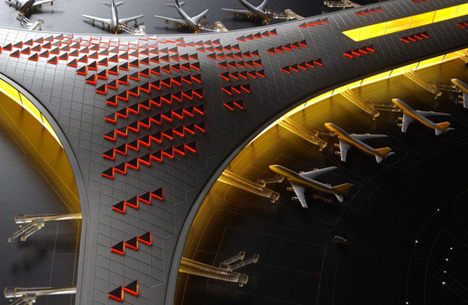
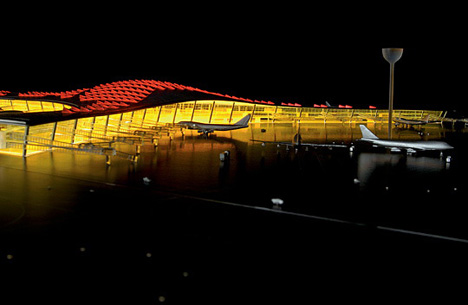
Praised by its architects as the world’s most technologically advanced airport building in terms of passenger experience, operational efficiency, and sustainability, Beijing Airport is one of many new ones being constructed in China. Due to open in time for next year’s Olympic Games, it boasts a spectacular, aerodynamic roof covering a floor space of more than a million square meters. The airport is expected to process some 53 million travelers by 2015. It was built using sustainable design principles, including southeast-oriented skylights (to maximize heat from early sunshine) and an integrated environment-control system that uses minimal energy.
Architect: Foster & Partners

If you liked this design, you would also be interested in:
- Design Digest Vol.12
- Cloud of Promise - 2008 Olympic Torch by Lenovo
- Airport Jitters
- Play & Soft - Furnishings for Children by ZPZ Partners
- Hotel Puerta Repetitive Rhythm Patition Walls by Plasma Studio
Keep up with the latest designs by subscribing to our RSS or Newsletter.


5 Comments »
Jade Doel says
that is a very beautiful building. Nice pictures too. one day I’ll be able to design such a building, what a challenge.
sexywings says
what does an airport need an aerodynamic roof for? will it lift off?
badkarma says
but when are they going to free tibet?
billy says
I think that Norman Foster is the best architect in the world, period.
however China is developing way too fast, using the worlds resources, producing to much green house gases, and now this tibet matter… so president bush, nuke them
Sam, Wisconsin says
Bad.
I see nothing but a bus terminal, turned into an airport.
Airplane passengers sit down for a very long time inside the plane, in a very closed space, with little chance to move, talk, or even do anything. As soon as the trip is over, they want to go out, walk, talk, see open spaces, see a lot of things related to the local culture of the place they have reached.
The airport terminal is a “reward” for taking the expensive exhausting trip. Thus it “must” have a ‘local’ shopping center, a tourism center, an art collection related to the local culture, an external view that tells in strait forward words where did you arrive ‘culturally’. Technological advances are no excuse for wiping out the heritage signature, and a computer can be installed in a wooden box, with no affect on the processing abilities.
“The airport is expected to process some 53 million travelers by 2015.” With this design, you just let that number of people see nothing, experience nothing, feel nothing, spend nothing, buy nothing, imagine nothing, get inspired of nothing, remember nothing, but a ‘fast’ in and out.
I cannot tell if this airport terminal is in China, New York, or even sub Saharan Africa. It looks like something out of a science fiction comics book for 2nd graders. The sad part is: it is in real life, and nothing can be done to stop the ugliness from happening, under the claim of “progress”.